HCPCS code K0552: Non-insulin infusion pump cartridge guide
HCPCS code K0552: Definition and code description HCPCS code K0552 describes sup...

Last Updated: Nov 23, 2026
99135 is the CPT code for anesthesia complicated by utilization of controlled hypotension. It's an add-on qualifying circumstance code, reported with a primary anesthesia code from 00100-01999 when blood pressure is lowered on purpose to cut surgical bleeding.
The ASA recommends 5 base units for it. Traditional Medicare bundles it and pays nothing separately, so commercial contracts decide what it's worth. It isn't reported on cardiac cases performed with cardiopulmonary bypass.
Let Pabau's smart automation suggest the right codes, reduce claim denials, and keep your practice compliant—effortlessly.
Automate repetitive tasks and focus on what matters most—your patients.
Reduce coding errors and ensure compliance with the latest regulations.
Clean claims, fewer denials, and faster reimbursements.
Powerful insights and reporting to help your practice thrive.
HIPAA compliant SOC 2 certified GDPR-compliant Trusted by 4,000+ clinics worldwide

CPT code 99135 is an add-on for planned controlled hypotension, always reported with a primary anesthesia code from 00100-01999.
CPT and ASA guidance don’t bar 99135 with 99116, so both can be reported when the record supports each one. Some payers still run their own edits.
Traditional Medicare bundles 99135 and pays nothing separately, while the ASA recommends 5 base units for payers that recognize qualifying circumstances.
Leave 99135 off cardiac cases performed with cardiopulmonary bypass, and never report it with 00561.
Pabau’s claims management sends anesthesia claims through Claim.MD and posts ERA remittances to each claim. A bundled or denied 99135 line is then easy to spot.
CPT code 99135 reports anesthesia complicated by utilization of controlled hypotension, a planned drop in blood pressure that limits surgical bleeding. The ASA’s qualifying circumstances guidance lists it as an add-on worth 5 base units. You report it on top of the primary anesthesia code, never alone.
The descriptor comes from the AMA’s CPT code set, so quote it word for word in appeals. It sits in the 99100-99140 group of qualifying circumstances, next to the codes for extreme age, hypothermia and emergencies. The primary codes it rides on are in our CPT code library.
Three conditions decide whether those units get paid. The record shows the hypotension was planned, the case didn’t use cardiopulmonary bypass, and the payer recognizes qualifying circumstances. Traditional Medicare doesn’t, so commercial contracts carry this code.
Deliberate hypotension is the intentional, controlled lowering of a patient’s mean arterial pressure (MAP) during surgery. It cuts blood loss, clears the surgical field and can reduce the need for a transfusion.
You’ll see it most in multilevel spinal fusion, craniotomies, major joint replacement and extensive maxillofacial surgery. The anesthesiologist picks the agents and sets a target MAP range, often 50-65 mmHg. Arterial pressure is then watched continuously until the phase ends.
A pressure drop the team reacts to doesn’t count. If the patient’s pressure falls unexpectedly and you treat it, that’s incidental hypotension, and 99135 stays off the claim. The decision has to be in the anesthesia record before or at the start of the procedure.
With the clinical side settled, here’s the path a 99135 claim takes. The code adds to the primary anesthesia service and never replaces it.
Get steps one to four right and you’ve built a clean claim before it leaves the practice. Steps five and six tell you whether the payer agreed.
The four qualifying circumstance codes describe different situations, and more than one can apply to the same case. The chart compares their unit values and shows how traditional Medicare treats each one.
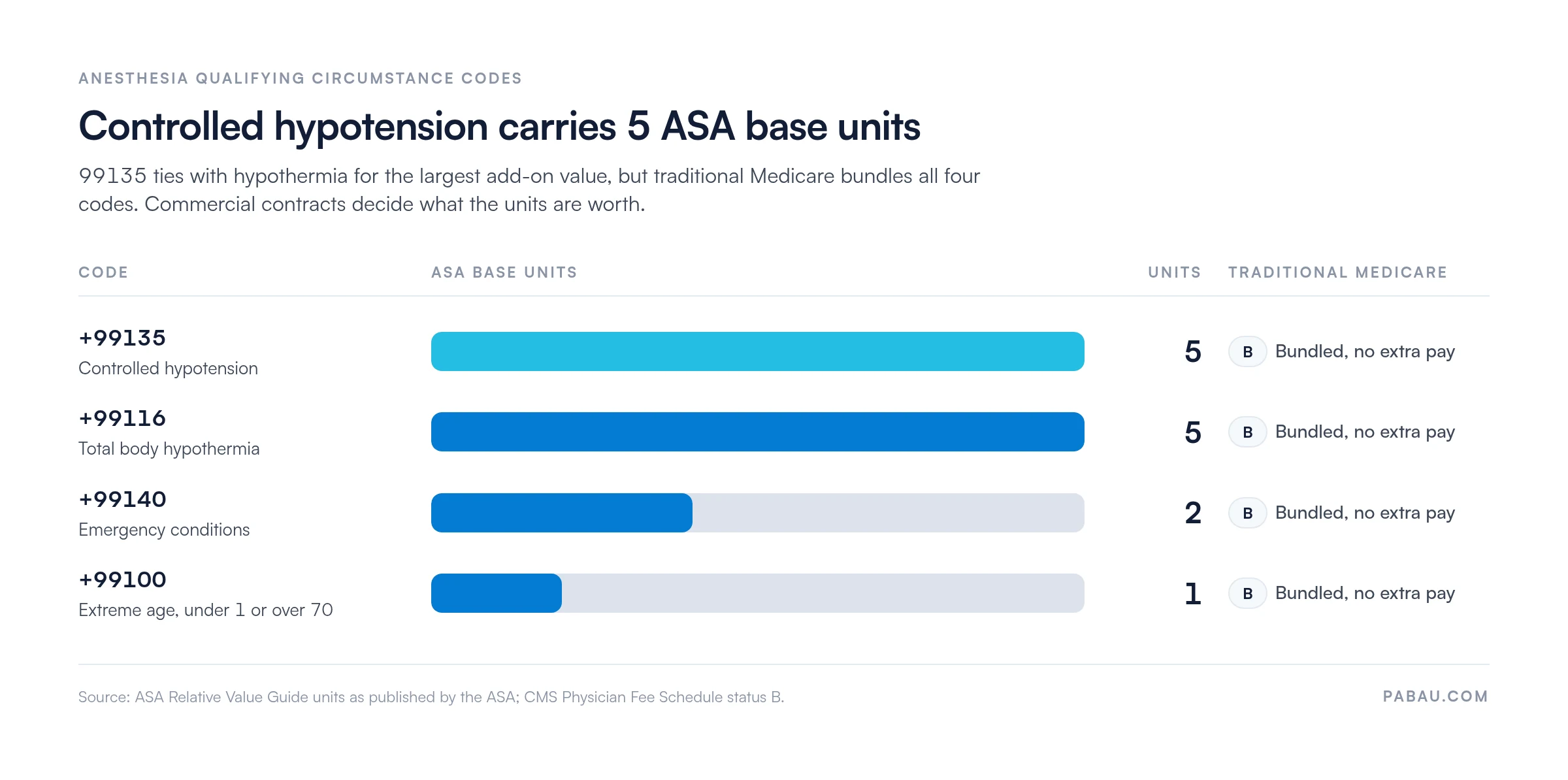
CPT and ASA guidance don’t prohibit 99135 with 99116. The ASA says more than one qualifying circumstance code may be reported when the patient’s conditions support it. Some commercial payers still run their own edits on the pair, so check the policy and document both techniques.
The other two codes stack the same way when they apply. A 75-year-old having an emergency spinal procedure under controlled hypotension could carry 99100, 99140 and 99135 on one claim.
ASA and CPT guidance exclude qualifying circumstance codes from cardiac procedures performed with cardiopulmonary bypass. That rule covers 99135 and 99116 alike. CPT also bars 99135 with 00561, anesthesia for heart procedures with a pump oxygenator in patients younger than 1 year.
Off-pump surgery is a different case. Code 00566 describes CABG without a pump oxygenator, so the bypass exclusion doesn’t apply on its face. Check the payer’s policy before you add 99135 to one.
Commercial payers can add their own exclusions on top. Read the policy for the procedure codes your group bills most, and keep a short list of any the payer names.
Traditional Medicare doesn’t pay 99135 separately. The CMS Physician Fee Schedule gives qualifying circumstance codes status B, meaning bundled, so the line pays nothing extra in any MAC region. You can confirm the status in the CMS Physician Fee Schedule lookup.
Commercial payers set their own value. The ASA recommends 5 base units for 99135, and many private payers recognize qualifying circumstances. An ASA payer survey from 2018 estimated that about 85% of payers covered these codes.
When a payer does pay, the anesthesia formula applies. Add the base units, time units and qualifying circumstance units, then multiply by your contracted conversion factor. So 99135 adds 5 units at whatever that factor is.
Commercial contracts usually handle 99135 in one of three ways:
Track which payers bundle 99135 every time. That pattern is evidence for your next contract talk, and it tells you which denials are worth appealing.
Once a payer pays the code, it may ask to see why. The anesthesia record and operative note together need to show the hypotension was planned, clinically indicated and actively managed.
Good medical billing compliance starts with these elements:
Wording matters here. A record that says only “hypotension occurred” reads as incidental, and the claim is exposed.
Audit your last 20 CPT code 99135 claims. Check that each anesthesia record names the target MAP range, the agent used and a pre-procedure note that the technique was planned. A missing element is the usual reason payers ask for records before paying.
Run this list on every case before the claim goes out. It takes a minute and covers the points payers check first.
Build a qualifying circumstance check into case closeout. The documenting provider answers four questions. Was the patient under 1 year or over 70? Was total body hypothermia used? Was controlled hypotension used? Was it an emergency? Each yes points to a code to review.
Even with the checklist, some claims come back. 99135 denials follow a handful of patterns, so sort them by cause in your denial management workflow. One fix then covers every claim with the same problem.
When a commercial payer denies 99135, send the anesthesia record, the operative note and the pre-procedure note on the hypotensive plan. Add the CPT descriptor and the ASA guidance on qualifying circumstances. A one-page letter that answers each stated reason beats a generic reconsideration request.
Denials are the visible losses. These habits cost units more quietly, often without anyone noticing.
Most anesthesia groups find 99135 problems on the remittance, weeks after the case. By then the coder has moved on, and someone has to pull the anesthesia record again.
Pabau, a practice management platform, includes claims management for practices that sends US claims as CMS-1500/837P files. Claims run through Claim.MD, which applies its payer edits before submission. Eligibility checks run before the case, so you know which plan you’re billing.
ERA remittances post back to the same claim, and secondary claims go out from there too. Your coders still decide when 99135 applies. What changes is the follow-up, because the team sees a bundled or denied line next to the claim while the case is fresh.

Pabau sends your anesthesia claims through Claim.MD, checks eligibility and posts ERA remittances to each claim. Your team spots a bundled or denied 99135 line and acts on it quickly.

Treat 99135 as a documentation code first and a billing code second. If the anesthesia record shows a planned technique with a target and agents, the code holds up. If it doesn’t, no clearinghouse edit will rescue it.
Then match the effort to the payer. Traditional Medicare will always bundle it, so don’t chase it there. Commercial contracts are where the 5 units pay, and where your appeals belong.
To see how Pabau tracks every 99135 line from submission to remittance, book a demo.

Need a clearinghouse that checks anesthesia claims? Pabau’s Claim.MD clearinghouse guide explains how a clearinghouse screens claims before they reach the payer.
Seeing ERA denials you cannot decode? Denial codes in medical billing breaks down CARC and RARC reason codes so your team can act on remittance data faster.
Billing an emergency case too? CPT code 99140 explains when the emergency qualifying circumstance applies.
Want to benchmark your anesthesia billing workflow? Best medical billing software for US practices outlines what a billing system should handle at each stage of the claim.
Yes. 99135 is an active add-on code in the 2026 CPT code set, with the same controlled hypotension descriptor. Check each January update before you rely on that.
No. 99135 adds a flat 5 ASA base units, however long the hypotensive phase lasts. Time is billed once, through the time units on the primary anesthesia code.
Yes. The code follows the anesthesia service, so whoever bills the primary anesthesia code reports 99135 on the same claim. That includes a CRNA billing with the QZ modifier.
Yes. Induced, deliberate and controlled hypotension all describe the same planned technique. Any of these terms supports 99135, as long as the record shows the plan and the target.
No single ICD-10 code does. The claim carries the diagnosis for the surgery, and the anesthesia record explains why controlled hypotension was medically needed for that case.