HCPCS code P9058: Red blood cells, leukocytes reduced, CMV-negative, irradiated
HCPCS code P9058: Official descriptor and key attributes HCPCS code P9058 report...

Last Updated: Oct 26, 2026
90885 is the CPT code for a psychiatric evaluation of records for medical diagnostic purposes. The records can include hospital records, other psychiatric reports, psychometric or projective tests, and other accumulated data. A psychiatrist or other qualified mental health professional reviews them without the patient present and documents an interpretation.
The code sits in the psychiatry section of CPT, alongside 90791 and 90792. Those evaluations require a patient interview, while 90885 covers the records work alone. Medicare bundles 90885 into other services rather than paying it separately.
Let Pabau's smart automation suggest the right codes, reduce claim denials, and keep your practice compliant—effortlessly.
Automate repetitive tasks and focus on what matters most—your patients.
Reduce coding errors and ensure compliance with the latest regulations.
Clean claims, fewer denials, and faster reimbursements.
Powerful insights and reporting to help your practice thrive.
HIPAA compliant SOC 2 certified GDPR-compliant Trusted by 4,000+ clinics worldwide

CPT code 90885 covers a psychiatric evaluation of records, reports and test data with no patient present.
Medicare lists 90885 as a bundled service (status B), so it is not paid separately, and other payers set their own rules.
A same-day claim with 90791 or 90792 from the same provider is commonly questioned, so check the current NCCI edits first.
Every 90885 note should name each record reviewed, the clinical question, and the clinician’s interpretation.
Pabau, the practice management platform we build, checks each claim for missing or invalid details before it reaches the payer.
CPT code 90885 covers a psychiatric evaluation of records for medical diagnostic purposes. The records can include hospital records, other psychiatric reports, psychometric or projective test results, and other accumulated data. A psychiatrist or other qualified mental health professional does the review while the patient is not present.
The American Medical Association (AMA) maintains the CPT code set and places 90885 in the psychiatry section (90785-90899). No face-to-face contact is required. The service is the review itself, plus the written interpretation it produces for clinical decision-making.
CPT code 90885 covers the professional work of reviewing and interpreting accumulated psychiatric and medical data to reach a diagnostic or clinical conclusion. The code captures work that takes time and expertise even though no patient is present.
Covered by 90885:
Not covered by 90885:
Explaining the results to family members or other responsible persons is a separate service, reported with 90887. Payers may not reimburse a review done purely for forensic or legal purposes, so confirm the diagnostic purpose and the payer’s policy first.
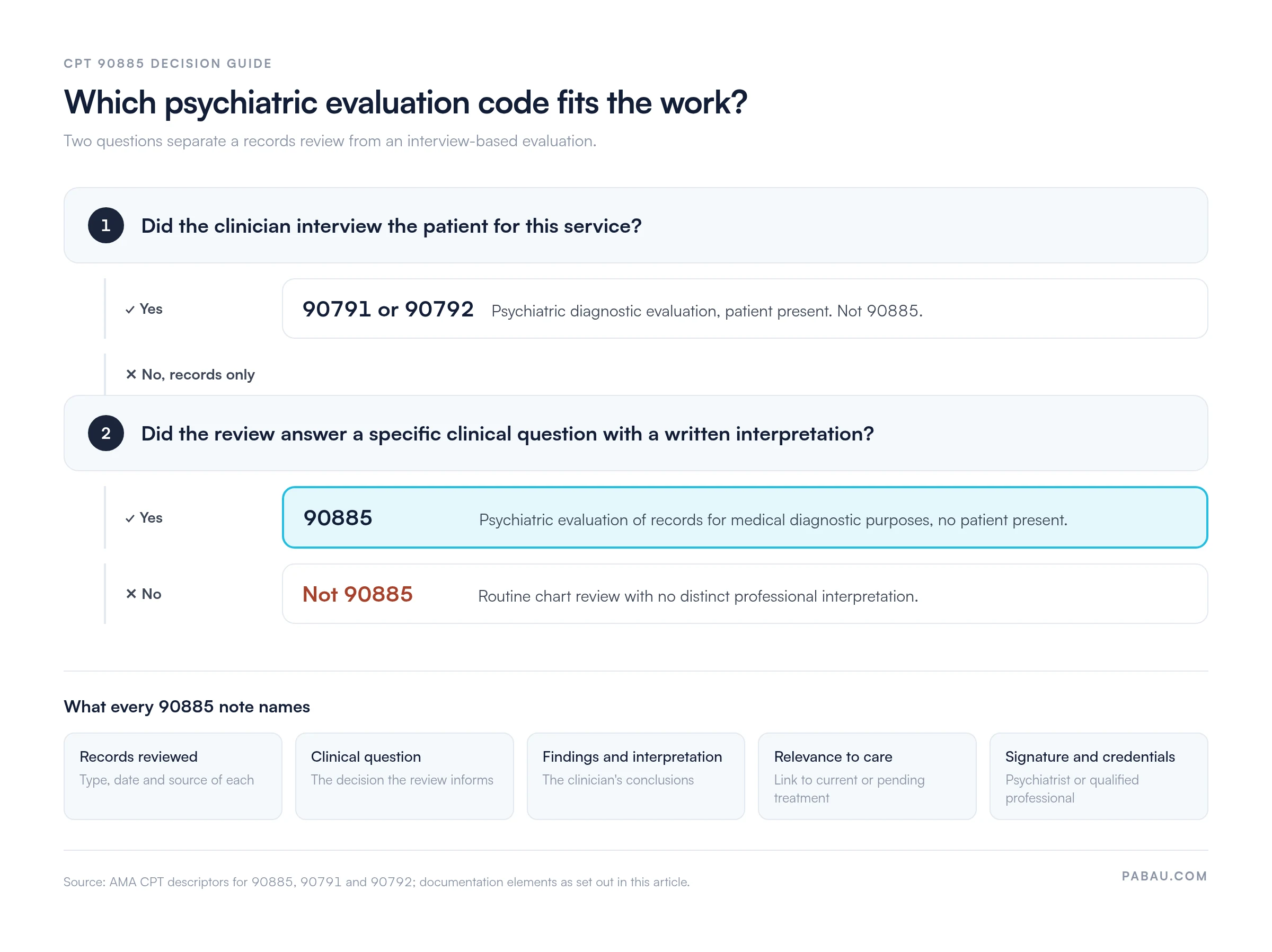
CPT 90885 and CPT 90791 are the psychiatric evaluation codes coders confuse most often. The core distinction is patient contact. 90791 requires a direct interview with the patient, while 90885 does not. Billing 90791 when only a records review was performed is a common upcoding error on psychiatric claims. Two questions settle which code fits, as the diagram below shows.
Thorough documentation is what separates a clean claim from a denied one on CPT code 90885. Because no patient contact occurs, payers rely entirely on the written record. It has to show the service was medically necessary and actually performed.
A documentation template built for records-review services helps make sure no element is left out. Every 90885 note should contain all of the following elements:
Medical necessity for CPT 90885 is established when a formal records review is needed to answer a specific clinical question. It applies when a direct patient interview alone cannot resolve that question. Payers expect the documentation to explain why a records-only evaluation was clinically appropriate.
Common clinical justifications include conflicting prior diagnoses, pre-admission psychiatric reviews, and second-opinion requests from referring providers. Court-ordered, disability or forensic reviews need a stated diagnostic purpose, because payers may not reimburse a purely legal review. Check the payer’s medical billing compliance policy before billing, since some ask for extra documentation of necessity.
Medicare does not pay CPT code 90885 separately. The 2026 CMS Medicare Physician Fee Schedule (MPFS) lists it with status indicator B, which means its payment is bundled into other services. Verify the current status in the MPFS Look-Up Tool, because CMS updates the file during the year.
CMS still publishes relative value units (RVUs) for 90885, but flags them as not used for Medicare payment. They show how much lighter the work is than an interview-based evaluation. 90885 carries a work RVU of 0.97, against 3.84 for 90791. Commercial and Medicaid plans set their own rules, so some pay the code while others follow Medicare’s bundling.
Check the status indicator, not just the rate. In the CMS Physician Fee Schedule Look-Up Tool, 90885 currently shows status B, which means Medicare bundles it into other services. Recheck it each January, and confirm how each commercial and Medicaid plan handles the code before you quote a fee.
Modifiers tell payers about the circumstances under which a service was delivered. CPT code 90885 involves no patient encounter, so telehealth modifiers seldom apply to it. It does not appear on the Medicare telehealth services list. Confirm any payer-specific use before billing.
Claims for CPT code 90885 draw a predictable set of denial codes, and each one points to a fixable step. Catching them before submission costs far less than working the denials afterward. Practices with systematic denial management workflows catch most of these before they reach the payer.
Review your 90885 denial rate quarterly. If denials cluster around a specific payer, pull the remittance advice codes (CARCs) and cross-reference them against your documentation template. A pattern of CO-197 (missing prior authorization) or CO-4 (service inconsistent with modifier) tells you which workflow step needs fixing. You can fix it without a full billing audit.
Prior authorization requirements for CPT code 90885 vary by payer and plan. Medicare doesn’t pay the code separately, so authorization questions mostly arise with commercial plans. Some of those plans require it for non-emergency forensic or second-opinion evaluations.
Before scheduling a records-only evaluation, verify the patient’s active coverage and check the payer’s authorization portal. Record the authorization number on the claim. If a request is denied, most payers allow a clinical appeal backed by a letter of medical necessity from the ordering psychiatrist. Our guide to the prior authorization process walks through each stage, from request to appeal.
Keep the appeal documentation in the patient record alongside the original records-review note.
A structured billing workflow for CPT code 90885 reduces errors at every stage, from patient intake to payment posting. The steps below follow the sequence that minimizes rework on this low-volume, high-denial-risk code.
Low-volume codes like CPT 90885 are where manual billing workflows break down. Coders see the code rarely, so its documentation rules get mixed up with those for 90791. A single missing element can produce a denial that takes weeks to overturn.
Pabau keeps the records-review note, the authorization, and the claim on one patient record. A digital form can prompt the clinician to list each record and state the clinical question before the note is signed. Prior authorizations are stored as cases, and a claim missing its authorization is flagged before it goes out.
With Pabau’s claims management software, US practices submit CMS-1500 claims through Claim.MD. Each claim is pre-filled from the invoice and checked for missing or invalid details first. Rejected claims show the reason, so your billing team can correct and resubmit without digging through remittance files.

Pabau pre-fills each claim from the invoice, checks it for missing or invalid details, and stores prior authorizations as cases. Your team sees why a claim was rejected and fixes it in one place.

CPT code 90885 rewards precision more than volume. With no patient in the room, the note carries the whole claim. Name every record, state the clinical question, and write down the interpretation before anyone codes it.
The payment question needs the same care. Medicare bundles the code, so the decision sits with commercial and Medicaid plans, and their answers differ. A quick check of the payer’s policy and the NCCI edits costs minutes, while a denial and an appeal cost weeks.
Book a demo to see how Pabau keeps records-review notes, authorizations, and claims together for psychiatric practices.

Explaining review findings to a patient’s family? CPT code 90887 covers interpreting psychiatric results for family members or other responsible persons.
Did the evaluation include a patient interview? CPT code 90791 explains the psychiatric diagnostic evaluation code and how to document it.
Want to understand how clearinghouses reduce claim errors? Claim.MD clearinghouse overview explains how electronic claim routing and edits catch problems before claims reach the payer.
Managing psychiatric billing compliance across your practice? What is medical billing covers the end-to-end revenue cycle workflow every psychiatric practice manager should understand.
CPT code 90885 covers a psychiatric evaluation of records, reports, psychometric tests, and other accumulated data for medical diagnostic purposes. It is performed without direct patient contact. A psychiatrist or qualified mental health professional reviews existing clinical materials to reach a diagnostic conclusion while the patient is not present.
CPT 90885 is a records-only evaluation requiring no patient contact, while CPT 90791 is a psychiatric diagnostic evaluation requiring a direct interview with the patient. Billing 90791 when only a records review was performed is a common upcoding error on psychiatric claims and a trigger for payer audits.
No, Medicare does not pay CPT code 90885 separately. The 2026 Medicare Physician Fee Schedule lists it with status indicator B, so its payment is bundled into other services. Verify the current status in the MPFS Look-Up Tool, and check commercial and Medicaid plans individually.
Sometimes, but a same-day claim with CPT 90791 or 90792 from the same provider is commonly questioned. Check the current NCCI procedure-to-procedure edits and the payer’s policy before you submit it. Billing 90885 with psychotherapy codes on different encounters may be permissible depending on payer policy.
Modifier 59 is the one most often relevant. It applies when 90885 is legitimately billed with another service on the same date and an NCCI edit requires the distinction. Because 90885 involves no patient encounter, telehealth modifiers seldom apply. Confirm any payer-specific use before billing.
The most frequent denial triggers are unnamed records, no documented clinical question, upcoding to 90791, same-day billing conflicts, and missing prior authorization. A standard records-review template prevents most documentation denials. Routing claims through a clearinghouse catches missing details before submission.