CPT code 21011: Excision of soft tissue tumor of the face
CPT code 21011: Official descriptor and procedure overview CPT code 21011, as pu...

Last Updated: Oct 8, 2026
CPT Code 90838 is a psychotherapy add-on code for sessions of 53 minutes or more, billed alongside an evaluation and management service. It carries a plus sign in the CPT codebook, so it never stands alone on a claim. Pair it with a base E/M code such as 99213, 99214, or 99215, and document the psychotherapy minutes separately from the evaluation.
The 2026 Medicare national non-facility rate is $136.61, and the facility rate is $110.22. This reference covers the time thresholds, the 90833/90836/90838 hierarchy, eligible providers, modifiers, and telehealth rules. It also covers documentation standards and the denial patterns that follow when one of them is missed.

CPT Code 90838 is a psychotherapy add-on code for sessions of 53 minutes or more, billed with an evaluation and management service.
It must always be paired with a primary E/M code such as 99213, 99214, or 99215. Submitting 90838 alone is the most common denial reason.
The 2026 Medicare national rate for 90838 is $136.61 in a non-facility setting and $110.22 in a facility, before GPCI adjustment.
Modifier 95 with place of service 02 or 10 is the Medicare telehealth pairing. GT was retired for Part B professional claims in 2018.
Practice management software like Pabau validates claims for missing details before submission, then files them electronically through Claim.MD.
CPT Code 90838 describes psychotherapy of 53 minutes or more performed as an add-on to an evaluation and management service. The American Medical Association maintains the CPT code set and classifies 90838 as an add-on code. The plus sign (+90838) in the codebook is what marks it as one.
Unlike the standalone psychotherapy codes 90832, 90834, and 90837, the add-on only appears on a claim alongside a primary E/M service code. The psychiatrist or prescribing provider conducts a medical evaluation and a psychotherapy session in the same encounter. The two components are then billed separately using a paired-code approach.
The 53-minute threshold applies to the psychotherapy component of the encounter only, and the E/M service time is counted separately. A session with 45 minutes of psychotherapy alongside a 15-minute medication management evaluation does not qualify. The psychotherapy component falls short of the threshold, so 90836 applies instead.
The three psychotherapy add-on codes divide session time into distinct brackets. Selecting the wrong code based on miscounted time is a common audit trigger.
Time must be documented in the medical record as the clock time of the psychotherapy component. Start and stop times, or a provider attestation of total psychotherapy minutes, are both acceptable for most payers. Vague notations like “extended session” are not sufficient.
The three add-on codes share identical billing mechanics but differ entirely on session length. Selecting the correct code requires knowing the psychotherapy minutes delivered, not the total appointment time.
Treat the three as a single family with time-based selection logic. Under 16 minutes of psychotherapy, no add-on code applies. From 16 to 37 minutes, use 90833. From 38 to 52 minutes, use 90836. At 53 minutes or more, use 90838.
Payment steps up with each tier, so the minute count in the note decides what the encounter earns.
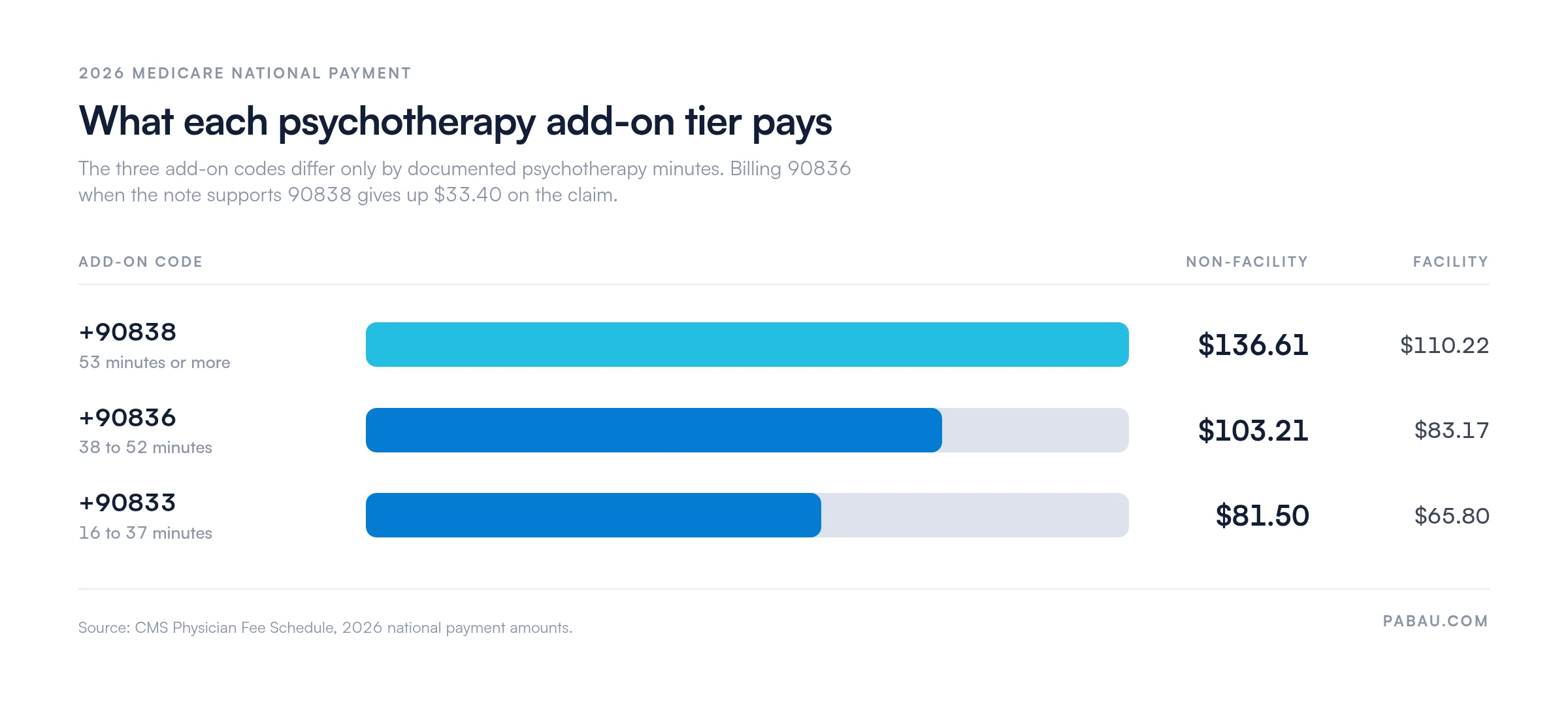
CPT 90837 is the 60-minute standalone psychotherapy code, and it is frequently confused with 90838. The distinction matters because billing the wrong one creates a claim that duplicates or conflicts with the other codes on the encounter.
If an encounter involves only psychotherapy with no medication review or E/M component, 90837 is correct. If the visit combines medication management with extended psychotherapy, 90838 is the appropriate add-on.
90838 is restricted to providers authorized to perform both psychotherapy and evaluation and management services. That scope excludes most non-prescribing therapists, who use standalone codes like 90837 instead. Eligibility also varies by state licensing laws and individual payer contracts, so verify with each payer before billing.
Selecting the right base E/M code matters as much as selecting 90838 itself. The E/M code reflects the complexity of medical decision-making, or the total provider time for the evaluation portion of the encounter. Under the 2021 AMA revisions, those two are the selection criteria for office-based E/M codes.
The E/M level selected must be supported by the medical record. Routinely selecting 99215 without documentation of high-complexity medical decision-making is a common audit finding. The complexity of the evaluation component, not the total session length, determines the appropriate E/M level.
The 2026 Medicare national non-facility rate for 90838 is $136.61, built from 4.09 total RVUs. The facility rate, for sessions delivered in a hospital or facility setting, is $110.22 from 3.30 total RVUs. Both are national amounts before geographic practice cost index (GPCI) adjustment, so payment varies by locality. Verify the figure for your area with the CMS Physician Fee Schedule lookup tool.
Psychiatric claims can be submitted electronically through Claim.MD, the US clearinghouse that integrates with practice management software like Pabau. Claim.MD reaches thousands of US payers for 837P claim submission. Real-time eligibility coverage is narrower, at roughly 400 payers, so confirm a specific plan is supported before relying on an instant response.
Medicare rates for the psychotherapy add-on codes rose in 2026, so a fee schedule built on last year’s figures now understates them. Pull the locality-adjusted amount from the CMS Physician Fee Schedule lookup tool before you set fee schedules or forecast monthly revenue.
Modifier selection for 90838 depends on the service setting, the payer, and whether the session was delivered by telehealth. Applying the wrong modifier, or omitting a required one, is a reliable path to denial. Most modifier errors involve telehealth, where Medicare and commercial rules differ.
CMS retired GT on Medicare Part B professional claims in 2018, replacing it with modifier 95 plus the correct place of service code. Sending GT on a physician claim today reads as a coding error to the payer. Some Medicaid programs and commercial plans still accept it, so check each payer’s current telehealth policy.
Under current CMS policy, CPT Code 90838 sits on the Medicare telehealth services list and can be billed for synchronous audio-video sessions. Telehealth eligibility for psychiatric add-on codes was expanded during the COVID-19 public health emergency and extended by later Congressional action. Confirm the current position on CMS.gov before you bill, because mental health telehealth policy keeps moving.
Documentation is where 90838 claims most often fail on audit. The medical record must support two distinct service components: the psychotherapy content and the E/M content. Writing them as a single narrative note, with no boundary between the two, is a common documentation error.
The diagnostic documentation has to be present as well, and it has to match the ICD-10-CM code submitted on the claim. An anxiety or depressive disorder named in the assessment supports the code; a diagnosis that appears only on the claim line does not.
Most 90838 denials are preventable, and the error patterns repeat across practices and payers. Reading the denial codes on the remittance tells you which pattern you have, and which upstream step produced it.
The cost compounds quickly. A practice submitting 90838 on 20 encounters a week, at a 15% denial rate, has around three claims a week to rework. At the 2026 non-facility rate, that is roughly $410 a week sitting in accounts receivable instead of the bank.
Add-on billing breaks down at the workflow level rather than the knowledge level. A prescriber who knows the rules still loses claims when every step is manual:
Each one is a place a claim can go out wrong, and none of them is caught by the payer until the remittance arrives.
Pabau, an all-in-one practice management system, keeps the psychotherapy note, the diagnosis, and the invoice on one patient record. The billing team is not reassembling the encounter from three places. Its claims management software validates each claim before submission and flags missing patient, insurer, and authorization details.
From there, claims go out electronically through the Claim.MD integration, which also returns eligibility responses and ERA remittances into the same system. Coding judgment stays with the biller, where it belongs. What changes is how much of the claim gets checked before it leaves the practice, which is what a clean claim rate is really measuring.

Pabau validates each claim for missing patient, insurer and authorization details before it goes out, then submits it electronically through Claim.MD. Psychiatric practices spend less time reworking rejected claims.

90838 is a well-paid code with a narrow set of conditions attached, and all of them are decided before the claim is built. The base E/M code, the documented minute count, and the telehealth modifier are settled in the note, not in the billing queue.
That is the trade-off worth remembering. Tightening how the note is written costs a few minutes per encounter, and it removes the rework that a denied add-on claim creates weeks later. Practices that document psychotherapy time and evaluation content separately rarely see this code come back.
Book a demo to see how Pabau keeps psychiatric notes, diagnoses, and claims on one record, so 90838 goes out complete the first time.

Billing other psychiatric services alongside 90838? ADHD screening CPT code sets out the screening codes psychiatric practices bill most often, and the documentation each one needs.
Want to understand how claim submissions connect to payment? Superbill guide explains how superbills capture CPT codes, diagnosis codes, and provider details for insurance claim submission.
Chasing a recurring denial on psychiatric claims? Denial codes in medical billing covers how to read and respond to CARC denial codes, so you can fix the pattern rather than the claim.
CPT Code 90838 is a psychotherapy add-on code describing individual psychotherapy of 53 minutes or more performed alongside an evaluation and management service. It is maintained by the American Medical Association and cannot be billed as a standalone procedure code.
Yes. CPT Code 90838 is designated as an add-on code, indicated by a plus sign in the CPT codebook. It must always be billed alongside a compatible primary evaluation and management code such as 99213, 99214, or 99215. Submitting it without a base E/M code on the same claim is the leading cause of denial.
Yes. Under current CMS policy, CPT Code 90838 appears on the Medicare telehealth services list and can be billed for synchronous audio-video sessions. Modifier 95 with place of service 02 or 10 is the Medicare pairing. Modifier GT was retired for Part B professional claims in 2018 and now applies only to Critical Access Hospital Method II institutional claims.
The 2026 Medicare national non-facility rate for CPT Code 90838 is $136.61, and the facility rate is $110.22. Both figures are national amounts before geographic GPCI adjustment, so the paid amount varies by locality. Verify the rate for your location using the CMS Physician Fee Schedule lookup tool.
The record must show total psychotherapy time of 53 or more minutes, with start and stop times or a provider attestation. It also needs a separate narrative describing the psychotherapy content, a separate E/M section supporting the base code level, and the treating provider’s dated signature.