CPT code 93503: Swan-Ganz catheter billing and modifiers
CPT code 93503: Official descriptor and procedure overview In the AMA CPT code s...

Last Updated: Oct 23, 2026
Billable Code
CPT code 86762 is the code for a rubella antibody test, with the official descriptor "Antibody; rubella." It covers rubella antibodies in serum, whether the lab tests IgG, IgM, or both, by any method and with qualitative or quantitative results.
There is no separate CPT code for rubella IgM or for a quantitative titer. Each antibody class tested is one unit, so an IgG and IgM panel is two units of 86762. When rubella is part of a complete obstetric panel, the lab bills CPT 80081 instead.
Let Pabau's smart automation suggest the right codes, reduce claim denials, and keep your practice compliant—effortlessly.
Automate repetitive tasks and focus on what matters most—your patients.
Reduce coding errors and ensure compliance with the latest regulations.
Clean claims, fewer denials, and faster reimbursements.
Powerful insights and reporting to help your practice thrive.
HIPAA compliant SOC 2 certified GDPR-compliant Trusted by 4,000+ clinics worldwide

CPT code 86762 covers rubella antibody testing for IgG or IgM, by any method, with one unit billed per antibody class tested.
When the lab runs the complete obstetric panel, rubella is billed inside CPT 80081 rather than as a separate 86762.
Prenatal panels and pre-employment occupational screening are the two main ordering contexts, and each needs its own ICD-10 pairing.
Non-covered ICD-10 pairings and a missing modifier -90 on reference lab work are the leading denial causes.
Pabau’s claims management software handles eligibility checks, claim submission and ERA posting for lab codes such as 86762.
CPT code 86762 is the code for a rubella antibody test, defined by the American Medical Association (AMA) as “Antibody; rubella.” It falls within the Immunology subsection of the Pathology and Laboratory section. Neighboring codes cover measles (86765), mumps (86735), and varicella-zoster (86787) antibodies.
Clinically, the test measures rubella-specific antibodies in serum. Most orders are for IgG, where a reactive result indicates prior immunity from vaccination or past infection. A non-reactive IgG result identifies susceptibility, which is the finding that triggers clinical action: Counseling, vaccination deferral in pregnancy, or additional workup.
IgM testing is ordered less often, to look for a recent or acute infection. It is billed under the same code, 86762. There is no separate CPT code for rubella IgM or for a quantitative titer.
CPT 86762 is the single CPT code for rubella antibody detection. It covers IgG and IgM, any assay method, and qualitative, semiquantitative, or quantitative results. Coding errors come from billing it for a different virus, or for tests that detect the virus itself rather than antibodies.
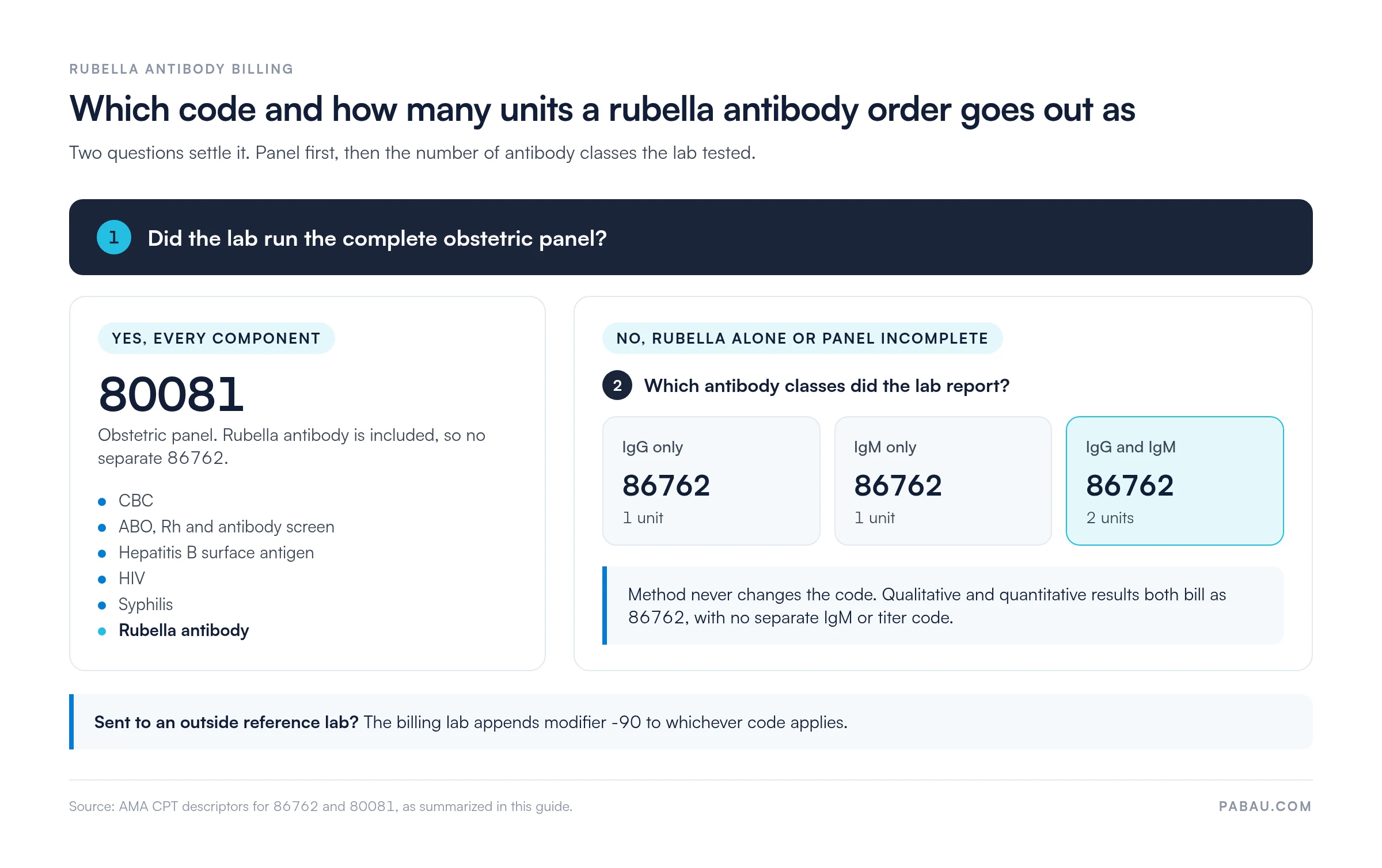
Bill one unit of 86762 for each antibody class tested. An IgG and IgM panel on the same specimen goes out as 86762 with two units. The record should name each class the lab tested, so the unit count matches the report.
One situation changes the code itself. When rubella is part of a complete obstetric panel, it is billed inside CPT 80081, as the diagram below shows.
Payers reviewing rubella serology claims look for four elements in the medical record.
Laboratories using automated platforms (Abbott ARCHITECT, Roche Elecsys, Beckman Coulter) typically generate a report that captures methodology and result interpretation automatically. In-office billing requires the ordering provider to document the indication separately in the visit note.
Every CPT code 86762 claim needs a supported ICD-10-CM diagnosis code that reflects the clinical indication. Medicare Administrative Contractors (MACs) apply Local Coverage Determinations (LCDs) to rubella serology, and unsupported codes trigger automatic denial. The table below covers the most commonly accepted pairings.
Always verify the selected ICD-10 pairing against the MAC LCD covering the ordering provider’s jurisdiction. Coverage policies for rubella serology vary between payers. A code accepted by one MAC may not be on another’s covered-diagnosis list.
Check your MAC’s LCD for rubella serology before assigning Z11.59 as the supporting diagnosis. Some MACs restrict coverage to documented exposure, prenatal context, or pre-vaccination verification rather than routine screening. A mismatched ICD-10 pairing is the fastest path to a medical necessity denial for CPT code 86762.
Rubella immune status testing has two dominant clinical ordering scenarios, and each carries different documentation and ICD-10 requirements.
The CDC’s rubella vaccine recommendations call for vaccinating pregnant patients without evidence of immunity right after delivery. That makes rubella immune status a routine prenatal check.
The American College of Obstetricians and Gynecologists (ACOG) includes rubella IgG in the standard first-trimester lab panel. The other components are a CBC, ABO and Rh typing with an antibody screen, hepatitis B surface antigen, HIV, and syphilis testing.
When the lab runs that full panel, bill CPT 80081 (obstetric panel) instead of 86762 and the other component codes. CPT 80081 already includes the rubella antibody test. Bill 86762 on its own only when rubella is ordered alone or the panel is incomplete.
In an incomplete panel, each test goes on its own line, such as a non-treponemal syphilis test under 86592. Either way, document the gestational age and the obstetric visit ICD-10 to support the claim.
Healthcare workers, teachers, and childcare workers often need rubella immunity verification as a condition of employment or clinical credentialing. The ordering context shifts from obstetric care to occupational medicine.
Use Z01.84 (encounter for antibody response examination) when the test checks immunity, or Z20.4 (contact with and suspected exposure to rubella) after a documented exposure. Verify payer coverage first. Commercial plans handling occupational health claims may apply different medical necessity criteria than a standard Medicare fee-for-service claim.
The codes most often confused with CPT code 86762 are the other MMR antibody codes. Each has a distinct descriptor, and billing the wrong one produces a descriptor mismatch denial.
When a full MMR immunity panel is ordered, CPT codes 86762, 86765, and 86735 are each billed separately on the same date of service. Check current National Correct Coding Initiative (NCCI) edits before billing the combination. Bundling rules change annually and may affect how the codes interact on a claim.
Medicare reimburses CPT code 86762 under the CMS Clinical Laboratory Fee Schedule (CLFS), not the Physician Fee Schedule.
Rates are set under the Protecting Access to Medicare Act (PAMA), which bases them on private payer market data. The national rate for 86762 is published each year in the CMS CLFS data file. Verify the current year rate directly with CMS, since the allowable changes from cycle to cycle.
Practices billing 86762 from an office setting must hold a valid CLIA certificate, issued under the Clinical Laboratory Improvement Amendments, for the test’s complexity category. Most rubella antibody immunoassay platforms are classified as moderately complex under CLIA. A lab claim sent without a CLIA certificate on file with the payer is one of the most common non-clinical denial triggers.
Three modifiers apply to CPT 86762, and each has a specific use case. Applying the wrong modifier, or omitting a required one, produces predictable denials.
Rubella serology denials cluster around a small set of preventable billing errors. Each one below comes with the fix that stops it before submission.
Most 86762 denials trace back to one of the seven causes in the table. To match the claim adjustment reason codes (CARCs) on a remittance to the error behind them, use this list of medical billing denial codes.
A repeatable pre-submission checklist reduces first-pass denial rates for rubella serology claims. The steps below address the points where CPT code 86762 claims most commonly fail.
Claims management software can check eligibility, send the claim in step 7, and post the remittance that comes back. The CLIA, ICD-10, modifier, and coverage decisions in steps 2 to 5 still need a coder’s judgment.
Rubella serology claims usually fail on administrative details. A unit count that misses the IgM result, a lost modifier -90, or an unchecked CLIA status each cost a resubmission.
Pabau, the practice management and billing platform we build, connects to Claim.MD, our US clearinghouse partner. It routes CPT code 86762 claims to thousands of US payers as electronic CMS-1500 claims. Insurance eligibility verification confirms patient coverage before the claim goes out.
After adjudication, electronic remittance advice (ERA) files post automatically. Denial codes show up in your workflow the same day, so your team can correct a 86762 claim inside the timely filing window. Your coders keep control of the code, units, and modifier, while Pabau handles the submission and follow-up around them.

Pabau checks eligibility, submits CPT code 86762 claims through Claim.MD, and posts ERAs for your full lab panel. Your billing team spends less time on rework and status calls.

CPT code 86762 is the one code for rubella antibody testing, whatever the antibody class or method. That makes the unit count the decision that matters most: One unit per class tested, read straight from the lab report.
Check the panel before you code. A complete obstetric panel goes out as 80081, so billing 86762 next to it charges for the rubella test twice.
The other failures are avoidable with a pre-submission check. Keep measles (86765) and mumps (86735) on their own lines, attach the right modifier, and pair the claim with a covered ICD-10 code.
Get those right and rubella serology becomes one of the simpler lab claims to bill cleanly. To see how Pabau checks eligibility, submits lab claims, and posts remittances, book a demo.

Need to understand how clearinghouse submission works for lab codes? Pabau’s Claim.MD clearinghouse guide explains how claims go out to payers and how remittances and eligibility answers come back.
Want to reduce your lab billing denial rate across the board? Medical billing compliance best practices covers documentation standards, CLIA requirements, and NCCI edit avoidance.
Billing the antibody screen from the same prenatal draw? CPT code 86850 covers red blood cell antibody screen units and the denials they trigger.
Adding hepatitis B to an incomplete prenatal panel? CPT code 87340 walks through billing the hepatitis B surface antigen test.
Screening healthcare workers for more than rubella? CPT code 86580 covers TB skin test billing and its ICD-10 pairing.
CPT code 86762 covers rubella antibody testing in serum, for IgG or IgM, by any method and with qualitative or quantitative results. Each antibody class tested is one unit, so an IgG and IgM panel is billed as two units. Measles (86765) and mumps (86735) antibodies, PCR, and viral culture use other codes.
Medicare reimburses CPT 86762 under the Clinical Laboratory Fee Schedule (CLFS), with rates set under PAMA from private payer market data. Check the current year CLFS data file on CMS.gov for the national rate, since it changes from cycle to cycle.
CPT 86762 is the rubella (German measles) antibody code, and CPT 86765 is the rubeola (measles) antibody code. They are distinct viruses with distinct descriptors and must not be substituted for each other on a claim. In an MMR immunity panel, both are billed separately on the same date of service.
Yes. Medicare and commercial payers generally cover rubella IgG testing ordered as part of a first-trimester prenatal panel with a supported ICD-10 code. If the lab runs the complete obstetric panel, bill CPT 80081, which already includes the rubella antibody test. The ICD-10 pairing and CLIA certificate requirements still apply.
The leading denial causes are a non-covered ICD-10 pairing and a missing CLIA certificate on file with the payer. An omitted modifier -90 for reference lab work and a same-day duplicate without modifier -91 follow. Z11.59 is especially at risk on MACs with restrictive LCDs. Each has a prevention fix in the denial table above.
Yes. When a full MMR immunity panel is ordered, CPT 86762, 86765 (measles), and 86735 (mumps) are billed separately on the same date of service. Verify current NCCI edits for this combination before submitting, since bundling rules are updated annually.