



HCPCS code E0198: Water pressure pad billing guide
HCPCS code E0198 is a water pad for a standard mattress HCPCS code E0198 is the ...

Last Updated: Oct 13, 2026

CPT Code 81025 reports a urine pregnancy test read by visual color comparison, on a dipstick or strip.
Billing 81025 requires a CLIA Certificate of Waiver from CMS, and a missing certificate is the most common reason for denial.
Medicare pays 81025 under the Clinical Laboratory Fee Schedule, so the code carries no RVUs and no MPFS rate.
Payer policies on billing 81025 inside the global OB period differ, so check the policy before you submit the claim.
Pabau’s claims management software runs validation checks before submission and tracks each claim afterwards, so coding problems surface early.
CPT Code 81025 reports a urine pregnancy test read by visual color comparison. The test uses a dipstick or strip, and a person reads the color change rather than an analyzer. The code sits in the Urinalysis Procedures range of the CPT codebook, inside the Pathology and Laboratory section.
81025 is CLIA-waived, so a physician office holding a Certificate of Waiver can perform and bill it. One detail catches coders out. Medicare pays 81025 from the Clinical Laboratory Fee Schedule, not the Physician Fee Schedule, so the code carries no RVUs at all.
The American Medical Association (AMA) maintains the CPT code set that US payers use to describe medical, surgical, and diagnostic services. Within that set, 81025 covers point-of-care pregnancy testing in OB/GYN offices, primary care, urgent care, and emergency departments.
This guide covers the descriptor, the CLIA rules, ICD-10 pairings, payment, and the documentation a payer expects.
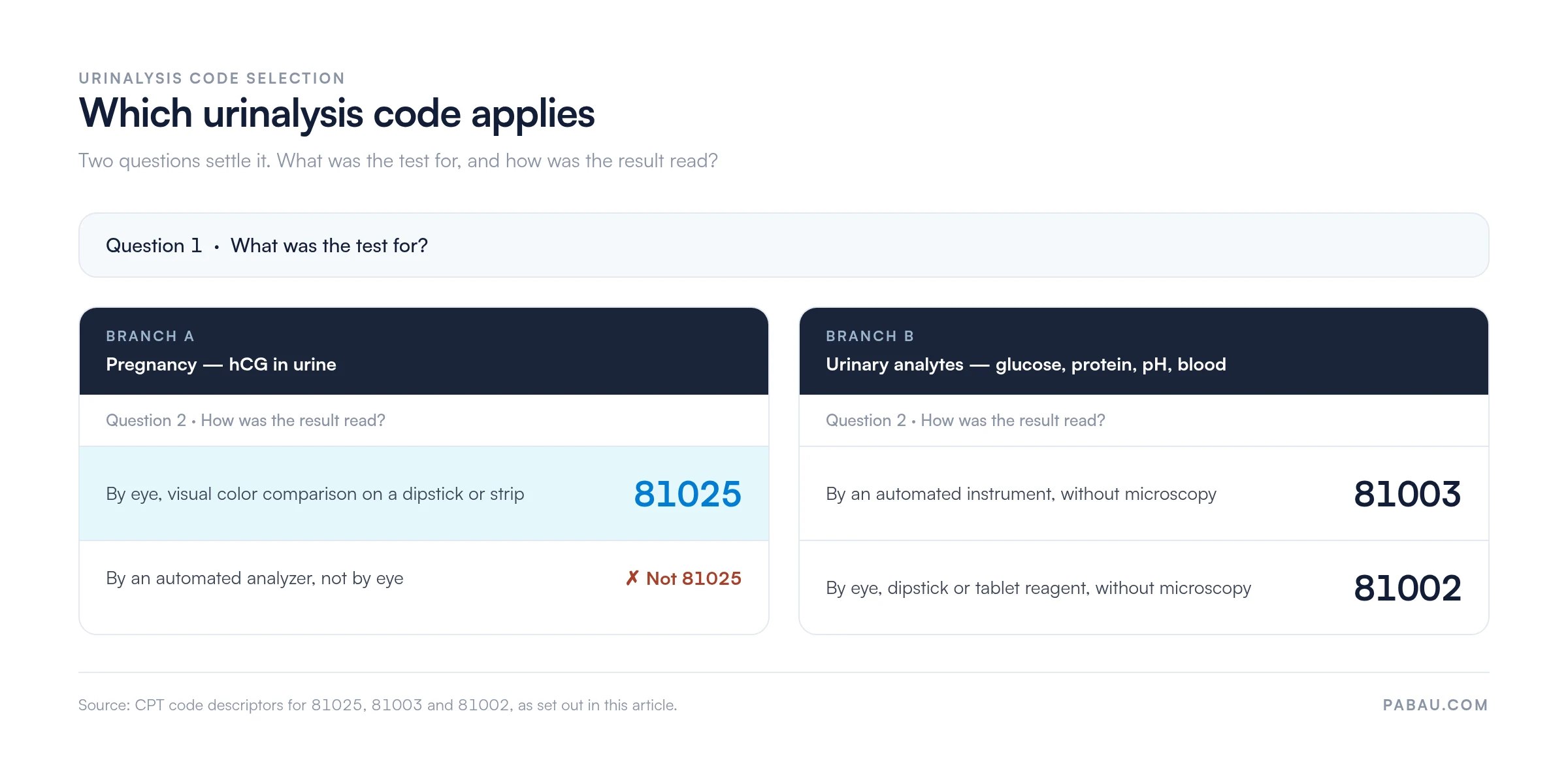
CPT Code 81025 has a precise official descriptor that defines exactly what the code covers. Getting this right matters, because reaching for 81003 or 81002 instead is one of the most flagged billing errors in urinalysis coding.
The key phrase in the descriptor is “visual color comparison methods.” The result is interpreted by looking at a color change on a dipstick or strip, not by an automated analyzer.
If your practice uses an automated instrument to read the result, a different code applies. Document the method used, because payers may ask for it during a post-payment audit.
CPT 81025 applies to a qualitative urine pregnancy test using the visual dipstick method. It is appropriate across a range of clinical settings and indications.
Settings where 81025 is commonly billed:
Do not use 81025 when: the test is read by an automated instrument, or a quantitative serum hCG is performed instead. The same applies when the practice runs a urine dipstick for a different clinical purpose. Selecting the wrong code in these scenarios is a compliance risk.
CPT 81025 is a CLIA-waived test, confirmed by the CMS list of waived tests. The Clinical Laboratory Improvement Amendments regulate laboratory testing performed on human specimens in the United States. A Certificate of Waiver is the minimum certification for performing and billing this test in a physician office.
Holding the certificate is only the first step. Here is what practices need to keep on top of:
State Medicaid programs may add requirements beyond the federal minimum. California’s Medi-Cal program, for instance, sets its own laboratory certification rules alongside the federal CLIA certificate. Check state-specific requirements with your state Medicaid agency before billing.
Every claim for CPT 81025 needs a supporting ICD-10-CM diagnosis code that establishes medical necessity. Payers routinely deny claims where the diagnosis does not support a pregnancy test. The codes below are the most common pairings used in practice.
Payer policies on accepted diagnosis codes vary. Some commercial payers publish coverage policies, or follow Local Coverage Determinations, that list approved diagnosis codes for in-office lab tests. Check your payer’s coverage policy before submitting 81025 with a diagnosis code that is not on that list.
Medicare pays CPT 81025 under the Clinical Laboratory Fee Schedule (CLFS). The CLFS covers clinical laboratory tests billed to Medicare Part B, and 81025 is not paid from the Physician Fee Schedule. That distinction is where most coders go wrong on this code.
Because 81025 falls outside the Physician Fee Schedule, it carries no relative value units. On the MPFS relative value file the code shows status indicator X, a statutory exclusion. An RVU lookup will not price it, and no locality adjustment applies the way it does to a physician service.
Use the CMS Clinical Laboratory Fee Schedule files to find the current payment amount for 81025. CMS publishes the file each year and issues quarterly updates, so check the version that covers your date of service.
Commercial rates for 81025 are set by contract and change when the contract does. Confirm the code’s current descriptor and status through the AAPC Codify CPT lookup. Take the rate itself from your payer contract, not from a published Medicare figure.
A clean claim for CPT 81025 needs documentation that supports both medical necessity and the test method used. Missing any of these elements creates grounds for denial or post-payment recoupment.
Capture each element at the point of care rather than reconstructing the record afterwards. A result written up an hour after the patient left is exactly the detail an auditor asks about.
CPT 81003 is the most commonly miscoded alternative to 81025. Both codes sit in the Urinalysis Procedures section, which is where the confusion starts. They describe fundamentally different tests performed on urine specimens.
CPT 81002 describes a non-automated urinalysis without microscopy, using a dipstick or tablet reagent method. Like 81025, the result is read visually. The distinction is the purpose of the test. 81002 screens for urinary analytes such as protein, glucose, pH, ketones, and blood, while 81025 tests for pregnancy.
Across all three codes the choice comes down to two questions, in this order. What was the test for, and how was the result read?
The global obstetric package bundles a defined set of services, running from the first prenatal visit through six weeks postpartum. Billing 81025 inside that window needs a look at the payer’s own policy, because the rules are not uniform.
As a general principle, CMS global surgery rules fold routine services into the global package. A urine pregnancy test done at the initial prenatal visit, as a routine part of prenatal care, may be treated as included. Billing 81025 separately may still be permitted when:
Payer policies diverge sharply here. Billing 81025 separately during the global period, without checking the policy first, generates both a denial and a compliance flag. Read the payer’s global OB documentation before you treat the test as a standalone service, and record the clinical rationale when you do.
Run a quarterly audit of all 81025 claims submitted in the past 90 days. Filter by denial reason code. If you see a pattern of CO-4 (inconsistent modifier) or CO-B7 (provider not certified) denials, your CLIA certificate documentation or MAC enrollment may need updating. Catching this quarterly saves you from a larger retrospective recoupment.
Claims for 81025 are denied for a fairly consistent set of reasons. Addressing them up front reduces rework and protects revenue.
Each of these arrives back as one of a small set of denial reason codes on the remittance. Sort a quarter’s denials by code rather than reading them claim by claim. The pattern tells you whether the weak step is your CLIA record, the diagnosis, or the code.
Review your 81025 denial rate for Medicare claims specifically. If Medicare is bundling 81025 with an E/M code billed the same day, check the E/M documentation. Was it a separate and distinct problem visit? If so, append modifier -25 to the E/M code, never to 81025, to signal a distinct service.
A standalone code lookup gives coders reference data, then leaves them to retype it into a separate billing system. That handoff is where a wrong code, an unpaired diagnosis, or an overlooked CLIA record slips through unnoticed.
Practice management software like Pabau keeps the encounter and the claim in one record instead. Pabau’s claims management software runs validation checks on a claim before it leaves the practice. A missing field or an unsupported diagnosis surfaces while your team can still fix it.
Claims are then submitted and tracked from the same screen. Your billing team can see which 81025 claims are open, which were paid, and which came back rejected. Nobody has to log into a separate portal to find out.

Pabau keeps point-of-care documentation and claims in one record, with validation checks before submission and status tracking afterwards. See how claims management handles CLIA-waived tests like CPT 81025 in your practice.

CPT 81025 is a simple code with a complicated envelope around it. An expired CLIA certificate, a diagnosis that contradicts the documented result, or an unchecked global OB policy will each sink the claim on its own.
Start with the certificate, because that failure stops every 81025 claim at once. Then fix diagnosis selection, so the Z32.0x code always matches the result in the record. What remains is documentation discipline at the point of care, which costs seconds during the visit and hours after a denial.
Sort one quarter of 81025 denials by reason code and the pattern will name your weak step. Book a demo to see how Pabau connects point-of-care documentation to claim submission and tracking.

Need to understand how claims flow after submission? Electronic remittance advice explained covers how ERA files map to CPT codes and how to read denial reason codes.
Credentialing before billing Medicare for 81025? Getting credentialed with insurance companies walks through the MAC enrollment steps required before submitting CLIA-waived lab claims.
Want fewer rejections on lab claims? What is a clean claim in medical billing? sets out the checks that get a claim paid on first submission.
CPT Code 81025 is a qualitative urine pregnancy test performed by visual color comparison methods, using a dipstick or strip. It sits under Urinalysis Procedures in the Pathology and Laboratory section of the CPT codebook. It is a CLIA-waived test used in physician offices, primary care, OB/GYN, and urgent care to detect human chorionic gonadotropin (hCG) in urine.
Yes, CPT 81025 is confirmed as a CLIA-waived test by CMS. Practices must hold a current CLIA Certificate of Waiver before performing and billing in-office pregnancy tests under this code. The certificate is renewed every two years. The kit must also be used strictly per the manufacturer’s instructions to keep its waived status.
CPT 81003 describes an automated urinalysis, without microscopy, that measures multiple urinary analytes using an instrument reader. CPT 81025 describes a pregnancy-specific test read visually by a clinician. The tests serve different clinical purposes and are coded separately. Both may be billed on the same date of service if both are medically indicated and documented.
It depends on the payer and the clinical context. Some payers bundle routine prenatal pregnancy testing into the global OB package. Separate billing may be permitted in three situations. The test is performed before the global period begins, or at a problem visit unrelated to routine prenatal care. It is also permitted when the payer excludes 81025 from its global OB definition. Check with the payer before billing.
The most commonly used ICD-10-CM codes with 81025 are Z32.01 (encounter for pregnancy test, result positive), Z32.02 (result negative), and Z32.00 (result unknown). Additional codes include N91.2 for amenorrhea and R10.2 for pelvic pain, when testing is part of a broader diagnostic workup. Select the code that matches the documented clinical indication most accurately.
Medicare pays 81025 under the Clinical Laboratory Fee Schedule, not the Physician Fee Schedule. The code carries no RVUs, and its status indicator on the MPFS relative value file is X, a statutory exclusion. Look up the current payment amount in the CMS Clinical Laboratory Fee Schedule files, which are published annually with quarterly updates.
Documentation must include the clinical indication, confirmation that a visual color comparison method was used, and the result. It also needs the ordering provider’s name and credentials, plus the date of service. Your CLIA Certificate of Waiver number must be on file with your MAC. Recording the test kit lot number and expiration date is also good practice.



