



CCSD code G5100: Bypass of duodenum billing guide
CCSD code G5100 bills a bypass that leaves the duodenum in place CCSD code G5100...

Last Updated: Oct 16, 2026

CPT code 77062 reports diagnostic digital breast tomosynthesis, bilateral. A diagnostic study of one breast is 77061.
Laterality sits inside the descriptor, so 77062 carries no RT or LT modifier and no modifier 50. It bills as one line item.
Medicare does not accept 77062. The fee schedule lists it as status indicator I with 0.00 RVUs. Medicare claims go out as 77065 or 77066 with add-on HCPCS code G0279.
Commercial and Medicaid plans that do accept the code still want a symptomatic or indeterminate-finding ICD-10 code, never the screening code Z12.31.
Practice management software like Pabau attaches codes at the point of care, so the code set each payer expects reaches the claim.
CPT code 77062 reports diagnostic digital breast tomosynthesis, bilateral. It covers a 3D mammogram of both breasts, ordered because of a symptom or an unclear prior finding. One fact decides most claims on it. Medicare does not accept the code at all, so a bilateral diagnostic study goes out as 77066 with add-on HCPCS code G0279.
Send 77062 to the wrong payer and the line denies, so a coder reworks the claim a week later. What follows is the descriptor, the modifier rules, the ICD-10 pairings, and the payer split that decides which code set goes out.
Official AMA descriptor: Diagnostic digital breast tomosynthesis; bilateral.
The American Medical Association’s CPT code set overview places 77062 in the Breast, Mammography subsection of the Radiology chapter.
The AMA introduced 77061, 77062, and 77063 effective January 1, 2015. Each code in that family carries its own clinical indication, laterality rule, and payer handling.
Digital breast tomosynthesis (DBT) takes several low-dose X-ray images of the breast from different angles. Software then reconstructs them into a three-dimensional dataset.
That extra depth improves lesion detection in dense breast tissue, compared with standard two-dimensional mammography.
CPT code 77062 covers the acquisition and the interpretation of that dataset, for both breasts, in a diagnostic context. Diagnostic means the patient has signs, symptoms, or an imaging finding that needs further evaluation.
Three questions decide the code. Is the encounter diagnostic or screening? Was one breast imaged, or both? And does the payer accept the CPT tomosynthesis codes?
The diagram below answers all three at once.
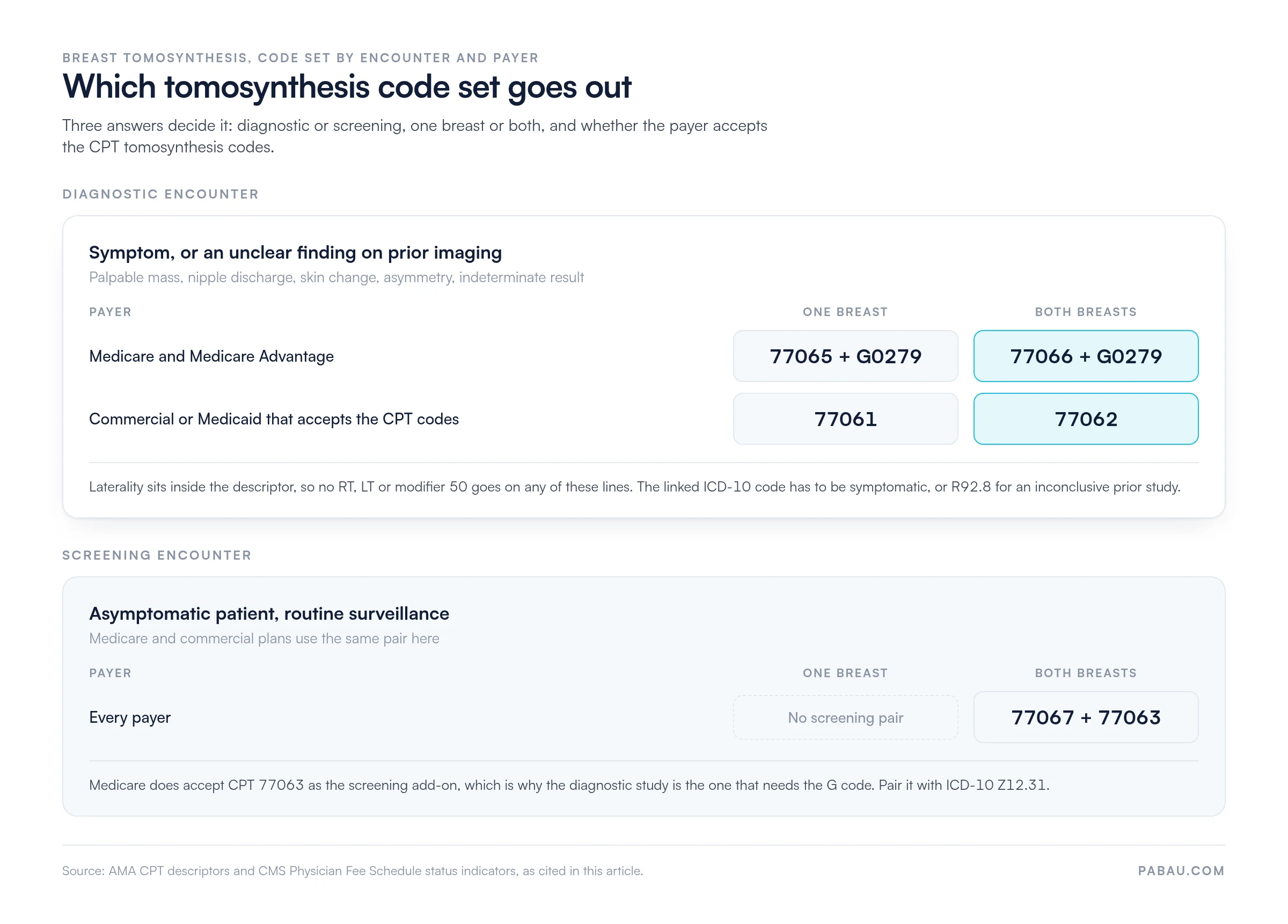
A diagnostic encounter happens when the patient presents with a new symptom, such as a palpable mass, nipple discharge, or a skin change. It also applies when a prior study produced an indeterminate result that needs clarification. Screening, by contrast, happens in an asymptomatic patient under routine surveillance.
Laterality is not a modifier decision on this code. A diagnostic study of one breast is 77061, and a study of both breasts is 77062.
Because 77062 already covers both sides, it goes out as a single unit on a single claim line. Two units for one session duplicate the bilateral service.
77062 takes component modifiers, not laterality modifiers. RT, LT, and modifier 50 restate what the descriptor already says. So the decisions worth making here are about who bills which part of the service.
Component modifiers carry most of the risk. When a radiologist reads the study in a hospital or imaging center, modifier 26 bills the interpretation alone.
The facility then files its own claim with modifier TC. Billing the global code in a split arrangement overstates the claim and creates compliance exposure.
Adding RT or LT to 77062 is the more visible error. It usually comes from a charge template built for a unilateral code. Some payer systems reject the line, others pend it for review, and either way somebody reworks the claim.
Every payer that covers diagnostic tomosynthesis wants a linked ICD-10-CM diagnosis code that shows medical necessity.
The CMS ICD-10 codes page keeps the current tabular list for verification. The diagnoses that pair with 77062 most often fall into four clinical groups.
The ICD-10 code has to match the clinical documentation. Attaching Z12.31 to a diagnostic DBT claim is a common and auditable error, since that code belongs with screening codes 77067 and 77063. Our ICD-10-CM code library goes deeper on each of these diagnoses.
Because 77062 covers both breasts, the record should show why each side was imaged. A single unilateral finding, with no stated reason for the second view, is the detail an auditor asks about first.
The AAPC’s CPT code lookup tool helps when you cross-reference pairings before submission.
Check the payer before you check the modifier. A bilateral diagnostic tomosynthesis study goes out as 77062 to a commercial plan, and as 77066 with add-on G0279 to Medicare. Build both versions into the charge template, so the code set follows the payer rather than getting fixed after the first denial.
Medicare does not pay 77062. The CMS Physician Fee Schedule relative value file marks both 77061 and 77062 with status indicator I, meaning neither is valid for Medicare purposes. Both carry 0.00 RVUs, so no locality-adjusted rate exists to bill against.
Instead, Medicare pays for the tomosynthesis through add-on HCPCS code G0279, reported on the same claim as diagnostic mammography code 77065 or 77066. For a bilateral diagnostic study, that pairing is 77066 plus G0279.
Screening runs the other way around, which is where coders get caught. Medicare does accept CPT 77063 as the screening tomosynthesis add-on to 77067. So the CPT add-on works for screening, while the diagnostic study needs the G code.
Medicare Advantage plans generally follow the Medicare code set, so expect the G0279 pairing there too. Still, confirm it with the plan before the claim goes out, because edits differ by carrier.
No Medicare fee schedule amount exists for 77062, because the code sits outside the schedule. Whatever it pays comes from the commercial contract, so allowed amounts differ by payer and by region.
The CMS Physician Fee Schedule lookup tool is still worth opening. It shows the status indicator on 77061 and 77062, and it carries the payable rates for 77065, 77066, and G0279 in each locality.
How the claim is split changes the amount as well. A practice that owns its imaging equipment and employs its radiologists bills the global service, with no component modifier. A hospital-based radiologist bills modifier 26, and the facility bills TC.
Tracking the trend matters as much as knowing today’s rate. Practice management software like Pabau integrates with Claim.MD, which routes tomosynthesis claims to thousands of US payers and returns 835 remittance files.
Revenue by code then becomes easy to watch, so a payer that keeps underpaying its contracted rate shows up as a pattern.
Coverage for 77062 is a plan-by-plan question, because Medicare is out of the picture. Commercial policies differ on three points. Does the plan accept the CPT tomosynthesis codes? Does tomosynthesis need prior authorization? And is the 3D acquisition bundled into the mammography payment?
Coverage criteria still center on a documented clinical indication. That means a palpable mass, nipple discharge, a skin change, asymmetry on prior imaging, or an indeterminate result.
No payer covers diagnostic tomosynthesis for routine screening, and that line has to show up in the ICD-10 code and in the record.
Verify benefits before the encounter rather than after the study. One eligibility check settles the code set and the authorization question together, at scheduling.
Documentation deficiencies are the second most common reason for 77062 denials, after code set and modifier errors. Every claim for this code needs a record that covers specific elements.
The radiology report is the primary documentation vehicle. It has to state that digital breast tomosynthesis was performed, not simply mammography, and it has to cover both breasts. A report that lists findings without naming the modality creates audit exposure.
Structured reporting templates cut the ambiguity. Practices that build modality and laterality fields into every DBT report get language that matches the CPT descriptor. The claim form and the radiology report then agree.
The code set is settled long before the claim reaches a payer. Five handoffs sit between the order and the payment, and each one can change what goes out.
Notice where the payer decision sits. It happens at registration, hours before anyone picks a code. Charge entry then applies it, sometimes by somebody who never sees the plan name. That distance is what produces Medicare claims carrying 77062.
Most denials and audit findings on 77062 trace to six patterns. Each one is correctable with a policy or workflow change, rather than an appeal.
Group your denials by root cause rather than by volume. Code set errors and screening-versus-diagnostic mismatches are both fixable at charge entry, well before an appeal is needed.
A coding reference tells you what 77062 means. It cannot tell you which payer this study is going to, and that is where the wrong code set enters the claim. The choice gets made in the clinical workflow, minutes after the radiologist signs the report.
Pabau embeds procedure coding in the appointment and treatment workflow. When a radiologist completes an interpretation, Pabau’s medical claims management attaches the code, the modifier, and the linked ICD-10 at the point of care.
Nobody re-keys them into a separate billing system, so the transcription step that produces code selection errors disappears.

Pabau’s Claim.MD integration then submits imaging claims in the 837P format to thousands of US payers. Each claim is validated against payer-specific edits before transmission. Coders see rejection reasons before the payer does, which cuts rework on codes like 77062.
Run a quarterly audit of tomosynthesis denials grouped by payer, not by code. Two causes usually account for the bulk of the rework. One is a Medicare claim carrying 77062 instead of 77066 with G0279. The other is the bilateral code reported for a one-breast study. Both are charge template fixes.

Pabau attaches CPT codes, modifiers, and ICD-10 pairings at the time of service, reducing transcription errors and accelerating claim submission for radiology and imaging practices.

77062 carries a narrow set of requirements. It needs a diagnostic indication, both breasts imaged, no laterality modifier, and a payer that accepts the CPT tomosynthesis codes. Medicare is not that payer, so those studies go out as 77066 with add-on G0279.
Build the payer branch into the charge template and most of the denials stop. Leave it to memory and the same two errors keep coming back, one claim at a time. Neither fix belongs in the radiology suite, which is worth remembering when the denial report lands.
Want to see the code, the modifier, and the linked ICD-10 attached before a claim leaves the building? Book a demo and we will walk through the radiology billing workflow with you.

Need to understand how claims reach payers electronically? Claim.MD clearinghouse overview explains how EDI submission, eligibility checks, and ERA returns work in practice.
Want to reduce claim denials before they happen? Clean claim submission guide covers the elements every claim needs to pass payer edits on the first submission.
Looking for guidance on credentialing with imaging payers? Credentialing with insurance companies walks through the enrollment process for radiology and imaging providers.
Yes. Medicare treats diagnostic imaging as an ordered test, so the treating provider requests the study and states the reason. Screening mammography is the exception that needs no order. Keep the order, with its indication, in the chart.
Yes. Under the Mammography Quality Standards Act (MQSA), the facility holds FDA certification, and the tomosynthesis portion of the unit needs a certificate extension. Personnel also need eight hours of DBT modality training.
Often, yes. A diagnostic breast ultrasound is separately reportable when the record supports both studies. Some plans reduce or bundle the second imaging line, so read the policy before you submit.
No fixed limit applies. Medical necessity drives each diagnostic study, while the annual frequency limit belongs to screening. Every repeat study needs its own documented indication in the order.
MQSA sets five years as the floor. Records run to 10 years where the patient has no further mammograms at that facility. State or local law can require longer, so check yours.



