HCPCS Code G0163: Skilled nursing observation and assessment
What is HCPCS Code G0163? HCPCS Code G0163 is a deleted Level II code for skille...

Last Updated: Oct 15, 2026
76706 is the CPT code for ultrasound, abdominal aorta, real time with image documentation, screening study for abdominal aortic aneurysm (AAA).
Denials on this code usually trace to three causes. Coders pair the wrong ICD-10 code, confuse 76706 with the limited study 76705, or bill the Medicare screening benefit more than once per lifetime. Every claim also needs real-time imaging, a permanent image record, and a signed physician interpretation.
Let Pabau's smart automation suggest the right codes, reduce claim denials, and keep your practice compliant—effortlessly.
Automate repetitive tasks and focus on what matters most—your patients.
Reduce coding errors and ensure compliance with the latest regulations.
Clean claims, fewer denials, and faster reimbursements.
Powerful insights and reporting to help your practice thrive.
HIPAA compliant SOC 2 certified GDPR-compliant Trusted by 4,000+ clinics worldwide

CPT code 76706 covers a complete real-time ultrasound screening of the abdominal aorta and iliac vessels, not a general abdominal study.
Medicare covers 76706 once per lifetime under the IPPE benefit, and its smoking-history criterion applies only to men aged 65 to 75.
76706 and 76705 cannot be billed together for the same aorta study, because NCCI edits bundle them.
Pairing 76706 with an ICD-10 code the local coverage determination does not accept is the most common denial on this claim.
Pabau’s claims management software tracks claim status and denial reason codes, so teams can resubmit 76706 claims before the filing window closes.
CPT code 76706 describes “Ultrasound, abdominal aorta, real time with image documentation, screening study for abdominal aortic aneurysm (AAA).” The study must cover the abdominal aorta from the diaphragm to the iliac bifurcation, with real-time imaging and a permanent image record. A physician interpretation and report are required.
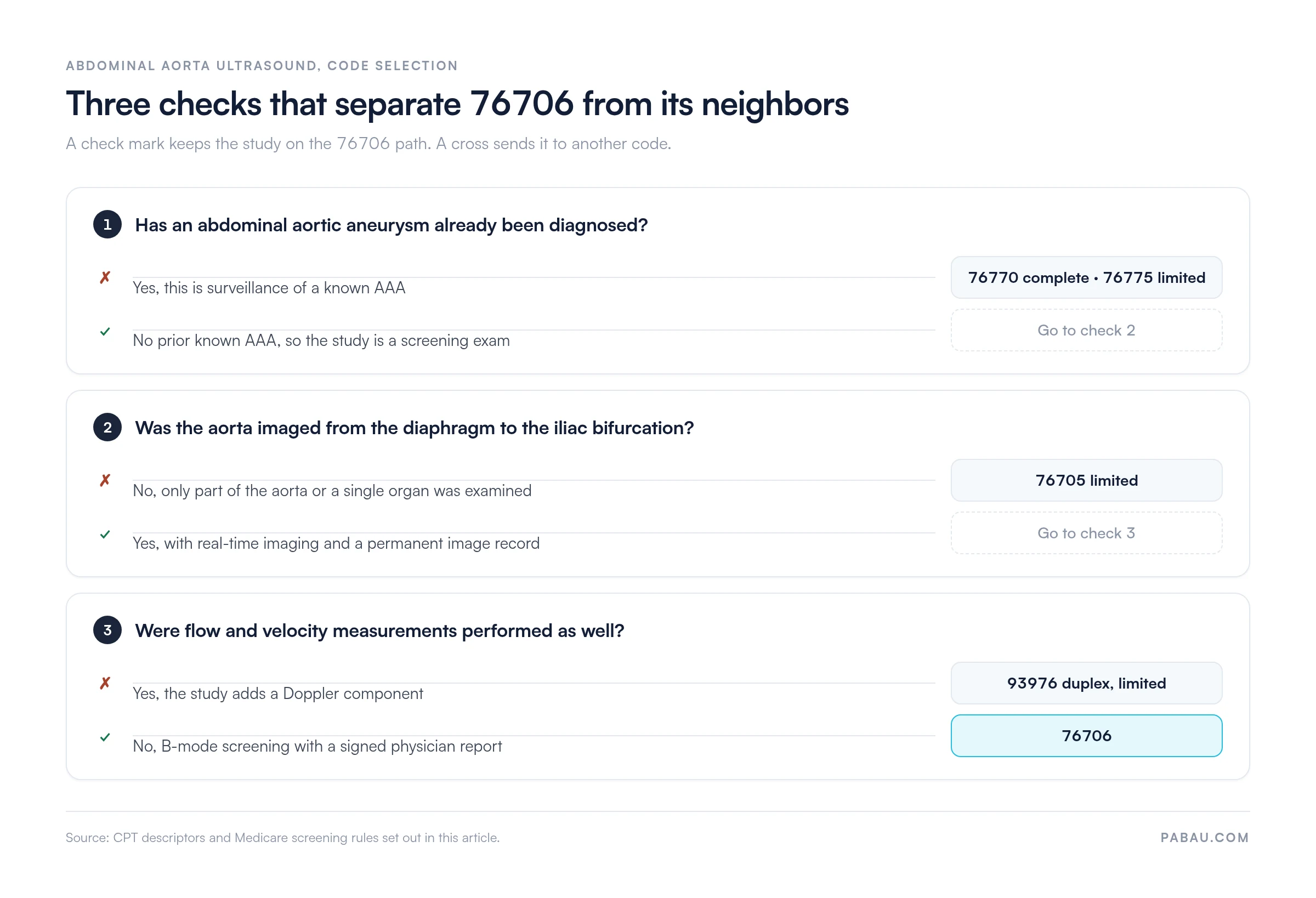
Three elements distinguish a valid 76706 study from a general abdominal ultrasound. First, it is a screening examination, meaning it is ordered in the absence of known AAA to detect disease early. Second, it must image the aorta as a complete study, capturing the transverse and longitudinal diameter at multiple levels through the iliac bifurcation. Third, the report must document the aortic measurement in centimeters.
CPT 76706 describes a complete screening study of the aorta. In contrast, CPT 76705 describes a limited abdominal ultrasound, examining only a portion of the abdominal cavity rather than the full aorta from diaphragm to iliac bifurcation.
These two codes are not interchangeable. National Correct Coding Initiative (NCCI) edits prevent billing them together for the same aorta study on the same date. The distinction matters because 76706 is the Medicare-covered preventive benefit, while 76705 does not carry the same coverage pathway.
76706 covers one specific scenario: screening for AAA with a complete aortic ultrasound. However, several adjacent codes handle different clinical situations, and selecting the wrong one is a common reason for denials based on code-to-diagnosis mismatch.
Practices that perform surveillance imaging on a patient with a previously detected AAA sometimes bill 76706 again. That is incorrect. Instead, once a patient carries a confirmed AAA diagnosis, the surveillance code is typically 76770, not the screening code. The three checks below settle which code the documentation actually supports.
Pairing 76706 with the wrong ICD-10 code is the most common reason for a medical necessity denial on this claim. Specifically, the ICD-10 code must match the clinical scenario: screening with qualifying risk factors, or a confirmed or suspected aortic condition.
Z13.6 is the primary ICD-10 code for the Medicare preventive benefit, though some Medicare Administrative Contractors require additional supporting codes. Check the local coverage determination (LCD) that applies to your MAC before submitting. If the report documents an aneurysm but does not name its site, the diagnosis code is I71.9, not I71.4.
Run an ICD-10 validity check against your MAC’s LCD for AAA screening before your first 76706 claim each calendar year. Noridian (Jurisdiction E and F) and other MACs update their LCDs periodically. A valid Z13.6 pairing at one MAC may require an additional supporting code at another.
Medicare covers CPT code 76706 as a one-time preventive benefit under the Initial Preventive Physical Examination (IPPE), also called the Welcome to Medicare visit. This benefit is authorized under Social Security Act Section 1861(s)(2)(F) and applies to beneficiaries who meet specific eligibility criteria.
Medicare treats a 76706 claim billed outside that framework, for a beneficiary who does not meet the criteria, as a false claim. As a result, the eligibility check belongs at the order stage, not at the remittance stage.
Three risk categories qualify a beneficiary for the Medicare-covered AAA screening under 76706:
The benefit is once per lifetime. A patient who already received a Medicare-covered AAA screening under 76706, at any Medicare-enrolled provider, cannot receive another one. A second screening claim comes back denied as a used benefit.
The 2026 Medicare Physician Fee Schedule (MPFS) rates for CPT code 76706 vary by geographic payment locality. Use the CMS Physician Fee Schedule Look-Up Tool to pull the exact non-facility and facility rates for your locality, since geographic adjustment factors differ materially between urban and rural settings.
When billing globally (both technical and professional components performed at the same site), report 76706 without a modifier. When splitting the service, append modifier TC (technical component) or modifier 26 (professional component) accordingly.

The FastRVU 2026 RVU lookup tool lists the work, practice expense, and malpractice RVU components by code and locality. Always confirm against the CMS tool before quoting patients a cost estimate.
When 76706 is billed under the Medicare IPPE benefit with a qualifying ICD-10 code, Medicare waives the Part B deductible and coinsurance. Submit it with the referral from the IPPE visit documentation. A missing referral note is a common reason the waiver fails and the patient is billed by mistake. Practice management software like Pabau keeps the rest of that follow-up visible. Its claims management software tracks claim status, denial reason codes, and resubmission deadlines, so a rejected 76706 claim is corrected in time.
Modifier selection for CPT code 76706 depends on where the technical and professional components are performed and who performs them. The default is global billing, with no modifier, when one physician performs and interprets the ultrasound at the same site.
Billing both TC and 26 on the same claim from the same provider is a common error. These modifiers split the global service between two billing entities, so they must appear on separate claims; otherwise, both on one claim triggers an automatic rejection.
A clean 76706 claim rests on what the report says. The radiology or ultrasound report must contain all of the following.
Capturing these elements at the point of service is what keeps the claim clean. When the clinical indication is missing from the report, medical necessity denials follow even where the imaging was appropriate. Check the report before the claim leaves the practice, rather than after a denial arrives. The AAPC Codify CPT lookup carries additional coding guidance and payer policy cross-references for 76706.
Almost every 76706 denial falls into one of six patterns. The table below maps each one to its corrective action.
Reading the denial reason codes on your electronic remittance advice (ERA) is the fastest way to spot a pattern. A cluster of CO-167 denials usually signals an ICD-10 mismatch, while CARC 50 points at missing documentation instead. A cluster of CO-4 denials signals a TC/26 workflow problem. Our denial codes guide maps the rest.
Review denial patterns as a batch each week, then update the front-end eligibility checks that produced them. That habit cuts the re-denial rate on corrected claims more than reworking each one alone.
Build a five-point check into your 76706 workflow. Validate the ICD-10 code against the current LCD, and confirm the one-time benefit has not been used. Check the report for the aortic diameter and the real-time notation. Match the modifier to the service arrangement, and attach the IPPE referral note. Clearing all five before submission removes the most common denial categories for this code.
Most billing teams track 76706 denials in a spreadsheet, updated whenever someone opens the remittance file. By then the timely filing clock has been running for weeks, and the reason code sits in a PDF nobody has read.
Pabau, by contrast, keeps the claim beside the appointment and the patient record it came from, so billing staff can see which 76706 claims were paid, which were denied, and which reason code came back, without opening a separate portal.
That shortens the loop between a denial and a corrected resubmission. A coding fix on a 76706 claim gets made while the payer still accepts it, instead of after the deadline has passed.

Pabau’s claims management software tracks claim status, denial reason codes, and resubmission deadlines. Your billing team sees which 76706 claims need work while there is still time to fix them.

CPT code 76706 is a narrow, well-defined code with a clear Medicare benefit pathway, and also one of the easier codes to bill incorrectly. The one-time benefit rule, the ICD-10 pairing requirement, and the real-time documentation standard each produce denials that a pre-submission review prevents.
In short, decide all of this before the study is ordered, not after the remittance arrives. Confirm the beneficiary’s eligibility category, pair the claim with an ICD-10 code the LCD accepts, and check that the report states the aortic diameter.
Pabau tracks claim status, denial reason codes, and resubmission deadlines, so a correction happens inside the filing window. To see how the billing workflow handles AAA screening claims end to end, book a demo with the team.

Need a framework for managing claim denials across your practice? Denial management in healthcare covers root-cause analysis methods and the workflow changes that reduce re-denial rates.
Want to understand how the billing workflow connects to reimbursement? Revenue cycle management explained maps each stage from eligibility check to payment posting.
Looking for guidance on clean claim requirements across code types? Medical billing compliance guidelines covers documentation standards, NCCI edits, and audit risk reduction.
CPT code 76706 covers a complete real-time ultrasound screening of the abdominal aorta. The study detects abdominal aortic aneurysm (AAA) in patients with qualifying risk factors. It must image the aorta from the diaphragm to the iliac bifurcation, and include a permanent image record and a written physician interpretation.
Medicare reimbursement for CPT code 76706 varies by geographic payment locality and changes each January under the Physician Fee Schedule update. Use the CMS MPFS Look-Up Tool for the exact current non-facility and facility rates for your ZIP code. When billed under the IPPE preventive benefit with a qualifying ICD-10 code, Medicare waives the patient deductible and coinsurance.
Z13.6 (encounter for screening for cardiovascular disorders) is the primary ICD-10 code for the Medicare IPPE benefit. I71.4 (abdominal aortic aneurysm without rupture) applies when a known AAA is documented, though surveillance of a known AAA typically warrants 76770, not 76706. Always verify the applicable ICD-10 against your MAC’s current local coverage determination.
Medicare does not require prior authorization for 76706 when it is billed under the IPPE preventive benefit for an eligible patient. Commercial payers vary considerably. Aetna, BCBS, and regional managed care plans each set their own prior authorization rules for AAA screening ultrasound. Check the payer’s policy before performing the study on a non-Medicare patient.