HCPCS code P9058: Red blood cells, leukocytes reduced, CMV-negative, irradiated
HCPCS code P9058: Official descriptor and key attributes HCPCS code P9058 report...

Last Updated: Oct 26, 2026
75565 is the CPT code for cardiac magnetic resonance imaging for velocity flow mapping (List separately in addition to code for primary procedure). It is an add-on code that adds phase-contrast flow measurement to a base cardiac MRI study.
It cannot be billed as a standalone charge and must sit on the same claim as 75557, 75559, 75561 or 75563. A missing parent code is a common reason this code gets denied, and naming the base code on every claim prevents it.
Let Pabau's smart automation suggest the right codes, reduce claim denials, and keep your practice compliant—effortlessly.
Automate repetitive tasks and focus on what matters most—your patients.
Reduce coding errors and ensure compliance with the latest regulations.
Clean claims, fewer denials, and faster reimbursements.
Powerful insights and reporting to help your practice thrive.
HIPAA compliant SOC 2 certified GDPR-compliant Trusted by 4,000+ clinics worldwide

CPT Code 75565 is an add-on (+) code for velocity-encoded cine cardiac MRI and cannot be billed without an approved base code.
Approved parent codes are 75557, 75559, 75561, and 75563, and billing 75565 without one of them on the same claim triggers an automatic denial.
Modifier 51 does not apply to add-on codes, while modifier 26 or TC applies when the professional or technical component is billed separately.
Medicare allows up to 4 units of 75565 per patient per day when each flow measurement is medically necessary and documented.
Pabau, the practice management platform we build, submits claims through the Claim.MD clearinghouse and tracks their status, so 75565 rejections surface quickly.
The American Medical Association publishes the descriptor for CPT Code 75565. It reads: Cardiac magnetic resonance imaging for velocity flow mapping (List separately in addition to code for primary procedure). The parenthetical instruction marks 75565 as an add-on (+) code. It can never appear on a claim without an approved parent code billed on the same date of service.
The code lives in the Diagnostic Radiology section of the CPT code set, specifically within the cardiovascular system imaging subsection. Cardiology and radiology practices both encounter it, and coders supporting either specialty need to know the parent-code list cold.
Velocity-encoded cine MRI is also called phase-contrast velocity mapping or flow quantification. It applies a magnetic gradient across a cardiac structure to measure blood velocity, direction, and volume. The technique produces quantitative flow data that standard cine cardiac MRI cannot provide.
Cardiologists order velocity encoding when they need a number, not just an image. Common clinical scenarios include:
The SCMR standardized CMR protocols include phase-contrast flow quantification for valve disease, shunts, and congenital heart disease. Payers expect the MRI report to show why that flow data was needed when 75565 is billed.
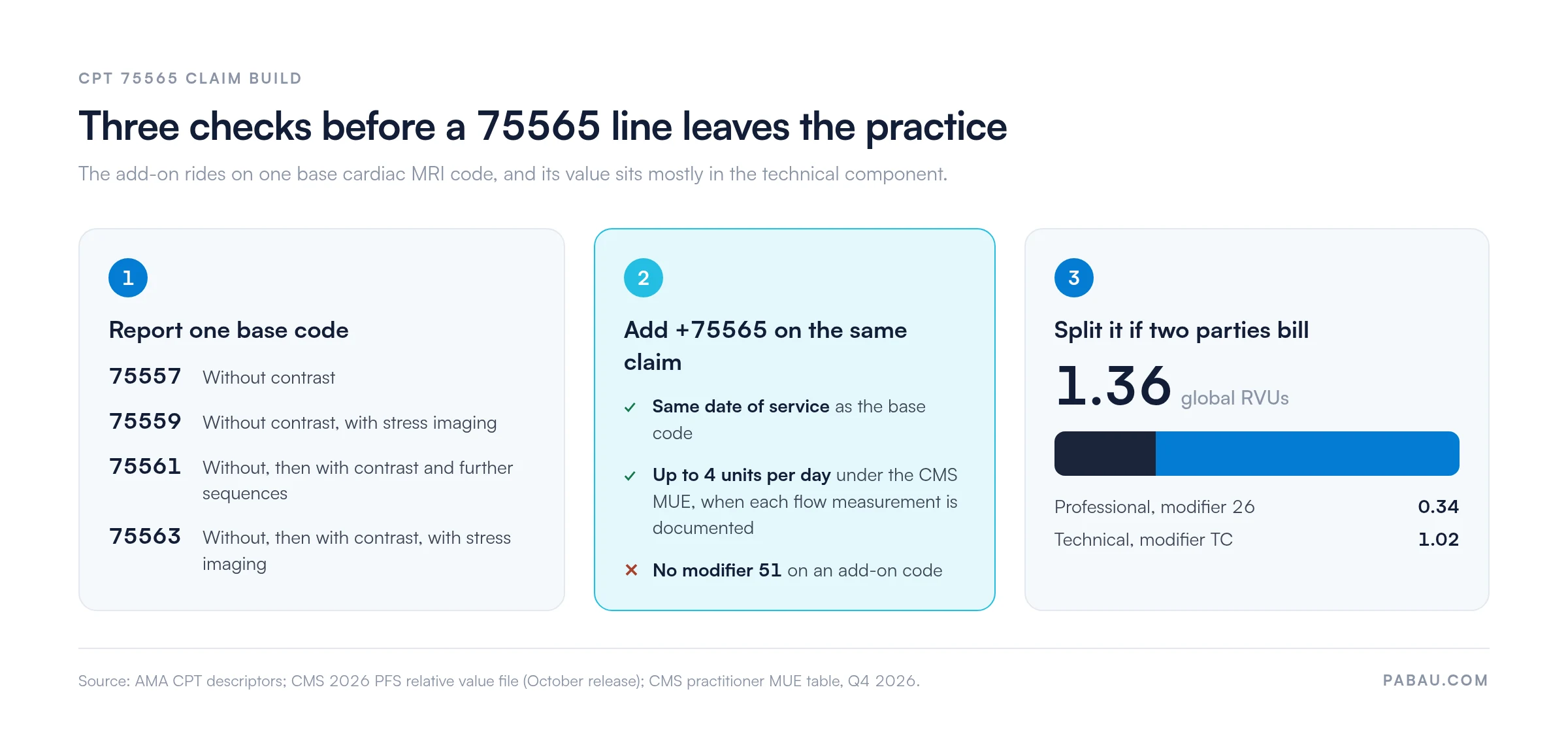
The cardiac MRI family covers four base codes (75557, 75559, 75561, and 75563) plus the add-on 75565. CPT Code 75565 sits alongside all four as the add-on for velocity flow mapping. It is only reportable when the MRI report documents the flow sequences.
75565 is approved for use with all four base codes. Flow quantification is a separate acquisition sequence, so it can be added whether or not contrast or stress imaging was used. On a non-contrast study, the base code is 75557, and 75565 rides on top of it.
Units matter too. The CMS practitioner MUE for 75565 is 4 units per patient per day. Up to four flow measurements can be billed when each is medically necessary. Record how many measurements were taken and which vessels, valves, or shunts they covered. The three checks below hold on every 75565 claim, whichever base code anchors it.
Add-on codes have a different modifier landscape than standalone procedure codes. Four modifiers come up with CPT Code 75565, and one of them is often misapplied.
Global billing (no modifier) applies when the same physician group owns both the equipment and the interpretation and bills as a single combined service. The global rate is always higher than either the TC or the 26 rate alone. Verify the billing arrangement with the facility before selecting a modifier.
Many 75565 denials trace back to the report rather than to coverage. Solid medical billing compliance means the MRI report does the heavy lifting before the claim ever reaches the clearinghouse. Five documentation elements matter most.
A velocity-encoding checkbox on your superbill template reminds the coder to confirm that the report names the flow sequences. A well-run study still gets denied when the report never describes it.
The table below lists ICD-10-CM codes most commonly accepted by payers alongside CPT Code 75565. Coverage is not universal: individual MACs and commercial plans issue Local Coverage Determinations that may restrict the list further.
Always check your MAC’s LCD and policy article before submitting. If the indication is aortic stenosis, the I35.0 reference covers the diagnosis side of the claim.
Run a pre-submission ICD-10 cross-check for every 75565 claim: confirm the diagnosis code on the claim appears in the payer’s cardiac MRI LCD. A covered base code paired with a non-covered diagnosis is still a medical necessity denial. Build this check into your billing workflow before the claim reaches the clearinghouse.
The Centers for Medicare and Medicaid Services (CMS) pays CPT Code 75565 under the Medicare Physician Fee Schedule (MPFS). The study must meet the medical necessity criteria in the applicable MAC’s Local Coverage Determination for cardiac MRI. There is no National Coverage Determination that blanket-restricts 75565, which means MAC-level LCDs govern coverage in each jurisdiction.
Commercial payer coverage varies. The medical billing process for 75565 at commercial plans often requires prior authorization, particularly for elective cardiac MRI studies. Many commercial plans publish medical policies that list the clinical indications they require before authorizing advanced cardiac imaging. Failing to obtain pre-authorization when required is one of the cleanest denial reasons to prevent.
The figures below come from the CMS 2026 PFS relative value file (October release). CMS updates the file during the year, so check the CMS fee schedule lookup before quoting an amount.
Payment is adjusted by each locality’s GPCI. In a facility setting the global service is not payable under the MPFS, so the interpreting physician bills the professional component with modifier 26. Commercial rates are set by each payer contract.
Because 75565 is an add-on code, it always pays in addition to the base cardiac MRI payment. Its multiple-procedure indicator in the 2026 MPFS file is 0, and it sits in no diagnostic imaging family. That means the imaging multiple-procedure reduction does not cut a 75561 + 75565 claim.
Denials for 75565 cluster around a small number of preventable errors. Knowing the pattern means most can be caught before the claim leaves the practice, reducing the rework that makes denial management workflows expensive.
A well-documented appeal can overturn many 75565 denials rooted in documentation or medical necessity. The clinical case for velocity encoding is usually defensible once the right records are assembled. Work through these steps in order.
Flag every 75565 denial by reason code in your practice management system. If one payer issues more than two denials per quarter for this code, escalate to a payer policy review instead of appealing claim by claim. A payer contract or LCD clarification resolves the root cause faster than repeated individual appeals.
Without a claims workflow, a missing base code or a stray modifier 51 usually surfaces only when the remittance comes back. By then the appeal clock is running and the cardiac MRI is weeks old.
Pabau’s billing software sends 837P claims electronically through the Claim.MD clearinghouse for US practices. Claim status, rejections, and denials are tracked in one place, so your billing team sees a 75565 problem while the study is still fresh.
Denials logged by reason code build a history for each payer. That history shows when a 75565 pattern needs a policy conversation rather than another appeal.

Pabau submits claims electronically through the Claim.MD clearinghouse and tracks claim status and denials in one place. Your team spends less time chasing cardiac MRI add-on claims and more time with patients.

The safest time to secure a 75565 payment is when the report is written. If the reader names each flow measurement and the vessel or valve it covered, the base code, unit count, and diagnosis follow from it.
The trade-off is a few extra lines in every cardiac MRI report. That costs far less than reworking an add-on denial worth about $46 nationally before locality adjustment.
Pabau tracks each claim from submission to payment, so add-on denials get worked while the study is still fresh. Book a demo to see how it fits your cardiac imaging billing.

Need a structured overview of US medical billing? What is medical billing covers the end-to-end process from charge capture through payment posting for US practices.
Want to reduce claim rejections across your CPT portfolio? Clean claim submission outlines the documentation and coding standards that get claims paid on first submission.
Building a denial prevention strategy? Denial management in healthcare covers how to categorize, track, and systematically reduce claim denials by root cause.
Coding aortic regurgitation? ICD-10 code I35.1 covers nonrheumatic aortic valve insufficiency, an indication for regurgitant fraction measurement.
Coding mitral regurgitation? ICD-10 code I34.0 explains how to report nonrheumatic mitral valve insufficiency on a claim.
CPT Code 75565 describes cardiac magnetic resonance imaging for velocity flow mapping. It is an add-on service, reported with a primary cardiac MRI code when phase-contrast sequences quantify blood velocity, direction, or volume. It is published by the AMA and carries the add-on (+) designation, meaning it cannot be billed as a standalone charge.
Yes. CPT 75565 is an add-on code, identified by the (+) symbol in the AMA CPT code book. It must always be listed in addition to an approved parent cardiac MRI code (75557, 75559, 75561, or 75563) on the same claim. Submitting it without one of those base codes will result in an automatic denial.
CPT 75561 is a base code for cardiac MRI for morphology and function without contrast material, followed by contrast material and further sequences. CPT 75565 is the add-on for velocity flow mapping. The two are complementary: 75561 covers the structural and functional MRI study, while 75565 captures the additional phase-contrast sequences that quantify blood flow. You bill both together when velocity encoding is performed as part of that study.
No. CPT 75565 cannot be billed without an approved base cardiac MRI code on the same claim. The AMA CPT descriptor includes the instruction “List separately in addition to code for primary procedure,” which is a binding billing rule. Claims submitting 75565 as a standalone service will be rejected during clearinghouse validation or denied by the payer.
Common denial reasons include billing 75565 without an eligible base code and appending modifier 51 in error. Others are an MRI report that never names the velocity-encoding sequences and missing prior authorization on commercial plans. A diagnosis code outside the payer’s Local Coverage Determination for cardiac MRI also triggers denials. Reviewing the revenue cycle management workflow for add-on code pairing before submission prevents most of these.