HCPCS code T2043: Hospice continuous home care billing guide
HCPCS code T2043 pays for hospice crisis care by the hour HCPCS code T2043 is th...

Last Updated: Oct 7, 2026

CPT code 72052 requires six or more distinct radiographic views of the cervical spine, documented in the report.
The three sibling codes 72040, 72050, and 72052 are chosen by documented view count, never by clinical complexity.
Medicare’s 2026 national non-facility payment for the global service is $62.79, built from 1.88 total RVUs.
Downcoding 72052 to 72050 costs $7.68 per claim, and dropping to 72040 costs $23.04.
Unsupported medical necessity and vague view-count notation are the two leading causes of 72052 denials.
CPT code 72052 is the billing code for a radiologic examination of the cervical spine using six or more views. It is the highest-level cervical spine X-ray code in the CPT set. Medicare’s 2026 national non-facility payment for the global service is $62.79.
Radiologists, orthopedic surgeons, and chiropractic practices report it when a complete multi-projection study is performed. The documented projection count is the only thing separating it from 72050 and 72040, so the radiology report decides which of the three is payable.
This guide covers the official descriptor, sibling code selection, modifiers, and fee schedule. It also covers RVUs, ICD-10 pairings, and the documentation that keeps claims clean.
CPT code 72052 is defined by the American Medical Association (AMA) as: Radiologic examination, spine, cervical; 6 or more views. The code sits in the Diagnostic Radiology section of the CPT manual. It applies whenever a physician orders a complete cervical spine study requiring at least six distinct projections.
A six-view cervical series typically includes anteroposterior (AP), lateral, odontoid (open-mouth), two oblique projections, and a flexion-extension lateral. Some ordering physicians add a swimmer’s view or further lateral projections. Those still fall under 72052, as long as the total reaches six or more.
The operative word in the descriptor is “views”. Each one must be a separately documented radiographic projection rather than a repeat exposure of the same anatomy.
The AMA groups cervical spine X-ray codes by view count rather than by diagnosis or technique. Coders must confirm the total projection count from the radiology report before assigning 72052. Assuming a “complete” study always reaches six views is the most frequent downcoding trigger auditors find in cervical radiology claims.
The three cervical spine X-ray codes share the same anatomical site and differ only by view count. Selecting the wrong one is a clean-claim failure that most payers flag automatically during adjudication.
Key rule: these codes are mutually exclusive for the same anatomical site on the same date of service. Never bill 72052 together with 72050 or 72040 for the same cervical spine encounter.
CPT code 72052 is appropriate when the ordering physician documents a clinical need for a complete cervical study. The most common indications appear in the American College of Radiology (ACR) appropriateness criteria and in payer Local Coverage Determinations.
The ordering physician’s documentation must state the clinical indication explicitly. A radiology order that says only “neck pain”, with no diagnosis code linking to one of these presentations, is a denial risk. Matching the correct ICD-10 code to the clinical scenario is what establishes medical necessity at the payer level.
Modifier selection depends on whether the radiology practice bills a global, professional-component, or technical-component claim. Applying the modifier correctly prevents split-billing errors and duplicate-claim denials.
Always verify current CMS National Correct Coding Initiative (NCCI) edits before appending modifier 59. Medicare has replaced many modifier 59 use cases with the X-modifier subset (XE, XS, XP, XU). Check the active procedure-to-procedure edit table for any code pair that includes 72052.
When a radiology group bills the professional component and the hospital bills the technical component, both claims must carry CPT code 72052. The date of service has to match on each one. Mismatched dates or codes trigger a split-billing denial that needs manual resubmission.
Medicare payment is calculated through the Medicare Physician Fee Schedule (MPFS), which CMS updates each January. The figures below are the CY 2026 national amounts. Actual payment varies by the Geographic Practice Cost Index (GPCI) for the provider’s locality.
Non-facility rates apply to freestanding imaging centers and physician offices. In a hospital outpatient department, the technical component is paid to the facility under OPPS instead, so the physician bills only the professional component.
Note: these are national amounts from the CY 2026 MPFS relative value file. Run your own locality through the CMS MPFS Look-Up tool before quoting a figure to a payer or an administrator. Private payer rates commonly land between 110% and 200% of Medicare, depending on the contract.
The sibling codes are paid on the same schedule, which puts a price on every missing projection. CMS pays $55.11 for 72050 and $39.75 for 72040 in the same non-facility setting. A study that earns 72052 but gets coded as 72050 therefore loses $7.68, and one coded as 72040 loses $23.04.
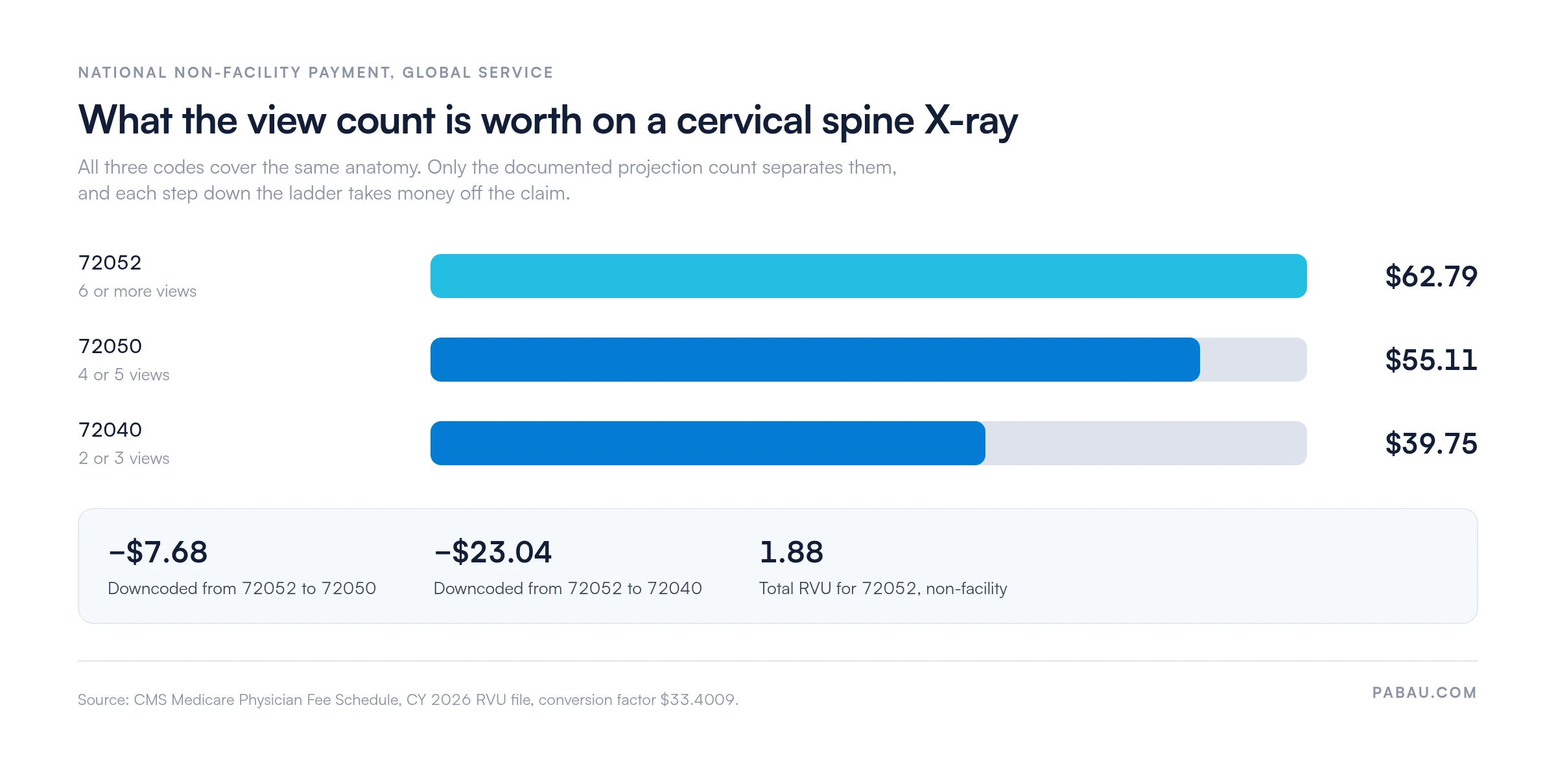
That spread is worth knowing before a practice invests in an appeal. A single downcode from 72052 to 72050 rarely justifies the staff time to fight it. The same error repeated across a month of imaging volume is a different conversation.
RVUs are the building blocks of the Medicare payment calculation. CMS multiplies each RVU component by its own geographic index, then adds the three results together. That subtotal is multiplied by the annual conversion factor, which is $33.4009 for 2026.
RVU values are adjusted every year in the MPFS final rule. Confirm the current values in the CMS relative value public use file before year-end budgeting or contract negotiations.
Pairing 72052 with a supported ICD-10-CM diagnosis code is what establishes medical necessity for payers. The diagnosis must appear in the ordering physician’s documentation and match the clinical scenario that prompted the study. The codes below are the ones named most often in published Local Coverage Determinations (LCDs) for cervical spine imaging.
Check the applicable payer’s LCD or National Coverage Determination before finalizing the pairing. LCDs vary by Medicare Administrative Contractor (MAC) region and are revised on their own schedule, separately from the MPFS cycle.
Spondylosis is the most frequently paired diagnosis of the group. M47.812 carries its own specificity rules, which matter when degenerative change and radiculopathy are both documented at the same level.
Clean claims rest on documentation that makes medical necessity self-evident to the payer’s automated adjudication system. Vague or missing documentation is the most preventable denial driver in diagnostic radiology.
Practices that check this list before submission see fewer retrospective denials. The check is cheap at the point of coding and expensive once a remittance advice comes back.

For 72052, the denial triggers that recur across payers fall into five recognizable patterns. Each one has a fix that belongs in the coding workflow rather than the appeals queue.
Tracking denial reasons by code in a reporting dashboard is faster than reading remittance advice documents one at a time. Grouping them against the standard denial codes shows which 72052 errors repeat, which tells an administrator where coder education will pay off.
In most radiology practices, the coding reference and the billing system are separate places. A coder reads the descriptor in one window, then types the code into another. No step in between confirms that the radiology report supports six views.
Practice management software like Pabau closes that loop by holding both. Pabau’s claims management software sits on the same record as the imaging order and the interpretation. The view-count check and the ICD-10 pairing then happen while the claim is being built.
The reporting layer then tracks 72052 performance by payer. An administrator can see which payers deny the code most often, and on what grounds. Coder education can then target the errors costing money rather than the ones easiest to teach.

Pabau connects clinical documentation, code validation, and claims submission in one platform. See how integrated billing workflows cut 72052 denials before claims leave the practice.

72052 is one of the few radiology codes where the whole coding decision is a number in the technique section. The useful intervention therefore sits upstream of billing. Get the radiologist to state the projection count in every cervical report, and the code assigns itself.
The money at stake per claim is modest, which is exactly why it goes unexamined. At $7.68 a downcode, no single claim is worth an appeal. Repeated across a month of imaging volume, the same reporting habit takes a visible amount off collections.
Treat the view count as a documentation standard rather than a coding question, and the denials mostly stop arriving. Book a demo to see how Pabau connects radiology documentation to claim submission in one workflow.

Coding a shorter cervical series? CPT code 72040 covers the two-to-three-view study and carries its own fee schedule and modifier rules.
Need to understand how clearinghouse submissions work? Our Claim.MD clearinghouse guide explains how 837P claims are validated and transmitted to over 4,000 US payers.
Struggling with remittance reconciliation after imaging claims? Electronic remittance advice (ERA) guide walks through how 835 files map denial codes back to specific claims.
Want a billing compliance framework for your radiology practice? Superbill documentation guide covers how to structure the billing data that flows from clinical documentation to the claim.
CPT code 72052 covers a radiologic examination of the cervical spine using six or more views. It is the highest-level cervical spine X-ray code in the CPT series. It applies when a complete multi-projection study is performed, typically including AP, lateral, odontoid, bilateral oblique, and flexion-extension projections.
CPT 72050 covers four or five cervical spine views, while 72052 requires six or more. The distinction rests entirely on the documented view count in the radiology report, not on clinical complexity or diagnosis. Billing 72052 when only four or five views were taken is an upcoding error that payers deny or recoup on audit.
The 2026 Medicare national non-facility rate for CPT 72052 is $62.79 for the global service. That figure is 1.88 total RVUs multiplied by the $33.4009 conversion factor. The professional component pays $14.36 and the technical component pays $48.43. Payment varies by locality, because CMS applies a separate geographic index to each RVU component.
Three denial reasons account for most 72052 rejections. The first is an insufficient view count in the radiology report, with fewer than six projections documented. The second is an ICD-10-CM diagnosis the payer’s Local Coverage Determination does not support for cervical spine imaging. The third is incorrect modifier use when the professional and technical components are split between a radiology group and a facility.
Commonly paired ICD-10-CM codes include M50.30 (other cervical disc degeneration), M47.812 (cervical spondylosis without myelopathy), and S13.4XXA (cervical ligament sprain, initial encounter). M54.12 (cervical radiculopathy) and M43.12 (cervical spondylolisthesis) also appear. The pairing must be supported by the applicable payer LCD. Generic diagnosis codes may not satisfy medical necessity criteria for every payer.
Six or more views must be documented in the radiology report to bill CPT code 72052. The report has to enumerate or confirm the total projection count. If only four or five views are taken, CPT 72050 applies instead. Coders should not assign 72052 from the clinical order alone, because the radiologist’s technique section is what confirms the count.