CPT Code 99418: Prolonged E/M services billing guide
What CPT code 99418 covers CPT code 99418 is the add-on code for prolonged inpat...

Last Updated: Oct 22, 2026
71552 is the CPT code for a chest MRI acquired without contrast, followed by contrast material and further sequences in the same session. The AMA descriptor names hilar and mediastinal lymphadenopathy as a typical reason for the study.
It belongs to the 71550 to 71552 chest MRI family, where contrast status decides the code. Below are the documentation, ICD-10 pairings, prior authorization rules, 2026 Medicare rate and denial fixes that keep a 71552 claim clean.
Let Pabau's smart automation suggest the right codes, reduce claim denials, and keep your practice compliant—effortlessly.
Automate repetitive tasks and focus on what matters most—your patients.
Reduce coding errors and ensure compliance with the latest regulations.
Clean claims, fewer denials, and faster reimbursements.
Powerful insights and reporting to help your practice thrive.
HIPAA compliant SOC 2 certified GDPR-compliant Trusted by 4,000+ clinics worldwide

CPT code 71552 reports a chest MRI acquired without contrast, then with contrast and further sequences, in one session.
Breast MRI is billed with 77046 to 77049, so a breast study never goes on a 71552 claim.
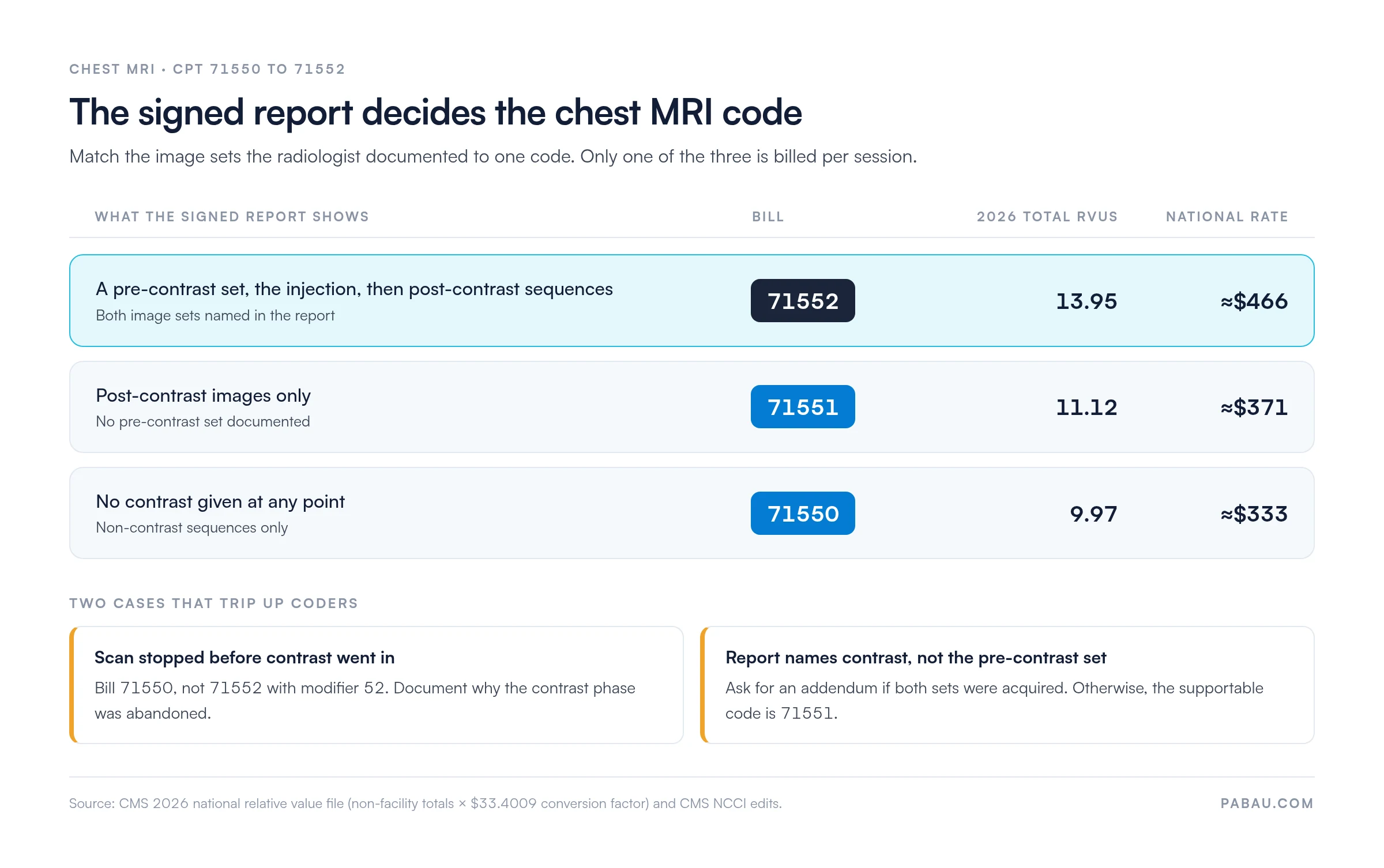
Bill 71552 alone when both sequence sets run. Never report 71550 or 71551 alongside it for the same session.
The 2026 national Medicare non-facility rate for the global 71552 is about $466, from 13.95 total RVUs.
Chest MRI has no laterality, so LT, RT and modifier 50 have no place on a 71552 claim.
CPT code 71552 reports one chest MRI session in which images are acquired without contrast, then again after contrast with further sequences. The American Medical Association (AMA) publishes the official descriptor, quoted in full in the table below. It sits in the Chest subsection of Diagnostic Radiology, which runs from 71045 to 71555.
So the code always carries two sets of images of the thorax. The first set is acquired before any gadolinium goes in. The second set follows the injection, along with any further sequences the protocol calls for.
71552 covers the whole chest: the mediastinum, the hilar regions, the pleura, the chest wall and nearby soft tissue. Radiologists choose the combined protocol when the clinical question turns on how tissue enhances.
Comparing the pre-contrast and post-contrast images shows whether a mass or node takes up gadolinium. That helps separate solid tumor from cyst, fluid or fibrosis. Orders billed under 71552 commonly document these indications:
Three nearby studies are not 71552, even though they image structures inside the chest. Breast MRI has its own codes, 77046 to 77049. Cardiac MRI uses 75557 to 75565, and magnetic resonance angiography of the chest is 71555.
All three chest MRI codes share the same region and modality. They differ only on contrast. The 2026 CMS relative value units (RVUs) climb with each step, which is why the right choice matters to payment.
Under CMS National Correct Coding Initiative (NCCI) edits, 71550 and 71551 are not reported with 71552 for the same session. 71552 already describes the combined study, so adding either one is unbundling.
The non-contrast version of this study has its own guide. CPT code 71550 covers the documentation and denial patterns when no gadolinium is used.
A payer reviewer should be able to trace every 71552 claim from the clinical question to both image sets. Most downcodes on this code start with a report that names contrast but not the pre-contrast images. A clean claim checklist catches that before submission. The chart below maps each documented image set to the one code it supports.
Every 71552 claim needs a diagnosis from the ICD-10-CM codes that matches the order and the report. Choose the most specific code the documentation supports. The table lists common pairings for chest MRI.
Use a symptom or finding code such as R59.0 or R91.8 only until a definitive diagnosis is documented. Coverage criteria vary by Medicare Administrative Contractor (MAC), so check the CMS Medicare Coverage Database before you submit.
Most commercial payers and many Medicaid managed-care plans require prior authorization for chest MRI. Build the check into insurance eligibility verification before the scan is booked.
Retro-authorization requests are often refused, so the request should leave with the order. A written prior authorization process keeps it off the scan-day to-do list. Clinical reviewers often cite the ACR Appropriateness Criteria when they assess an imaging request.
Medicare pays 71552 under the 2026 Medicare Physician Fee Schedule (MPFS). The figures below come from the CMS 2026 national relative value file, multiplied by the $33.4009 conversion factor.
These are national amounts before Geographic Practice Cost Index (GPCI) adjustment, so your local rate will differ. Qualifying APM participants use a slightly higher conversion factor of $33.5675.
In a hospital outpatient setting, the radiologist bills 71552-26 under the MPFS. The hospital’s technical payment comes through the Outpatient Prospective Payment System instead, so the global and TC amounts above don’t apply there.
CMS also flags 71552 for the diagnostic imaging multiple procedure payment reduction. When several advanced imaging studies happen in one session, later studies are paid at a reduced rate. Check your locality in the CMS Physician Fee Schedule lookup tool before you project revenue.
Modifiers tell the payer who did which part of the study, or that something changed during it. On 71552 the component split is by far the most common case.
Laterality modifiers have no role here. The chest is imaged as one region, and CMS gives 71552 a bilateral indicator of 0. LT, RT and modifier 50 don’t apply.
A provider who bills the global code should not also bill TC or 26 for the same study. That pays the same work twice and invites an audit.
If the scan stops after the pre-contrast images and no contrast is given, don’t bill 71552 with modifier 52. The completed study matches 71550, so bill that code and document why the contrast phase was abandoned.
71552 claims fail for a predictable set of reasons, and most can be fixed before submission. A structured denial management workflow stops the same error from repeating.
If your team bills breast MRI as well, keep the two code sets apart in your charge master. CPT code 77049 covers bilateral breast MRI without and with contrast.
Run these checks at the coding step, while a fix still takes minutes rather than an appeal.
Many imaging practices keep the order in one system, the safety questionnaire on paper and the invoice in another. When a payer queries a 71552 claim, staff hunt across all three for the indication and the signed forms.
Pabau, the all-in-one practice management system we build, keeps them on one patient record. MRI safety and contrast screening questionnaires go out as digital forms before the appointment. The answers land on the patient’s file, next to the appointment and the treatment notes.
Coding decisions stay with your coders. With Pabau’s medical billing software, the claim is then submitted, tracked and reconciled from that same record. When a payer asks for the order, the screening forms or the payment, they sit in one place.

Pabau holds the order, screening forms, notes and invoice on one patient record. Your team answers a payer query without searching three systems.

Treat the signed radiology report as the deciding document for 71552. If it names both image sets and the order explains why MRI beat CT, the code defends itself on review.
The costlier mistakes happen before coding starts. A breast study coded as a chest MRI, or an authorization issued for the wrong contrast code, turns into weeks of appeals. A question to the radiologist or the payer before submission costs minutes.
Pabau keeps the order, screening forms and invoice for each scan on one patient record. Book a demo to see how it fits your imaging practice’s workflow.

Billing a chest MRI with no contrast? CPT 71550 covers the non-contrast study and the denials that follow when contrast status is unclear.
Coding a breast MRI instead? CPT 77049 explains bilateral breast MRI without and with contrast, and how it differs from 77048.
Getting denials you can’t decode? Denial codes in medical billing covers the most common CARC reason codes and how to respond to each one.
Want to see how clearinghouse submission works end to end? Medical claims clearinghouse guide explains the 837P transaction flow and how claims are checked before payer adjudication.
Reconciling an imaging payment? Electronic remittance advice (ERA) explains how to read 835 files and post payment adjustments.
CPT code 71552 covers an MRI of the chest acquired without contrast, followed by contrast and further sequences, in one session. Both image sets must appear in the signed report.
No. 71552 is a chest MRI code. Breast MRI is reported with 77046 to 77049, with 77049 covering bilateral breast MRI without and with contrast.
The 2026 national non-facility rate for the global 71552 is about $466, from 13.95 total RVUs. The technical component is about $362 and the professional component about $104, before locality adjustment.
No, not for the same session. 71552 already describes the combined study, and NCCI edits treat adding 71550 or 71551 as unbundling.
No. The chest is imaged as a single region, and CMS assigns 71552 a bilateral indicator of 0. LT, RT and modifier 50 don’t apply.
Use 71555 for magnetic resonance angiography of the chest, excluding the myocardium. Cardiac MRI has its own codes, 75557 to 75565.