Pabau Engage inbox

Pabau Engage is here: every patient conversation in one inbox.

Learn more
CPT Code

CPT code 64505 – Sphenopalatine ganglion nerve block injection


Code Definition

64505 is the CPT code for injection, anesthetic agent; sphenopalatine ganglion. It covers one target only, the sphenopalatine ganglion (SPG) deep behind the nasal cavity. Practices use it most for cluster headache, trigeminal neuralgia, and post-dural puncture headache.

The code sits in the Surgery/Nervous System section (61000-64999), in the nerve-block injection subsection (64400-64530). Payment turns on three things: a covered diagnosis, a note naming the approach and agent, and prior authorization where the plan requires it. Each one is a point where 64505 claims stall, so the sections below take them in order.

Section
10004-69990 Surgery
Subsection
61000-64999 Nervous system
Code range
64400-64530 Introduction/injection of anesthetic agent (nerve block), diagnostic or therapeutic
Billable
No
Code also known as
SPG block, sphenopalatine block, pterygopalatine ganglion block, Tx360 block, SphenoCath block
Save time. Improve accuracy. Get paid faster.
Automate coding with Pabau

Let Pabau's smart automation suggest the right codes, reduce claim denials, and keep your practice compliant—effortlessly.

  • AI-powered code suggestions
  • Real-time compliance checks
  • Faster claims, fewer denials
Why practices choose Pabau
Save hours every week

Automate repetitive tasks and focus on what matters most—your patients.

Improve accuracy

Reduce coding errors and ensure compliance with the latest regulations.

Get paid faster

Clean claims, fewer denials, and faster reimbursements.

Grow with confidence

Powerful insights and reporting to help your practice thrive.

HIPAA compliant SOC 2 certified GDPR-compliant Trusted by 4,000+ clinics worldwide

Key takeaways

Key takeaways

CPT code 64505 covers anesthetic injection into the sphenopalatine ganglion, not other peripheral nerve blocks or ganglion blocks coded elsewhere.

Supported ICD-10 diagnoses include G44.009 (cluster headache), G50.0 (trigeminal neuralgia), and G97.1 (post-dural puncture headache).

Modifier 50 applies for bilateral SPG blocks, but some payers require RT/LT instead, so verify before submitting.

Imaging guidance codes 76942 and 77002 are billable only when a permanent image is stored and documented.

Pabau’s claims management software pre-fills claims from the patient record, checks required fields such as authorization codes, and submits through Claim.MD.

CPT code 64505 covers one target, the sphenopalatine ganglion

CPT code 64505 is defined by the American Medical Association as “Injection, anesthetic agent; sphenopalatine ganglion.” It describes a single, anatomy-specific nerve block that delivers local anesthetic to the sphenopalatine ganglion (SPG). Injections at other ganglia, peripheral nerves, or branches have their own codes.

The SPG is a parasympathetic ganglion in the pterygopalatine fossa, behind the middle turbinate. It connects to the trigeminal nerve, the facial nerve, and autonomic fibers. That makes it a target for pain with a craniofacial or autonomic component. The block temporarily interrupts those pain pathways without surgery.

Procedure notes document one of three approach routes:

  • Transnasal: a cotton-tipped applicator soaked in local anesthetic is passed through the nares to the posterior nasal mucosa over the ganglion
  • Intranasal catheter: a dedicated device (e.g., SphenoCath or Tx360) delivers the agent more precisely to the sphenopalatine fossa
  • Infrazygomatic (lateral): a needle approach through the infratemporal fossa, typically image-guided

Name the approach in the procedure note. Payers and auditors look for the route, the anesthetic agent and volume, and the patient’s response.

Medical necessity decides when 64505 gets paid

CPT 64505 applies when the SPG block treats a medically necessary indication backed by the patient’s documented diagnosis. Most payer policies accept these indications:

  • Cluster headache (episodic or chronic)
  • Atypical facial pain or craniofacial neuralgia
  • Trigeminal neuralgia
  • Post-dural puncture headache (spinal headache), particularly in obstetric or post-procedural settings
  • Migraine, when conservative treatment has failed and the clinical rationale is documented
  • Burning mouth syndrome (less commonly accepted, so check your MAC’s LCD)

A diagnosis code alone doesn’t establish medical necessity. The record must show which conservative treatments failed, why an SPG block was chosen, and what outcome was achieved or expected. Payers then apply their Local Coverage Determinations (LCDs) on top of the ICD-10 pairing, so both have to line up.

The ICD-10 codes payers expect with CPT 64505

The table below lists the ICD-10-CM codes most often paired with CPT code 64505. Acceptance depends on your payer’s LCD and the clinical documentation in the record.

ICD-10-CM CodeDescriptionNotes
G44.009Cluster headache syndrome, unspecified, not intractablePrimary indication. Use G44.001 for intractable.
G44.001Cluster headache syndrome, unspecified, intractableSelect when documented as intractable or refractory. Episodic and chronic types have their own G44.01- and G44.02- codes.
G50.0Trigeminal neuralgiaWell accepted. Document why an SPG block was chosen over other approaches.
G97.1Other reaction to spinal and lumbar puncturePost-dural puncture headache, widely accepted when clinically documented
G43.909Migraine, unspecified, not intractable, without status migrainosusCoverage varies by payer. Document failed conservative therapy.
G89.29Other chronic painUse only when a more specific code does not apply. Pair it with the underlying etiology.
G50.1Atypical facial painAccepted by many MACs. Check the LCD for your jurisdiction.

Always check your MAC’s Local Coverage Determination for the current list of covered diagnoses. An ICD-10 code one MAC accepts may be excluded under another MAC’s LCD.

What CPT 64505 doesn’t cover

64505 is anatomy-specific. Billing it for a block at a different nerve or ganglion is a coding error, even when the clinical intent is similar.

  • Stellate ganglion block: use CPT 64510, a separate code for injection at the cervical sympathetic ganglion
  • Other peripheral nerve blocks: use CPT 64450 when the injection targets a peripheral nerve or branch not named by a specific code
  • Celiac plexus block: CPT 64530 covers anesthetic injection at the celiac plexus, a distinct anatomical target
  • Gasserian ganglion procedures: the CPT 64600 series covers trigeminal ganglion destruction, not anesthetic injection
  • Procedures that don’t match the 64505 descriptor: use CPT 64999 (unlisted nervous system procedure) when no specific code describes the service. Submit it with a detailed cover letter

National Correct Coding Initiative (NCCI) edits restrict same-day billing of 64505 with certain evaluation and management (E/M) codes. Check the current NCCI edit tables before you submit an E/M on the same date as the block.

Neighboring codes: CPT 64505 vs 64450, 64510, and 64999

Three codes cause the most confusion alongside CPT 64505. The deciding question is always anatomy: which nerve or ganglion was injected?

CPT CodeDescriptor (abbreviated)Key differentiatorUse when…
64505Injection, anesthetic agent; sphenopalatine ganglionAnatomy-specific to SPG in pterygopalatine fossaSPG block for headache, facial pain, or post-dural puncture headache
64450Injection, anesthetic agent; other peripheral nerve or branchCatch-all for peripheral nerves without a named codeNerve block at a peripheral nerve not listed in the 64400-64530 named codes
64510Injection, anesthetic agent; stellate ganglion (cervical sympathetic)Cervical sympathetic chain, not pterygopalatine fossaStellate ganglion block for hot flashes, PTSD-related sympathetic activation, or cardiac arrhythmia
64999Unlisted procedure, nervous systemNo specific CPT code exists for the procedure performedNovel or off-label nerve block approaches that don’t match any named descriptor

Bilateral blocks change how you report 64505

CPT code 64505 is a unilateral procedure by default. When the block is done on both sides in one session, or another circumstance changes the service, add the matching modifier.

ModifierWhen to usePayer notes
50Bilateral SPG block performed in the same sessionMost MACs accept modifier 50 on a single line; some prefer two lines with RT/LT. Verify your payer’s preference before submitting.
RT / LTRight side or left side only when bilateral is performed as separate line itemsSome commercial payers prefer RT on one line, LT on a second line rather than modifier 50
76Repeat procedure by the same physician in the same settingDocument clinical necessity for repeating the procedure; payers may request records
52Reduced services, procedure partially completedRarely needed for SPG block but applies if the procedure was discontinued after start

Medicare typically pays 150% of the unilateral rate for a bilateral block, 100% for the first side and 50% for the second. Commercial rates vary, so confirm with each payer before assuming bilateral doubles the fee.

Imaging guidance is billable only with a stored image

Imaging guidance is the most common companion code when 64505 is done under fluoroscopy or ultrasound. It has to be documented separately to be paid separately.

  • CPT 76942 (ultrasound guidance for needle placement, radiological supervision and interpretation): bill it when real-time ultrasound was used. A permanent image must also be recorded and stored. Check current NCCI edits for the 64505 + 76942 pairing before submitting.
  • CPT 77002 (fluoroscopic guidance for needle placement): bill it when fluoroscopy guided the infrazygomatic approach. Record the image, and document the guidance separately from the procedure note.
  • E/M codes (99202-99215): NCCI bundling limits same-day E/M billing with 64505 unless a separately identifiable service was provided. In that case, append modifier 25 to the E/M code, not to 64505.

Never bill a guidance code unless the image was acquired, stored, and documented. An attestation that guidance was used, with no stored image behind it, creates audit exposure.

Pro Tip

Check CPT 76942 + 64505 against the current NCCI edit table before submitting. Bundling edits on imaging guidance codes change with each annual update. An edit that did not exist last year may now block separate payment. Run this check when you update your code reference materials each January.

Medicare coverage for 64505 depends on your MAC

Medicare has no national coverage determination specifically for sphenopalatine ganglion blocks. MAC-level LCDs govern coverage instead, so whether you get paid depends on which MAC covers your jurisdiction.

  • Some MACs cover 64505 for cluster headache and post-dural puncture headache, with documented medical necessity and failed conservative treatment.
  • Other MACs maintain non-coverage policies for SPG blocks, or limit coverage to specific indications. Check your MAC’s published LCD before scheduling the procedure for a Medicare patient.
  • Frequency limits vary by payer. Many commercial insurers cap SPG blocks at a set number per rolling 12-month period (commonly 2-4 per side). Going past the cap triggers an automatic denial, whatever the medical necessity.
  • Commercial payers with active coverage policies typically want proof of failed conservative therapy first. That means oral medications, physical therapy, or nerve pain management.

For 64505, medical billing compliance comes down to two checks before the procedure date. Review the LCD for every Medicare patient, and the prior authorization rules for every commercial plan.

Prior authorization for 64505 takes five steps

Many commercial payers require prior authorization (PA) for CPT 64505. Medicare doesn’t require PA as a national rule, but some Medicare Advantage plans do. Assuming a non-Medicare patient needs no authorization is a common and costly mistake.

A standard PA workflow for 64505 runs like this:

  1. Confirm the requirement: run insurance eligibility verification for the patient’s plan, and check whether it requires PA for 64505.
  2. Gather clinical documentation: diagnosis codes, failed conservative treatment history (medication trials, dates, outcomes), the physician’s attestation of medical necessity, and the planned approach.
  3. Submit the request: use the payer’s portal or fax the clinical package. Some payers accept clinical decision support tools, while others require a physician-to-physician peer review.
  4. Record the authorization number: save it in the patient record and attach it to the claim. A claim sent without it is denied on the first pass.
  5. Handle urgent cases: for an urgent SPG block, such as an acute cluster headache series, call the payer’s urgent PA line. Document the urgency, get verbal authorization, and file the written confirmation.

How Medicare sets the 64505 payment rate

Medicare pays CPT code 64505 through the Medicare Physician Fee Schedule (MPFS), which assigns work, practice expense, and malpractice RVUs to the code. Geographic adjustments (GPCIs) then shift the amount by locality.

Figures change every year. Use the FastRVU lookup tool or the CMS Physician Fee Schedule search to find the current rate for your ZIP code.

Payment factorWhat it means for 64505
Setting (facility vs non-facility)Non-facility (office) rates are higher because practice expense RVUs are not shifted to the facility. Document the setting accurately. Billing a facility rate for an in-office procedure can cut reimbursement significantly.
Geographic GPCI adjustmentMedicare applies a locality-based multiplier to each RVU component. High-cost areas (New York, San Francisco) pay more than rural areas for the same code.
Bilateral adjustmentMedicare pays 150% of the unilateral rate for bilateral procedures billed with modifier 50: 100% for the primary side, 50% for the second side.
Commercial payer ratesNegotiated rates vary widely. Some commercial payers reimburse at 110-150% of Medicare; others use a separate fee schedule. Review your payer contracts to know your contracted rate for 64505.

What the 64505 procedure note must show

In an audit, the procedure note is the claim’s main defense. A generic note, such as “SPG block performed, patient tolerated well,” won’t survive a medical necessity review.

Every element below belongs in the record:

  • Diagnosis and clinical rationale: the condition being treated, why an SPG block was chosen, and which conservative treatments were tried and failed
  • Approach route: transnasal, intranasal catheter, or infrazygomatic, stated explicitly rather than implied
  • Anesthetic agent and volume: the agent (e.g., 4% lidocaine, 0.5% bupivacaine), its concentration, and the volume delivered
  • Laterality: right, left, or bilateral, which decides the modifier
  • Imaging guidance (if billed separately): ultrasound or fluoroscopy, confirmation that real-time imaging was performed, and proof that a permanent image was stored
  • Patient response: the response immediately after the procedure, and any adverse reactions observed
  • Physician attestation: the treating physician signs the note. Mid-level documentation without a supervising physician’s attestation may fail payer requirements

Structured procedure note templates capture these elements the same way every time. A clean claim starts with a complete note, before the coding team ever touches the encounter.

How a 64505 claim moves from note to payment

Each stage of a 64505 claim depends on the one before it. A missing PA number at the front desk turns into a denial weeks later, when it’s much harder to fix.

The path below shows what each stage needs and where it usually breaks.
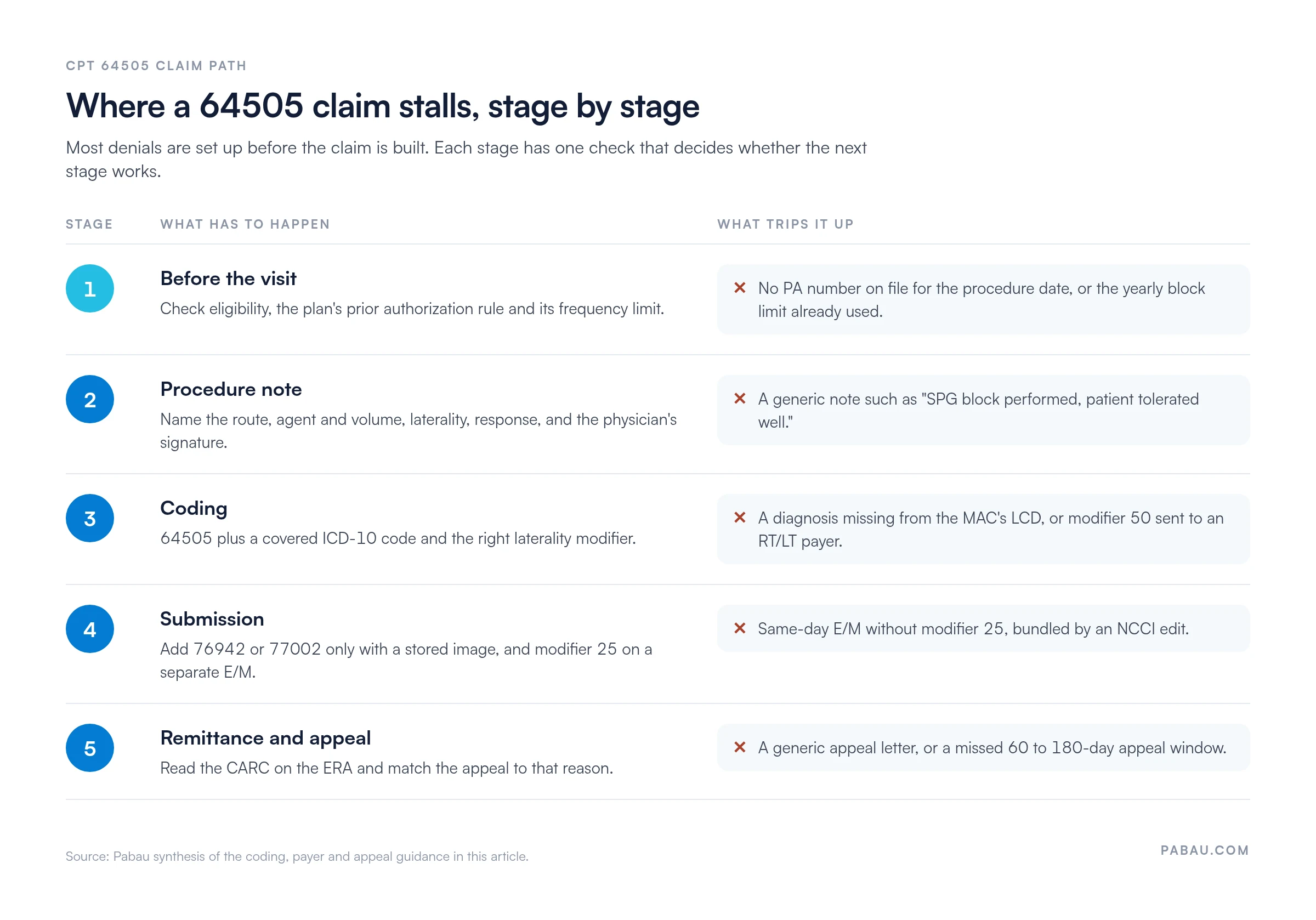
Five-stage CPT 64505 claim path
Several 64505 failures, from a missing PA number to a vague note, start before a code is ever chosen. The stages follow the payer and coding guidance in this article.

So check the front of the path hardest. A coding error can be corrected and resubmitted, while a missed authorization is far harder to recover after the procedure date.

Seven reasons 64505 claims come back denied

64505 denials cluster around a small number of fixable problems. Spot the pattern hitting your practice, and you can fix the root cause instead of appealing claim by claim.

  • Unsupported or missing ICD-10 code: the diagnosis isn’t on the payer’s covered list, or a vague code stood in for a more precise one
  • Medical necessity not documented: the record shows the diagnosis but not the clinical rationale, the failed treatment history, or why the SPG block was selected
  • Modifier error: a bilateral procedure sent without modifier 50, or modifier 50 sent to a payer that requires RT/LT
  • Bundling with E/M: a same-day E/M sent without modifier 25, triggering an NCCI edit that bundles it with the procedure
  • Frequency limit exceeded: the patient received more SPG blocks than the payer allows in the coverage period
  • Prior authorization not obtained: the claim is denied outright because no PA number is on file for the procedure date
  • Imaging guidance billed without support: CPT 76942 or 77002 was submitted, but the record doesn’t describe real-time imaging or a stored image

Strong denial management workflows track denial reason codes by payer and CPT code. That makes it easy to spot when 64505 denials spike after an LCD update or a policy change.

Pro Tip

Track CPT 64505 denials by CARC code in a simple spreadsheet or your practice management system. Watch for one denial reason, such as CO-50 for medical necessity, on three or more 64505 claims from one payer within 30 days. That pattern signals the payer has updated its LCD or internal policy. Pull the updated LCD, compare it to your documentation template, and update the template before the next batch.

Your 64505 checklist before you submit

Run these checks on every 64505 claim before it leaves the practice:

  • The PA number is on file and matches the procedure date
  • The patient hasn’t reached the payer’s frequency limit for the period
  • The ICD-10 code appears on your MAC’s LCD or the payer’s covered list
  • The note names the route, agent, volume, laterality, and response, and carries the physician’s signature
  • The laterality modifier matches the format the payer wants, 50 or RT/LT
  • Any 76942 or 77002 line has a stored image behind it
  • Any same-day E/M is separately documented and carries modifier 25

How to appeal a denied CPT 64505 claim

Appeals succeed when they answer the specific denial reason with targeted evidence. A generic “we disagree with this denial” letter almost never works.

  1. Identify the denial reason code: the Claim Adjustment Reason Code (CARC) on the electronic remittance advice (ERA) tells you why the claim was denied. It points to medical necessity, bundling, frequency, or authorization.
  2. Gather supporting clinical evidence: pull the procedure note, the failed treatment history, and the treating physician’s attestation. Add peer-reviewed literature on SPG block for the diagnosis.
  3. Draft a medical necessity letter: the physician connects the patient’s diagnosis to the evidence for SPG block. The letter explains how the service met the payer’s criteria.
  4. Submit within payer timelines: most payers allow 60-180 days from the denial date. Missing the window forfeits the appeal right.
  5. Escalate if needed: if the first appeal fails, request a peer-to-peer review between the treating physician and the payer’s medical director. This step resolves many medical necessity denials that survive the paper appeal.

How claims management software keeps 64505 claims complete

Pain management and neurology practices billing CPT code 64505 juggle a layered workflow. They verify eligibility, confirm PA, document the procedure, code it with the right ICD-10 code and modifier, then submit. A break at any step creates a denial.

Pabau, the practice management platform we build, pre-fills each claim from the patient record. Its medical billing software includes CPT and ICD-10 lookup libraries, and it checks that required fields are complete before submission.

Through the Claim.MD clearinghouse, it also runs real-time eligibility checks and posts 835 electronic remittance advice files.
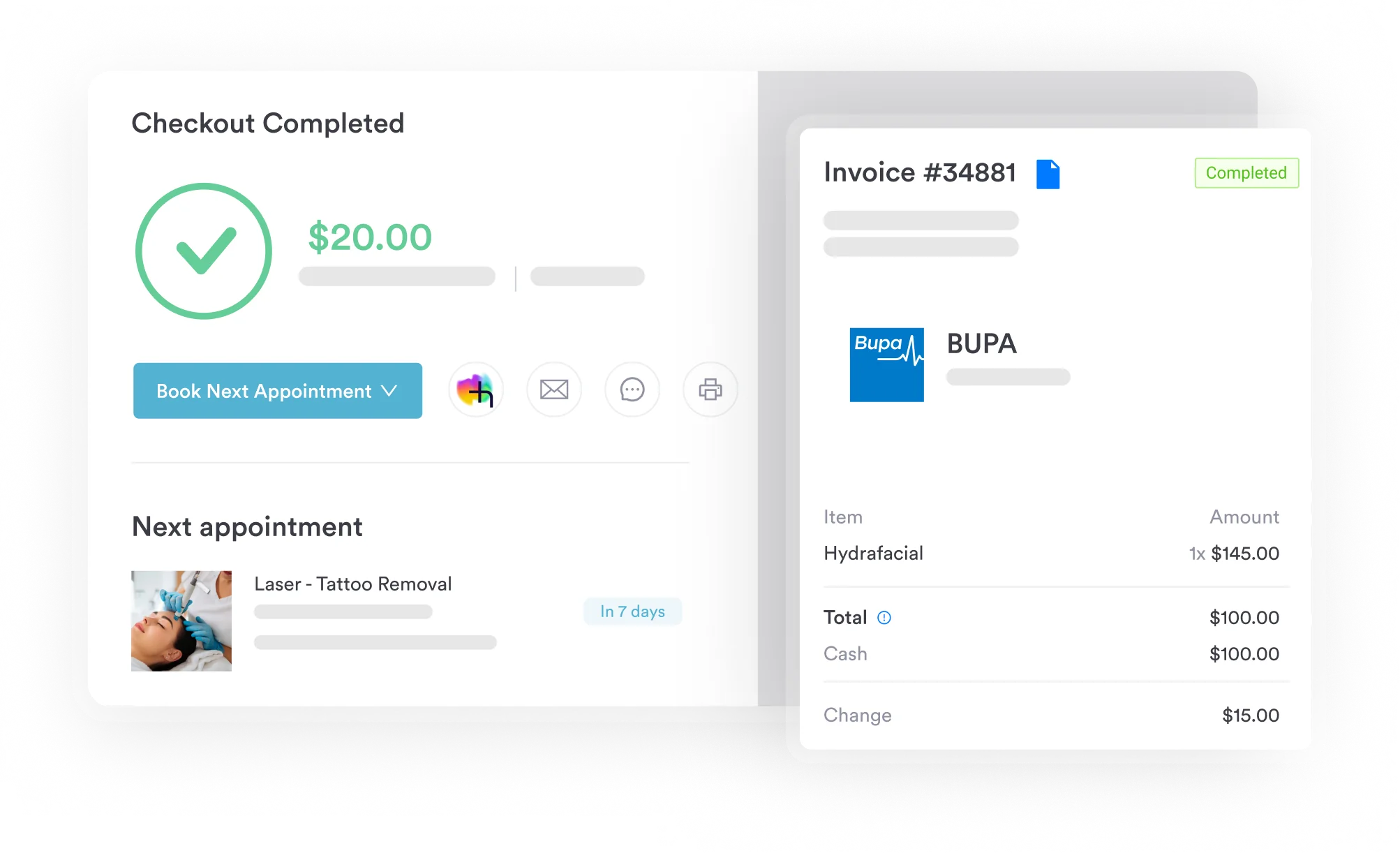
Automate claims and billing with Pabau
Pabau builds the claim from the patient record, so a 64505 charge goes out with its authorization code and required fields already filled in.

For a small pain practice running 64505 alongside other nerve block codes, that cuts the manual chasing. Staff stop re-typing claim details, and a claim missing its authorization code is held back before it reaches the payer.

Simplify pain management billing with Pabau

Pabau’s built-in claims management pre-fills claims from the record and checks required claim fields. It connects to the Claim.MD clearinghouse so 64505 claims reach the payer complete.

Pabau practice management software billing dashboard

Conclusion

CPT code 64505 is straightforward when the procedure note, diagnosis, and modifier line up. Structured templates fix the note, and pre-claim required-field checks keep incomplete claims from going out. The diagnosis still needs a coder’s check against the LCD.

So start at the front of the claim path. Confirm authorization and frequency limits before the patient is booked, and treat the note as the claim’s evidence. The trade-off is a few extra minutes per patient, set against weeks of appeals.

Pabau checks required claim fields before submission and connects to Claim.MD for eligibility and electronic remittance. It also tracks claim status in the same system where notes are written. Book a demo to see how it handles 64505 claims in a pain management or neurology practice.

Continue your research

Continue your research

Need to understand how clearinghouse submissions work end to end? Medical claims clearinghouse guide explains the 837P transaction flow and how payers receive electronic claims.

Dealing with repeated claim adjustments and ERA reconciliation? Electronic remittance advice (ERA) explained covers how 835 files work and how to reconcile payments against submitted claims.

Want to reduce the administrative load on credentialing before billing 64505? How to get credentialed with insurance companies walks through the enrollment process required before payers will reimburse nerve block procedures.

Need a repeatable way to get blocks approved? The prior authorization process breaks down each step from request to approval, and what to keep on file.

Billing a trigeminal nerve block instead of an SPG block? CPT code 64400 covers trigeminal nerve injections, with their own modifiers and documentation rules.

Frequently asked questions

What is CPT code 64505?

CPT code 64505 reports an anesthetic injection into the sphenopalatine ganglion, a nerve cluster in the pterygopalatine fossa. It’s used mainly for cluster headache, trigeminal neuralgia, and post-dural puncture headache.

Does Medicare cover CPT code 64505?

Coverage is set by each MAC’s Local Coverage Determination, not by a national policy. Some MACs cover SPG blocks for cluster headache and post-dural puncture headache, while others limit or exclude them. Check your MAC’s LCD before scheduling a Medicare patient.

Is the local anesthetic billed separately with 64505?

Under Medicare, no. The local anesthetic counts as a supply within the procedure’s practice expense, so it doesn’t get its own drug line. Commercial contracts can differ, so check yours.

What is the global period for CPT 64505?

64505 has a 0-day global period in the Medicare fee schedule, so no follow-up days are bundled in. A same-day E/M still needs modifier 25 and separate documentation.

Does one prior authorization cover a series of SPG blocks?

It depends on the payer’s authorization terms. Check how many blocks and which dates the approval covers. Then request a new authorization before you exceed either.

What modifiers are used with CPT code 64505?

Use modifier 50 or RT/LT for a bilateral block, depending on the payer, and modifier 76 for a repeat procedure by the same physician. Modifier 25 goes on a same-day E/M, not on 64505.
Avatar photo
Monika Lazarevska
Content Writer

Monika Lazarevska writes content for owners and healthcare professionals who want clear, no-fluff content that actually helps them run their practice better. With a background in storytelling and SEO, she knows how to make even the driest topics worth reading. Off the clock, you'll find her in a café somewhere in Europe, probably with a good book and an even better coffee.
×