CCSD code M5630: Therapeutic injection into bladder neck
CCSD code M5630: Definition and clinical description CCSD code M5630 covers ther...

Last Updated: Nov 23, 2026
61626 is the CPT code for transcatheter permanent occlusion or embolization of a head or neck vessel outside the central nervous system. Typical uses are stopping epistaxis or traumatic bleeding, devascularizing an extracranial tumor before surgery, and closing an extracranial vascular malformation. Since CPT 2026, the code also includes radiological supervision and interpretation, roadmapping and imaging guidance.
Its sibling code 61624 covers the same procedure for intracranial and spinal cord targets. The territory of the target decides between the two, not the vessel the catheter travels through.
Let Pabau's smart automation suggest the right codes, reduce claim denials, and keep your practice compliant—effortlessly.
Automate repetitive tasks and focus on what matters most—your patients.
Reduce coding errors and ensure compliance with the latest regulations.
Clean claims, fewer denials, and faster reimbursements.
Powerful insights and reporting to help your practice thrive.
HIPAA compliant SOC 2 certified GDPR-compliant Trusted by 4,000+ clinics worldwide

CPT code 61626 reports permanent transcatheter embolization of a head or neck vessel outside the central nervous system, such as an external carotid branch.
CPT code 61624 covers the same procedure for intracranial and spinal cord targets, so the territory of the target decides between the two codes.
Since CPT 2026, 61626 includes radiological supervision and interpretation, roadmapping and imaging guidance, so 75894 and 75898 are not added to it.
Typical 61626 cases are refractory epistaxis, juvenile nasopharyngeal angiofibroma, carotid body tumors, neck trauma and extracranial vascular malformations.
Pabau’s billing tools send US claims through Claim.MD and warn staff when a case is missing its prior authorization code.
CPT code 61626 reports transcatheter permanent occlusion or embolization of a head or neck vessel that lies outside the central nervous system. For CPT 2026, the AMA revised the code to include the imaging work, as the Society of Interventional Radiology’s 2026 coding update confirms.
The physician reaches an extracranial or brachiocephalic-branch target percutaneously and blocks it with coils, particles or a liquid embolic agent. The CPT 2026 long descriptor for 61626 reads:
Transcatheter permanent occlusion or embolization (eg, for tumor destruction, to achieve hemostasis, to occlude a vascular malformation), including all radiological supervision and interpretation, intraprocedural roadmapping, and imaging guidance necessary to complete the intervention, percutaneous, any method; non-central nervous system, head or neck (extracranial, brachiocephalic branch)
The examples in the descriptor set the scope: tumor destruction, hemostasis, and occlusion of a vascular malformation. In practice that means a bleeding internal maxillary artery, the feeders of a juvenile nasopharyngeal angiofibroma, or a carotid body tumor before resection. The descriptor says “any method”, so coils, particles, gelatin sponge and liquid agents all report the same code.
Code 61626 describes the embolization of a target, not each injection or catheter repositioning. When the physician treats separate territories in one session, check the CMS Medically Unlikely Edit for 61626 before reporting a second unit. Document each territory, the vessel treated and the reason for treating it, so a second unit holds up on review.
Report 61626 when the target lies in the head or neck outside the central nervous system. Report 61624 when it is intracranial or in the spinal cord.
The route the catheter takes does not change the answer. A dural arteriovenous fistula embolized through the middle meningeal artery is still an intracranial target, so it is a 61624 case. The guide to CPT code 61624 covers the CNS side in detail.
An operative note that names both an intracranial and an extracranial target needs a closer look before coding. Query the physician about each target, then check the current NCCI edit for the 61624 and 61626 pair. The diagram below runs that territory question first, then the 2026 check on every other line of the claim.
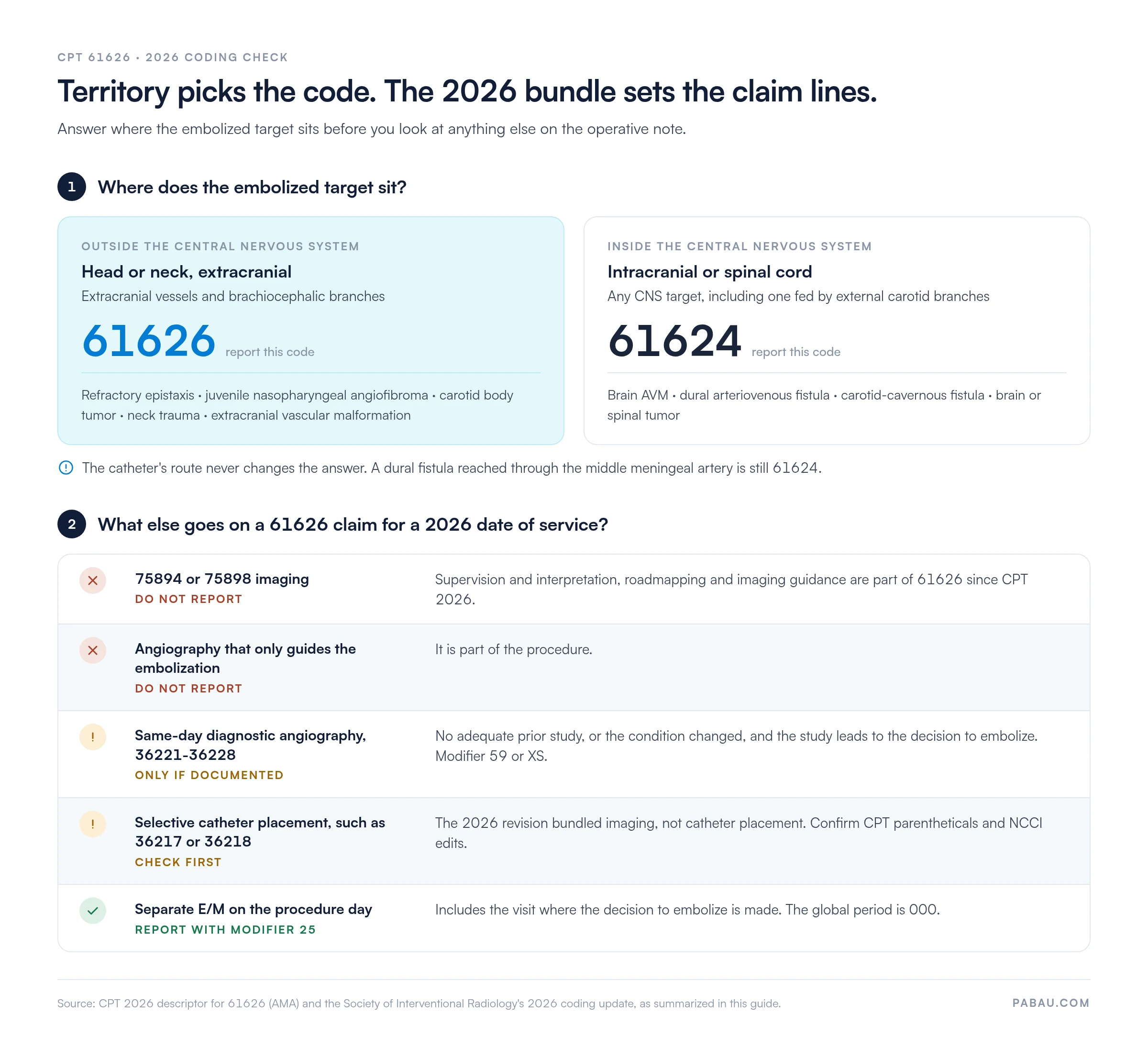
CPT code 61626 is used when embolization stops bleeding, devascularizes a tumor, or closes a malformation in the extracranial head or neck. The table pairs each common indication with an ICD-10-CM example checked against the current code set.
Brain AVMs, dural arteriovenous fistulas, carotid-cavernous fistulas and brain tumors do not belong here. Their targets sit inside the CNS, so they take 61624 and diagnosis codes from the cerebral ranges.
The 2026 revision changed which imaging codes travel with 61626. Catheter placement and diagnostic angiography follow their own rules, so check each line before the claim goes out.
Radiological supervision and interpretation, intraprocedural roadmapping and imaging guidance are now part of 61626. Do not add 75894 or 75898 for the same procedure, and remove that pairing from charge templates built before 2026. CPT Assistant advice that allowed the pairing predates the revision.
The 2026 revision bundled imaging, not catheter placement. Selective catheterization has historically been reported alongside 61626 with codes such as 36217 and 36218. When a same-session diagnostic external carotid study is coded with 36227, that code already includes every selection in the external carotid family. Confirm the current CPT parenthetical notes and NCCI edits before you add a catheter code.
Angiography performed only to guide the embolization is part of the procedure and is not billed. A same-day diagnostic study is separately reportable only when the record shows both of these conditions:
Append modifier 59 or XS to the angiography code only when the record shows that decision. Check the current NCCI procedure-to-procedure edit for the exact code pair before submission.
The operative report has to show the coder where the target sits and what was done to it. Check that each of these elements is present before the claim is built.
A note that says only “branches of the ECA were embolized” leaves the coder guessing about territory and catheter codes. Ask for a physician addendum before billing rather than appealing a denial later. A clean claim submission starts with an operative report that names the target.
The diagnosis on a 61626 claim must describe the condition that justified the embolization, not the procedure. Each code below was checked against the ICD-10-CM code set. Confirm the full code, side and encounter character for your case. For angiofibroma cases, the D10.6 guide explains how that nasopharyngeal neoplasm code is assigned.
Confirm each code in the CDC/NCHS ICD-10-CM browser tool for the fiscal year of service. Codes such as Q28.2, Q28.3 and I67.1 describe cerebral vessels. On a 61626 claim they point to a code-selection problem, not a pairing.
Medicare pays 61626 through the Physician Fee Schedule, and the rate depends on the year and your locality. Look up current work, practice expense and malpractice RVUs in the CMS Physician Fee Schedule Look-Up Tool before you quote a figure. FastRVU’s 2026 RVU lookup shows the same components with geographic adjustment applied.
The global period is 000, so only same-day postoperative work is bundled. A separately identifiable E/M service on the day of the procedure takes modifier 25, including the visit where the decision to embolize is made. Most cases take place in a hospital, so the facility rate applies to the physician claim.
Because the imaging now sits inside 61626, a 2026 case no longer carries a separate 75894 payment. Compare 2026 remittances with 2025 cases on that basis before you decide a payer underpaid.
Whether you need prior authorization depends on the plan and on whether the case is elective. Preoperative tumor embolization is scheduled in advance, and many commercial and Medicare Advantage plans review it before the date. Emergency embolization for active epistaxis or trauma bleeding usually cannot wait, so the plan’s emergency or retrospective review rules apply instead.
For an elective case, a typical authorization packet includes these items:
Policies change between contract cycles, so confirm the rule with each plan before an elective case. This medical claims clearinghouse guide covers how the claim side of that workflow runs.
Most 61626 denials fall into six categories, and each has its own fix.
Systematic denial management workflows catch these patterns before they repeat across a payer. The list of denial codes in medical billing explains the remittance codes that come back with each one.
Each month, pull the 61626 claims denied in the last 90 days and sort them by claim adjustment reason code. CARC 11 means the diagnosis does not fit the procedure, which often signals a 61624 case coded as 61626. CARC 97 flags a bundled line, usually a leftover 75894. CARC 197 means the authorization was absent.
Most 61626 errors start between the angiography suite and the billing desk. A coder reads the operative note days later and decides the territory, the imaging line and the authorization from what the note happens to say.
In Pabau’s practice software, the case record holds the authorization code, its dates and its sessions, and it warns staff when one is missing. Charges and diagnoses sit on the same record, and US claims go out as 837P files through the Claim.MD clearinghouse.
Eligibility checks and ERA remittances come back to the same place. Because Pabau’s claims software for specialists sits on the clinical record, a denied 61626 line leads straight back to the note behind it.

Pabau tracks prior authorizations on the case, sends US claims through Claim.MD and posts ERA remittances back to the same record. Your coders see the note, the charge and the payer’s answer in one place.

Code 61626 is the right choice only when the target sits in the head or neck outside the CNS. Settle that territory question from the operative note first, because it decides between 61626 and 61624 and drives the diagnosis code.
Then retire the pre-2026 habits. The 75894 line no longer belongs on these claims, and a same-day diagnostic angiogram has to earn its place in the record. Practices that update their charge templates now avoid a year of bundling denials.
To see how Pabau keeps embolization charges, authorizations and remittances in one record, book a demo.

Coding a CNS target instead? CPT code 61624 covers intracranial and spinal cord embolization under the same 2026 imaging bundle.
Cleaning up old embolization charge templates? CPT code 75894 explains which embolization codes now absorb the imaging line.
Need a clearinghouse for US procedure claims? Claim.MD clearinghouse guide explains how claims, eligibility checks and remittances run through the integration.
Confused by what a clean claim requires? Clean claim submission standards breaks down the data elements payers check before adjudicating a procedure code.
Looking for the full list of medical billing denial codes? Denial codes in medical billing maps CARC and RARC codes to the documentation or authorization problem behind each denial.
CPT code 61626 covers transcatheter permanent occlusion or embolization of a head or neck vessel outside the central nervous system. Typical targets are a bleeding internal maxillary artery, a juvenile nasopharyngeal angiofibroma, a carotid body tumor or an extracranial vascular malformation. Since CPT 2026, the code also includes radiological supervision and interpretation, roadmapping and imaging guidance.
The territory of the target decides. Code 61626 covers non-CNS targets in the head or neck, meaning extracranial vessels and brachiocephalic branches. Code 61624 covers intracranial and spinal cord targets, including those reached through external carotid feeders. A brain AVM, dural arteriovenous fistula or carotid-cavernous fistula is therefore a 61624 case.
No, not for dates of service from 2026 onward. The CPT 2026 revision added radiological supervision and interpretation, intraprocedural roadmapping and imaging guidance to 61626. Codes 75894 and 75898 are not reported with it for the same procedure.
Only when the diagnostic study meets the CPT and NCCI conditions for separate reporting. Angiography done only to guide the embolization is included. A same-day study counts separately when no adequate prior study exists or the condition has changed, and the study leads to the decision to treat. Check the current NCCI edit and use modifier 59 or XS where it applies.
It depends on the plan and on urgency. Elective preoperative tumor embolization often needs prior authorization from commercial and Medicare Advantage plans. Emergency embolization for active bleeding falls under the plan’s emergency or retrospective review rules. Confirm the requirement with each payer before an elective case.
Use a diagnosis that matches the extracranial target. Common examples are R04.0 for epistaxis, D10.6 for juvenile nasopharyngeal angiofibroma and D35.5 for a carotid body tumor. Q27.39 fits an extracranial arteriovenous malformation, and I77.0 an acquired fistula. Cerebral diagnoses such as Q28.2 point to 61624 instead.
CPT 61626 has a 000-day global period. Only same-day postoperative work is bundled into the code. A separately identifiable E/M service on the day of the procedure takes modifier 25.