

HCPCS Code Q4175: Billing, coverage, and documentation guide
HCPCS code Q4175: Code description and product identity HCPCS Code Q4175 is the ...

Last Updated: Nov 20, 2026
52442 is the CPT code for cystourethroscopy, with insertion of permanent adjustable transprostatic implant; each additional permanent adjustable transprostatic implant. It is the add-on code for the prostatic urethral lift (UroLift), billed only with 52441, which covers the first implant.
Report one unit of 52442 for each implant after the first, so a four-implant session bills 52441 once and 52442 three times. For 2026, Medicare values it at 0.98 work RVUs with a ZZZ global period.
Let Pabau's smart automation suggest the right codes, reduce claim denials, and keep your practice compliant—effortlessly.
Automate repetitive tasks and focus on what matters most—your patients.
Reduce coding errors and ensure compliance with the latest regulations.
Clean claims, fewer denials, and faster reimbursements.
Powerful insights and reporting to help your practice thrive.
HIPAA compliant SOC 2 certified GDPR-compliant Trusted by 4,000+ clinics worldwide

CPT code 52442 is an add-on code for each additional transprostatic implant in a prostatic urethral lift, billed after 52441 covers the first implant.
Report one unit of 52442 per extra implant, and never append modifier 51, because add-on codes are exempt from it.
N40.1, benign prostatic hyperplasia with lower urinary tract symptoms, is the standard diagnosis pairing for UroLift claims.
In 2026, Medicare values 52442 at 0.98 work RVUs, and the office rate runs about 20 times the facility rate because of practice expense.
Pabau, a practice management platform, submits claims through Claim.MD and records prior authorization codes and dates on the patient’s case.
CPT code 52442 reports each additional permanent adjustable transprostatic implant placed during a cystourethroscopy, after the first implant. CMS’s 2026 relative value file lists 52442 with a ZZZ global period, which marks a service always billed with a primary procedure. It is an add-on (+) code in the vesical neck and prostate range of the urinary system section, so it never stands alone on a claim.
The procedure is the prostatic urethral lift (UroLift), an FDA-cleared system made by NeoTract, part of Teleflex. A urologist places small implants through a cystoscope to hold obstructing prostate tissue away from the urethra. No tissue is removed and no heat is used. Most patients need more than one implant per session. That is why the work is split across 52441 for the first implant and 52442 for each one after it.
52441 is the primary code for the first implant placed. 52442 is reported once for each additional implant placed in the same session. A patient receiving four implants generates one unit of 52441 and three units of 52442 on the claim.
Because 52442 is an add-on code, two rules apply automatically under AMA CPT convention. First, modifier 51 (multiple procedures) must never be appended to 52442. Add-on codes are modifier 51 exempt because their value already reflects the smaller extra effort of each additional implant. Second, 52442 cannot appear on a claim without 52441 on the same date of service.
The diagnosis code paired with 52442 must match the documented clinical indication and show medical necessity. N40.1 (benign prostatic hyperplasia with lower urinary tract symptoms) is the standard pairing for most UroLift claims. The procedure is indicated when lower urinary tract symptoms (LUTS) are present and conservative management has failed.
Using N40.0 when N40.1 is clinically accurate is a frequent documentation error. Some payers limit UroLift coverage to N40.1 specifically. Mixing up the two codes can then trigger a coverage denial, even when the procedure was medically appropriate. Confirm which diagnosis codes each payer’s medical policy accepts before submitting.
Run a diagnosis code audit on your 52442 claims every quarter. Pull each denial with CARC 11 (diagnosis inconsistent with the procedure) or CARC 50 (not deemed medically necessary). Check whether N40.0 went out where the chart documents symptoms that support N40.1. Correct the code only where the record backs it, then resubmit.
Medicare covers CPT code 52442 when the record shows the prostatic urethral lift is medically necessary. There is no national coverage determination for the procedure, and NGS retired its UroLift LCD, L36601, in February 2018. Your Medicare Administrative Contractor (MAC) therefore applies its own medical-necessity review, and commercial payers apply their own policies.
Those reviews usually look for the same clinical picture, with thresholds that differ by payer:
Blue Cross Blue Shield plans, Aetna and Cigna each keep their own medical policies for the prostatic urethral lift. Most ask for similar documentation, but prostate volume limits and the required length of medical therapy differ by plan. Never assume every commercial payer covers the procedure. Check each payer’s current medical policy before the procedure date.
Most commercial payers and many Medicare Advantage plans require prior authorization (PA) for CPT 52442. Traditional Medicare fee-for-service does not require PA for this code. PA rules change often, so confirm them with each payer before you schedule the procedure. For the steps from request to decision, see this walkthrough of the prior authorization process.
Include the following documentation with a PA request to give it the best chance of approval on the first submission:
Missing any one of these elements is a common reason PA requests come back incomplete rather than approved. Build a PA checklist into your intake workflow so clinical staff capture every data point at the consultation visit.
Medicare pays CPT code 52442 through the Medicare Physician Fee Schedule, which updates its values every January. The 2026 national figures below come from the CMS relative value file, at the $33.4009 conversion factor. Payment varies by locality, so check the CMS Physician Fee Schedule lookup tool for your area.
The 2026 work RVU of 0.98 is down from 1.01 in 2025. For a component view of the same code, the FastRVU 2026 RVU lookup shows each RVU alongside a national payment estimate.
The site of service decides which rate the urologist is paid. In a hospital outpatient department or ambulatory surgery center (ASC), the physician bills the facility rate and the facility bills its own fee. In the office, the physician bills the non-facility rate, and its practice expense RVU covers staff, equipment and supplies.
For 52442, practice expense is where nearly all of the difference sits, as the chart below shows.
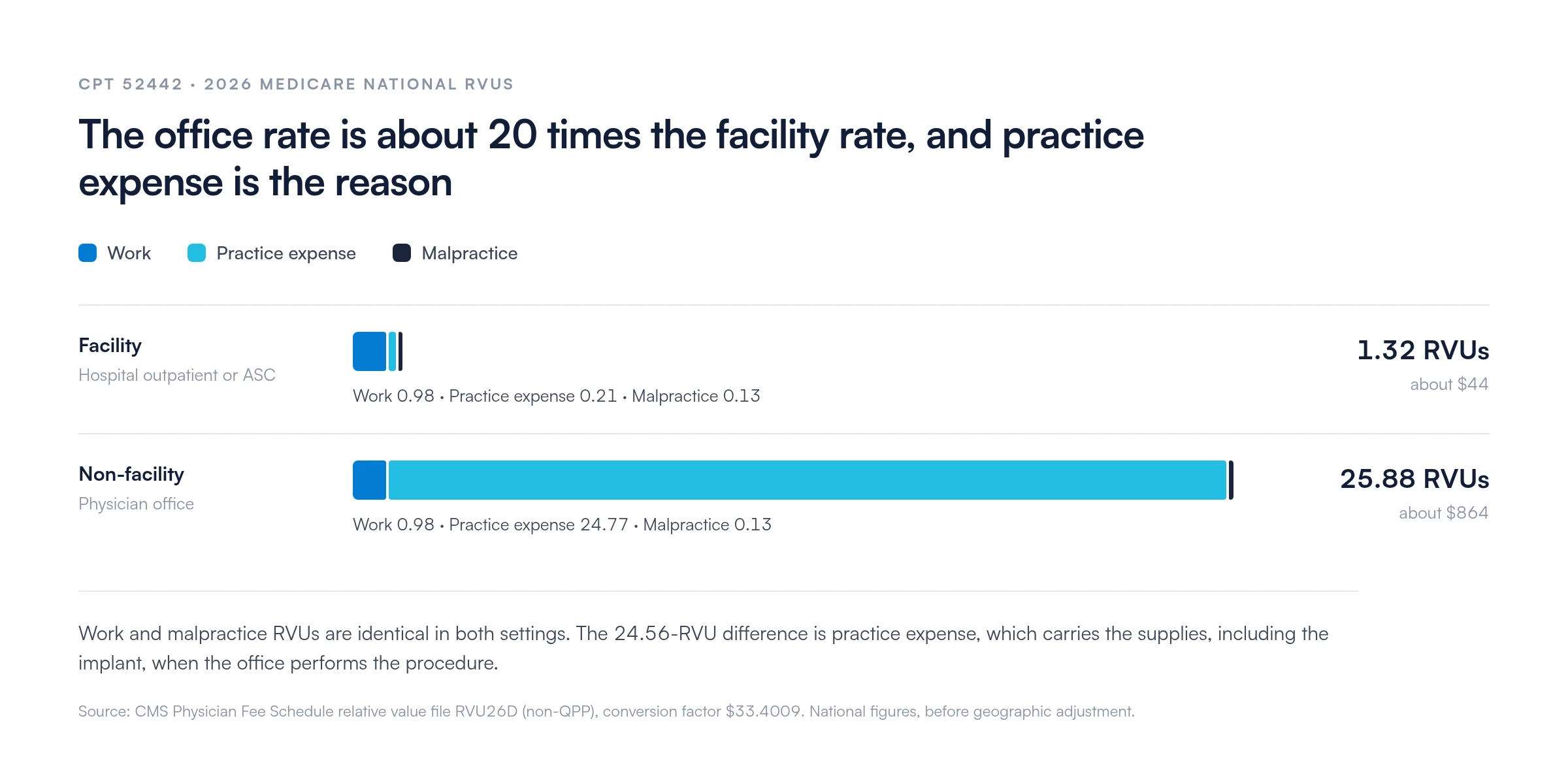
The office rate looks generous, but the practice buys the implants that the rate pays back. In a facility, the facility carries that cost and recovers it through its own payment.
An operative report that omits the number of implants placed is a common reason 52442 claims fail review. Without an explicit implant count, the coder cannot tell how many units of 52442 to bill, and an auditor cannot verify them. Every operative report supporting a 52442 claim should contain all of the following elements:
Write the implant count as a number, and match it to the claim before billing. Four implants in the note means one unit of 52441 and three units of 52442.
CPT code 52442 has a distinctive denial pattern because of its add-on status and device-specific clinical criteria. Knowing which denial types hit most often lets billing teams prevent them upstream rather than work appeals later.
Each of these denials starts as an error you can fix before submission. When a denial does arrive, the denial codes reference maps CARC and RARC codes to the corrective actions your billing team needs.
Set a standing audit. Pull all 52442 claims from the previous 90 days and filter for more than five units. Any claim above five units warrants a chart review, because it may reflect a documentation error rather than a session with six or more implants. Catching it early heads off a later Recovery Audit Contractor (RAC) flag.
Several services that might seem separately billable are bundled into CPT 52442 by National Correct Coding Initiative (NCCI) policy. They cannot be billed alongside it on the same claim.
NCCI edit tables are updated quarterly. Check the current column 1/column 2 edits for 52441 and 52442 against the latest NCCI Policy Manual before billing an additional code. A pair that was unbundled in a prior year may be bundled in the current quarter.
In many urology practices, the implant count travels from the operative note to a coder, then to a claim form, then to the clearinghouse. Prior authorization details often sit in a separate spreadsheet or the payer portal. Each handoff is a chance for the unit count or the PA date to slip.
Pabau, a practice management platform with built-in claims management software, keeps the claim and the patient record in one system. US practices submit claims through its Claim.MD clearinghouse integration, check eligibility and post ERA remittances in the same place.
The PA code, its dates and approved sessions are recorded on the patient’s case, and Pabau warns you when one is missing. That lets your team confirm the PA before the procedure date and follow each 52441 and 52442 line through to payment. For the full picture, the revenue cycle management overview shows how scheduling, claims and payment connect.

Pabau keeps the operative note, the prior authorization and the claim in one record. Submit 52441 and 52442 claims through Claim.MD and track each one to payment.

CPT code 52442 rewards precision more than memory. The rules are short. Bill one unit per implant after the first, always with 52441, and never with modifier 51. The money depends on setting, because the office rate carries an implant cost that a facility claim does not.
If you bill UroLift regularly, tie the implant count in the note to the units on the claim. Confirm the PA before the procedure date, too. Those two checks address the most common 52442 denials. Book a demo to see how Pabau keeps the note, the PA and the claim in one record for your urology team.

Need a ready-made PA request? Medical prior authorization form gives you a template for the clinical details payers ask for before approving a procedure.
Want to understand how clean claims are built? Clean claim requirements and best practices walks through every field that must be correct for first-pass payment.
Looking for a framework to reduce denials practice-wide? Denial management in healthcare covers the CARC/RARC workflow and how to build a denial tracking system.
CPT code 52442 covers each additional permanent adjustable transprostatic implant placed during a cystourethroscopy, beyond the first implant. The procedure is the prostatic urethral lift (UroLift). The cystoscopic guidance, any fluoroscopy used and the periurethral local anesthetic are bundled and cannot be billed separately.
Yes. CPT 52442 is a designated add-on (+) code, so it is modifier 51 exempt. It must always be reported on the same claim as primary code 52441, and it cannot be billed as a standalone procedure.
52441 is the primary code for the first UroLift implant placed in a session. 52442 is the add-on code for each additional implant beyond the first. A session with four implants bills as 52441 x1 and 52442 x3.
Yes, when the record shows the procedure is medically necessary. Medicare has no national coverage determination for it, so your MAC applies its own medical-necessity review. Document BPH with LUTS, failed medical therapy, the symptom score and the prostate volume. Medicare Advantage plans may add prior authorization requirements.
The most common denial is 52442 billed without 52441 on the same claim. Next come a unit count that differs from the operative report and a missing or expired prior authorization. Medical necessity documentation that falls short of the payer’s criteria is the fourth. NCCI bundling edits for separately billed cystoscopy are a secondary driver.
No. CPT 52442 is modifier 51 exempt. Appending modifier 51 to an add-on code triggers a denial, because payers treat add-on codes as already carrying a reduced work value. Remove modifier 51 from 52442 and resubmit to resolve this denial type.
The long descriptor and add-on status of 52442 are unchanged for 2026. Its short and medium descriptors were revised on January 1, 2026, and the 2026 work RVU fell to 0.98 from 1.01. Check the CMS Physician Fee Schedule lookup tool for your locality’s payment rate.





