CPT code 34812: Open femoral artery exposure for endovascular repair
CPT code 34812: Official descriptor and procedure overview CPT code 34812 is off...

Last Updated: Nov 19, 2026
43229 is the CPT code for flexible transoral esophagoscopy with ablation of tumor(s), polyp(s), or other lesion(s). Pre- and post-dilation and guide wire passage are included when performed.
It is a standalone procedure with a 000 global period, reported when the scope stays in the esophagus. If the scope passes the pylorus into the duodenum, the ablation is coded as 43270 instead.
Let Pabau's smart automation suggest the right codes, reduce claim denials, and keep your practice compliant—effortlessly.
Automate repetitive tasks and focus on what matters most—your patients.
Reduce coding errors and ensure compliance with the latest regulations.
Clean claims, fewer denials, and faster reimbursements.
Powerful insights and reporting to help your practice thrive.
HIPAA compliant SOC 2 certified GDPR-compliant Trusted by 4,000+ clinics worldwide

CPT code 43229 reports flexible transoral esophagoscopy with ablation of tumors, polyps or other lesions.
Pre- and post-dilation and guide wire passage are bundled into 43229 when performed, so they are never billed beside it for the same lesion.
It is a standalone primary procedure with a 000 global period, billed on its own line with no EGD code beside it.
Scope extent picks the code. If the scope passes the pylorus, the same ablation is reported with 43270 instead.
Pabau, the practice management platform we build, sends 43229 claims through Claim.MD as CMS-1500/837P files, with eligibility checks and ERA remittances on the same record.
CPT code 43229 reports a flexible transoral esophagoscopy in which the endoscopist ablates one or more tumors, polyps or other lesions. The 2014 GI society coding update introduced it as a new code that year, replacing deleted 43228.
The code is a standalone primary procedure. It carries no + symbol, so it is billed on its own line with no EGD code beside it. Pre- and post-dilation and guide wire passage are bundled into it when performed.
According to the American Medical Association (AMA), which publishes the CPT code set, 43229 carries this long descriptor:
Ablation destroys the lesion in place, so no tissue is cut away and retrieved. The techniques reported with 43229 include:
Removal is coded differently. A lesion taken off with hot biopsy forceps is 43216, and a snare removal is 43217. Photodynamic therapy is reported as 43229 plus the time-based add-on +96570, with +96571 for each further 15 minutes.
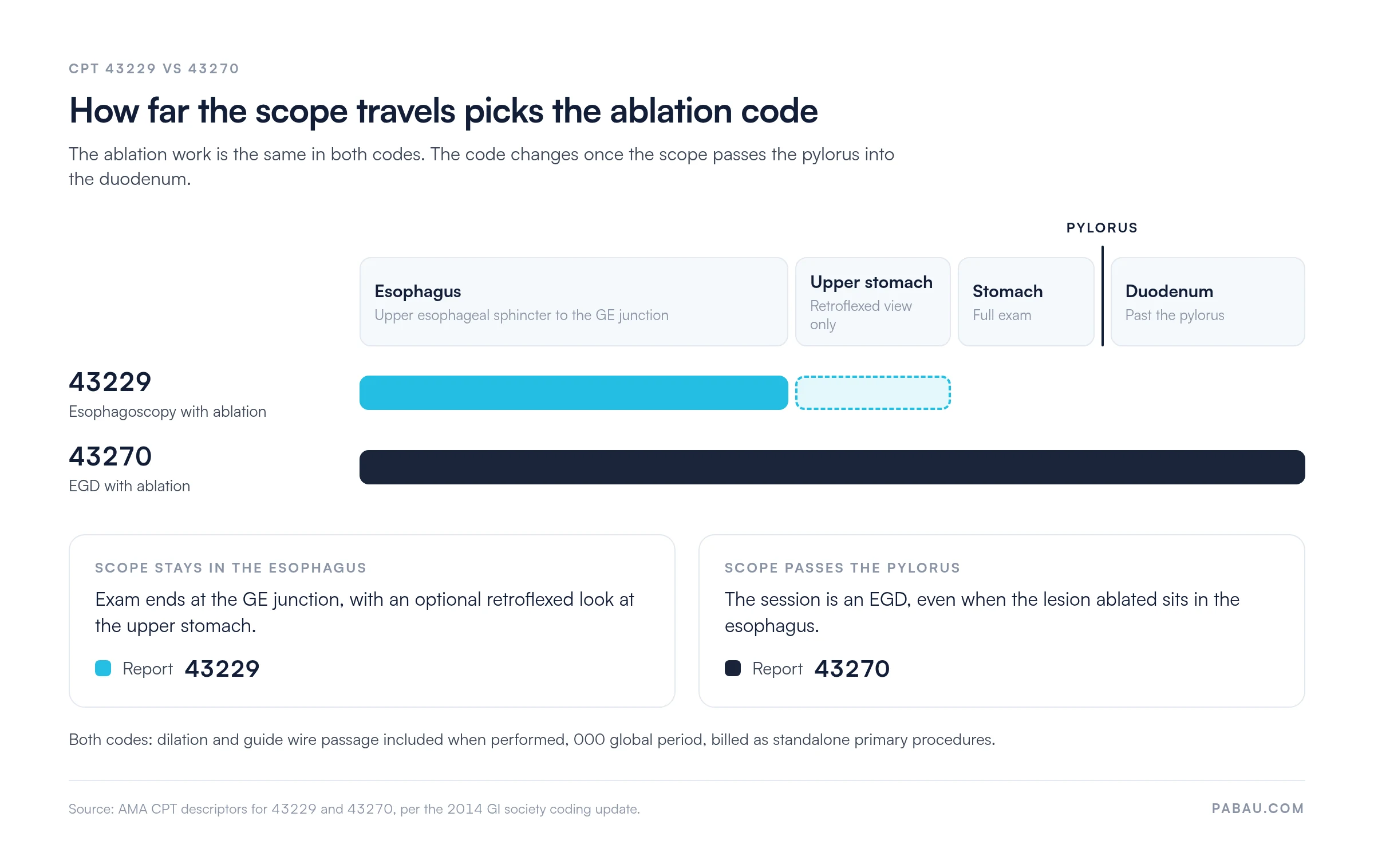
The two codes describe the same ablation work, and the distance the scope traveled separates them. Esophagoscopy stops at the gastroesophageal junction, with an optional retroflexed look at the upper stomach. If the endoscopist passes the pylorus into the duodenum, the session is an EGD and the ablation is reported with 43270.
Code the extent the report documents, not the lesion’s location alone. A Barrett’s ablation done during a full EGD is still 43270, because the scope passed the pylorus. The diagram maps where each code’s exam stops.
CPT code 43229 sits in the flexible transoral esophagoscopy family, 43200 to 43232. Its neighbors describe different work on the same organ, and the EGD family has a parallel code for each. Knowing the pairs is the core of upper GI endoscopy billing.
Older reference sheets sometimes list 43239 as an injection code. It is EGD with biopsy, a standalone code. The injection codes are 43201 for esophagoscopy and 43236 for EGD.
CPT 2014 rebuilt the upper GI endoscopy section. Rigid and flexible esophagoscopy were split into separate families, and both ablation codes were replaced. The deleted codes carried the phrase “not amenable to removal by hot biopsy forceps, bipolar cautery or snare technique.” The new codes dropped it.
Billing templates built before 2014 can still carry that retired wording, sometimes pasted against the new code number. A cheat sheet that describes 43229 as an EGD code is working from the old 43258 text. Replace it with the current descriptor before it shapes another claim.
The diagnosis on a 43229 claim has to be one of the ICD-10-CM codes for an esophageal lesion. Barrett’s esophagus with dysplasia is the most common indication, followed by esophageal polyps and tumors. Each code must match the pathology and the site in the procedure report.
Gastric and duodenal diagnoses point to the other code. K31.7 (polyp of stomach and duodenum) and D13.1 (benign neoplasm of stomach) describe lesions past the esophagus. Treating them takes an EGD, so they pair with 43270.
ICD-10-CM codes update every October 1. Confirm each code against the CDC/NCHS ICD-10-CM web tool before you submit the claim.
Most 43229 claims need no modifier at all. The exceptions involve a second lesion, a second procedure, or a session that stopped early. Getting them right is part of medical billing compliance for any endoscopy service.
The 2014 CPT guidance says ablation codes are reported without modifier 52 even when no dilation or guide wire passage was needed. Commercial payers handle modifier 51 in different ways, so check each contract before adding it.
Medicare pays CPT code 43229 under the Medicare Physician Fee Schedule. The 2026 values below come from FastRVU’s CPT 43229 lookup, at the $33.4009 conversion factor and before geographic adjustment. Confirm them in the CMS Physician Fee Schedule look-up tool for your locality.
The non-facility rate applies when the ablation happens in a physician office. Its practice expense value covers the staff, equipment and supplies the practice pays for. In a hospital outpatient department or an ambulatory surgery center, the facility bills its own fee and the physician claim takes the lower facility rate.
Medicare groups 43229 with the flexible esophagoscopy family, which uses 43200 as its base code. When two codes from that family are billed for one session, the highest-valued code is paid in full. Each additional code is paid at its value minus the value of 43200.
Run your 43229 lookup for your own MAC locality and place of service. The non-facility total is 23.41 RVUs against 5.23 in a facility. The place of service code moves the payment more than any modifier on the claim.
Traditional Medicare does not generally require prior authorization for 43229, but it expects the record to show medical necessity. Commercial and Medicare Advantage plans set their own rules, especially for radiofrequency ablation of Barrett’s esophagus. Running insurance eligibility verification before the session surfaces those rules in time.
Payers that review these claims usually ask for:
When a plan requires authorization, record the number before the procedure date. A claim that reaches that payer without one is denied, however strong the clinical record is.
The procedure report decides whether 43229 holds up. It has to show that the scope stayed in the esophagus and that the lesion was destroyed in place. A clean claim for 43229 rests on these elements:
Bleeding caused by the ablation and controlled during the session is part of 43229. CPT tells coders not to report 43227 for bleeding that the endoscopic procedure itself caused.
Most 43229 denials trace back to the code’s history or to the scope’s extent. Building these checks into your denial management workflows before submission costs less than working rejections afterward.
In many GI practices, the endoscopy report and the claim live in different systems. A biller reads the report days later and chooses between 43229 and 43270 from the narrative. The scope’s furthest point is easy to miss in that handoff.
Pabau keeps the procedure, the diagnosis and the authorization on one patient case. The auth code, dates and sessions sit on that case, and Pabau warns the team when an authorization is missing.
Pabau’s claims management software sends US claims through the Claim.MD clearinghouse as CMS-1500/837P files. Your team checks eligibility before the visit, and ERA remittances post back to the same record. That keeps claim submission and payment tied to one case, so billers code from the report the endoscopist signed.

Pabau keeps the 43229 procedure, its diagnosis and the prior authorization on one patient case. Claims go out through Claim.MD as CMS-1500/837P files, and ERA remittances come back to the same record.

Pick the code from the scope’s furthest point first, then check the technique. An esophagus-only exam with tissue destroyed in place is 43229, billed on its own with a 000 global period. Once the scope passes the pylorus, the same work becomes 43270.
The risk sits in the code’s history. Retired 43228 and 43258 wording still circulates, and it pulls coders toward EGD logic that no longer applies. Audit your templates against the current descriptor once, and the costliest errors stop repeating. Book a demo to see how Pabau carries the endoscopy record through to a Claim.MD submission.

Need a US clearinghouse connected to your patient records? Claim.MD clearinghouse review explains how claims go out to payers and how remittances and eligibility answers come back.
Want to understand what makes a GI endoscopy claim clean? Clean claim best practices covers the field-level requirements that reduce first-pass rejection rates across all procedure types.
Looking for denial pattern analysis across your endoscopy claim volume? Denial codes in medical billing maps common CARC denial reason codes to their root causes and resolution paths.
Ready to code the same session as a full EGD? CPT code 43235 covers the diagnostic EGD base code that 43270 builds on.
Dilating a stricture instead of ablating a lesion? CPT code 43249 explains EGD balloon dilation and the 30 mm line that moves it to 43233.
CPT code 43229 covers flexible transoral esophagoscopy with ablation of tumors, polyps or other lesions. Pre- and post-dilation and guide wire passage are included when performed. It applies when the scope stays in the esophagus.
No. CPT code 43229 is a standalone primary procedure with no + symbol, so it is billed without a primary code beside it. Its global period is 000.
The difference is how far the scope travels. 43229 is esophagoscopy, which stops at the gastroesophageal junction. 43270 is EGD with ablation, used when the scope passes the pylorus into the duodenum.
No, not for the same lesion in the same session. The 43229 descriptor includes pre- and post-dilation and guide wire passage, so 43220 and 43226 are not reported beside it.
The most common are the Barrett’s esophagus codes K22.710, K22.711 and K22.719. Esophageal polyps (K22.81), benign esophageal neoplasms (D13.0) and esophageal cancers (C15.3 to C15.9) also qualify. Gastric diagnoses such as K31.7 and D13.1 pair with 43270 instead.
For 2026, CPT code 43229 carries 3.40 work RVUs. Total RVUs are 23.41 non-facility and 5.23 facility, per FastRVU. That puts national Medicare payment at about $781.92 in the office and $174.69 in a facility, before geographic adjustment.
CPT code 43229 has a 000 global period. Only same-day post-procedure care is bundled, so later visits are billed separately when documented.
Yes. Medicare covers 43229 when the record shows medical necessity, usually a pathology-confirmed esophageal lesion such as Barrett’s esophagus with dysplasia. Traditional Medicare does not generally require prior authorization, but Medicare Advantage plans may.