



CCSD code G5100: Bypass of duodenum billing guide
CCSD code G5100 bills a bypass that leaves the duodenum in place CCSD code G5100...

Last Updated: Oct 16, 2026

CPT code 42820 describes combined tonsillectomy and adenoidectomy in patients younger than age 12.
Age on the date of service decides the code: Under 12 uses 42820, age 12 and older uses 42821.
Billing adenoidectomy separately at the same session as 42820 breaks NCCI bundling rules and triggers a denial.
Medicare pays the same national amount of about $260.86 in facility and office settings, before GPCI adjustment.
Practice management software like Pabau captures the correct age-sensitive CPT code at the point of care, which cuts post-visit coding errors.
CPT code 42820 describes the surgical removal of both the palatine tonsils and the adenoids in patients younger than age 12. According to the American Medical Association (AMA), which maintains the CPT code set, the official descriptor reads: Tonsillectomy and adenoidectomy; younger than age 12.
The code sits in the CPT section covering Excision and Destruction Procedures on the Pharynx, Adenoids, and Tonsils, which runs from 42800 to 42894.
The age threshold is not approximate. A patient who turns 12 on the date of service no longer qualifies under CPT code 42820 and must be billed under CPT 42821. Getting this wrong is one of the most common denial triggers for ENT billing teams.
The single factor separating CPT 42820 from CPT 42821 is the patient’s age on the date of service. Both codes describe a combined tonsillectomy and adenoidectomy (T&A). Code 42820 applies when the patient is younger than 12, and 42821 applies at age 12 and older.
Medicare and most commercial payers reimburse these codes at different rates, reflecting the additional complexity typically associated with adult and older pediatric airway anatomy.
Use CPT 42825 or 42826 when only the tonsils are removed. Use CPT 42820 or 42821 only when both the tonsils and adenoids are removed in the same operative session. The grid below maps the whole family to the two facts that select a code.
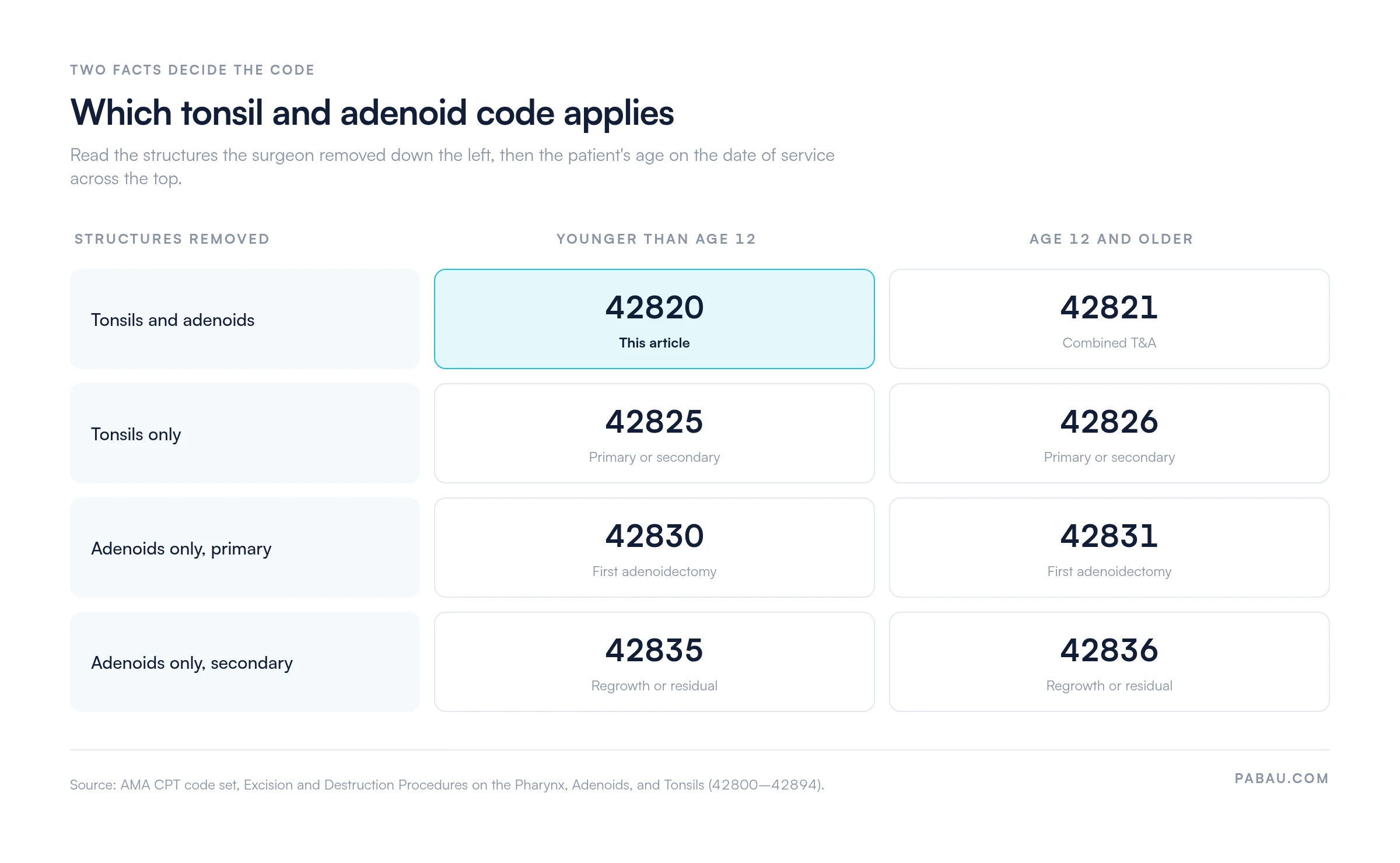
These codes sit in the Excision and Destruction Procedures on the Pharynx, Adenoids, and Tonsils section, which runs from 42800 to 42894. The 42820 to 42836 range covers standalone tonsillectomy, standalone adenoidectomy, and combination procedures across both age groups.
Coders billing ENT procedures should know the complete family, so the wrong code is not selected when only one structure is removed.
Check payer coverage before each surgical encounter. Coverage for standalone adenoidectomy (42830-42836) can differ from coverage for the combined T&A codes, even within the same plan.
CPT 42820 applies when the surgeon removes both the palatine tonsils and the adenoids in a single operative session. The patient must also be younger than age 12 on the date of service. The procedure is never appropriate for tonsil-only or adenoid-only removals, regardless of patient age.
Common clinical indications that support medical necessity for this code include:
Always link the CPT code to a supporting ICD-10-CM diagnosis. Submitting CPT 42820 without a matched diagnosis code is the most common reason for payer denial on pediatric ENT claims.
The ICD-10-CM codes below are commonly paired with CPT code 42820 to establish medical necessity. Payers may apply additional Local Coverage Determinations (LCDs) beyond these standard CMS pairings, so always verify against the specific payer’s coverage policy before submission.
Medicare pays the same national amount for CPT 42820 whether the procedure happens in a facility or an office. The practice expense RVU is identical in both settings, so the place of service does not move the physician payment.
That is unusual for a surgical code, and it means a facility-versus-office argument with a payer is rarely worth having on this claim.
Always confirm current rates directly via the CMS Physician Fee Schedule lookup tool, as rates change annually.
The approximate 2026 national Medicare payment rates for CPT 42820 are shown below. Geographic adjustments via the Geographic Practice Cost Index (GPCI) will shift reimbursement above or below these national figures depending on locality. Use FastRVU’s 2026 RVU lookup to calculate locality-adjusted payments for your specific region.
Note: $260.86 is the national figure before the GPCI adjustment. Verify the exact rate for your locality and payer via the CMS MPFS lookup. Pediatric T&A is almost always performed in a facility, so check the facility line on your remittance against this amount.
Relative Value Units (RVUs) determine how CMS calculates the Medicare payment. Each component reflects a different cost element of performing the procedure. The practice expense value is the same in both settings, which is why the facility and office payments match. Cross-check these 2026 values against the AAPC Codify CPT lookup or the CMS MPFS data file.
Verify all RVU values against the current CMS MPFS data file before using them for budget forecasting or payer contract negotiations. Annual CMS updates can shift work RVUs by small but meaningful increments.
Modifiers signal to payers that a procedure was performed under circumstances that justify a payment adjustment. Using the wrong modifier, or omitting one when required, is a fast path to a denial or underpayment. Verify every modifier against payer-specific policy before submission, because the rules differ by plan.
Modifier -50 (bilateral procedure) does not apply to CPT 42820. The descriptor already covers removal of both palatine tonsils together with the adenoids, so a bilateral modifier adds no information. Applying -50 to this code will result in a payer rejection.
Documentation decides whether a modifier claim pays or draws an audit flag, so capture the operative detail while the surgeon still remembers it.
Run a monthly audit of all 42820 claims submitted with modifier -22. Flag any where the operative note does not document a specific unusual circumstance. Payers increasingly request records on -22 claims, and a note that only says “complex anatomy” without measurable detail is a denial waiting to happen.
Four errors account for most denials and audits on 42820 claims. Each one is preventable at the point of coding rather than after the remittance arrives.
The most common mistake is billing 42820 when the patient was 12 years old on the date of surgery. Age is calculated on the date of service, not the date of the scheduling call or the preoperative visit.
A patient scheduled at age 11 who turns 12 before the OR date must be billed as 42821. Many billing systems do not flag this automatically, so the error only surfaces at the denial stage.
Practice management software like Pabau captures the age at the point of care. Our medical claims management tools link the clinical note to the CPT selection, so the coder sees the date-of-service age rather than the scheduling age.
CPT 42820 already includes the adenoidectomy component. Billing CPT 42830 or 42835 (adenoidectomy codes) separately on the same claim, same date of service, violates National Correct Coding Initiative (NCCI) bundling rules. The adenoidectomy is bundled into the combined T&A code by definition.
Payers will deny the separately billed adenoidectomy and may flag the practice for a pattern audit if the error repeats. Our guide to denial codes covers the CO-97 and OA-97 remarks that signal a bundling rejection.
Submitting CPT code 42820 without a diagnosis code, or pairing it with a diagnosis that does not support medical necessity, produces predictable denials. The ICD-10 code must match the documented clinical finding in the operative and office notes.
The note might say “adenotonsillar hypertrophy with sleep-disordered breathing” while the claim submits J35.01 for chronic tonsillitis only. That diagnosis does not match the documented indication. Use J35.3 for combined hypertrophy, or G47.33 when a sleep study documents obstructive sleep apnea. Check the diagnosis against the documentation before the claim goes out.
A complete 42820 claim carries six elements. Omit any one of them and the claim is rejected before adjudication begins.
Run that check before submission rather than after a rejection. A claim rejected at this stage never reaches an adjudicator, so it produces no remittance advice for the billing team to work from.
CPT 42826 (tonsillectomy only, age 12 and older) is sometimes confused with CPT 42820 in practices that see both pediatric and older adolescent patients. The distinction is straightforward on paper. It causes claims errors when operative notes get coded without checking the patient’s age and the scope of the procedure.
When the adenoids are not removed, bill from the 42825/42826 family. When both are removed in the same session on a patient under 12, CPT code 42820 is the correct choice. Mixing these up ships a code that contradicts the operative report. That is a documentation problem as well as a billing one, and it is what auditors look for.
In many ENT practices the CPT code is picked after surgery, from an operative note a coder reads days later. By then the age at scheduling and the age on the date of service look identical on paper. The wrong age band goes out on the claim, and the denial arrives weeks after that.
Pabau keeps the patient record, the operative note and the claim in one system. The date of service and the date of birth sit on the same screen as the code selection. Age-band errors get caught while the note is being written, rather than after a payer sends the claim back.
Claims then route out electronically through our clearinghouse integration, with eligibility checked before the surgery is booked. Every subscription includes the full billing toolset, so a two-surgeon practice works from the same denial reporting as a multi-site group.

Pabau captures age-sensitive CPT codes at the point of care and routes claims to the clearinghouse. Your billing team spends less time correcting errors and more time getting paid.

Three variables decide whether a CPT code 42820 claim pays on first submission. They are the patient age on the date of service, the scope of the procedure, and a matched ICD-10 diagnosis code. Get one wrong and the denial is predictable.
The fix sits upstream of the claim. A practice that captures the age and the diagnosis while the note is being written stops arguing about 42820 versus 42821 at the remittance stage. Book a demo to see how Pabau handles age-sensitive coding in a pediatric ENT workflow.

Need to understand how claims reach payers? Medical claims clearinghouse guide explains how electronic routing works between your practice and insurers.
Managing post-adjudication reconciliation? Revenue cycle management overview walks through every stage from scheduling through payment posting.
Dealing with repeated payer rejections? Claim.MD pricing and features outlines the clearinghouse options available to reduce rejection rates on surgical claims.
CPT code 42820 describes a combined tonsillectomy and adenoidectomy (T&A) performed on a patient younger than age 12 on the date of service. The American Medical Association maintains the code. It sits in the Excision and Destruction Procedures on the Pharynx, Adenoids, and Tonsils section, CPT range 42800-42894.
Both codes describe a combined tonsillectomy and adenoidectomy. Use 42820 when the patient is younger than age 12 on the date of service. Use 42821 for patients aged 12 and older. The age threshold is calculated on the date of surgery, not on the date of scheduling or the preoperative visit.
The most commonly paired ICD-10-CM codes include J35.03 (chronic tonsillitis and adenoiditis), J35.3 (hypertrophy of tonsils with hypertrophy of adenoids), and G47.33 (obstructive sleep apnea). The selected diagnosis must match the documented clinical indication in the operative and office notes.
Standalone primary adenoidectomy is CPT 42830 under age 12 and 42831 at age 12 and older. Secondary adenoidectomy is CPT 42835 under age 12 and 42836 at age 12 and older. Do not bill any of these separately alongside CPT 42820. NCCI edits bundle the adenoidectomy into the combined T&A code.
The 2026 national Medicare rate for CPT 42820 is about $260.86, and it is the same in a facility and an office setting. Geographic locality shifts that figure through the GPCI adjustment. Confirm the exact rate for your region via the CMS Physician Fee Schedule lookup tool.
No. A patient has one age on one date of service, so only one of these codes can apply to a given encounter. If the patient is younger than 12, bill 42820. If the patient is 12 or older, bill 42821. Billing both codes for the same patient on the same date is not a valid claim scenario and will result in a rejection.
Five modifiers apply: -22 for increased procedural complexity, -52 for reduced services, and -62 for two surgeons. Use -78 for an unplanned return to the OR during the global period, and -79 for an unrelated procedure in that period. A -22 claim needs supporting documentation attached. Modifier -50 (bilateral) does not apply to CPT 42820 and will trigger a payer rejection if submitted.



