

HCPCS Code Q4185: Cellesta flowable amnion billing guide
HCPCS Code Q4185: definition and official descriptor HCPCS Code Q4185 is the Lev...

Last Updated: Nov 20, 2026
33286 is the CPT code for removal of a subcutaneous cardiac rhythm monitor, the implantable loop recorder placed under the chest skin. It covers the incision, device retrieval, and wound closure, whatever the reason for removal.
Insertion is reported separately with CPT 33285. Programming and interrogation after implant have their own codes: 93285, 93291, and 93298. The operative note should name the device model and serial number, state the reason for removal, and confirm a complete explant.
Let Pabau's smart automation suggest the right codes, reduce claim denials, and keep your practice compliant—effortlessly.
Automate repetitive tasks and focus on what matters most—your patients.
Reduce coding errors and ensure compliance with the latest regulations.
Clean claims, fewer denials, and faster reimbursements.
Powerful insights and reporting to help your practice thrive.
HIPAA compliant SOC 2 certified GDPR-compliant Trusted by 4,000+ clinics worldwide

CPT code 33286 reports removal (explant) of a subcutaneous cardiac rhythm monitor. Insertion is 33285, which includes programming at implant.
Programming and interrogation after implant have their own codes: 93285 for programming, 93291 for in-person interrogation, and 93298 for remote interrogation.
33286 carries a 0-day global period, and its 2026 national Medicare rate is about $128.93 non-facility and $74.82 facility.
Same-date billing of 33285 and 33286 fits a device replacement, with modifier -59 or XU and an operative note showing two steps.
A missing or mismatched ICD-10 diagnosis is a common denial cause, so pair every 33286 claim with a supported diagnosis code.
CPT code 33286 is the code for removing a subcutaneous cardiac rhythm monitor, also called an implantable loop recorder (ILR) or implantable cardiac monitor (ICM). The table below sums up the billing facts to confirm before you build the claim.
CPT code 33286 covers the surgical removal of a subcutaneous cardiac rhythm monitor, the ICM or ILR placed under the chest skin. The code applies whenever a physician makes a skin incision, retrieves the device, and closes the wound, whatever the reason for removal.
A 33286 claim usually follows battery depletion or the end of a diagnostic workup. That workup is typically for unexplained syncope, atrial fibrillation (AFib) detection, cryptogenic stroke, or palpitations. Device makers include Medtronic (Reveal LINQ), Abbott (Confirm Rx), and Biotronik (BioMonitor). Coverage does not vary by brand, provided the device is FDA-cleared.
What 33286 does not include:
The American Medical Association’s CPT code set governs the official descriptor for 33286 and publishes updates every calendar year.
Accurate documentation of the explant procedure is the foundation of a clean 33286 claim. Each step below corresponds to a documentation element payers and auditors look for in the operative note.
An operative note without the device model and serial number is a common trigger for post-payment audits. Build an operative note template that asks for both before the note can be closed.
CPT 33285 is the insertion code for a subcutaneous cardiac rhythm monitor, and it includes programming at implant. CPT 33286 is its removal counterpart. The two codes sit at opposite ends of the device’s life, and mixing them up is a common coding error on ICM claims.
Device replacement on a single date of service (DOS) causes the most confusion. When an old device comes out and a new one goes straight in, both 33286 and 33285 may be reported. The note has to show the removal and the insertion as distinct procedural steps, not one continuous event split across two codes.
CPT code 33286 is half of a two-code surgical pair. 33285 puts the monitor in, and 33286 takes it out. Programming and data review in between use the device evaluation codes, as the map below shows.
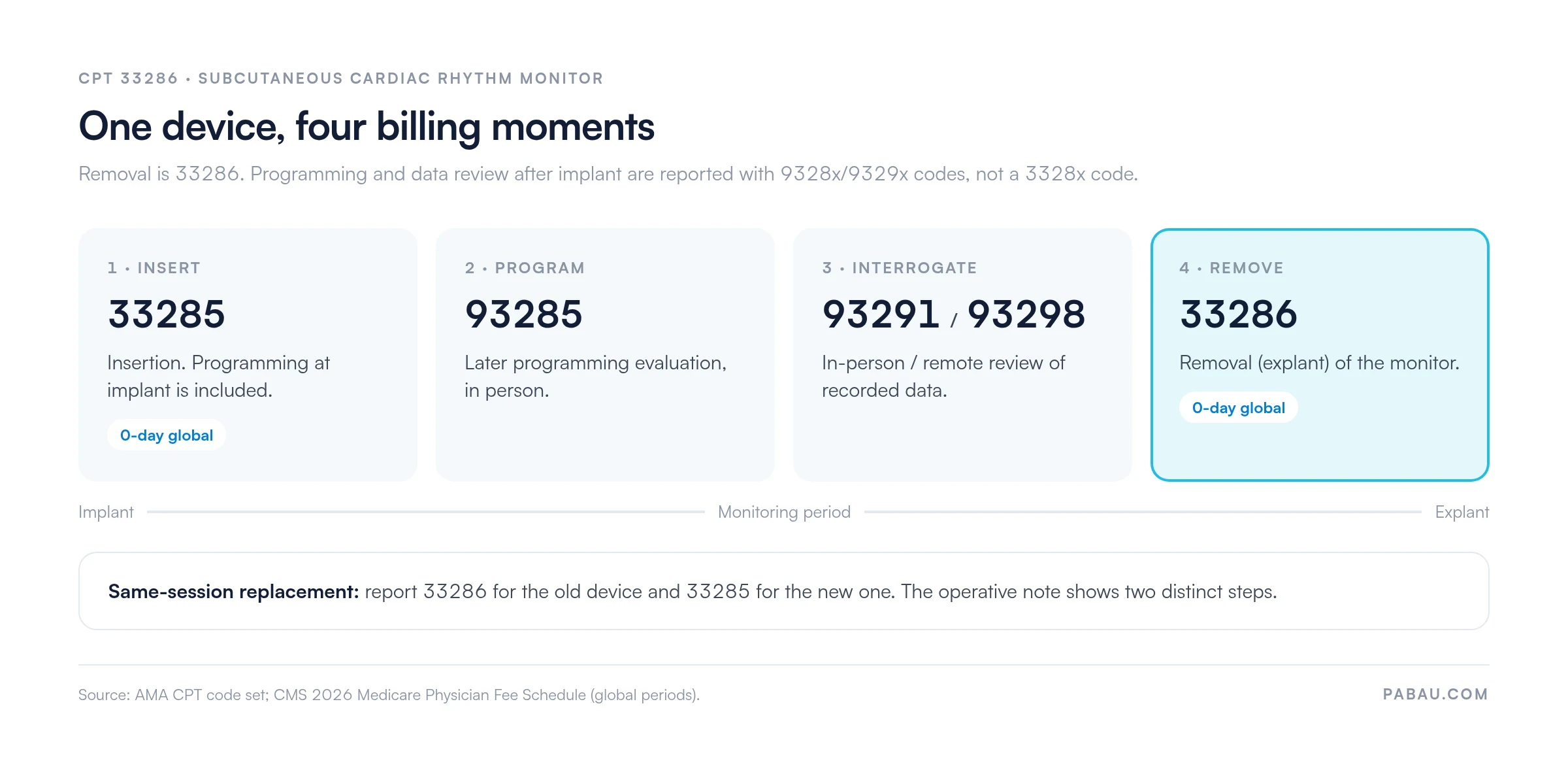
Programming and interrogation are not part of 33286, but they can still bundle with it on the same date. The bundling section below covers how to check those pairs.
Every 33286 claim must carry at least one ICD-10-CM diagnosis code that supports the medical necessity of the removal. Missing or unsupported diagnosis codes are a common cause of denials for this procedure. The table below lists commonly accepted codes. Verify them against the Local Coverage Determination (LCD) for your Medicare Administrative Contractor (MAC) before submitting.
LCD policies differ by MAC jurisdiction. Novitas Solutions, CGS Administrators, WPS Government Health Insurance, and Palmetto GBA each publish their own coverage criteria for ambulatory cardiac monitoring. Confirm the applicable LCD before submitting claims to avoid a medical necessity denial that could have been prevented at intake.
Medicare reimburses CPT code 33286 under the Medicare Physician Fee Schedule (MPFS). Payment rates vary by site of service (facility vs non-facility) and by location. The figures below are 2026 national rates at the $33.4009 conversion factor. Check the CMS Physician Fee Schedule lookup tool for the most current year and locality-adjusted amounts.
The practice expense RVU drives the difference between settings. In the office, the physician fee for 33286 runs about $54 higher than in a hospital outpatient department. There, the facility bills its own costs separately. Use the FastRVU lookup tool to run location-specific calculations with the current conversion factor.
Run an eligibility check before the procedure date to confirm the patient’s plan covers monitor removal. It heads off post-service denials on coverage grounds.
Run a site-of-service check before scheduling. At 2026 national rates, the physician fee for 33286 is about $54 higher in the office than in a facility. Across 50 explants a year that adds up to roughly $2,700, so the place of service on the claim must match where the removal happened.
Medicare does not universally require prior authorization for CPT code 33286, but prior authorization requirements vary substantially by commercial payer and Medicare Advantage plan. Each plan year’s benefit structure determines whether removal of a cardiac monitor triggers a pre-auth requirement. Treat the following as a starting framework and verify with each payer’s current policy before proceeding.
Track prior auth status alongside scheduling and claim submission, so an authorization doesn’t lapse before the claim goes out. Our guide to medical billing workflows shows how those steps connect.
Coverage criteria for CPT code 33286 flow from each MAC’s Local Coverage Determination governing ambulatory cardiac monitoring. The criteria below reflect common requirements across major MACs. Check the specific LCD for your jurisdiction.
Denials on 33286 claims usually trace back to one of five root causes, each with its own fix. Sorting them this way gives your denial management workflow a clear starting point.
The adjustment reason code on the remittance tells you which row applies. Our guide to denial codes in billing explains how to read each one.
NCCI (National Correct Coding Initiative) edits govern which procedure codes may be billed together with CPT 33286 on the same date of service. A wrong modifier decision here quickly leads to a bundling denial or a post-payment audit.
Modifier -59 and XU: Both modifiers signal a distinct procedural service. Use either when billing 33285 (insertion) alongside 33286 (removal) on the same DOS. Only do so when the record documents a device replacement, not an accidental double bill. The operative note must describe two separate acts: The explant of the old device and the implant of a new one.
Modifier -79: Use when performing CPT 33286 during the global surgical period of a different, unrelated procedure. The 0-day global period of 33286 rarely creates a conflict of its own. But if the patient is inside the global period of a prior cardiac procedure, -79 signals that the removal is unrelated to it.
NCCI edits with 93285, 93291, and 93298: Programming (93285) and interrogation (93291 or 93298) may bundle with 33286 under the quarterly NCCI table in effect. Confirm the edit status for each pair in the AAPC Codify CPT lookup or the CMS NCCI tables before billing them on the same DOS.
Building a clean claim for device replacement scenarios means documenting the modifier rationale in the operative note, not just appending it to the claim line. Payers increasingly require supporting documentation before they will override an NCCI edit, particularly for the 33285/33286 pair.
Give your EP team a device replacement checklist to complete in the OR. It confirms the old serial number removed and the new serial number implanted. It also records two separate procedural steps in one operative note. That checklist supports modifier -59 or XU and cuts same-day bundling denials caused by missing documentation.
In many electrophysiology practices, the explant note lives in one system and the claim gets built in another. Billers retype the serial number, the diagnosis, and the modifier, and each retype risks a denial.
Pabau, the practice management and billing platform we build, keeps the procedure note and the claim on the same patient record. Its claims management software sends US claims through Claim.MD as CMS-1500/837P files, with eligibility checks before the visit. Prior auth codes, dates, and sessions sit on the case, with a warning when one is missing.
ERA remittances come back to the same record, so your team sees the adjustment reason on a denied 33286 line and fixes it there. Less time goes on chasing paperwork, and more explants get paid on the first submission.

Pabau keeps claim submission, prior auth tracking, and remittances on one patient record. Your billing team spends less time on rework and more on clean first-pass claims.

CPT code 33286 is a simple explant code, and its claims fail for avoidable reasons. Three checks decide most of them. You need a supported ICD-10 code and the right modifier on a same-day replacement. The place of service must also match where the removal happened.
Start with the operative note template, because each of those checks depends on it. When the note names the device, the reason for removal, and every procedural step, the code choice follows from the record instead of from memory.
Book a demo to see how Pabau carries your 33285 and 33286 documentation straight into a clean claim.

Need to understand how clearinghouse submission works for cardiac codes? Claim.MD clearinghouse overview explains how electronic claim routing reduces CPT code rejection rates.
Seeing recurring CARC denial codes on 33286 claims? Denial codes in medical billing breaks down the most common adjustment reason codes and how to respond.
Confused about how 837 electronic claim files map to procedure code pairs? 837 file format guide covers how CPT codes, modifiers, and ICD-10 codes map to claim segments.
CPT code 33286 covers surgical removal of a subcutaneous cardiac rhythm monitor, also called an implantable cardiac monitor (ICM) or loop recorder (ILR). The code includes the incision, device retrieval, and wound closure. An electrophysiologist or cardiologist performs it in an office, outpatient hospital, or ASC setting.
CPT 33285 is the insertion code for a subcutaneous cardiac rhythm monitor, and it includes programming at implant. CPT 33286 is the removal code. Both may be billed on the same date of service only for a device replacement. That needs modifier -59 or XU and an operative note documenting two distinct procedural steps.
Yes, Medicare covers CPT code 33286 under the Medicare Physician Fee Schedule when the claim carries a supported ICD-10 diagnosis code. The medical necessity criteria in your MAC’s Local Coverage Determination must also be met. Traditional Medicare does not typically require prior authorization, though Medicare Advantage plans may.
At 2026 national rates, Medicare pays about $128.93 for CPT 33286 in a non-facility setting and about $74.82 in a facility. Those figures come from 3.86 and 2.24 total RVUs at the $33.4009 conversion factor. Your locality adjustment changes the final amount.
Prior authorization requirements vary by payer. Traditional Medicare generally does not require prior auth for 33286, but commercial payers and Medicare Advantage plans often do. Check each payer’s current policy before scheduling, as requirements can change between plan years.
Yes, but only when the encounter is a device replacement. The old device is removed (33286) and a new device is implanted (33285) in the same session. Append modifier -59 or XU, and document two separate procedural steps in the operative note. Billing both codes without a modifier or a replacement scenario will trigger an NCCI bundling denial.
CPT code 33286 carries a 0-day global period under the Medicare Physician Fee Schedule. Only same-day post-operative care is included in the payment, so follow-up visits on later days are billed separately with E/M codes. Verify the global period indicator each year, as CMS can update it in the annual final rule.





