



HCPCS code E0198: Water pressure pad billing guide
HCPCS code E0198 is a water pad for a standard mattress HCPCS code E0198 is the ...

Last Updated: Oct 13, 2026

CPT code 21138 covers reduction forehead contouring plus application of prosthetic material or a bone graft, and it includes obtaining the autograft.
Fixation does not separate 21137, 21138, and 21139. The difference is what the surgeon adds after contouring.
The code sits in the CPT 21120-21296 range, which covers repair and reconstruction procedures on the head.
Medicare usually treats forehead contouring as cosmetic and non-covered. Reconstructive claims need medical necessity documentation and LCD compliance.
The global period is 090 days, so most routine post-operative care is bundled into the surgical payment.
Practice management software like Pabau links treatment notes, consent forms, and invoicing, so the documentation behind a 21138 claim stays in one record.
CPT code 21138 covers reduction of the forehead with contouring and the application of prosthetic material or a bone graft. The descriptor includes obtaining the autograft, so harvesting the graft is not billed separately. The code sits in the 21120-21296 range for repair and reconstruction procedures on the head, maintained by the American Medical Association (AMA).
A common coding error treats 21137, 21138, and 21139 as a fixation ladder. Fixation never decides the code. 21137 is contouring alone, 21138 adds prosthetic material or a graft, and 21139 adds a setback of the anterior frontal sinus wall.
Plastic surgeons and craniofacial surgeons perform this procedure. It appears in facial feminization surgery. In cosmetic surgery practices, deciding whether a case is cosmetic or reconstructive is the most consequential step before the claim goes out.
CPT 21138 covers forehead contouring plus the addition of material to the treated area in the same operative session. Both halves have to be documented for the code to hold up.
The surgeon burrs or osteotomizes the frontal bone to reduce a prominent brow ridge or frontal bossing. Contouring alone stops there and reports 21137. Under 21138, the surgeon then augments or resurfaces the area with added material.
Two material types both map to this one code:
Fixation is not a factor in code selection. Plates, screws, or wires used to secure the material do not move the case between 21137, 21138, and 21139, and they are not reported separately.
Report 21138 once per operative session. The forehead is treated as one anatomical site, so a bilateral modifier rarely applies to this code.
Modifier selection decides whether a CPT 21138 claim processes cleanly or triggers a review. Payers look hard at modifiers on this code, because the same procedure can be cosmetic in one case and reconstructive in the next.
Verify all modifier applications against current National Correct Coding Initiative (NCCI) edits before submission. The AAPC CPT code lookup provides modifier compatibility checks as a secondary reference.
Reimbursement for CPT 21138 varies based on place of service, geographic locality, and whether the payer covers the procedure at all. The CMS Physician Fee Schedule lookup is the primary source for current Medicare rates by locality.
When the procedure does qualify as reconstructive, rates follow the standard Medicare Physician Fee Schedule (MPFS) locality adjustment. Private payers and commercial insurers vary significantly, so verify benefits and prior authorization before scheduling.
The facility rate applies when the procedure is performed in a hospital or ASC. The non-facility (office) rate is higher because the physician bears the overhead costs directly.
Exact dollar amounts change with each CMS annual update and differ by geographic locality. Use the CMS MPFS search tool or a verified RVU calculator to confirm current rates before setting your fee schedule. Cross-check any figure published by a third-party tool against the current year’s CMS data.
Practices charting musculoskeletal procedures in Jane often compare Jane App alternatives once billing and caseloads get heavier.
Relative Value Units (RVUs) are the building blocks of Medicare physician payment. Each CPT code carries three RVU components. Multiplied by the Medicare conversion factor and a geographic adjustment, they produce the allowed amount.
To look up the current RVU values for CPT 21138, use the FastRVU 2026 RVU lookup or the CMS MPFS search tool. RVU values are updated in the annual Physician Fee Schedule final rule, typically published in November for the following year.
Check the CMS MPFS search tool each January after the new fee schedule takes effect. RVU values and conversion factors change annually. Stale figures leave you under-charging or over-charging for 21138 all year.
CPT 21138 carries a 090-day global period. CMS bundles most post-operative care delivered within 90 days of surgery into the original surgical payment. Billing separately for routine follow-up visits during this window results in claim denials.
Services bundled into the global period include routine post-operative office visits and suture removal. Minor complications count too, as long as they do not require a return to the operating room.
Services that may be billed separately include treatment of unrelated conditions and extensive complications needing a separate procedure. Evaluation and management visits for new problems also qualify. Append modifier 24, 78, or 79 as appropriate, along with documentation that distinguishes the service from bundled post-op care.
Forehead contouring is commonly performed in an ambulatory surgical center or a hospital outpatient department when reconstructive justification supports coverage. Whether the ASC itself gets paid depends on the CMS payment status indicator assigned to the code.
When billing in an ASC, the facility bills under the CMS ASC payment system while the physician bills separately under the MPFS. Check the code against the annual CMS ASC covered surgical procedures list before scheduling, because status indicators can change in each update.
CMS generally classifies forehead contouring as cosmetic and excludes it from Medicare coverage. This is the most consequential billing question for CPT 21138, because the answer decides whether any payment is possible.
Coverage can still apply when the procedure is medically necessary and meets the criteria of a Local Coverage Determination (LCD). The key distinction is whether the surgery addresses a functional impairment, an injury sequela, or a documented medical condition.
Reconstructive classification commonly applies to post-traumatic forehead reconstruction after frontal bone fractures, congenital craniofacial anomalies, and contour defects left by tumor excision. Gender dysphoria cases sit in a separate lane. Many commercial plans cover facial feminization procedures under a dedicated gender-affirming surgery policy with its own criteria. Benefit verification tells the practice what the plan covers, which is a separate question from whether the patient is active.
Each case needs documented clinical justification. Confirm requirements with the applicable Medicare Administrative Contractor (MAC) and read the relevant LCD before submitting. A medical spa compliance checklist helps aesthetic practices build a consistent pre-authorization workflow for these claims.
Payers match the submitted diagnosis code against 21138 to decide whether the surgery was reconstructive. A cosmetic-only diagnosis produces an automatic denial, whatever the operative note says.
Check the payer’s own policy before choosing between a gender dysphoria code and a trauma or tumor code. The same procedure can fall under two different policies at the same insurer, each with its own criteria and its own review path.
Assume prior authorization is required. Most commercial payers will not pay a 21138 claim submitted without an approved authorization on file, even when the case is plainly reconstructive.
A complete authorization request for 21138 usually includes:
Approval is not a payment guarantee. Payers still review the operative note afterwards, so that note has to show both the contouring and the material that was added.
Call the payer when the operative plan changes in theater. Billing 21139 against an authorization written for 21138 is a routine cause of retrospective denial.
Inadequate documentation is the leading cause of CPT 21138 claim denials, after the cosmetic exclusion itself. These are the elements billers and coders should confirm before submitting.
Consent and intake forms captured through digital forms software build an auditable record trail that supports medical necessity.

These are the denials that come up most often on this code, and what stops each one.
Build a CPT 21138 documentation checklist into your pre-operative workflow. Before the surgery date, confirm you have the diagnosis code, prior authorization number, operative plan, and consent form all attached to the patient record. Catching missing items pre-operatively is far cheaper than handling a denial post-submission.
CPT 21138 sits in the 21120-21296 range for the skull and facial bones. Choosing between its neighbors depends on what the surgeon added and how far the dissection went. Temporomandibular joint work falls outside this range.
The choice between 21137, 21138, and 21139 turns on what happened after contouring. Nothing added means 21137. Added prosthetic material or a graft means 21138. A setback of the anterior frontal sinus wall means 21139. For whole-forehead rebuilds, look at 21179 or 21180 instead. Neighboring facial bone procedures carry their own codes.
For plastic surgery and aesthetic practices, the work that decides a CPT 21138 claim happens long before the claim. Every case has to produce the operative detail, the diagnosis, and the consent record a payer will ask for.
Practice management software like Pabau connects treatment notes, consent forms, and invoicing in a single clinical record. When a surgeon documents a reconstructive forehead case, the operative detail and ICD-10 diagnosis sit in the record that generates the invoice. That link cuts the transcription errors and missing-field denials that come with running separate systems.
The claims management feature tracks submission status, manages rejections, and flags incomplete documentation before claims go out. For reconstructive cases needing prior authorization.
Practices doing plastic and reconstructive work get those tools in the plastic surgery EMR setup. Teams running injectables and skin treatments alongside surgery work from the same patient record in Pabau’s med spa software, so nothing is documented twice.
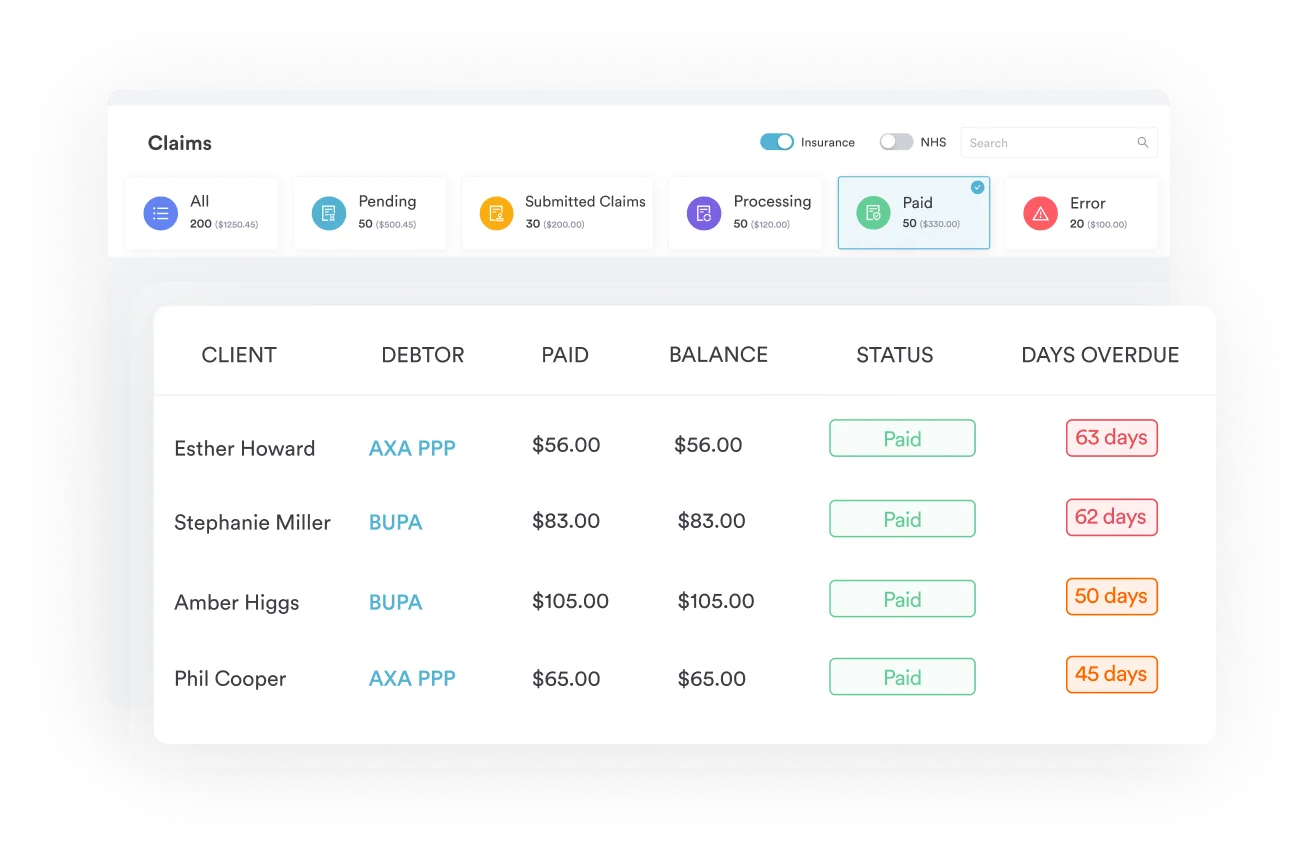

Pabau connects treatment notes, consent forms, and invoicing in one workflow. Aesthetic and plastic surgery practices capture the documentation a CPT 21138 claim needs.

CPT 21138 claims live or die on documentation. Pick the code from what the surgeon added, not from whether anything was fixated. Contouring alone is 21137, added prosthetic material or a graft is 21138, and a frontal sinus setback is 21139.
From there, the billing challenge is proving the surgery was reconstructive rather than cosmetic. Get the ICD-10 pairing right and confirm prior authorization where required. Before the claim goes out, check that the operative note records the contouring and the material added.
Pabau’s integrated clinical records and automated workflows build that discipline into every patient encounter. Practices capture the evidence up front instead of chasing it after a denial. To see how Pabau supports reconstructive and aesthetic billing workflows, book a demo.

Coding another craniofacial excision? CPT code 21044 walks through billing for excision of a malignant mandibular tumor.
Billing chin augmentation in the same range? CPT code 21120 covers genioplasty augmentation, another code in the same 21120-21296 range.
Documenting polyostotic fibrous dysplasia? ICD-10 code Q78.1 covers the billable code for polyostotic fibrous dysplasia, where fibrous tissue replaces bone at several sites.
CPT code 21138 is reduction forehead; contouring and application of prosthetic material or bone graft (includes obtaining autograft). The surgeon reshapes the frontal bone, then adds prosthetic material or a bone graft over the contoured area. The code sits in the CPT 21120-21296 range for repair, revision, and reconstruction procedures on the head, maintained by the AMA.
The three codes differ by what the surgeon does after contouring, not by fixation. 21137 covers contouring only, with no material added. 21138 covers contouring plus prosthetic material or a bone graft. 21139 covers contouring plus a setback of the anterior frontal sinus wall, the most invasive of the three.
No. The 21138 descriptor states that the code includes obtaining the autograft, so the harvest is bundled into the procedure. Reporting a separate graft harvest code alongside 21138 is an unbundling error, and it will trigger a denial or a refund request.
Medicare typically classifies CPT 21138 as a cosmetic procedure and does not cover it. Coverage may apply when the surgery is reconstructive, such as post-traumatic repair or a congenital craniofacial condition. The claim still needs medical necessity documentation meeting the applicable Local Coverage Determination (LCD) criteria. Confirm coverage with your MAC before submitting.
Common modifiers for CPT 21138 include modifier 22 for increased procedural services and modifier 51 for multiple procedures in one session. Modifier 62 covers two primary surgeons, and modifier 80 covers an assistant surgeon. Modifier 52 applies when the procedure is reduced or partially completed. Always verify modifier combinations against current NCCI edits before submission.
The global period for CPT 21138 is 090 days. Routine post-operative visits and minor complication management within 90 days of surgery are bundled into the original surgical payment. Separate billing during the global period requires a modifier, such as modifier 24 for unrelated E/M services, plus supporting documentation.
The diagnosis depends on the indication. Post-traumatic cases usually pair with T90.2XXS, congenital deformity with Q75.8 or Q67.4, and tumor-related contour defects with D16.4. Facial feminization cases are commonly submitted with F64.0, sometimes alongside Z87.890. Always check the payer policy that governs the specific indication first.
A 21138 claim needs an operative report that describes the contouring and the material added. It also needs a medical necessity statement for reconstructive claims, prior authorization documentation, and a supporting ICD-10 diagnosis code. Facility and ASC billing adds anesthesia records. Clinical photographs of the pre-operative contour strengthen reconstructive claims.
CPT 21138 can be performed in an ambulatory surgical center, but ASC facility payment depends on the current CMS payment status indicator. Check the code against the annual CMS ASC covered surgical procedures list. The facility bills under the ASC payment system while the surgeon bills the physician component separately under the MPFS.



