



HCPCS code E0198: Water pressure pad billing guide
HCPCS code E0198 is a water pad for a standard mattress HCPCS code E0198 is the ...

Last Updated: Oct 13, 2026

CPT 19001 covers puncture aspiration of a breast cyst, for each additional cyst beyond the first.
It is an add-on code, so it only bills alongside CPT 19000 on the same claim.
Modifier 51 never applies, while modifier 50, LT, and RT depend on the payer’s bilateral policy.
Report one unit for each additional cyst, then document every cyst in the procedure note.
Pabau pre-fills claims from the patient record, then tracks each one from submitted to paid.
CPT code 19001 is the add-on code for puncture aspiration of a breast cyst, reported once for each additional cyst beyond the first. Specifically, its official descriptor, maintained by the American Medical Association (AMA), reads “puncture aspiration of cyst of breast; each additional cyst”.
The code sits in the integumentary system section of the CPT code set, inside the breast aspiration subsection. Because it is an add-on code, the AMA instructs coders to list it in addition to the code for the primary procedure.
Every claim carrying 19001 must therefore also carry CPT 19000 for the first cyst. In addition, the code is active under the 2026 Medicare Physician Fee Schedule (MPFS).
CPT 19000 and 19001 work as a pair whenever more than one breast cyst is aspirated in a session. Specifically, CPT 19000 covers the first cyst and is always the primary code, while CPT 19001 is reported once for every additional cyst after that.
First, subtract one from the total number of cysts aspirated. The result is therefore the number of units to report for 19001. For example, a surgeon who aspirates four cysts in one session bills 19000 once and 19001 with three units. Also, each of those units needs its own entry in the procedure note.
Add-on codes follow AMA rules that differ from standard procedure codes, and breaking any of them costs you the claim. In fact, these five rules hold for 19001 with every payer, not just Medicare.
The same pairing logic runs through the rest of the breast family. For example, CPT 19083 covers the first lesion biopsied under ultrasound guidance, and its own add-on covers each lesion after that. Therefore, build both checks into your claim scrubbing rules so a lone add-on never leaves the practice.
Bilateral procedures add a layer of modifier logic. Specifically, the right approach depends on how many cysts came out of each breast and which payer is processing the claim.
Modifier 50 can be acceptable to some Medicare Administrative Contractors (MACs) and commercial payers when one cyst per side is aspirated. However, payer preferences on modifier 50 against LT and RT split billing vary widely. Therefore, check the payer’s Local Coverage Determination (LCD) or billing guide before you default to modifier 50.
Plastic surgery practices that run breast procedures weekly should keep a bilateral coding checklist in the pre-claim workflow.
Four modifiers matter for 19001, each with its own trigger. Indeed, using the wrong one, or leaving a required one off, is one of the most common reasons these claims come back.
One rule has no exceptions. Modifier 51 is prohibited on 19001, because add-on codes are inherently exempt from it under AMA guidelines. As a result, appending it tells every payer reviewer who sees the claim that the coder has misread the add-on rules.
Before you submit a bilateral aspiration claim, check the payer’s Local Coverage Determination for its modifier 50 preference. In fact, Medicare contractors and commercial payers often split on modifier 50 against LT and RT billing. Record the answer for each payer once, so the check happens before submission rather than after a denial.
Every claim for 19001 needs a diagnosis code that establishes medical necessity. The code has to match the documented clinical finding, not a convenient placeholder. Consequently, weak diagnosis linkage is a leading cause of medical necessity denials on aspiration claims.
Always pick the most specific code the documentation supports. Indeed, payers flag claims where the diagnosis and the procedure do not line up clinically. For instance, N63 paired with three units of 19001 invites a medical necessity review, because the diagnosis describes one uncharacterized mass rather than several confirmed cysts.
If the aspirate is bloody and cytology later confirms cancer, the diagnosis moves to a malignancy code such as C50.411.
CPT 19001 pays less than CPT 19000, which reflects the smaller amount of work involved in each extra cyst. Payment also varies by setting and by geographic locality. Specifically, the figures below are approximate 2026 Medicare national averages. Therefore, verify your own numbers in the CMS fee schedule lookup for your MAC and locality.
Commercial payers usually set their rate as a percentage of the Medicare fee schedule, and the multiplier changes from contract to contract. Therefore, check both your contracted rate and the Medicare rate when you model expected revenue. Specifically, the FastRVU 2026 lookup returns the work, practice expense, and malpractice components you need to compare against your local conversion factor.
After coding errors, thin documentation is the next reason these claims are denied. Specifically, the procedure note has to support medical necessity and the exact number of units billed. Indeed, HIPAA-compliant documentation practices hold every encounter to that standard, with enough detail to justify each line on the claim.
Practices that use digital intake forms and a structured procedure note template catch missing details before the claim goes out. For example, a breast aspiration template that prompts for cyst count, laterality, and fluid description takes under two minutes to complete. Similarly, the same structured-note thinking applies across medical record documentation for any procedure type.

Denials on 19001 trace back to a handful of repeat offenders. In fact, spotting the pattern is what turns a rework queue into a fix you make once.
Review denied claims once a month against that list. The pattern usually points at one coder, one provider, or one payer. From there, check your own practice management software to see which of these checks you can build into claim scrubbing.
Run a quarterly denial report filtered to 19001 and sort it by denial reason code. Typically, three causes account for most of the volume. Specifically, the primary code is missing, the modifier is wrong, or the diagnosis does not support the units billed. As a result, fix those three in your claim scrubber and the rework queue shrinks before claims ever leave the practice.
CPT 19001 sits inside a wider breast procedure family. Indeed, knowing the neighboring codes stops you undercoding a session, and stops you reaching for an aspiration code when the clinical picture has changed.
Prior authorization rules differ from payer to payer. Medicare generally does not require it for 19000 or 19001. However, commercial payers sometimes do, especially for planned bilateral procedures or sessions involving three or more cysts. Therefore, verify the requirement with each payer before you schedule.
Aspiration is also the wrong code when the fluid turns out to be pus, since drainage of a breast abscess belongs to CPT 19020.
Deleted codes are the other trap in this family. For example, CPT 19324 no longer exists in the code set, so any fee schedule or superbill still carrying it will generate rejections. Therefore, reconcile your breast codes against the current CPT release each January. In short, the AAPC Codify lookup is a quick way to confirm a code is still active before you bill it.
Add-on pairs are where manual billing slips. For instance, a coder working from a paper charge ticket can miss the third cyst or drop a laterality modifier. Meanwhile, others key a unit count that the note does not support. Breast complaints land in plastic surgery, dermatology, and OB/GYN practices alike. As a result, each of them rekeys the same details twice.
Practice management software like Pabau removes the second round of typing. Specifically, Pabau’s claims management software pre-fills each submission from data already held in the patient record. In practice, that covers the patient’s details, the appointment, and the charges attached to it. Claims then go out electronically through the clearinghouse for your market, which is Claim.MD in the US. Practices reconciling payment posting against expected fees find short-paid claims that never appear as denials.
In practice, every submitted claim carries a status the whole team can see, moving from pending through submitted, processing, and paid, or landing on error. When a 19001 line errors out, you see it in the claims list instead of on a remittance three weeks later.
Your coders still choose the codes and modifiers, but nobody rebuilds the claim from scratch to chase it.
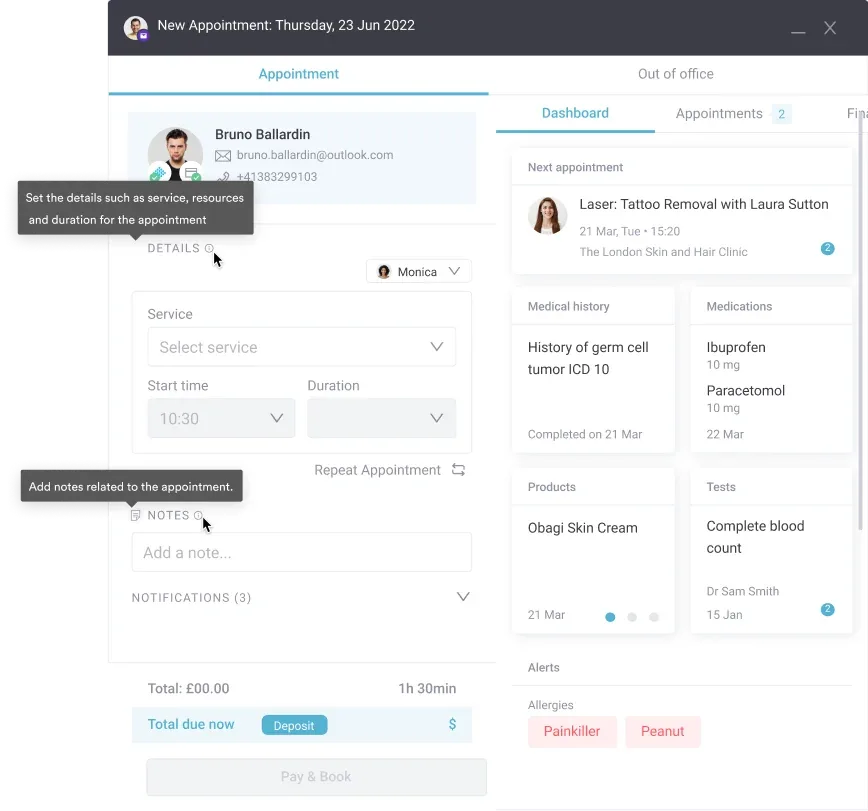

Pabau pulls claim details straight from the patient record and submits them electronically. You can then track every claim from submitted through to paid without leaving the system.

CPT 19001 is simple in principle and easy to get wrong in a busy clinic. In short, no standalone billing, no modifier 51, and one unit for every additional cyst that the note accounts for.
Two habits pay for themselves here. Confirm each payer’s bilateral preference once and write it down, then reconcile unit counts against the procedure note before anything is submitted. As a result, do both and the denial pile shrinks to the occasional genuine dispute. Book a demo to see how Pabau submits breast procedure claims and tracks each one to payment.

Coding the first cyst in the session? CPT code 19000 walks through the primary aspiration code that 19001 always attaches to.
Aspirating pus rather than cyst fluid? CPT code 19020 covers the abscess drainage code and the documentation it needs.
Taking tissue under ultrasound guidance? CPT code 19083 explains the biopsy pairing and when the imaging is billed separately.
Placing a breast brachytherapy catheter? CPT code 19298 sets out the placement rules and the payer checks that go with them.
Still seeing 19324 on your superbill? CPT code 19324 covers the deleted mammaplasty code and what to report instead.
CPT 19001 is the add-on code for puncture aspiration of a breast cyst, reported for each additional cyst beyond the first. It goes on the same claim as CPT 19000, which covers the first cyst. It cannot be billed on its own.
Yes. The AMA designates 19001 as an add-on code, so it always reports in addition to primary code CPT 19000. Add-on codes are exempt from modifier 51 and are never submitted alone.
Modifier 50 may apply to a bilateral procedure, depending on payer policy. LT and RT are used for split bilateral billing. Modifier 59 applies when NCCI edits flag a bundling issue with another same-day procedure. Modifier 51 is never appended to 19001.
No. CPT 19001 has no standalone payment value, so it needs 19000 on the same claim. A claim submitting 19001 alone is denied by every payer.
Roughly $24 to $26 per unit in the office setting, based on 2026 Medicare national averages. The facility rate is lower. Commercial payers usually pay a percentage of the Medicare fee schedule, so check your contract and the CMS lookup tool.



