



CCSD code G5100: Bypass of duodenum billing guide
CCSD code G5100 bills a bypass that leaves the duodenum in place CCSD code G5100...

Last Updated: Oct 16, 2026

CPT Code 11105 covers a punch biopsy of skin, including simple closure if performed, for each separate lesion after the first.
11105 is an add-on code, so it cannot be reported alone. It must always be paired with CPT 11104, the primary punch biopsy code.
Billing 11105 without 11104, or using it for a tangential or incisional technique, are the two most common audit triggers for this code.
Practice management software like Pabau validates the fields a claim needs and tracks its status. That helps catch missing information before an 11105 claim goes out.
Punch biopsy billing trips up even experienced coders. One patient, four suspicious lesions, one dermatology visit. The right code combination protects your reimbursement and keeps you audit-clean. The wrong one triggers an NCCI edit denial before the claim leaves your system.
CPT Code 11105 is the add-on code for a punch biopsy on every lesion after the first. It came out of a 2019 overhaul that retired the old 11100/11101 pair for six technique-specific codes. This add-on always rides along with its primary counterpart. Confirm that pairing before you submit the claim.
The American Medical Association (AMA) defines CPT Code 11105 as a punch biopsy add-on code. The official descriptor reads as follows. Punch biopsy of skin (including simple closure, when performed); each separate/additional lesion (List separately in addition to code for primary procedure).
Three elements define this code’s clinical and billing identity:
The code sits under CPT Category I, Surgery section, Integumentary System. Its “+” prefix marks it as an add-on code, so modifier -51 never applies and it is always billed next to its primary code.
Before 2019, every skin biopsy used just two codes: CPT 11100 for the first lesion, and 11101 for each additional one. That year’s CPT revision split them into six technique-based codes instead.
Picking the wrong technique code is one of the most common biopsy billing errors. The table below maps each code to its technique and its primary-or-add-on status.
Mixing technique codes in the same session.
Document each technique-code pairing separately: the code has to reflect the exact clinical method performed, not whichever option is easiest to bill.
CPT Code 11105 cannot be reported alone. This is a hard AMA rule: 11105 must always ride along with CPT 11104 on the same claim. Think of it this way: 11104 covers lesion number one, and 11105 covers every lesion after that in the same encounter.
Example scenario: A dermatologist performs punch biopsies on four separate suspicious nevi during a single visit. The correct billing is 11104 x1 for the first lesion, and 11105 x3 for the three additional lesions. Each unit of 11105 corresponds to one distinct lesion, so the claim line carries a quantity of 3.
Situations where 11105 applies:
11105 does not apply when the additional lesion was biopsied using a tangential or incisional technique instead. In that case, 11103 or 11107 applies to the add-on lesion, depending on the method used.
It also does not apply once the workup moves past biopsy. If pathology confirms malignancy, the follow-up excision uses a different code entirely, such as CPT 11643 for a malignant lesion on the face.
An EMR designed for plastic surgery keeps consents, operative notes, and staged repair timelines in one record.
Insufficient documentation is the leading reason for 11105 audits and retrospective denials. Payers reviewing these claims look for specific elements in the procedure note. A generic note that just says “biopsies performed” will not satisfy medical necessity review.
Using structured skin assessment documentation in your EHR makes this easier to standardize across providers. Each lesion needs these minimum elements:
Digital procedure documentation built into a practice management platform can enforce these elements automatically, instead of relying on free-text notes.
As an add-on code, CPT 11105 carries its own RVU value and reimbursement rate, separate from the 11104 primary code. The figures below are non-facility, or office, rates: national averages that the CMS Medicare Physician Fee Schedule updates each year. Geographic adjustment factors mean your actual payment will vary by locality.
Use the FastRVU RVU lookup tool to check current Work, PE, and malpractice RVU values for your own locality. Treat the rates above as a national average, not a submission-ready number. Private payers negotiate their own rates, which can run higher or lower than Medicare’s.
Run a four-lesion punch biopsy scenario through your billing system before the visit: 11104 x1 + 11105 x3. Confirm the system auto-links the add-on to the primary code and applies the correct units. Catching this in setup prevents denial on day one.
Because 11105 is an add-on code, several standard modifier rules apply differently than they would for a primary procedure. Misapplying a modifier here is a common reason for claim delays.
The modifier rule that matters most: never append modifier -51 to 11105. The AMA lists it in Appendix D of the CPT manual as an add-on code that is specifically exempt from the multiple-procedure reduction. Appending -51 anyway tells the payer you do not understand the code’s add-on status, and it can trigger a manual review.
Every 11105 claim needs a supporting ICD-10 diagnosis code that justifies medical necessity for that specific lesion’s punch biopsy. Payer LCD (Local Coverage Determination) policies often spell out which diagnosis codes support biopsy reimbursement.
The AAPC CPT-to-ICD-10 crosswalk is a useful starting reference, though each payer’s own LCD governs what is actually covered.
Coders who handle a lot of dermatology claims usually keep a short list of diagnosis codes on hand for punch biopsies. The most common ones include:
Assign the most specific code available for each lesion site. Use a site-specific variant.
Connective tissue disease. It often shows up when a persistent rash or nodule does not respond to treatment.
OIG’s recent dermatology-billing audits have focused mainly on modifier -25 misuse. That happens when a same-day E/M visit is billed alongside a minor procedure, not on add-on pairing itself. Even so, the four patterns below are what actually trip up most 11105 claims. Risk of complications carries more weight than volume of notes when the visit level is questioned.
Run a monthly internal audit of your 11104/11105 claims. Compare the number of 11105 units billed per claim against the number of lesion sites documented in the matching note. Even one mismatched lesion, repeated across several claims, is a pattern auditors notice.
CPT Code 11105 carries a 0-day global period, so no post-procedural follow-up is automatically bundled into the code. Any medically necessary evaluation after the procedure date can be billed separately, with an appropriate E/M code.
That 0-day global period does not mean everything on the same day bills separately, though. NCCI edits still bundle these services into 11105:
What can be billed separately on the same day:
Understanding which services the global period bundles, and which need a modifier to unbundle legitimately, keeps a claim clean. The NCCI Policy Manual, available via CMS, is the definitive reference for which code combinations need a modifier and which do not.
When billing an E/M visit alongside 11104 and 11105 on the same date, apply modifier -25 to the E/M code. Without it, many payers will automatically deny the E/M as bundled into the biopsy procedure. Document the E/M note separately from the biopsy procedure note.
Manual biopsy billing has a measurable error rate. Coders tracking add-on pairings, lesion counts, modifier eligibility, and documentation completeness across dozens of daily encounters are fighting the system’s complexity by hand.
Practice management software like Pabau removes some of that friction by handling the repetitive checks automatically.
Pabau’s claims management software checks that a claim carries every field an insurer requires before it can be sent. It will not let the claim go out until that is true. It also tracks each claim’s status afterward, so a coder can see exactly where an 11105 claim sits without calling the payer.
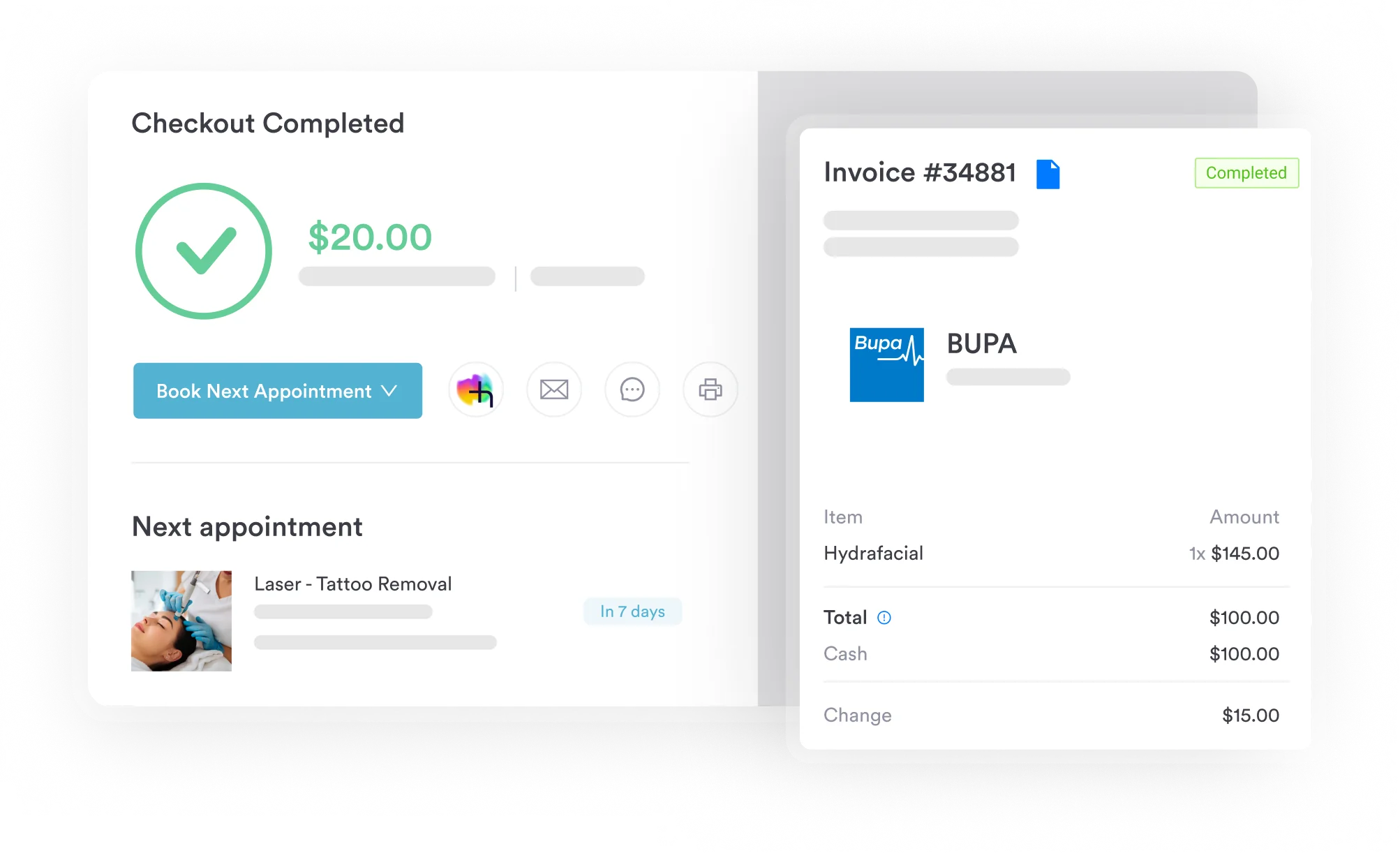
For a practice running high volumes of multi-lesion biopsy visits, catching one missing field before submission is what actually keeps denials down. Dermatology and skin-focused practices already lean on this.
Practices managing skin biopsy workflows alongside broader clinical documentation can explore Pabau’s full toolkit for dermatology EMR software. It is built around structured procedure notes and claims tracking in one system.

Pabau checks that every required field is filled in before a claim goes out, then tracks its status until it is paid. That means fewer claims stall in review for something you could have caught upfront.

CPT Code 11105 is simple in concept, but it consistently generates denials. Most of those trace back to a misunderstood add-on pairing rule, incomplete documentation, or a missed modifier exemption. Every unit billed needs a matching 11104, a separately documented lesion site, and a note that confirms the punch technique.
Dermatology practices billing several punch biopsies per visit gain the most from tightening up these checks before a claim goes out.
Practice management software helps by validating the required fields and tracking each claim’s status. That catches the kind of problem that would otherwise surface as a denial weeks later. Book a demo to see how Pabau supports dermatology billing workflows like this one.

Billing a cosmetic skin excision instead of a diagnostic biopsy? CPT Code 15836 covers arm skin excision and shows how differently that procedure gets coded and paid.
Coding another high-volume dermatology procedure? CPT Code 11056 covers paring corns and calluses, a code with its own separate billing rules.
Billing a debridement alongside a biopsy visit? CPT Code 11042 walks through subcutaneous tissue debridement billing and its bundling rules.
Most payers apply a Medically Unlikely Edit that caps how many units they will pay in one visit, though the exact number varies by payer. Check your payer’s MUE table before billing more than a handful of lesions in a single session, since anything above the cap denies automatically.
Most Medicare and commercial plans do not require prior authorization for an in-office punch biopsy, since it is a low-risk diagnostic procedure. Some plans do apply prior authorization rules when the same visit includes a separate surgical excision, so confirm the payer’s policy first. Patient coverage can change between the referral and the procedure, so eligibility verification belongs close to the date of service.
Yes. An NP or PA can perform and bill a punch biopsy under their own National Provider Identifier. They can also bill it under incident-to rules when a physician is on-site. Incident-to billing pays at the physician’s full rate, so the route you use changes the reimbursement.
Yes. The rates earlier in this guide are non-facility, or office, figures. The facility rate is lower, since CMS assumes the facility, not the practice, covers costs like supplies and staff time in that setting.



