



HCPCS code E0198: Water pressure pad billing guide
HCPCS code E0198 is a water pad for a standard mattress HCPCS code E0198 is the ...

Last Updated: Oct 13, 2026

CPT code 01829 describes anesthesia for diagnostic arthroscopic procedures on the wrist only — not open/therapeutic wrist surgery, carpal tunnel release, fracture reduction, or tendon repair — within the AMA anesthesia range 01810-01860
Base units for CPT 01829 are 3 per the ASA Relative Value Guide; reimbursement uses the formula (Base Units + Time Units) x Conversion Factor, using the anesthesia-specific conversion factor (not the physician fee schedule RVU rate)
Applicable modifiers include AA, QK, QX, and QZ; selecting the wrong modifier is the most common reason for claim denial on this code
Practice management software like Pabau can help anesthesia and surgical practices keep structured clinical documentation — anesthesia records, provider credentials, and case-timing details — organized in the patient chart
Most anesthesia claim denials come down to one of three problems: wrong modifier, missing time documentation, or an ICD-10 code that does not pair cleanly with the procedure billed.
CPT code 01829 is a narrow, specific code for diagnostic wrist arthroscopy, but it still trips up billing staff who conflate it with the open/surgical arthroscopy code (01830) or adjacent wrist and forearm codes, or who skip the medical direction attestation when a CRNA is involved. This reference covers the code description, base units, billing formula, modifiers, Medicare and commercial payer rates, ICD-10 crosswalk, and the documentation checklist that separates clean claims from denied ones.
The American Medical Association (AMA) maintains the CPT code set, and anesthesia codes within the 00100-01999 range are reimbursed differently from surgical procedure codes: payment is unit-based, not service-based. Other codes in this range. Understanding how those units stack matters for every 01829 claim you submit.
CPT code 01829 describes anesthesia for diagnostic arthroscopic procedures on the wrist. It sits within the anesthesia code range for the forearm, wrist, and hand (01810-01860), within the musculoskeletal anesthesia subsection of the AMA CPT anesthesia chapter (00100-01999).
The code applies specifically when a physician anesthesiologist or certified registered nurse anesthetist (CRNA) provides anesthesia while a surgeon performs a diagnostic wrist arthroscopy: inserting a small camera (an arthroscope) into the wrist joint to visualize and diagnose problems such as ligament tears, cartilage damage, or unexplained wrist pain, without repairing anything in the same session. Orthopedic and sports medicine practices bill this code most often, typically after an inconclusive MRI or persistent post-injury wrist pain.
01829 is deliberately narrow, and coders should not default to it for every wrist or hand case. It does not cover:
If the operative report documents any repair, debridement, or fixation performed during the scope, the correct code shifts to 01830, not 01829.
CPT 01829 carries 3 base units as assigned in the ASA Relative Value Guide, and CMS adopts this same value for Medicare reimbursement. Base units reflect the relative complexity and risk of providing anesthesia for a given procedure category; they do not change with the duration of the case.
Base units for a diagnostic wrist arthroscopy are modest compared with major spine procedures such as CPT 00670 or with thoracic and cardiac anesthesia, both of which carry 20-25 base units — and modest even compared with some of its own sibling codes, such as 01832 for total wrist replacement (6 base units). That reflects the lower physiologic complexity and shorter typical duration of a diagnostic scope in otherwise healthy patients. When co-morbidities elevate patient acuity, physical status modifiers (P1-P6) may be appended to reflect added risk, though their direct impact on reimbursement varies by payer.
Anesthesia reimbursement does not follow the standard relative value unit (RVU) formula used for surgical or evaluation-and-management codes, and it is not priced off the Medicare Physician Fee Schedule (MPFS) work/practice-expense/malpractice RVUs. Instead, it uses this formula:
(Base Units + Time Units + Qualifying Circumstances) x Anesthesia Conversion Factor = Allowable Payment
Here is a concrete worked example for CPT 01829 under Medicare:
Anesthesia conversion factors are set per Medicare Administrative Contractor (MAC) locality, so a claim billed in San Francisco will reimburse differently than the same claim billed in rural Mississippi. These locality anesthesia conversion factors are published in the Medicare Physician Fee Schedule Final Rule (Addenda D and E) and by each MAC’s anesthesia fee schedule pages — they are a separate figure from the standard work/practice-expense/malpractice GPCI used to adjust RVU-based codes, so always pull the locality-specific anesthesia conversion factor from the CMS Anesthesiologists Center before estimating collections, rather than an MPFS RVU lookup tool. Batch submissions group many claims into one claim file, and one malformed record can hold up the batch. Risk of complications carries more weight than volume of notes when the visit level is questioned.
Commercial payers negotiate their own conversion factors. Most pay at a multiplier of Medicare, such as 110-150%, though actual contracted rates vary widely. Never present a commercial estimate to a patient without first confirming the contracted rate in the payer agreement. Practice management software like Pabau can help practices keep payer contract details and billing documentation organized alongside the patient record, so staff aren’t hunting through separate files for the numbers they need.
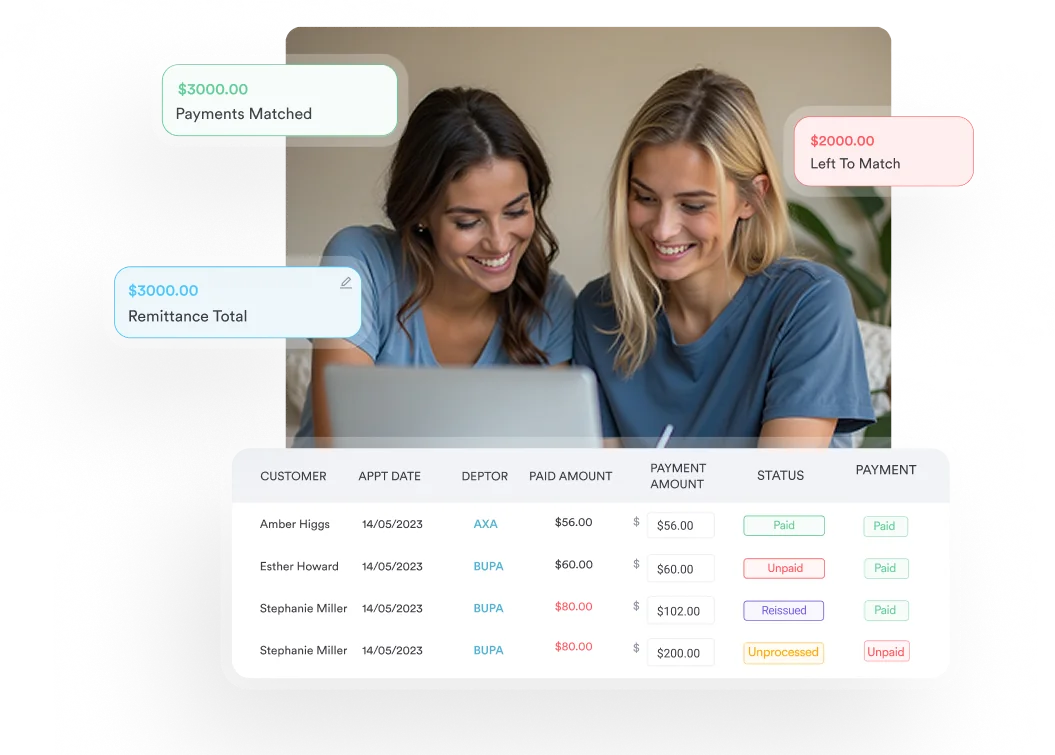
Because anesthesia claims hinge on time units and modifiers, claims management software helps catch errors before payers do.
Anesthesia modifier selection determines who is being paid and in what capacity. Using the wrong modifier is the fastest route to a claim denial or a compliance audit. The four core provider-type modifiers for CPT 01829 are:
QK and QX must appear on separate claims: one from the directing physician (QK) and one from the CRNA (QX). Together they account for 100% of the allowable payment. When only one claim is submitted with QK, the CRNA’s 50% share goes uncollected.
CRNA independent billing (QZ) is available only in states where the governor has exercised the Medicare opt-out from physician supervision requirements. As of mid-2026, at least 27 states have opted out — a number that has grown steadily since the first states opted out in the early 2000s. CRNA billing authority still varies by state and payer; always confirm the current opt-out status before billing QZ.
Run a modifier audit quarterly: pull all 01829 claims and verify QK claims each have a matching QX claim on the same date of service. Missing QX claims against QK claims = lost CRNA revenue and potential compliance exposure.
Medicare reimburses CPT 01829 using the unit-based formula described above. The national anesthesia conversion factor for 2026 is approximately $20.4976 per unit (or $20.5998 for qualifying APM participants), up from $20.3178 in 2025 — both figures are subject to annual update and geographic adjustment. CMS publishes the final conversion factor and locality tables in the Medicare Physician Fee Schedule final rule each fall; always use the current-year figure from the CMS Anesthesiologists Center rather than prior-year estimates or a physician-fee-schedule RVU lookup tool, which prices a different set of codes off a different conversion factor entirely.
For a standard 45-minute diagnostic wrist arthroscopy case (6 total units using the worked example above), the Medicare allowable would be approximately $123 in a mid-range locality before any cost-sharing adjustments, using the 2026 national conversion factor. Facility and non-facility rates do not differ for anesthesia the way they do for evaluation-and-management or surgical codes; the locality-specific conversion factor is the primary geographic variable.
Rates above are estimates based on the 2026 national anesthesia conversion factor and do not account for locality adjustments. Use the ResDAC coding resources to access historical Medicare claims data for anesthesia code benchmarking in your region.

Practice management software like Pabau helps anesthesia and surgical practices keep structured clinical documentation — provider credentials, case times, and required billing fields — organized in the patient chart. See how it works for your practice.

Commercial payer rates for CPT 01829 vary widely depending on the network contract, the geographic market, and the provider type. The table below provides general ranges; always verify against your specific payer agreements. The AAPC Codify CPT lookup provides additional payer-specific benchmarking data for anesthesia codes.
Commercial rates above are illustrative ranges only. Specific contracted amounts depend on individual payer agreements. Always refer to your executed contracts and verify current fee schedules with each payer before estimating patient out-of-pocket costs.
Anesthesia CPT codes require an accompanying diagnosis code to establish medical necessity. Because CPT 01829 covers a diagnostic arthroscopy, the ICD-10 codes that pair with it should reflect a reason to visualize the joint — unexplained pain, suspected ligament or cartilage injury — rather than a condition already scheduled for surgical repair in the same session.
The surgical CPT code most often crosswalked to 01829 is 29840 (diagnostic wrist arthroscopy); if the operative note documents any repair, debridement, or fixation, both the surgical and anesthesia codes shift (29843-29848 surgically, 01830 for anesthesia).
This table lists common pairings; it is not exhaustive. Coders should select the most specific ICD-10 code available for the patient’s confirmed diagnosis. Laterality matters: using an unspecified laterality code when the site is documented as right or left will downcode specificity and can trigger payer scrutiny. Conditions typically treated surgically in the same session — carpal tunnel syndrome (G56.0-), trigger finger (M65.3-), or a fracture going straight to fixation — pair with CPT 01810, 01820, or 01830 rather than 01829. Verify ICD-10 pairings against the AAPC CPT-to-ICD-10 crosswalk for current-year medical necessity guidance.
Selecting the wrong adjacent code is a common error when the operative report describes a therapeutic procedure rather than a purely diagnostic one, or when the site is near the wrist-hand boundary. The table below maps the closest anesthesia codes so coders can distinguish the correct selection. The same diagnostic-versus-therapeutic distinction applies to CPT 01382, the equivalent code for a diagnostic knee arthroscopy.
Key distinction: CPT 01829 covers a diagnostic-only wrist arthroscopy — the scope is used to visualize and identify a problem, and nothing is repaired in the same session. CPT 01830 covers open or surgical arthroscopic/endoscopic procedures on the distal radius, distal ulna, wrist, or hand joints — that is, when the joint is being treated, not just examined. If the operative report describes any repair, debridement, or fixation performed during the scope, 01830 is the correct code, not 01829. Carpal tunnel release and tendon repair are soft-tissue procedures that fall under 01810, not 01829, and closed fracture reduction falls under 01820.
Documentation failures cause a significant proportion of anesthesia claim denials. Clean CPT 01829 claims require specific records that confirm provider identity, case timing, and the appropriateness of any modifier selected. Structured medical intake forms should capture all of the following elements before a claim is submitted.
Practices using digital anesthesia forms can standardize these documentation elements into structured templates that capture required fields at the point of care, reducing the risk of incomplete records reaching the billing team. ICD-10 code O89.2 covers central nervous system complications of anesthesia, illustrating how complication-specific diagnosis coding differs from the diagnostic-only ICD-10 pairings above.

Anesthesia claims have a higher denial rate than most procedure categories because of the multi-step modifier system and the time-based reimbursement model. These are the most frequent failure points for CPT 01829 specifically.
Build a denial reason tracker for CPT 01829 claims. Categorize each denial by root cause (modifier, time unit, ICD-10, credential, wrong adjacent code). After 30 days, the pattern will tell you where to focus your pre-submission audit checklist.
Practices that track documentation patterns by CPT code can catch systemic errors before they compound. Pabau’s practice management software gives teams structured reporting tied to the patient chart, making it easier to catch documentation errors clustering around specific codes like CPT 01829 without combing through individual charts manually.
CPT code 01829 is a narrow, specific code by anesthesia standards, but clean reimbursement depends on getting three things right every time: confirming the scope was diagnostic only (not 01830), an accurate provider-type modifier, and a diagnosis code that matches a diagnostic indication rather than a planned repair. The B+T×CF formula is simple once you know it; the documentation behind it is where most practices lose money.
Pabau helps surgical and anesthesia practices keep structured documentation — anesthesia records, provider credentials, and required billing fields — organized in the patient chart, so the details behind every CPT 01829 claim are easy to find when billing needs them. To see how it works in a practice like yours, book a demo.

Billing a methyldopate HCl injection? methyldopate HCl billing guide covers the correct IV push pairing for this drug, billed at up to 250 mg per unit.
Need the code for an alprostadil suppository? alprostadil suppository billing guide covers the per-suppository billing unit and the self-administered drug exclusion that usually applies.
Billing an onabotulinumtoxinA injection? onabotulinumtoxinA billing guide covers the drug only, paid for FDA-approved therapeutic indications and never for cosmetic treatment.
CPT 01829 bills anesthesia for diagnostic arthroscopy of the wrist, where the surgeon inserts a small camera into the joint to diagnose problems such as ligament tears, cartilage damage, or unexplained pain. It excludes open or therapeutic wrist arthroscopy (CPT 01830) and other wrist procedures such as carpal tunnel release (01810) or fracture reduction (01820). It applies when an anesthesiologist or CRNA provides the anesthesia.
CPT 01829 carries 3 base units per the ASA Relative Value Guide, fixed regardless of case length. Time units are added at 1 unit per 15 minutes (Medicare), then the total is multiplied by the anesthesia conversion factor to set the allowable payment.
Four provider-type modifiers apply: AA (anesthesiologist personally performs all services), QK (physician directing 2-4 CRNAs), QX (CRNA under medical direction), and QZ (CRNA without medical direction). Every Medicare anesthesia claim requires one modifier; omitting it causes automatic denial.
Medicare pays CPT 01829 as total anesthesia units multiplied by the CMS anesthesia conversion factor for your locality — not the standard RVU rate. A 45-minute case with the AA modifier (6 units) yields roughly $123 nationally at the 2026 factor of about $20.4976 per unit, before geographic adjustment. Verify current rates via the CMS Anesthesiologists Center.



