



HCPCS code E0198: Water pressure pad billing guide
HCPCS code E0198 is a water pad for a standard mattress HCPCS code E0198 is the ...

Last Updated: Oct 13, 2026

CPT Code 01472 describes anesthesia for repair of ruptured Achilles tendon, with or without graft, on the lower leg, ankle, and foot
The code carries 5 ASA base units, and reimbursement follows the formula (Base Units + Time Units) x Conversion Factor
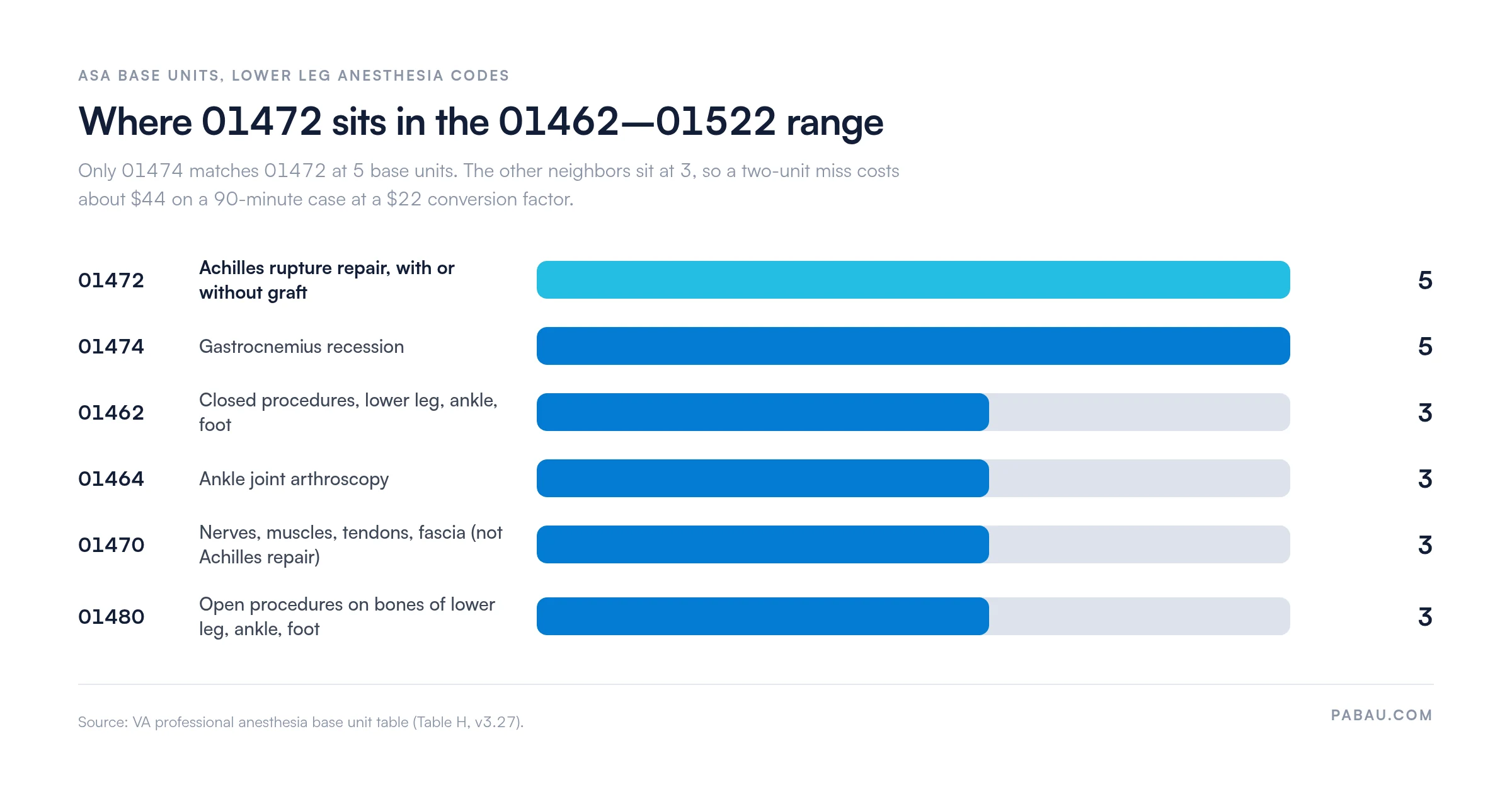
At 5 base units, 01472 sits 2 units above 01470 and level with 01474, so code choice is about accuracy rather than unit value
Pair 01472 with M66.361 for the right leg or M66.362 for the left, and reserve M66.369 for cases where the side is unconfirmed
Practice management software like Pabau tracks anesthesia codes, modifiers, and documentation for surgical practices in one place
CPT Code 01472 is the anesthesia code for repair of a ruptured Achilles tendon, with or without graft. It sits in the lower leg, ankle, and foot range, and carries 5 ASA base units. The anesthesia provider reports it, not the surgeon.
Coders reach for 01472 when the operative report names an Achilles rupture repair. General tendon or fascia work on the same lower leg belongs to 01470 instead, at 3 base units.
Per the American Medical Association’s CPT code set, which owns and maintains all CPT codes, CPT Code 01472 carries the following official descriptions. Anesthesia billing teams use both forms when documenting the case and submitting the claim.
The “with or without graft” language is clinically significant. Whether the surgeon uses a tendon graft to augment the repair or performs a primary end-to-end repair, the anesthesia code does not change. This is one of the most common points of confusion when coders first encounter 01472.
Every anesthesia code carries a base unit value assigned by the American Society of Anesthesiologists (ASA) Relative Value Guide. That value reflects the complexity, risk, and skill the procedure demands. CPT Code 01472 carries a base unit value of 5. Published payer schedules confirm that figure, including the VA professional anesthesia base unit table and state Medicaid anesthesia schedules. Verify the value against your own payer’s current schedule before you quote an expected payment.
Base units alone do not determine reimbursement. Anesthesia payment moves with the length of the case, so the time-based formula below is what a coder needs before a claim goes out.
The example above uses a 90-minute case and a mid-range conversion factor for illustration only. Actual reimbursement varies by geographic locality and payer. Document anesthesia start and stop times precisely in the anesthesia record. Missing entries and suspiciously round numbers are both common audit triggers.
At 5 base units, 01472 sits at the top of the lower leg anesthesia range, level with 01474. Most of the neighboring codes carry 3. The chart below plots the whole range, and the related codes section further down gives each descriptor.
Medicare reimbursement for CPT Code 01472 follows the formula above, but the conversion factor varies by geographic locality. The standard Physician Fee Schedule lookup tool will not price it, because CMS assigns no RVUs to anesthesia codes. Take the locality figures from the anesthesia conversion factor files published in the CMS Anesthesiologists Center instead.
Because rates shift annually and vary by locality, always cite the specific year and CMS locality code when documenting expected reimbursement internally. Relying on a prior year’s rate for financial forecasting is a consistent source of billing surprises for anesthesia groups.
Run a payer-specific rate audit on CPT Code 01472 at the start of each calendar year. Pull the new anesthesia conversion factor from the CMS Physician Fee Schedule Final Rule and compare it to every contracted commercial rate. Flag any contract you have not renegotiated in the past 24 months. A $1 move in the conversion factor is worth $11 on a 90-minute Achilles repair case.
Modifier selection is where anesthesia claims most frequently stall. The modifiers below identify the provider type and the medical direction relationship, which payers use to set the allowable amount. Always verify modifier requirements with each specific payer before submitting.
Most payers reject an anesthesia claim that arrives without a P-status modifier. For a standard Achilles repair, P2 (mild systemic disease) and P3 (severe systemic disease) are the most common designations. Which one applies depends on the comorbidities documented in the pre-anesthesia evaluation.
Pairing CPT Code 01472 with the correct diagnosis code is what establishes medical necessity. Laterality is required for Achilles rupture codes, so a non-specific or wrong-sided code invites a denial. Our ICD-10-CM code set reference explains how each character position carries that detail. Our medical coding cheat sheet keeps the common pairings within reach of the billing desk.
The M66.36 descriptions surprise coders who expect to see the word Achilles. Official ICD-10-CM text for M66.361 reads spontaneous rupture of flexor tendons, right lower leg. The Achilles is a flexor tendon of the lower leg, so the alphabetic index routes an atraumatic Achilles rupture to this subcategory. The code is correct even though its printed descriptor never names the tendon.
Verify laterality against the operative note rather than the face sheet. Where the rupture has a traumatic mechanism, such as a fall or a sudden push-off during sport, the S86 series may fit better. Confirm the choice between the M66 and S86 families with the physician. Check every pairing against current NCCI edits and payer policy, since either can restrict which diagnoses support medical necessity.
Qualifying circumstance codes (99100-99140) are add-on codes reported alongside the primary anesthesia code. Each one applies only where a specific patient or procedural condition is met and documented. None of them is routine.
Hypothermia and controlled hypotension are separate codes with separate descriptors, and 01472 rarely calls for either. For an Achilles repair, 99140 is the likely qualifying circumstance when the case is done urgently for an acute rupture. 99100 applies if the patient is over 70. Reporting one without meeting its criteria is an OIG audit risk, so never add a code because the case felt complex.
Complete documentation is the foundation of a defensible anesthesia claim. The Office of Inspector General has identified anesthesia billing as a high-risk area for improper payments. The records below are what auditors request first.
Anesthesia records form part of the designated record set. The same retention and access rules apply to them as to any other protected health information. Verify payer-specific requirements before submitting, since some commercial payers ask for elements not listed above.
Most CPT 01472 denials fall into a small number of repeatable patterns. Knowing them saves rework before the claim goes out the door. Each pattern below can be caught by a pre-submission edit built around that exact failure point.
Selecting the right code requires knowing what the adjacent codes cover. The 01462-01522 range covers all anesthesia for lower leg, ankle, and foot procedures. When the operative report describes a procedure in this anatomical zone, look for the most specific code before defaulting to a general one. Defaulting is where reimbursement leaks.
Two rows in that table trip up billing teams. 01474 carries the same 5 base units as 01472. A mix-up between them costs nothing in units, but it still misstates the procedure on the claim. Most other codes in the range sit at 3 units, which is where the money is lost.
A Strayer procedure is sometimes performed for equinus in the same session as an Achilles repair. Ask the surgeon and the payer whether that gastrocnemius recession is separately reportable or bundled under 01472. NCCI edits govern this. Do not assume separate billing is appropriate without confirming it.
In most practices, 01472 errors surface only after the payer finds them. A claim goes out without a P-status modifier, or with an unspecified laterality code, and the denial arrives weeks later. By then the coder has moved on to other cases.
Practice management software like Pabau puts those checks in front of the claim instead of behind it. Our claims management software keeps the code, the modifiers, and the diagnosis on the same record as the anesthesia note. Billing staff can see whether the documentation supports what is about to be submitted.
That shortens the rework queue. Anesthesia groups spend less time rebilling Achilles repair cases, and more time on the claims that genuinely need a second look.

Pabau helps surgical and orthopedic practices track procedure codes, modifiers, and documentation requirements in one place. See how claims management tools can reduce rework before claims go out.

Achilles tendon repair is a high-stakes procedure for the patient and a high-error zone for the billing team. Code choice matters less for its unit value than most teams assume. 01472 and 01474 both sit at 5 base units, and 01470 is only 2 units lower.
What drives the denials is the detail around the code. That means laterality on the diagnosis, precise anesthesia start and stop times, and a modifier that matches the provider arrangement on the day.
Build those checks into the workflow rather than into the memory of whoever is coding that day. A pre-submission review of laterality, P-status, and anesthesia times will catch most of what payers reject. Book a demo to see how Pabau supports anesthesia billing for surgical and orthopedic practices.

Need the code for general tendon work on the same lower leg? 01470 sets out what the 3-unit code covers and when it is the correct pick.
Billing a gastrocnemius recession in the same anatomical zone? 01474 explains the code that shares 01472’s 5 base units.
Need the adjacent skin and soft tissue codes for lower leg surgery? 15274 sets out how skin substitute graft billing is documented and reported.
Still sorting out how encounter and laterality characters work? S23.110A shows how the encounter character changes the diagnosis code you submit.
Billing post-operative mobility equipment after a lower limb repair? E0159 covers how walker attachments are coded and supported in the record.
CPT Code 01472 is the anesthesia code for repair of a ruptured Achilles tendon, with or without graft, on the lower leg, ankle, and foot. It is reported by the anesthesia provider, not the surgeon. It covers the full anesthetic service, from pre-operative assessment through post-anesthesia recovery documentation.
CPT 01472 carries 5 base units on published anesthesia base-unit schedules. That is 2 units above 01470 (3 units) and the same as 01474 (5 units). Confirm the figure against your payer’s current schedule, since Medicaid programs sometimes use a different scale.
The most common modifiers are AA (anesthesiologist personally performed), QK (medical direction of 2-4 CRNAs), QX (CRNA under medical direction) and QZ (independent CRNA). The ASA physical status modifiers P1 through P6 also apply. Most payers require the P-status modifier, and it should reflect the status documented in the pre-anesthesia evaluation.
The codes paired with CPT 01472 are M66.361 for the right lower leg and M66.362 for the left. Official ICD-10-CM text for both reads spontaneous rupture of flexor tendons, which is where an atraumatic Achilles rupture is indexed. M66.369 covers an unspecified leg, and should be used only when laterality cannot be confirmed. For traumatic mechanisms, the S86 series may apply.
Yes, Medicare covers CPT 01472 when it is medically necessary and properly documented. Payment is based on the CMS anesthesia conversion factor for the relevant geographic locality, updated each January through the Physician Fee Schedule Final Rule. The standard Physician Fee Schedule lookup tool does not price anesthesia codes. Take the locality figures from the anesthesia conversion factor files in the CMS Anesthesiologists Center.



