HCPCS code E0198: Water pressure pad billing guide
HCPCS code E0198 is a water pad for a standard mattress HCPCS code E0198 is the ...

Last Updated: Oct 13, 2026

CPT Code 00539 describes anesthesia for intrathoracic tracheobronchial reconstruction procedures, classified under the 00500-00599 anesthesia range.
Anesthesia reimbursement is calculated as (base units + time units) multiplied by the CMS conversion factor. Base unit values are set by the ASA Relative Value Guide.
Modifier selection (AA, QK, QX, QY, QZ, AD) depends on the provider supervision arrangement and whether the CRNA is working independently or under physician direction.
Practice management software like Pabau supports anesthesia billing workflows with automated modifier prompts and integrated documentation tools that help reduce claim denials.
CPT Code 00539 is a billable anesthesia code covering intrathoracic tracheobronchial reconstruction, the surgical repair of the trachea and bronchi. It falls within the 00500-00599 intrathoracic anesthesia range, and billing it correctly requires accurate base unit assignment, correct modifier pairing, and complete documentation from pre-op assessment through recovery.
This reference covers everything anesthesia billers, coders, and practice administrators need to submit clean claims: code description, base units, applicable modifiers, Medicare reimbursement guidance, ICD-10 crosswalk, documentation requirements, and the most common denial triggers for CPT Code 00539.
Short description: Anesthesia for intrathoracic procedures; tracheobronchial reconstruction.
Long description: Anesthesia for intrathoracic procedures; tracheobronchial reconstruction.
CPT Code 00539 is maintained by the American Medical Association (AMA) as part of the CPT code set. It falls within the intrathoracic anesthesia subsection (codes 00500 through 00599), which covers anesthesia services for procedures performed within the thoracic cavity.
Verify the code’s current active status against the AMA’s annual CPT release before billing, since code sets are updated every year.
Tracheobronchial reconstruction is a surgical procedure involving the trachea and bronchi, typically performed to address conditions such as tracheal stenosis, benign or malignant tracheal tumors, post-intubation strictures, or congenital airway abnormalities. The procedure requires general anesthesia with specialized airway management techniques, often including one-lung ventilation or jet ventilation.
Anesthesiologists managing these cases must document their services against this specific code rather than more general thoracic codes.
Anesthesia reimbursement does not work like standard surgical billing. Instead of a flat payment for the service, payers calculate reimbursement using a formula: (base units + time units) x conversion factor. This formula, confirmed by CMS’s Physician Fee Schedule, applies to all Medicare anesthesia claims including CPT Code 00539.
The ASA assigns base unit values to anesthesia codes, and individual payers may recognize different values. Always verify the base unit value for CPT Code 00539 against the current ASA Relative Value Guide and the CMS anesthesia base unit file for Medicare claims.
Using the FastRVU 2026 RVU lookup tool can help confirm Medicare-recognized values and locality adjustments before submitting claims.
Important: Medicare anesthesia conversion factors and locality-adjusted rates change annually. Any dollar figure for CPT Code 00539 must be verified against the current CMS payment year data before submitting claims or publishing fee schedules internally.
Modifier selection is where most CPT Code 00539 claims fail. The correct modifier signals which provider type delivered the anesthesia service and what supervision arrangement was in place. Using the wrong modifier, or omitting it entirely, triggers automatic denial on most payer systems.
The modifiers below are standard anesthesia modifiers applicable across anesthesia codes. Verify applicability with current CMS anesthesia modifier rules and your specific payer contracts, as payer-specific policies can restrict which modifiers are accepted.
CRNA opt-out states: Whether a CRNA may practice without physician medical direction depends on each state’s opt-out status under CMS rules. In non-opt-out states, CRNAs billing Medicare claims for complex intrathoracic procedures typically require medical direction documentation. Confirm state-specific rules before applying QZ to any anesthesia claim.
Audit your anesthesia modifier workflow quarterly. The most common error is submitting QK (physician direction) when the documentation supports only QY (direction of one CRNA), or omitting the corresponding CRNA modifier entirely. Both physician and CRNA claims for the same case must carry paired, matching modifiers. Run a modifier pairing report against your anesthesia records before each monthly claim submission cycle.
The best medical practice management tools capture start and stop times at the point of care, which anesthesia billing depends on.
Medicare reimbursement for CPT Code 00539 follows the anesthesia payment formula rather than the standard Physician Fee Schedule RVU structure. Because intrathoracic reconstruction procedures are complex and time-intensive, both base unit complexity and procedure duration directly affect the final reimbursement amount.
Use the AMA’s CPT coding resources and the CMS anesthesia base unit file to verify current Medicare rates. Key reimbursement variables include:
For current Medicare facility and non-facility reimbursement amounts, query the CMS Physician Fee Schedule search tool directly with CPT Code 00539 and your MAC’s locality code. No single published dollar figure stays accurate across payment years or localities.

Pabau’s claims management tools help anesthesia and surgical practices track modifiers, automate documentation prompts, and submit cleaner claims. See how it works for your practice.

Every anesthesia claim requires a supporting ICD-10-CM diagnosis code to establish medical necessity. For CPT Code 00539, the appropriate diagnosis code reflects the underlying condition requiring tracheobronchial reconstruction. The ICD-10-CM codes below represent the primary diagnostic categories paired with this procedure. Verify each code against the current fiscal year’s ICD-10-CM tabular list, as codes are subject to annual updates. Coding compliance rests on the note supporting the code, every time, not on the code being plausible. Risk of complications carries more weight than volume of notes when the visit level is questioned.
These diagnoses fall under two ICD-10-CM parent categories: chapter 10.
Use the AAPC CPT-to-ICD-10 crosswalk tool to verify medical necessity alignment between the surgical CPT code and the diagnosis code. Payers run automated edits that flag mismatched diagnosis-procedure pairs, so confirm the ICD-10-CM code reflects the documented clinical indication precisely.
Multi-specialty groups.
Incomplete documentation is the second most common reason anesthesia claims for complex intrathoracic procedures are denied or audited. Maintaining standardized medical forms reduces audit exposure and supports cleaner first-pass submissions. The following elements are required in the anesthesia record for CPT Code 00539 claims:
For practices using digital anesthesia forms, templated pre-op assessments with mandatory field logic prevent incomplete submissions before the record reaches the billing team. This is where the largest time savings occur in complex anesthesia billing workflows.

Anesthesia billing for complex intrathoracic procedures concentrates denial risk in four specific areas. Most practices see the same errors repeat claim cycle after claim cycle because the underlying workflow issue is never corrected. Reviewing secure patient data handling practices alongside billing workflows helps ensure records are complete before claims go out.
CPT Code 00539 sits within a range of intrathoracic anesthesia codes. Selecting the wrong adjacent code is a common error, particularly between 00539 and 00540. The table below compares CPT Code 00539 against neighboring codes to support correct code selection.
The same base-unit-plus-time-unit structure applies across other anesthesia sections. Region-specific codes like 01230 apply the same structure to a different anatomical area.
The most critical distinction is between CPT Code 00539 and CPT Code 00540, which covers thoracotomy procedures not otherwise specified, including lobectomy and pneumonectomy. If the operative report documents reconstruction of the trachea and bronchi, 00539 applies. If it describes a general thoracotomy or lung resection without airway reconstruction, 00540 is the correct code instead.
There is no dedicated anesthesia CPT code for an isolated tracheal resection, so when reconstruction is part of the procedure, 00539 remains the applicable code. Code 00542 is unrelated to airway surgery: it covers anesthesia for thoracotomy with decortication, the surgical removal of the fibrous lining from the lung or pleura.
Practices handling multiple anesthesia code ranges.
Complex anesthesia codes like CPT Code 00539 create specific workflow problems that generic billing tools struggle to address. Modifier selection depends on real-time supervision documentation, time unit calculation requires precise induction and emergence timestamps, and ICD-10 crosswalk validation needs to happen before the claim leaves the practice.
Pabau’s claims management software addresses these gaps with built-in modifier prompts that trigger based on provider type entered in the procedure record, integrated digital forms that capture anesthesia start and stop times, and automated crosswalk checks between diagnosis and procedure codes.
Rather than relying on billing staff to remember modifier rules for each intrathoracic code, the system surfaces the correct options at the point of claim creation.

The practice management software features most relevant to anesthesia billing workflows include:
Practices handling high-volume intrathoracic surgical cases benefit from automated billing workflows that reduce the per-claim administrative burden on billing staff. When modifier errors and documentation gaps are caught at the point of entry rather than post-denial, the average days-in-AR for complex anesthesia cases drops significantly.
Learn how Pabau’s time-saving practice features help surgical and anesthesia practices manage multiple case types simultaneously.
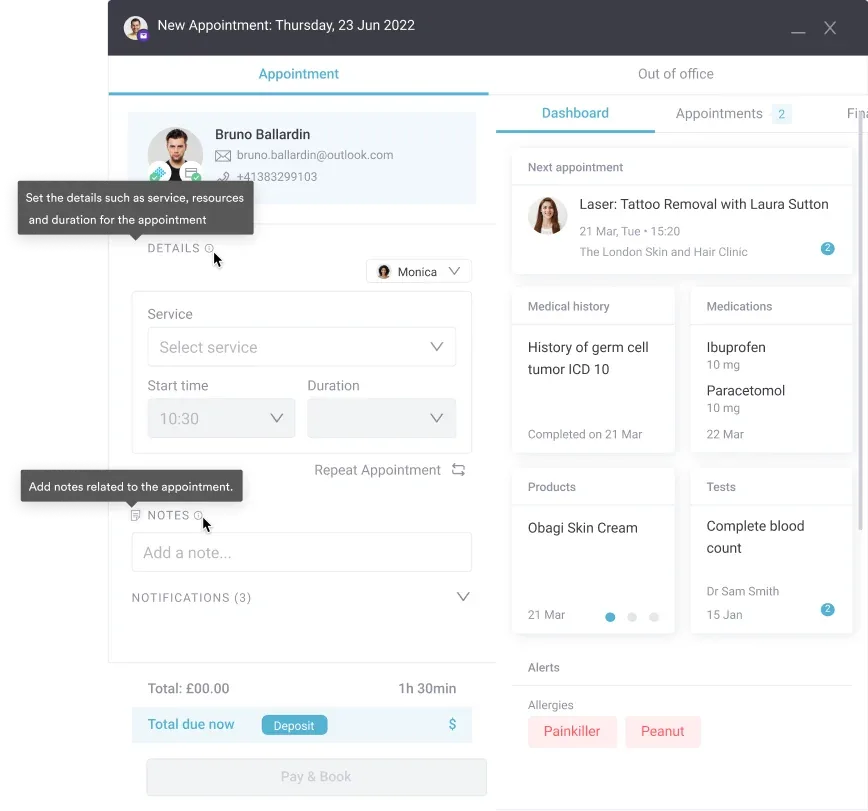
Billing CPT Code 00539 accurately requires four things to align: the correct code for the specific procedure performed, the right modifier pairing for the supervision arrangement, a complete anesthesia record with precise time capture, and an ICD-10-CM diagnosis code that supports medical necessity for tracheobronchial reconstruction.
Any one of these failing triggers a denial that costs the practice time and revenue to resolve.
Pabau’s claims management tools help anesthesia and surgical practices close those gaps at the workflow level, before claims go out rather than after denials come back. To see how the platform handles complex anesthesia billing workflows, book a demo with the Pabau team.

Coding an unspecified corneal scar? ICD-10 code H17.9 applies when a corneal scar or opacity cannot be classified under a more specific subcode.
Need a reference for a related anesthesia code? 01120 covers anesthesia billing for bony pelvis procedures using the same base-unit-plus-time-unit structure.
Coding a cardiac device implant alongside anesthesia? C1722 breaks down billing for the single-chamber defibrillator devices covered under CPT Code 00534.
CPT Code 00539 is used to bill anesthesia services for intrathoracic tracheobronchial reconstruction procedures. It describes the provision of general anesthesia for surgical repair and reconstruction of the trachea and bronchi, typically performed for conditions such as tracheal stenosis, tracheal tumors, post-intubation strictures, or congenital airway abnormalities. The code falls within the 00500-00599 intrathoracic anesthesia subsection maintained by the AMA.
Base unit values for CPT Code 00539 are assigned by the American Society of Anesthesiologists (ASA) Relative Value Guide and recognized (sometimes at different values) by CMS for Medicare purposes. Because these values are subject to annual updates and payer-specific variation, verify the current base unit value against the ASA’s current RVG and the CMS anesthesia base unit file before billing. Do not rely on historical figures published without a specific payment year citation.
The applicable modifiers for CPT Code 00539 depend on who delivered the anesthesia and the supervision arrangement: AA for personally performed anesthesia by a physician anesthesiologist; QK when the physician is medically directing 2-4 concurrent CRNA/AA cases; QX for the CRNA under medical direction; QY when a physician directs a single CRNA; QZ for an independent CRNA in an opt-out state; and AD when a physician supervises more than 4 concurrent cases. QS, G8, and G9 apply to monitored anesthesia care (MAC) scenarios, subject to clinical circumstances and payer policy.
CPT 00539 covers anesthesia specifically for tracheobronchial reconstruction, where the airway is surgically repaired or restructured. CPT 00540 covers anesthesia for thoracotomy procedures not otherwise specified, including lobectomy and pneumonectomy. The key distinction is procedure type: if the operative report documents reconstruction of the trachea and bronchi, use 00539; if the procedure is a general thoracotomy or lung resection without airway reconstruction, 00540 or another adjacent code is more appropriate. Review the operative note before assigning either code.
MAC billing eligibility for CPT Code 00539 depends on clinical circumstances and individual payer policy. Tracheobronchial reconstruction typically requires general anesthesia given the complexity of airway management involved, making MAC uncommon for this procedure. However, if MAC is clinically appropriate and documented, QS (and potentially G8 or G9) modifiers may apply. Confirm MAC eligibility with your MAC contractor and the specific commercial payer before billing.
Common ICD-10-CM codes used with CPT Code 00539 include J95.5 (post-procedural subglottic stenosis), J39.8 (other specified diseases of upper respiratory tract), Q32.1 (congenital malformations of trachea), C34.10 (malignant neoplasm of bronchus or lung), and D38.1 (neoplasm of uncertain behavior of tracheobronchial tree). Always verify codes against the current fiscal year’s ICD-10-CM tabular list and use the AAPC CPT-to-ICD-10 crosswalk tool to confirm medical necessity alignment before submission.