CPT code 56606: Vulvar biopsy additional lesion billing guide
CPT code 56606: Official descriptor and add-on code classification CPT code 5660...

Last Updated: Nov 26, 2026
V0310 is the CCSD code for an exploratory open craniotomy, a surgical procedure. It covers opening the skull through a bone flap so the surgeon can inspect an intracranial problem that imaging has not explained.
The code sits in sub-chapter 2.2.0 Cranium of the CCSD schedule used by UK private medical insurers, under CCSD reference Fb.020. When the surgeon goes on to treat what they find, the code for that treatment normally replaces V0310.
Let Pabau's smart automation suggest the right codes, reduce claim denials, and keep your practice compliant—effortlessly.
Automate repetitive tasks and focus on what matters most—your patients.
Reduce coding errors and ensure compliance with the latest regulations.
Clean claims, fewer denials, and faster reimbursements.
Powerful insights and reporting to help your practice thrive.
HIPAA compliant SOC 2 certified GDPR-compliant Trusted by 4,000+ clinics worldwide

CCSD code V0310 covers an exploratory open craniotomy, where the surgeon opens the skull to inspect an intracranial problem that imaging hasn’t explained.
UK private insurers such as Bupa, AXA Health, Aviva and Vitality generally expect planned surgery to be pre-authorized. Get the authorization reference before the operation.
The code sits in CCSD sub-chapter 2.2.0 Cranium under reference Fb.020, and National Friendly’s schedule places it in the Major Plus band.
If the surgeon goes on to biopsy, excise or drain what they find, code that procedure instead. CCSD treats the craniotomy as the approach to it.
The operation note has to state the exploratory intent and the findings, so the insurer can match it to the V0310 narrative.
UK private insurers authorize and pay for an exploratory open craniotomy under CCSD code V0310. National Friendly’s CCSD-based schedule of fees, for example, lists V0310 among the procedures its policies provide benefit for, in the Major Plus band.
CCSD stands for the Clinical Coding & Schedule Development group, which maintains the procedure codes used across UK private and independent healthcare. The group brings together representatives of the major UK private medical insurers. Its schedule gives V0310 the narrative “Exploratory open craniotomy”, and insurers such as Bupa, AXA Health, Aviva and Vitality work from it.
The key word in that narrative is “exploratory”. V0310 describes an operation whose purpose is to open the skull, look and decide. The surgeon doesn’t yet know what they will find, or whether it can be treated in the same sitting.
The CCSD Group publishes the codes, but each insurer sets its own complexity band and fee. National Friendly, for example, lists a £949 procedure fee for V0310. Check the schedule of the insurer that is paying before you invoice. For the other procedure codes in the schedule, browse our CCSD code library.
In an exploratory open craniotomy, the neurosurgeon lifts a temporary bone flap from the skull to reach the space inside it. The steps are the same whether the operation stops at exploration or goes further.
Step four is where the coding decision is made. If the operation ends after inspection, V0310 describes it. If the surgeon takes a biopsy, removes a lesion or drains a collection, it has become a different operation, and the code changes with it.
The CCSD technical guide and business rules explain why. Therapeutic procedures include the approach to the organ when both are done at the same time. The code is meant to capture the most significant intervention, not every step.
The craniotomy is the approach. So when a planned exploration turns into an evacuation or an excision, the treatment code describes the operation, and V0310 doesn’t sit beside it.
The guide also covers abandoned procedures, which are coded to the stage reached rather than the intention. If a planned excision stops once the skull is open and the area inspected, the stage reached may be an exploratory craniotomy.
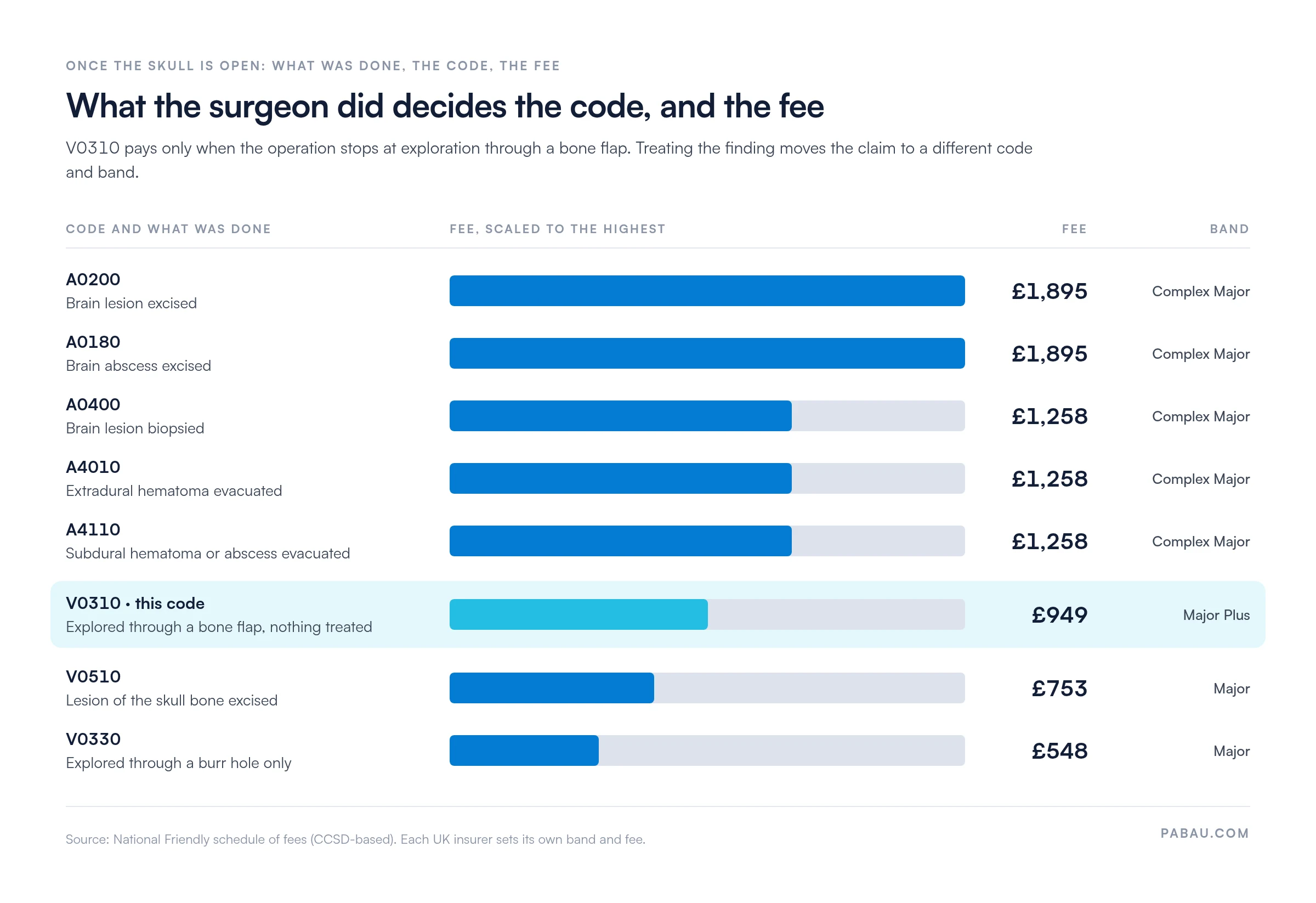
The table lists the codes most likely to replace V0310. Narratives come from the CCSD schedule, and bands and fees from National Friendly’s schedule.
Getting this wrong costs money as well as accuracy. Coded as V0310, a subdural hematoma evacuation would be paid at £949 in National Friendly’s schedule, not £1,258. The narrative on the claim wouldn’t describe the operation either. Set side by side, the fees show how far each outcome moves the claim.
V0310’s own CCSD record cross-references about 30 other codes in its coding principles, including A0400, A4010 and A4110. The CCSD website flags each code’s unacceptable combinations, so check that list before you put V0310 on a claim with another code. Insurers also set their own rules on multiple codes, so ask the insurer first.
Review your V0310 claims every quarter against the operation notes. If a note describes a biopsy, an excision or an evacuation, the claim needed that code instead. Change the note template so the findings section asks what was done, not only what was seen.
Insurers want to know why the skull is being opened before they authorize surgery. Record the indication in the referral, the pre-authorization request and the operation note in the same terms. The WHO ICD-10 browser holds the codes below, which often describe a V0310 patient.
Where the findings change the diagnosis, record both: The indication that justified exploring, and what the operation found. That trail shows the insurer why an exploratory code was the right one. If a suspected abscess turns out to need excision, the claim moves to A0180 instead.
A V0310 claim is only as strong as the operation note behind it. If the note just says “craniotomy”, the coder can’t tell whether the surgeon explored, biopsied or excised, and the insurer may query it.
UK insurers such as Bupa, AXA Health, Aviva and Vitality generally ask for planned surgery to be approved in advance. The patient’s policy decides what is covered, so confirm each step with the insurer. Our guide to Bupa CCSD codes covers how Bupa handles CCSD claims.
An exploratory craniotomy is sometimes urgent. When surgery can’t wait for approval, contact the insurer as soon as you can and ask how it handles authorization after the event.
The anesthetist usually bills separately for the same operation. Check whether the insurer wants both claims to carry the same authorization reference.
Each of these slips gives the insurer a reason to query a V0310 claim, and each one has a fix.
If a claim is still refused, follow the appeal process in the insurer’s current provider manual. Quote the operation note’s findings in your reply, since they explain the code.
Neurosurgical claims pass through many hands. The authorization often arrives by email, the operation note sits in another system, and the claim is keyed in by hand. Every handoff is a chance to lose the reference or bill the booked code instead of the right one.
Pabau keeps those steps on the patient record. Its claims management software sends claims electronically through Healthcode and to Bupa. The authorization code, dates and sessions sit on the patient’s case, with a warning when one is missing.
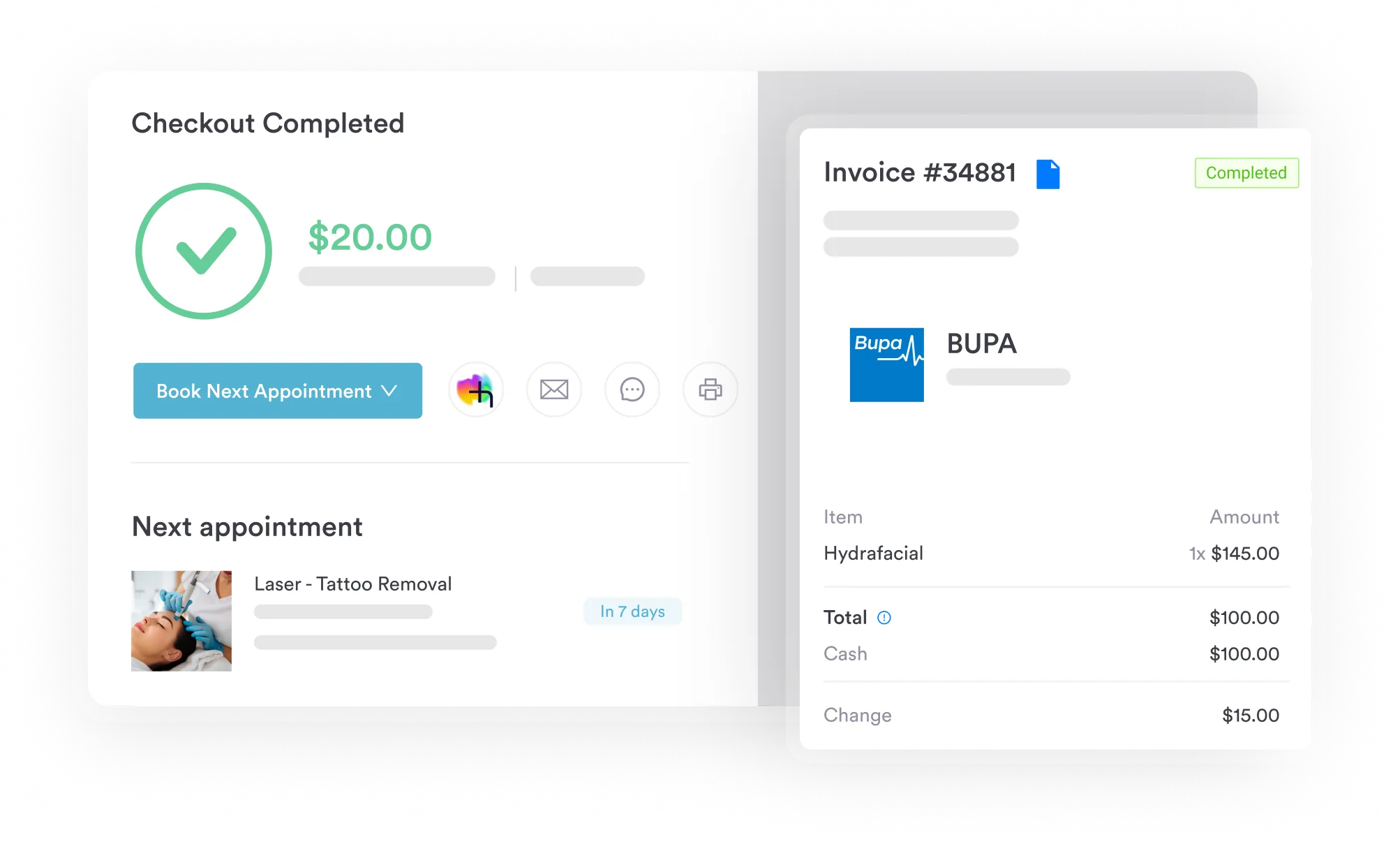
When the note and the claim live on the same record, your coder can check the code against the findings before the claim leaves. A craniotomy that became a biopsy goes out as a biopsy, and fewer claims come back for rework.

Pabau tracks authorization codes on the patient’s case and sends claims electronically through Healthcode and to Bupa. You see each claim’s status without phoning the insurer.

V0310 is the code for not knowing yet. It fits an operation that opens the skull, looks and closes, and it stops fitting once the surgeon treats what they find. Most V0310 problems come from claims coded from the booking instead of the note.
Build a note template that records the indication, the bone flap and what was and wasn’t done. Then check each insurer’s current schedule before you invoice. Book a demo to see how Pabau tracks authorizations and sends your Healthcode claims from one patient record.

Looking for another CCSD procedure code? CCSD codes lists the procedure codes Pabau covers, chapter by chapter.
Need a full Bupa CCSD billing reference? Bupa CCSD codes covers Bupa’s procedure list and how its claims work.
Did the surgeon take a biopsy? CCSD code A0400 explains how to code a brain biopsy for UK insurers.
Was a hematoma evacuated? CCSD code A4010 covers evacuation of an extradural hematoma.
CCSD code V0310 covers an exploratory open craniotomy. The surgeon lifts a bone flap from the skull to inspect an intracranial problem that imaging hasn’t explained, without treating it in the same operation.
CCSD is the Clinical Coding & Schedule Development group. It maintains the procedure codes used in UK private and independent healthcare, and insurers such as Bupa, AXA Health, Aviva and Vitality use its schedule.
V0310 sits in chapter 2.0.0 Brain, Cranium and Other Intracranial Organs, sub-chapter 2.2.0 Cranium. Its CCSD reference is Fb.020.
Not normally. The CCSD technical guide says a therapeutic procedure includes the approach to the organ when both are done together. Code the biopsy, excision or evacuation instead, and ask the insurer before combining codes.
V0310 is an exploratory open craniotomy, with a bone flap lifted from the skull. V0330 is an exploratory burr hole of the cranium. National Friendly’s schedule places V0310 in the Major Plus band and V0330 in the Major band.
Most UK insurers expect planned surgery to be pre-authorized, and the patient’s policy decides what is covered. For urgent surgery, contact the insurer as soon as you can, and put the authorization reference on the claim.
Submit it electronically via Healthcode or direct to the insurer, with the authorization reference and a fee that matches the insurer’s current schedule. Keep the operation note ready in case the insurer asks for it.