CPT Code 25210: Excision of a single carpal bone
CPT Code 25210: Official descriptor and quick-reference data CPT Code 25210 is a...

Last Updated: Nov 26, 2026
T6461 is the CCSD code for tendon transfer of toe – bilateral. It covers moving toe tendons to a new attachment point on both feet in one theatre session. The usual aim is to straighten flexible hammertoes or claw toes.
A transfer on one foot is billed as T6460. If a lesser-toe joint is also excised, T6462 applies instead. The CCSD lists T6461 as an unacceptable combination with both. UK private medical insurers set their own authorisation and payment rules.
Let Pabau's smart automation suggest the right codes, reduce claim denials, and keep your practice compliant—effortlessly.
Automate repetitive tasks and focus on what matters most—your patients.
Reduce coding errors and ensure compliance with the latest regulations.
Clean claims, fewer denials, and faster reimbursements.
Powerful insights and reporting to help your practice thrive.
HIPAA compliant SOC 2 certified GDPR-compliant Trusted by 4,000+ clinics worldwide

CCSD code T6461 is tendon transfer of toe, bilateral, listed in Chapter 16 of the CCSD schedule under section 16.11.5 Toes.
It covers transfers on both feet in the same sitting, billed as one T6461 line rather than two T6460 lines.
If a lesser-toe joint is also excised, T6462 applies, and the CCSD lists T6461 as an unacceptable combination with T6460 and T6462.
The CCSD schedule sets no fees, so pre-authorisation and payment follow each insurer’s own rules.
The operative note must describe each foot separately, naming the toes, the tendon moved and any K-wire.
CCSD code T6461 is the UK private billing code for a tendon transfer of toe performed on both feet in one sitting. It comes from the CCSD schedule, maintained by the Clinical Coding and Schedule Development Group. Insurers such as Bupa, AXA Health, Aviva and Vitality use its codes to authorise and pay claims.
The code sits in Chapter 16, which covers bones, joints and connective tissue. Within that chapter, it belongs to section 16.11.5 Toes, next to the unilateral code T6460 and the joint-excision code T6462. Claims usually reach the insurer electronically through Healthcode.
The descriptor ends in “bilateral”, and that word sets the scope. Both feet must be operated on in the same theatre session. The full CCSD codes reference explains how the chapters fit together.
A tendon transfer moves where a tendon attaches, while its muscle stays in place. On a lesser toe, the aim is to turn a tendon that curls the toe down into one that holds it straight. The classic version is the flexor-to-extensor transfer, often called the Girdlestone-Taylor procedure.
On each foot, it usually runs like this:
Under T6461, the surgeon completes that sequence on both feet under a single anaesthetic. The transfer suits a flexible deformity, where the toe straightens when you push up under the ball of the foot. A fixed, rigid deformity usually needs joint work too, and that changes the code. Arthritis in the big toe joint is billed under other codes. A cheilectomy for hallux rigidus on one foot, for example, takes CCSD code W0860.
A bilateral transfer makes sense when both feet show the same flexible deformity and footwear changes, padding or orthoses have not helped. The usual indications are:
Operating on both feet means one anaesthetic and one recovery period, but both feet are out of action at once. The consultation letter should explain why the surgeon chose simultaneous correction over staged surgery. That reasoning helps if the insurer asks about it at authorisation.
Three neighbouring entries cover toe tendon transfers. Two questions sort them out, in this order. Was a lesser-toe joint excised as well as the tendon moved? And was one foot treated, or both?
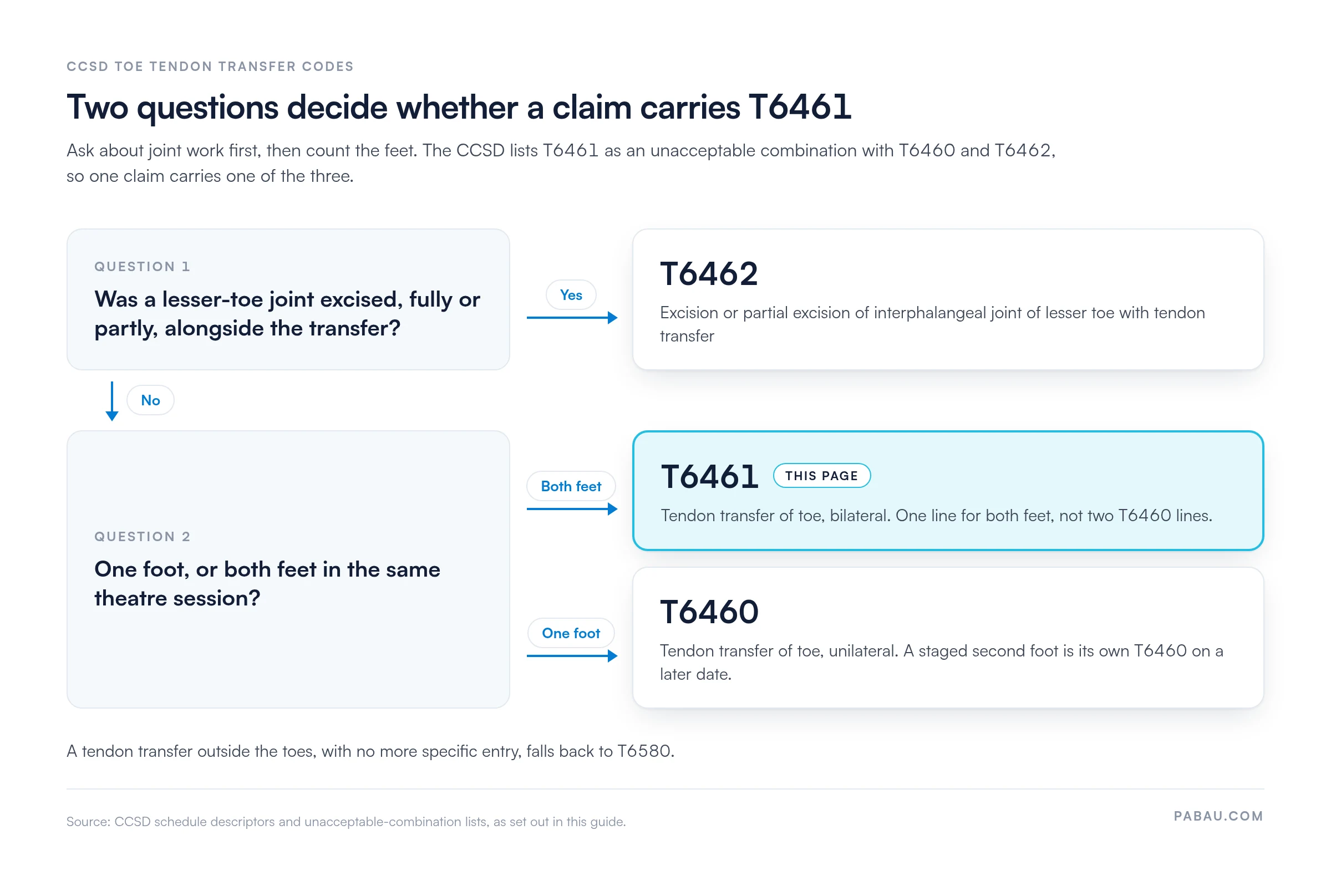
The CCSD lists T6461 as an unacceptable combination with T6460 and T6462, and with W0310 from the forefoot section. Put simply, those codes should not appear with T6461 on one claim.
The CCSD technical guide adds a caveat. These lists are guidelines, and each insurer decides whether to apply them. The CCSD Group also states that its schedule does not determine reimbursement or fees.
Staged surgery is coded differently. If the second foot is operated on at a later date, each operation is unilateral, so each date carries its own T6460. A sitting that pairs a plain transfer on one foot with joint excision on the other does not fit T6461 neatly. Agree the coding with the insurer before surgery.
The descriptor also leaves open how several toes on the same foot are counted. Ask the insurer before you add any extra line for further toes.
A T6461 claim stands or falls on the operative note. A coder reads it to choose between three codes, and an insurer reads it to check the choice. For a bilateral code, it should record:
A note copied from one side to the other invites a query. If the findings differ between the feet, record the difference.
UK private claims use the WHO edition of ICD-10, not the US ICD-10-CM. Make sure the diagnosis matches the toes and sides described in the note. These codes come up most often:
UK private medical insurers generally expect pre-authorisation before planned surgery, and each sets its own process. The member or the practice contacts the insurer with the planned code and diagnosis, then receives an authorisation reference. Have these ready:
Timescales and the documents required vary by insurer and by policy. If the plan changes in theatre, contact the insurer before you submit the claim.
Before you submit a T6461 claim, run three checks. Does the authorisation reference cover T6461 rather than T6460? Does the operative note describe the left and right foot separately? And does the diagnosis code match the one given at authorisation?
Bilateral toe surgery claims tend to trip over the same few mistakes. Each one has a simple fix.
The technical guide says no common procedure should routinely need more than one code. Each insurer still sets its own rules on multiple codes, and the Bupa CCSD codes guide shows how one insurer applies the schedule.
Consultant orthopaedic surgeons with a foot and ankle practice perform most toe tendon transfers. In the UK, they hold entry on the GMC Specialist Register. Some insurers also recognise podiatric surgeons, who are HCPC-registered podiatrists with further surgical training.
Recognition is set by each insurer, not by the CCSD schedule. Confirm that the insurer recognises the surgeon for this procedure before the operation is booked. The anaesthetist and the hospital bill separately, quoting the same authorisation reference.
Bilateral foot surgery doubles the detail a claim depends on. Two sides, several toes and any fixation all have to match the authorised code. Yet the authorisation is often agreed weeks before anyone knows what the surgeon will find.
Pabau, a practice management platform, keeps the clinical record and the claim on the same episode. Its claims management software pre-fills the insurer claim from the patient record and sends it through Healthcode.
Pabau checks required fields, such as membership and authorisation numbers, before sending, so a missing reference is flagged before the claim goes out. The note for each foot stays one click away when an insurer asks.
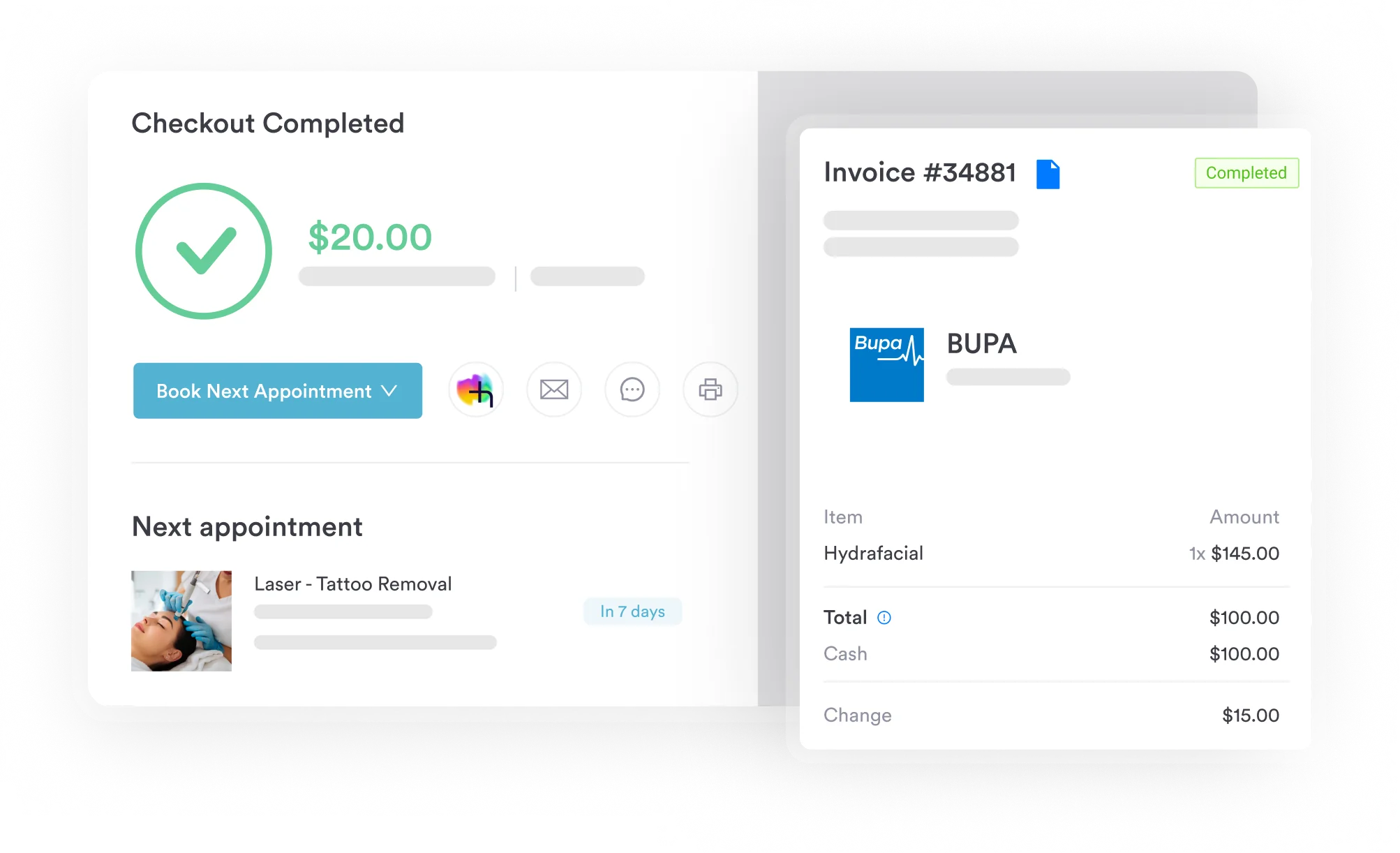

Pabau pre-fills insurer claims from the patient record and checks the authorisation reference before sending them through Healthcode. Your team spends less time rebuilding a claim after a query.

T6461 is one line for two feet. It pays for tendon transfers on both sides in the same sitting. Treat one foot, stage the second side or excise a joint, and a different code takes over.
The operative note decides the code more than any fee rule does. Describe each side, check that the authorisation covers T6461, and the insurer has little left to query.
Book a demo to see how Pabau keeps CCSD codes, authorisation references and operative notes on one patient record.

Operating on one foot only? CCSD code T6460 covers the unilateral toe tendon transfer and how it differs from T6461.
Excising a toe joint as well? CCSD code T6462 covers interphalangeal joint excision of a lesser toe with tendon transfer.
New to the CCSD schedule? CCSD codes explains how the chapters are organised and how UK insurers use them.
Need the wider Bupa view of the schedule? Bupa CCSD codes covers how Bupa applies the schedule, with billing rules and payer guidance.
Billing a tendon transfer outside the toes? CCSD code T6580 covers tendon grafts and transfers with no more specific entry.
CCSD code T6461 covers tendon transfer of toe, bilateral. It applies when a surgeon moves toe tendons on both feet in the same theatre session. It sits in Chapter 16 of the CCSD schedule, section 16.11.5 Toes.
No. T6461 belongs to the CCSD schedule, which UK private medical insurers use to process claims. OPCS-4 is the classification NHS hospitals use to record procedures.
T6460 is a tendon transfer of toe on one foot. T6461 is the same procedure on both feet in one sitting. T6462 covers excision or partial excision of a lesser toe interphalangeal joint with tendon transfer. The CCSD lists T6461 as an unacceptable combination with both.
UK private medical insurers generally expect pre-authorisation before planned surgery. Each insurer sets its own process and documents. Contact the insurer with the planned code and diagnosis code before booking the operation.
No. The CCSD Group maintains the codes and descriptors but does not determine reimbursement or fees. Each insurer applies its own benefit schedule and its own rules for bilateral procedures.
Common choices are M20.4 for other acquired hammer toes and M20.5 for other acquired toe deformities, which covers claw toe. G60.0 can be added when Charcot-Marie-Tooth disease drives the deformity. UK claims use the WHO edition of ICD-10.