

HCPCS Code Q4185: Cellesta flowable amnion billing guide
HCPCS Code Q4185: definition and official descriptor HCPCS Code Q4185 is the Lev...

Last Updated: Nov 20, 2026
L9580 is the CCSD code for varicography for recurrent varicose veins. It covers a contrast X-ray study of the leg veins. Dye is injected straight into visible varices under fluoroscopy to map where the veins have come back after earlier treatment.
UK private insurers use the code to identify the procedure for billing. It applies only when the notes record prior varicose vein treatment, and it isn't used for a first presentation.
Let Pabau's smart automation suggest the right codes, reduce claim denials, and keep your practice compliant—effortlessly.
Automate repetitive tasks and focus on what matters most—your patients.
Reduce coding errors and ensure compliance with the latest regulations.
Clean claims, fewer denials, and faster reimbursements.
Powerful insights and reporting to help your practice thrive.
HIPAA compliant SOC 2 certified GDPR-compliant Trusted by 4,000+ clinics worldwide

CCSD code L9580 covers varicography for recurrent varicose veins only, so it can’t be billed for first-presentation disease.
The procedure injects contrast directly into visible varices under fluoroscopic screening to map recurrent tributaries, perforators, and junctional incompetence.
If the clinical notes never use the word “recurrent,” the insurer can treat the claim as primary disease. That is a leading cause of L9580 denials.
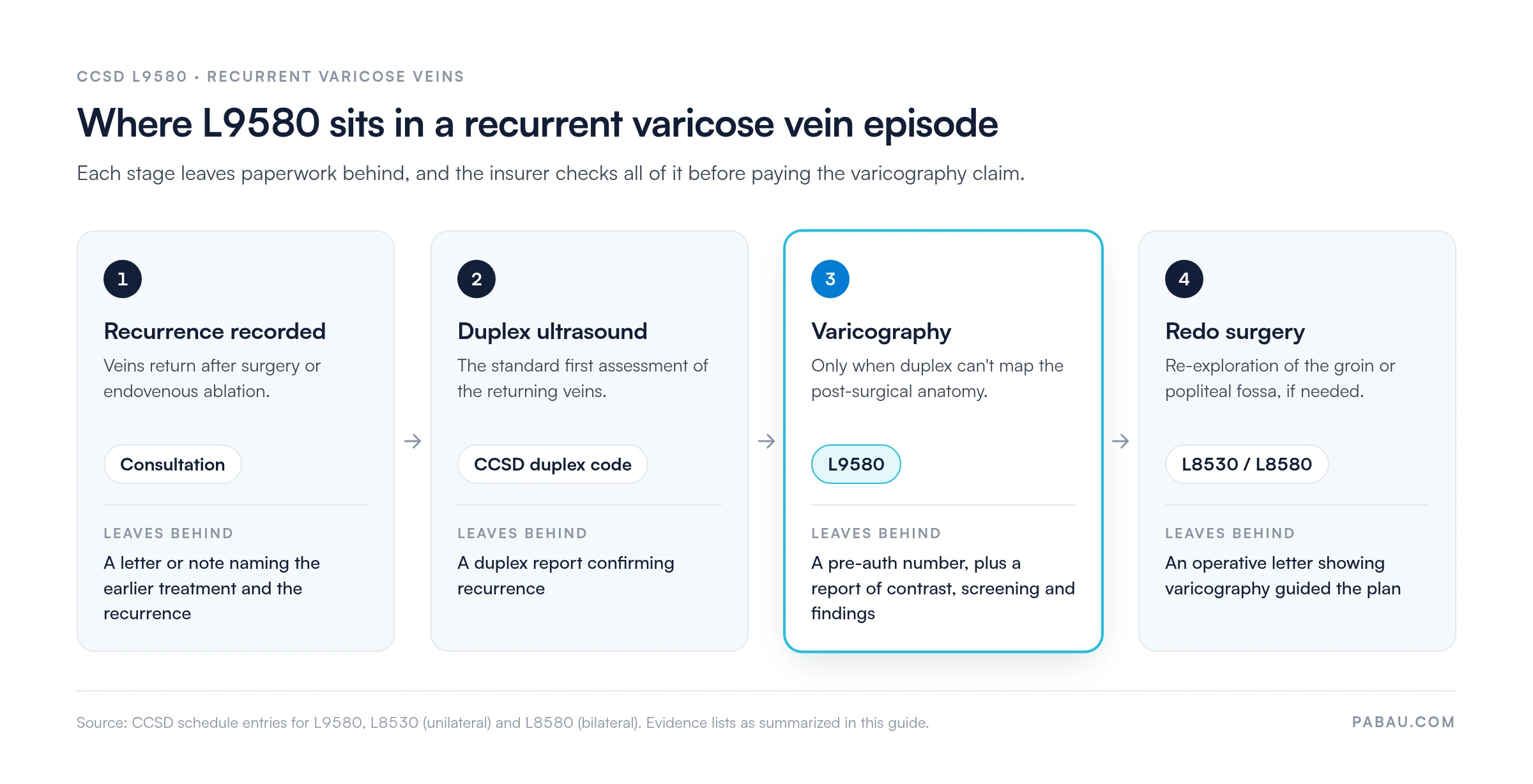
Redo surgery that follows the varicography is billed on its own line, under L8530 for one leg or L8580 for both.
Pabau’s claims management software keeps the CCSD code, the pre-auth number, and the procedure report on one patient record before submission.
CCSD code L9580 is the Clinical Coding and Schedule Development (CCSD) procedure code whose official descriptor is “Varicography for recurrent varicose veins.” CCSD’s own entry for the code lists that descriptor under reference FI.079a. It sits within the vascular chapter of the CCSD schedule, the schedule most UK private insurers use to identify procedures for billing.
Vascular surgeons, interventional radiologists, and their billing teams use it to bill private medical insurers for a contrast study of returning varicose veins. Its neighbors in the vascular chapter sit with the rest of the CCSD codes in our code library.
Three facts define L9580 at a glance:
The word “recurrent” is built into the descriptor. Your clinical notes and your pre-authorization request both have to show recurrence, not a patient presenting with varicose veins for the first time.
Varicography is a contrast venography technique. Iodinated contrast medium is injected directly into visible surface varices while the leg is imaged under fluoroscopic (X-ray) screening. The images map recurrent tributaries and identify incompetent perforating veins.
They also reveal junctional incompetence at the saphenofemoral junction (SFJ) or saphenopopliteal junction (SPJ). That incompetence may have been missed at the first operation, or the vein may have recanalized since.
The procedure follows a standard sequence:
Varicography is most useful after earlier varicose vein surgery, because scar tissue often distorts the venous anatomy. Duplex ultrasound can miss deep perforators or unusual tributary patterns in that setting. Varicography gives the redo surgeon a road map that duplex scanning alone can’t always provide.
L9580 is appropriate only when recurrent varicose vein disease is the established clinical context. It shouldn’t be assigned for a patient with untreated primary varicose veins. In UK private vascular practice, these scenarios justify varicography and support L9580 billing:
Varicography is not a first-line investigation, and duplex ultrasound remains the standard initial assessment. The surgeon turns to it, and to L9580, when duplex findings can’t support a safe plan for redo surgery.
Bill L9580 only for contrast varicography in recurrent disease. Color duplex scanning, for primary or recurrent reflux, takes a CCSD duplex ultrasound code instead. Coders mix the two up because both assess venous disease, but the modality, the contrast, and the indication all differ:
Whether duplex ultrasound and varicography can both be billed in one episode depends on two things. Those are the CCSD edition in force and the insurer’s own bundling rules. Verify against the current CCSD schedule and your insurer’s fee schedule before submitting both on a single claim.
L9580 rarely sits alone on a claim. The table below lists codes commonly billed alongside or instead of L9580 in a recurrent varicose vein episode. Always verify current code descriptors against the CCSD schedule and the Bupa procedure fee schedule before submission. Bundling rules and fee values are edition-specific.
When the varicography leads to redo surgery, the operation goes on its own claim line. L8530 covers re-exploration of the groin or popliteal fossa on one leg, and L8580 covers both legs. The flow below shows where each code falls in the episode and what paperwork each stage leaves behind.
Three ICD-10 diagnosis codes are relevant to the claim. I83.1 covers varicose veins of lower extremities with inflammation, and I83.2 covers varicose veins with both ulcer and inflammation. I83.9 covers varicose veins without ulcer or inflammation. None of these codes records recurrence, so the clinical notes have to carry it.
Verify the current ICD-10 edition against the Healix fee schedule and your insurer’s coding requirements before assignment, because code coverage is insurer-specific.
Always confirm the CCSD edition year on your insurer’s fee schedule before billing. Bundling rules, fee values, and modifier requirements change between editions. Submitting a claim based on a superseded edition is a preventable denial.
Incomplete documentation is a common reason insurers reject L9580 claims, alongside missing evidence of prior treatment. A patient record that timestamps each entry and ties it to the submitted code makes the package easier to defend. Insurers reviewing an L9580 claim expect all of the following:
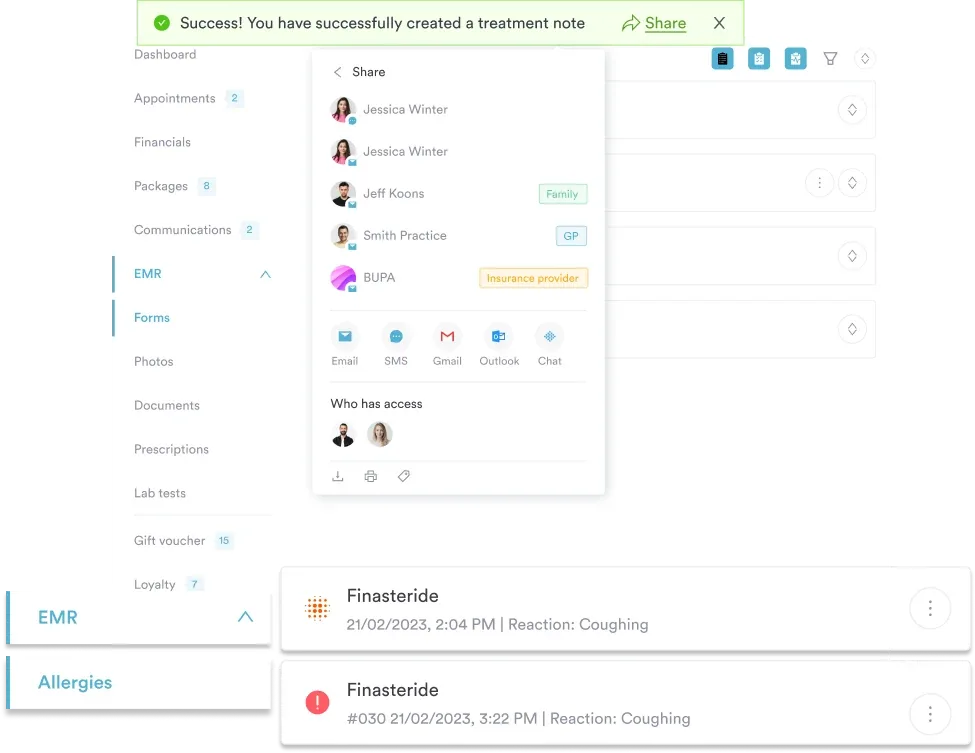
Store digital clinical forms with the procedure report in the same patient record, and the full package is ready when an insurer asks for evidence. A claim sent without the radiology report, or with a report that never says “recurrent,” is an avoidable denial.
Most major UK private medical insurers require pre-authorization for L9580 before the procedure takes place. A varicography claim without a valid pre-auth number is almost certain to be denied, however strong the clinical case.
The table below summarizes typical pre-auth requirements across the main payers. Each insurer updates its own criteria, so check the current version before you request authorization.
When you request pre-auth, the CCSD code on the request must match the insurer’s own fee schedule exactly. Our Bupa CCSD codes guide shows how to check a code against Bupa’s schedule.
A pre-auth granted for the wrong code, or an adjacent one, won’t cover the L9580 claim at payment. Keep the pre-auth reference number on the patient record, so it’s on hand at claim submission.
L9580 claims follow a predictable pattern of denial when documentation or administrative steps are skipped. These are the six rejection triggers to watch for:
Knowing the scope of L9580 prevents under-billing, where legitimate extra codes are missed, and overbilling, where bundled items are itemized again. The breakdown below follows standard CCSD bundling conventions. Check it against the edition in force on the date of service, because inclusion rules change between schedule updates.
Bilateral varicography means studying both legs in the same session, and it’s a common clinical scenario. Code it wrong and the practice is either underpaid or faces an unbundling query.
The key questions for bilateral L9580 are:
Miss the bilateral coding on a two-leg session and you’ll be chasing the second leg’s fee through a re-claim. Getting it right at submission is far less work.
A clean L9580 claim follows a six-step workflow. Each step corresponds to a denial risk: Skip one, and the claim is likely to be queried or rejected.
Run a weekly audit of pending L9580 claims and filter by status. A claim unpaid after 30 days with no denial code has likely been held for supporting documentation. Send that documentation before the insurer formally rejects the claim.
In many practices, an L9580 claim is assembled from four places. The consultation letter sits in one system, the duplex report in another, and the pre-auth number in an email. The radiology report lands in a shared folder, and every handoff is a chance for the word “recurrent” to drop out.
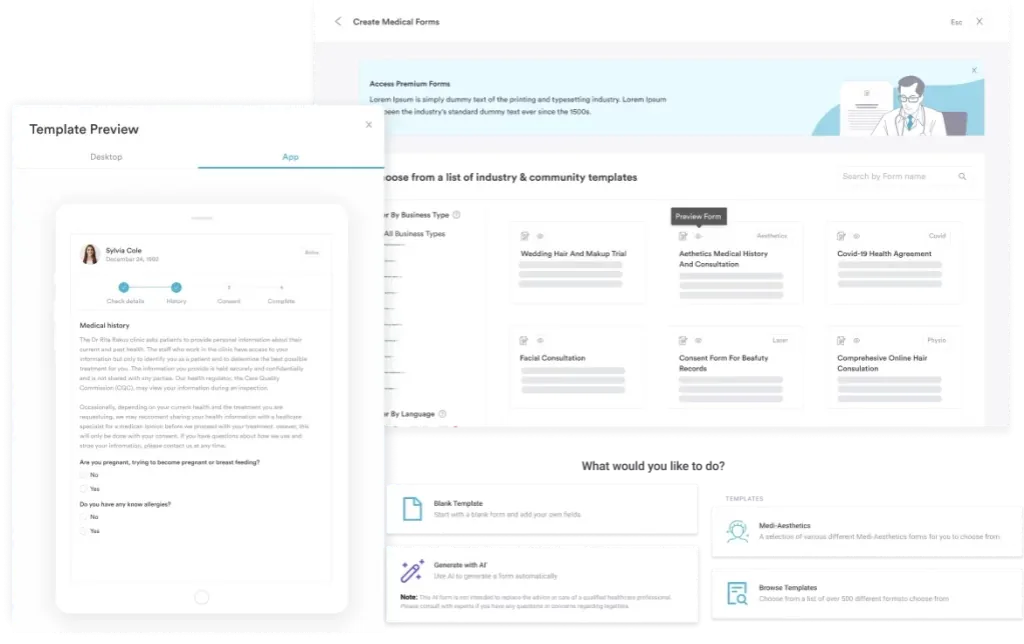
Pabau keeps those pieces on one patient record. Your vein consultation form can ask about earlier treatment, so the answer lands in the record from the first visit. The pre-auth code, dates, and sessions are tracked on the case, with a warning when one is missing. Claims then go to UK insurers through Healthcode, or directly to Bupa.
The result is a varicography claim that leaves complete. Your team spends less time rebuilding the paperwork after an insurer query, and more L9580 claims are paid on first submission.

Pabau lets UK private practices record CCSD codes, track pre-auth numbers, and submit insurer claims from the patient record. Varicography claims go out complete the first time.

An L9580 claim pays when the record proves recurrence before anyone builds the claim. Get the consultation letter, the duplex report, the pre-auth number, and the radiology report onto one record first. The code, the diagnosis, and the bilateral line then follow from documents the insurer can check.
The trade-off is a little more discipline at consultation in exchange for far fewer re-claims. A note that says “recurrent” costs one word, and a note without it can cost the whole varicography fee.
Book a demo to see how Pabau keeps CCSD codes, pre-auth numbers, and procedure reports together for UK vascular practices.

Need a full reference for Bupa procedure codes? Bupa CCSD codes guide covers the full schedule structure and how to look up codes in the Bupa portal.
Looking for the Bupa procedure fee values? Bupa procedure fee schedule provides a detailed breakdown of fees across CCSD chapters including vascular procedures.
Want to reduce claim submission errors across your practice? Claims management software from Pabau links CCSD codes, pre-auth numbers, and documentation in a single submission workflow.
Billing a phlebectomy after the varicography? CCSD code L8750 covers local excision of varicose veins by multiple phlebectomy.
Coding a saphenous vein stripping? CCSD code L8700 covers saphenous vein ligation and stripping.
CCSD code L9580 covers varicography for recurrent varicose veins. This is a contrast-based fluoroscopic study that maps venous anatomy after earlier varicose vein treatment. It includes the surgeon’s or radiologist’s professional time, standard fluoroscopy screening, and a standard contrast volume. It doesn’t cover anesthesia, excess contrast, or a therapeutic procedure on the same day.
No. L9580 is restricted to recurrent varicose veins, because the official CCSD descriptor says “recurrent varicose veins.” Billing it for a patient with no prior treatment is an indication mismatch that will trigger denial. Use the appropriate primary varicose vein procedure or duplex codes for first-presentation disease.
Standard contrast volumes are typically included within L9580 under CCSD bundling conventions. Contrast above the schedule allowance may be billed separately, with the clinical justification documented in the procedure report. Check the CCSD edition in force on the date of service, because bundling rules are edition-specific.
L9580 covers fluoroscopic contrast varicography and is restricted to recurrent disease. CCSD duplex ultrasound codes cover color duplex scanning, which needs no contrast or radiation and suits primary or recurrent disease. The two can complement each other in complex cases. Whether both are billable in one episode depends on the insurer and the current CCSD schedule, so verify before submitting both.
The leading rejection reasons are missing evidence of prior varicose vein treatment and a missing or thin procedure report. Pre-authorization that was never obtained, or was obtained for the wrong code, is another. So is a diagnosis whose notes describe primary rather than recurrent disease. A bilateral session billed as one unilateral unit usually leads to underpayment rather than outright denial.
When a therapeutic procedure follows the varicography, L9580 is often billed with recurrent varicose vein surgery codes. Those come from the L85xx series (for example L8530 and L8580). An anesthesia code is added if sedation or general anesthesia was given. A color duplex code may appear if the scan was separate and not bundled under the insurer’s rules. Check the insurer’s same-day billing rules before submitting multiple codes on one claim.





