CPT Code 19361: Latissimus dorsi flap breast reconstruction
CPT code 19361: Official descriptor and payment basics CPT code 19361 is the Cat...

Last Updated: Nov 18, 2026
T2200 is the CCSD code for primary repair of femoral hernia, the first operation on a femoral hernia in UK private practice. It is the standard repair code, while recurrent, strangulated and robotic-assisted femoral repairs carry codes of their own.
T2200 sits in chapter 11 of the CCSD Schedule, Abdominal Wall. Insurers expect it paired with an ICD-10 K41 diagnosis code and, for elective surgery, a pre-authorisation reference.
Let Pabau's smart automation suggest the right codes, reduce claim denials, and keep your practice compliant—effortlessly.
Automate repetitive tasks and focus on what matters most—your patients.
Reduce coding errors and ensure compliance with the latest regulations.
Clean claims, fewer denials, and faster reimbursements.
Powerful insights and reporting to help your practice thrive.
HIPAA compliant SOC 2 certified GDPR-compliant Trusted by 4,000+ clinics worldwide

CCSD Code T2200 covers the primary, first-time repair of a femoral hernia, and a recurrent femoral repair is coded T2300 instead.
T2200 is the standard primary femoral repair code, while robotic-assisted (T2210, T2221) and strangulated (T2280) repairs have codes of their own.
Pair T2200 with an ICD-10 K41 diagnosis code that states laterality and obstruction status, or the insurer is likely to reject the claim.
Most major UK PMI insurers, including Bupa and AXA Health, require pre-authorisation before an elective femoral hernia repair can be billed.
CCSD Code T2200 is the Clinical Coding and Schedule Development code for the primary repair of femoral hernia. It applies when a consultant surgeon repairs a femoral hernia for the first time in a UK independent-sector setting. The CCSD Schedule holds the standard procedure codes for the UK private healthcare sector, and its governing group includes four major private insurers.
T2200 sits in chapter 11 of the schedule, Abdominal Wall, alongside the other hernia codes. Femoral repairs use T22xx codes plus T2300, which covers a recurrent femoral hernia. T2200 is reserved for a first operation on that femoral canal.
A femoral hernia occurs when abdominal contents protrude through the femoral canal, below and lateral to the inguinal ligament. Primary repair reduces the hernial contents and closes the defect in the femoral canal. The approach differs from inguinal repair, and the narrow femoral ring makes strangulation more likely. That higher risk shapes the urgency classification and the documentation insurers expect.
Most femoral hernia repairs in the independent sector are day-case surgery under general or regional anaesthesia. The British Hernia Society recommends tension-free mesh repair where bowel resection is not required. Sutured repair is still used in specific clinical circumstances.
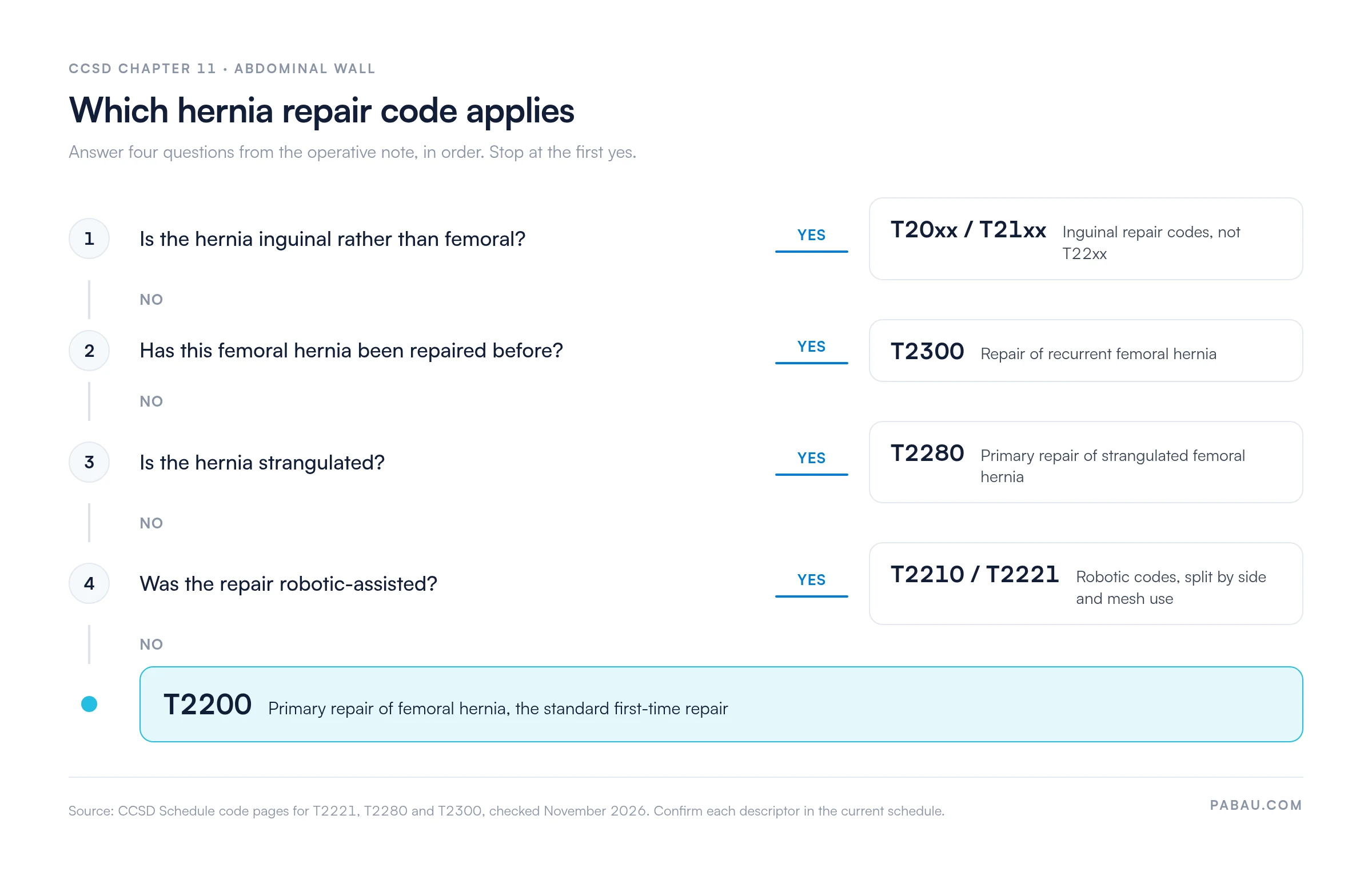
It can. T2200 is the standard code for a primary femoral hernia repair, but the CCSD Schedule holds separate codes for several variants. Robotic-assisted repairs have their own codes, such as T2210 for a unilateral repair not requiring mesh and T2221 for a bilateral repair requiring mesh. A strangulated femoral hernia repaired for the first time is coded T2280.
Check the current schedule for the variant that matches the operative note before you submit. The CCSD revises codes in each publication cycle, so a code chosen from memory can be out of date.
Inguinal hernia repairs use T20xx and T21xx codes, such as T2000 for an open repair and T2002 for a laparoscopic one. Femoral repairs use T22xx codes and T2300. Coding across these two ranges is a common error, and within the femoral range the next distinction is primary versus recurrent.
Confirm the hernia type intraoperatively before coding, because an operative note that describes the anatomy ambiguously invites an insurer query. If T2200 and T2300 could both apply, check the patient’s surgical history with the surgeon before the claim goes in. Our CCSD codes library covers the neighbouring abdominal wall codes, and the flow below sets the order of the checks.
Femoral and inguinal hernias occur in adjacent anatomical locations but are clinically and surgically distinct. Using an inguinal code (T20xx or T21xx) for a femoral hernia repair, or the reverse, is a known audit trigger for UK PMI insurers. It can lead to a claim query or rejection, so the operative note must state the anatomy explicitly.
CCSD Code T2200 is a procedure code and must be paired with an ICD-10 diagnosis code on the claim. The diagnosis comes from category K41, femoral hernia, in Chapter XI (Diseases of the digestive system). Laterality and obstruction status decide the specific code. A K40 inguinal code alongside T2200 is a data-inconsistency error that most PMI insurer systems flag automatically.
K41.9 is the code most often used alongside CCSD Code T2200 in elective private practice. When bowel resection is required, additional procedure codes apply beyond the hernia repair. Discuss them with the operating surgeon before submitting the claim.
Confirm laterality in the operative note before coding the ICD-10. If the note describes a unilateral repair but does not specify left or right, ask the surgeon to clarify before submission. Some PMI systems flag unspecified laterality as an incomplete record and generate an automatic query.
A complete operative note is the biggest factor in getting a T2200 claim paid first time. Insurers audit surgical claims against the documentation they receive. Vague or incomplete notes are a leading cause of queries and delayed payment.
Include these elements in the operative note or claim documentation for a femoral hernia repair:
Most UK PMI insurers require pre-authorisation before an elective femoral hernia repair. A T2200 claim submitted without a valid pre-auth reference is a frequent cause of non-payment. Obtain the reference before the procedure, because no major insurer guarantees retrospective authorisation. Policies change, so verify current requirements with each insurer.
When requesting pre-auth, provide the CCSD code (T2200), the proposed ICD-10 diagnosis code (K41.x), and the consultant’s GMC number. Add the anticipated procedure date and the hospital or independent practice where the procedure will take place.
Femoral hernia repair claims face a predictable set of denial triggers. Most are avoidable with the right documentation habits. The table below maps each common cause to the prevention action.
T2200 covers the primary surgical procedure only. Other elements of the episode of care are billed separately and must not be bundled into the T2200 claim line.
Healthcode is the standard electronic billing platform for UK private healthcare invoicing. Most PMI insurers, including Bupa and AXA Health, receive claims through Healthcode’s system. The steps below cover a standard CCSD Code T2200 submission.
Healthcode’s system flags common data errors before submission, such as a missing GMC number, an unrecognised CCSD code or a mismatched diagnosis. Resolve any flagged errors before confirming the claim.
Managing T2200 claims by hand means tracking a different pre-authorisation process and set of documentation requests for each insurer. Pabau, the practice management platform we build, brings that work into its claims management software. Each claim then starts from the patient’s case rather than a spreadsheet.
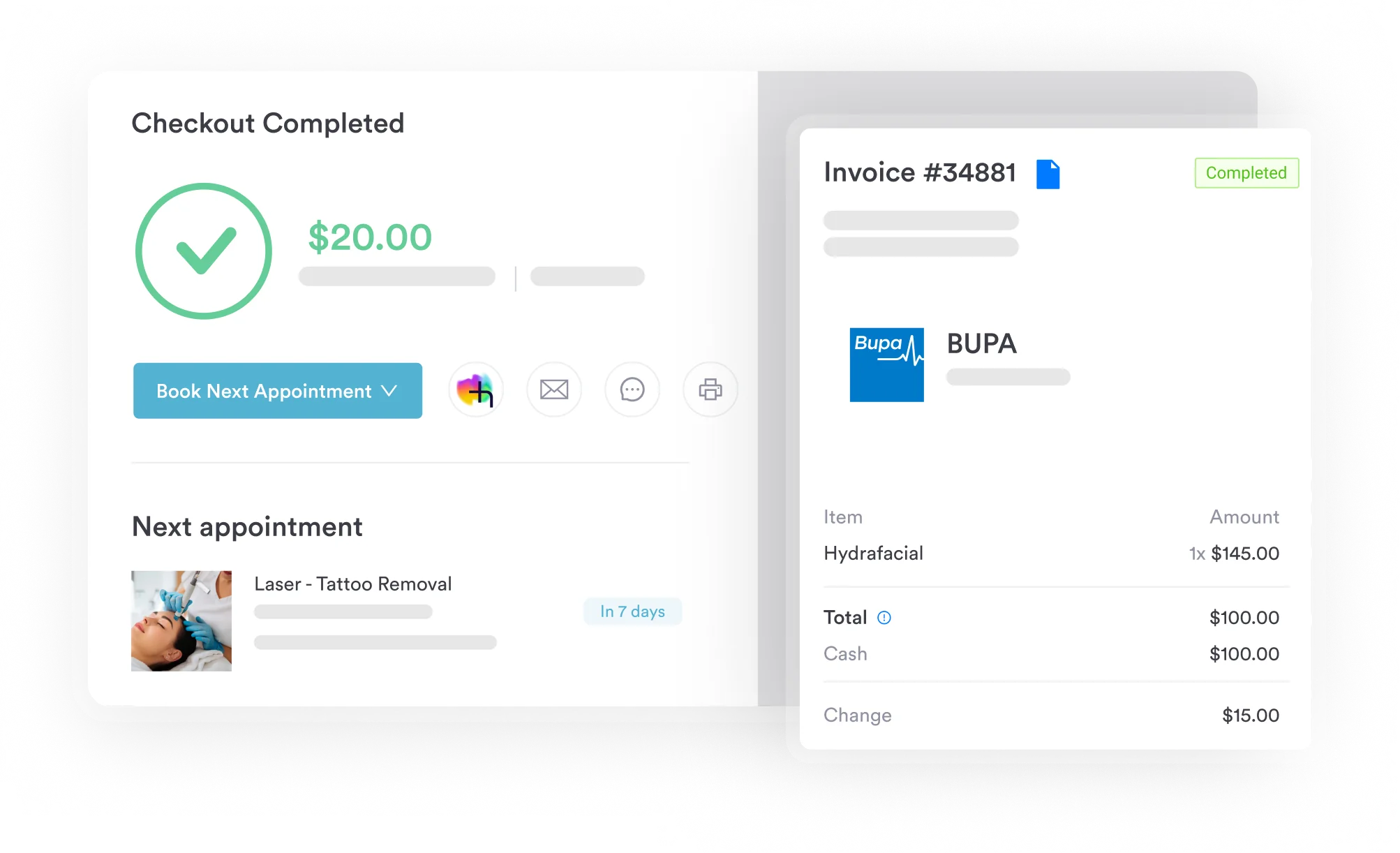
UK practices submit claims from Pabau through Healthcode and Bupa. The case holds each pre-authorisation code with its dates and authorised sessions, and Pabau shows a warning when a code is missing. That way a T2200 claim does not go out without the reference the insurer will check first.
For insurer-specific rules, our Bupa CCSD codes guide explains how Bupa processes CCSD-coded surgical claims. Core claims features are included in every plan, and add-ons enhance the experience.

Pabau submits CCSD claims through Healthcode and Bupa and records each pre-authorisation code on the patient’s case. Your team sees a warning before a T2200 claim goes out without its authorisation reference.

T2200 is the right code only when three facts hold. The hernia is femoral, this is its first repair, and no robotic or strangulated variant applies. Settle those facts in the operative note before the claim is built, and the code choice follows from them.
The cost of skipping that step lands later. A pre-authorisation request with the wrong code, or a claim without its reference, takes far longer to fix once the insurer has queried it. Book a demo to see how Pabau tracks pre-authorisation codes and submits CCSD claims through Healthcode.

Need a broader CCSD billing reference? Bupa CCSD billing guide covers how Bupa recognises and processes CCSD-coded surgical claims across all procedure chapters.
Looking to streamline surgical claim submission? Claims management for private practices explains how Pabau brings billing, pre-auth tracking, and claim status into a single consultant workflow.
Repairing a femoral hernia for the second time? CCSD code T2300 covers the repair of a recurrent femoral hernia.
CCSD Code T2200 covers the primary, first-time repair of a femoral hernia in a UK independent-sector setting. It is the standard primary femoral repair code and covers mesh and non-mesh repairs. Recurrent, strangulated and robotic-assisted femoral repairs have their own codes, and inguinal repairs use separate CCSD codes.
Femoral hernia repairs use T22xx CCSD codes and T2300, paired with ICD-10 K41 diagnosis codes. Inguinal hernia repairs use T20xx and T21xx codes, paired with K40. The hernia’s position relative to the inguinal ligament decides which range applies. Using an inguinal code for a femoral hernia is a known PMI denial trigger.
T2200 is the standard code for a primary femoral hernia repair, including a conventional laparoscopic TAPP or TEP repair where no approach-specific code applies. Robotic-assisted repairs have their own codes, such as T2210 and T2221, and a strangulated hernia uses T2280. Check the current CCSD Schedule for the variant that matches the operative note.
No. T2200 covers primary repair only. If the patient has had a previous repair of the same femoral hernia, use T2300, repair of recurrent femoral hernia. The CCSD lists T2200 and T2300 as an unacceptable combination, and an insurer whose records show a prior repair may reject a T2200 claim.
The anaesthetist fee, pre-operative consultation, assistant surgeon fee, and post-operative reviews may each be billed separately with the relevant CCSD codes. Mesh material may be separately billable, depending on the insurer contract. None of these belong on the T2200 claim line, and each needs its own submission with the appropriate code.