

Pabau Engage inbox

Pabau Engage is here: every patient conversation in one inbox.

Learn more
CCSD Code

CCSD code F0530 – Suturing a lip wound


Code Definition

F0530 is the CCSD code for suture of lip (as sole procedure). It applies only when suturing the lip is the only procedure in the episode. UK private medical insurers such as Bupa, AXA Health and Aviva use it on claims.

The code sits in CCSD chapter 6.0.0 Face, Mouth, Salivary & Thyroid, under sub-chapter 6.2.0 Lips. A lip wound repaired as part of a larger operation falls outside it.

Group
6.0.0 Face, Mouth, Salivary & Thyroid
Category
6.2.0 Lips
Subcategory
F0530 Suture of lip (as sole procedure)
Billable
No
Code also known as
lip laceration repair, lip wound closure, lip suture, soft tissue lip repair
Save time. Improve accuracy. Get paid faster.
Automate coding with Pabau

Let Pabau's smart automation suggest the right codes, reduce claim denials, and keep your practice compliant—effortlessly.

  • AI-powered code suggestions
  • Real-time compliance checks
  • Faster claims, fewer denials
Why practices choose Pabau
Save hours every week

Automate repetitive tasks and focus on what matters most—your patients.

Improve accuracy

Reduce coding errors and ensure compliance with the latest regulations.

Get paid faster

Clean claims, fewer denials, and faster reimbursements.

Grow with confidence

Powerful insights and reporting to help your practice thrive.

HIPAA compliant SOC 2 certified GDPR-compliant Trusted by 4,000+ clinics worldwide

Key takeaways

Key takeaways

CCSD code F0530 is suture of lip (as sole procedure), so it applies only when the lip suture is the only procedure in the episode.

The clinical note should record how the injury happened, the tissue layers involved, the suture material, the number of sutures and the aftercare instructions.

F0530 does not cover complex plastic surgical revision, nose or chin lacerations, or a lip suture done as part of a larger procedure.

Each insurer sets its own claim window and its own rules for extra codes, so check the schedule before you submit.

Pabau, the practice management platform we build, keeps digital forms and Client records together, so the note insurers want is ready when you claim.

CCSD code F0530: Definition and clinical scope

CCSD code F0530 is the code for suture of lip (as sole procedure) in the CCSD schedule. CCSD stands for Clinical Coding and Schedule Development, the coding schedule used by UK private medical insurers and consultants. Insurers that work from it include Bupa, AXA Health and Aviva.

F0530 sits in chapter 6.0.0 Face, Mouth, Salivary & Thyroid, under sub-chapter 6.2.0 Lips. The F-series covers face, mouth, salivary gland and thyroid procedures.

In October 2022, CCSD changed the descriptor from “Suture of lip” to “Suture of lip (as sole procedure).” That qualifier is the code’s main rule. F0530 applies only when suturing the lip is the only procedure performed, so a lip suture done during a larger operation isn’t billed with it.

The CCSD Technical Guide sets out the schedule’s coding rules. Check the current edition before you add any other code to an F0530 claim.

What the procedure involves

Suture of the lip is a soft tissue repair. Each step below maps to a detail the clinical note should record.

  1. Anesthesia: Infiltration anesthesia or an infraorbital or mental nerve block is given, typically lidocaine with epinephrine. Whether it’s paid separately depends on the insurer’s schedule.
  2. Wound assessment: The clinician checks the depth and extent of the wound and identifies which layers are breached. The skin, vermilion, orbicularis oris muscle and oral mucosa can all be involved, and each one goes in the note.
  3. Debridement: Foreign material and devitalized tissue are removed, and the wound edges are cleaned to reduce infection risk before closure.
  4. Layer-by-layer closure: In a full-thickness wound, the muscle layer is closed first with absorbable suture, typically polyglactin (Vicryl) 3-0 or 4-0. Mucosa is closed with absorbable suture. The vermilion border is aligned and sutured with interrupted non-absorbable sutures (silk or nylon 5-0 or 6-0) before the skin edges are brought together.
  5. Dressing and aftercare: The wound is covered, and the patient gets written instructions on wound care, suture removal timing and signs of infection.

Vermilion border alignment is the most technically demanding step. A 1 mm misalignment at the mucocutaneous junction is visible at conversational distance and may count as a clinical complication. Record the technique you used, as well as the suture type, for medicolegal purposes.

Clinical indications for lip suture

F0530 fits a lip wound when the suture is the only procedure in the episode. The table shows how common presentations line up against that rule.

PresentationF0530 applicable?Notes
Traumatic lip laceration (sport or fall)YesThe most common scenario. Confirm there’s no underlying fracture or foreign body.
Post-surgical wound dehiscence (lip)Yes, if the re-suture is the only procedureDocument that the closure relates to the original surgical site.
Animal bite (lip)Yes, with cautionSome insurers require pre-authorization. Document the infection risk.
Complex laceration requiring plastic surgical revisionNoRefer to maxillofacial or plastic surgery. F0530 does not cover complex revision.
Nose or chin lacerationNoIt’s outside the lip, so a different CCSD code or an emergency department referral applies.
Lip suture done as part of a larger procedureNoThe “as sole procedure” descriptor excludes it. Code the main procedure instead.

What F0530 includes and excludes

F0530 covers suture of the lip when that suture is the only procedure performed. The descriptor names no suture material, technique or number of sutures.

These fall outside F0530, or depend on each insurer’s own rules.

  • A lip suture performed as part of a larger procedure, which the descriptor excludes
  • Complex multi-layer plastic surgical repair that needs specialist anesthesia or an operating room
  • Lacerations of nearby structures, such as the nose, the chin or skin beyond the lip border
  • Local anesthesia, imaging and follow-up suture removal, which each insurer handles under its own schedule
  • Wound irrigation as a standalone procedure for a contaminated wound

Check the insurer’s fee schedule and bundling rules before you add a second code. A second procedure in the same episode can mean F0530 no longer applies.

Neighboring CCSD codes and how to choose

F0530 sits beside other suture codes in chapter 6, and the site of the wound decides which one you use. The Bupa CCSD codes guide shows how one major insurer applies the schedule. The diagram below walks through the two questions that settle it.
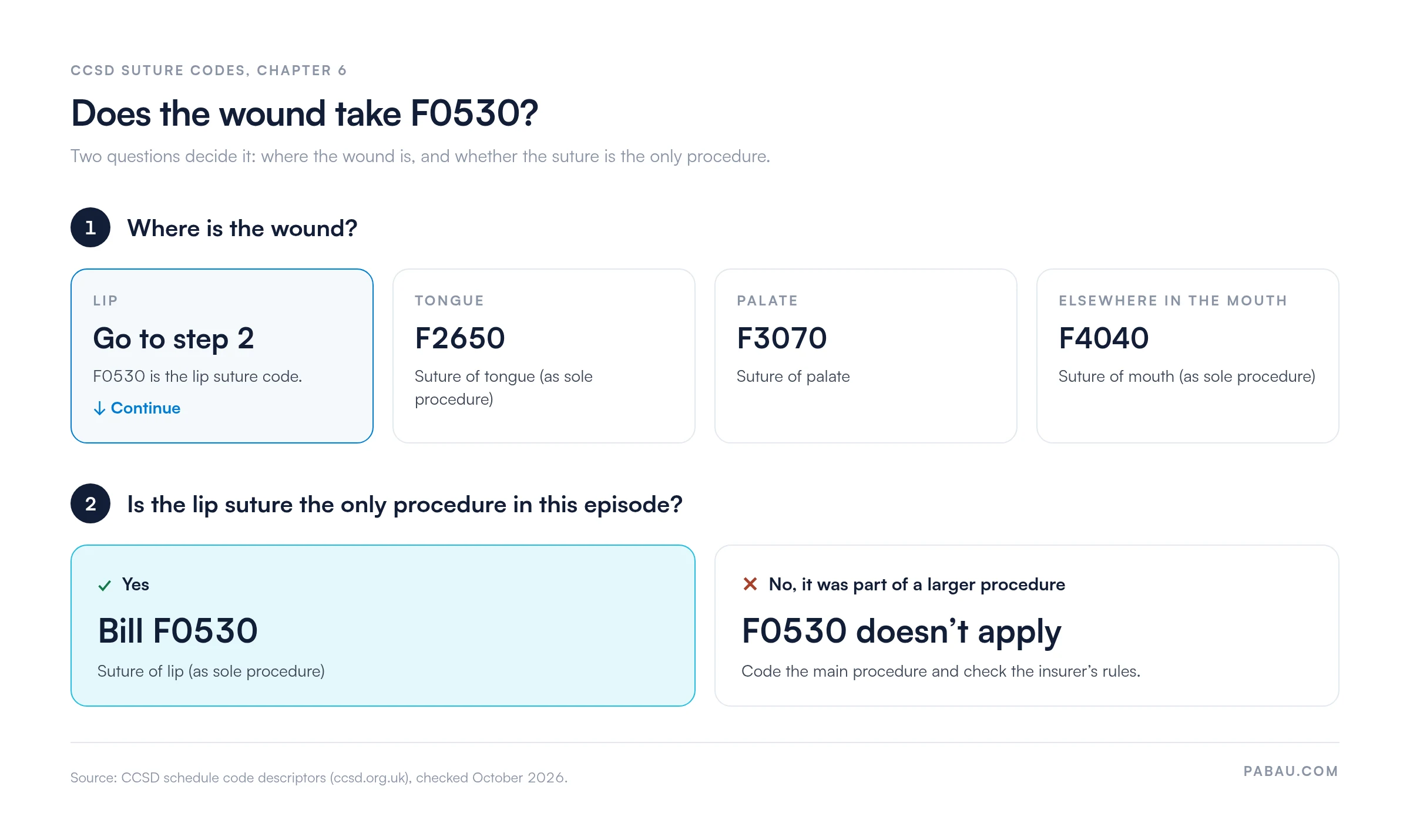
Decision diagram for CCSD suture codes: a lip wound goes to step 2, tongue is F2650 suture of tongue (as sole procedure), palate is F3070 suture of palate, elsewhere in the mouth is F4040 suture of mouth (as sole procedure). If the lip suture is the only procedure, bill F0530; if it was part of a larger procedure, F0530 does not apply.
The wound site picks the suture code, and the sole-procedure rule decides whether F0530 applies. Descriptors are taken from the CCSD schedule.
CCSD codeDescriptorUse when…Key distinction from F0530
F0530Suture of lip (as sole procedure)The lip suture is the only procedure in the episodeThe target code for this article
F2650Suture of tongue (as sole procedure)The wound is on the tongueThe site is the tongue, not the lip
F3070Suture of palateThe wound is on the palateThe site is the palate, and the descriptor carries no sole-procedure qualifier
F4040Suture of mouth (as sole procedure)The wound is elsewhere in the mouthIt covers other mouth sites, not the lip

Palate wounds go to F3070, the one code in this group without the sole-procedure qualifier. For a wound on the nose, the chin or skin beyond the lip, search the full list of CCSD codes instead.

Documentation requirements

Clinical documentation is what an insurer reviews when it queries an F0530 claim. A clear operative note justifies the procedure clinically and gives the insurer the detail it needs to pay without follow-up letters.

Digital clinical forms with set fields for wound size, tissue layers and suture materials make omissions less likely. Notes saved to a structured patient record are also quick to retrieve if an insurer queries a claim months later. Keeping records in line with UK GDPR is a baseline obligation, whatever the insurer asks for.
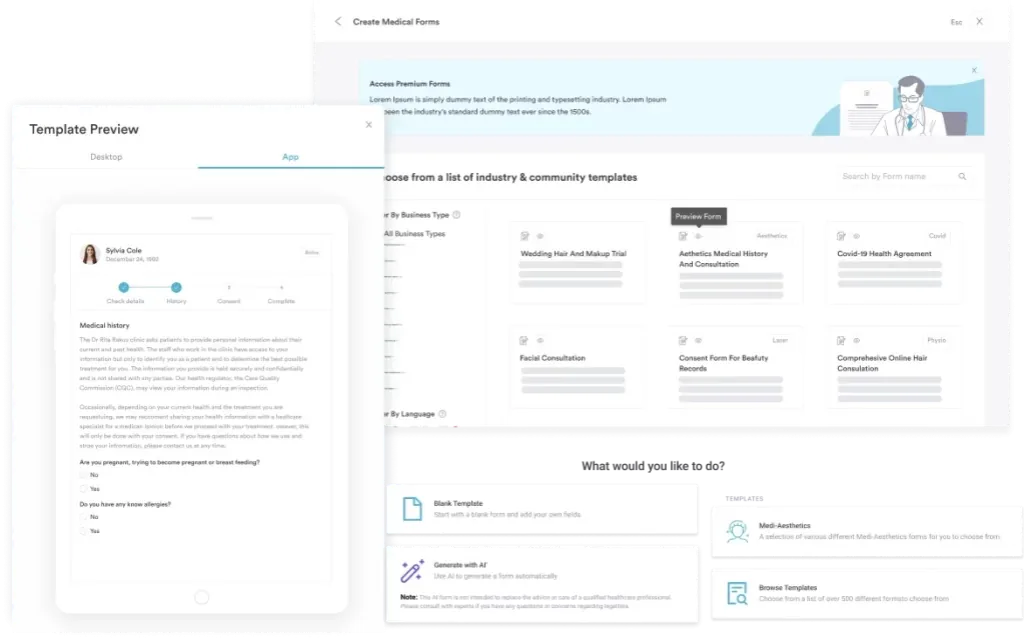
Pabau digital form builder showing a template library and a medical history form preview
Pabau’s digital forms start from a blank template or a library form. Build a lip suture note with a field for each item insurers check.

An F0530 operative note should cover these eight points.

  • Injury etiology: How the wound occurred, such as a fall, a sports impact, an animal bite or post-surgical dehiscence
  • Wound dimensions: Approximate length in millimeters and depth (superficial, involving muscle, or full-thickness)
  • Tissue layers involved: Which of the skin, vermilion, orbicularis muscle and oral mucosa were breached and closed
  • Suture material and gauge: Absorbable or non-absorbable, the specific material (Vicryl, silk, nylon) and the gauge, such as 4-0 or 5-0
  • Number of sutures placed: Total interrupted or continuous sutures per layer
  • Anesthesia given: Type (infiltration or nerve block), agent and volume
  • Consent: Written consent obtained, with risks documented
  • Aftercare instructions: Written copy given, plus a suture removal date if non-absorbable sutures were used

Some insurers also ask for a clinical photo taken at presentation, particularly for animal bites or complex lacerations. Check the insurer’s submission guidelines before treating, as these cases may need pre-authorization.

Billing F0530: Claim submission guide

An F0530 claim goes to the patient’s private medical insurer under the CCSD schedule. Pabau’s claims management software keeps the clinical note and photos on file with the patient, which cuts the back-and-forth with insurers before payment.
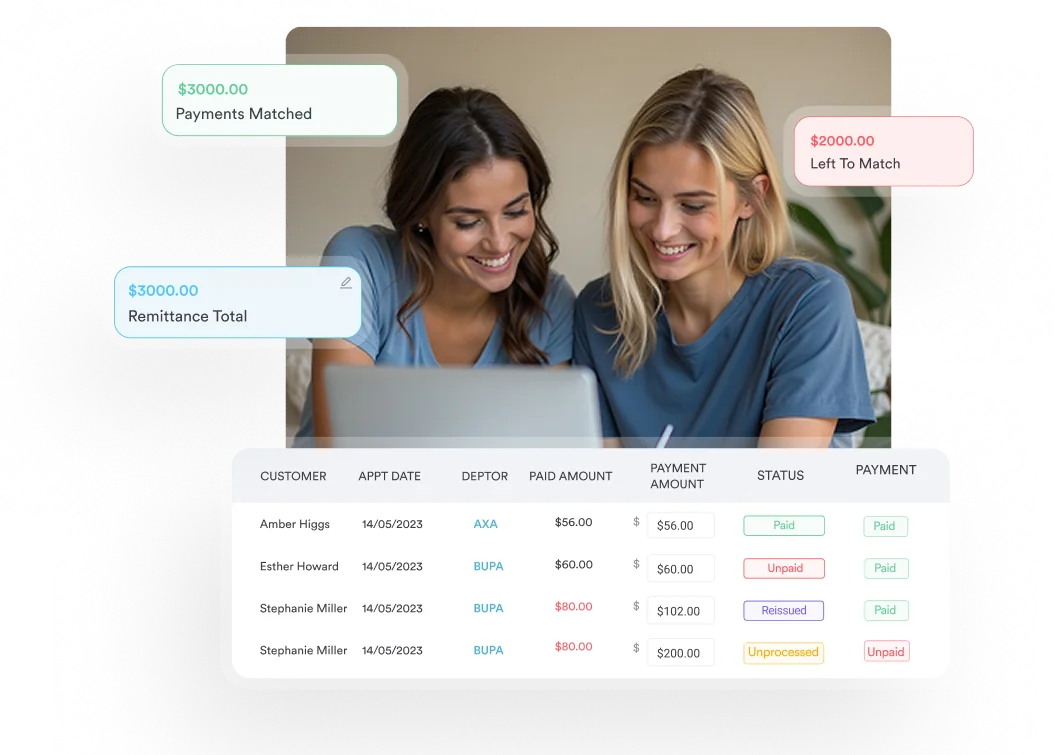
Pabau insurer remittance table showing Bupa and AXA payments matched to appointments with paid and unpaid status
Pabau matches insurer remittances from Bupa and AXA against each appointment, so an unpaid F0530 claim stands out and gets chased quickly.
  1. Select F0530 on the claim form. Enter the code in the procedure field. Don’t swap in a general wound closure code from another chapter.
  2. Attach the operative note. Include each documentation element listed in the previous section. Claims sent without supporting notes are more likely to be queried before payment.
  3. Check before adding other codes. F0530 applies only when the lip suture is the sole procedure. Where an insurer pays local anesthesia or imaging separately, list each on its own line as its schedule directs.
  4. Check pre-authorization status. For animal bites and complex presentations, confirm whether the insurer needs prior approval. An emergency lip suture done before approval can be submitted afterward, but record why treatment couldn’t wait.
  5. Submit within the insurer’s claim window. Insurer claim windows vary, so check each insurer’s terms.
  6. Retain copies. Keep the claim form and supporting notes in line with the NHS Records Management Code of Practice. It sets eight years after treatment ends for adult records. Children’s records are kept until their 25th birthday, or their 26th if they were 17 when treatment ended.

Common reasons CCSD code F0530 claims are rejected

The reasons below reflect common patterns with surgical CCSD codes. Individual insurers may apply extra criteria.

  • Insufficient clinical documentation. A claim note that records only “lip laceration sutured” without wound dimensions, layers or suture materials gives the insurer no basis for clinical review. Expand the note to cover each required element before submitting.
  • Suture billed alongside another procedure. F0530 covers a lip suture as the sole procedure. Claiming it when the suture was part of a larger operation conflicts with the descriptor and invites a query.
  • Missing pre-authorization. For insurers that require prior approval on surgical procedures, a claim without a reference number is rejected automatically. If emergency treatment came before approval, include a written explanation of why it couldn’t wait.
  • Extras the insurer includes in the fee. Listing local anesthesia, irrigation or dressings as separate lines can trigger a bundling query where the schedule already covers them. Check each insurer’s rules first.
  • Out-of-scope procedure. If the claim note describes a procedure outside F0530’s scope, such as a nose laceration or a plastic surgical revision, the claim may be rejected. Refer complex cases before treating.

Can F0530 be billed alongside other CCSD codes?

Sometimes, but only where the insurer’s schedule allows it and the lip suture is still the sole procedure. The table shows the services that often come up alongside F0530 and how to check each one.

Concurrent code or serviceSeparately billable?Notes
Local anesthesiaInsurer-specificCheck whether the insurer pays it as its own line or within the F0530 fee.
Imaging to exclude a foreign bodyInsurer-specificRecord the clinical reason, such as a suspected retained foreign body, in the note.
Consultation or examination codeInsurer-specificSome insurers bundle the first assessment into the surgical fee, so check the schedule.
Wound irrigationGenerally bundledDon’t bill it separately unless the schedule explicitly permits it.
Dressings or wound packingGenerally bundledA standard post-closure dressing is normally part of the procedure fee.
A second surgical procedure in the same episodeNo, not with F0530F0530 is limited to suture as the sole procedure, so code the main procedure instead.

When a claim carries more than one code, document the clinical reason for each line item separately. An insurer auditor looks for evidence that each service was distinct from the others. The table reflects general CCSD practice, so verify it against the insurer’s own schedule. Bupa, Healix and Cigna UK each publish their own rules for providers.

Pro Tip

Before you submit a multi-code F0530 claim, check each extra code against the insurer’s fee schedule. Then confirm the lip suture was still the sole procedure, because F0530 only applies when it was.

How Pabau keeps F0530 claims complete

A free-text operative note makes it easy to leave out the wound size or suture gauge an insurer asks about. The query then lands weeks later, when the details are harder to recall.

With Pabau’s digital forms, the lip suture note becomes a set of required fields for site, layers, suture material and aftercare. The finished form saves straight into Client records, next to the patient’s photos.

When you claim, the note is already on file beside the claim in Pabau’s claims management. Your team sends a complete F0530 claim the first time and answers any later query from the same record.

Send complete F0530 claims the first time

Pabau’s digital forms, Client records and claims management keep lip suture notes and insurer claims together. Your team spends less time answering queries and more time treating patients.

Pabau practice management platform

Conclusion

F0530 is a narrow code with one condition attached. Bill it when a lip suture is the only procedure in the episode, and pick a different code when it isn’t.

The work sits in the note and the insurer’s schedule. A note that records site, layers and materials gives the insurer little to query. Checking each extra line against the schedule stops the claims the descriptor would reject.

Private practices that keep operative notes in structured forms send these claims faster and defend them more easily. Book a demo to see how Pabau’s digital forms and claims management fit your F0530 billing.

Continue your research

Continue your research

Billing more than one insurer? Bupa CCSD codes and fee schedule guide explains how Bupa applies the CCSD schedule and its fees.

Treating a palate wound instead? CCSD code F3070: Suture of palate billing guide covers the neighboring suture code for palate repairs.

Closing a skin wound on the trunk or a limb? CCSD code S4213: Debridement and primary suture covers skin-only wound closure away from the face.

Coding other chapter 6 procedures? CCSD code F4430: Partial parotidectomy billing guide covers a salivary gland procedure from the same chapter.

Frequently asked questions

What does CCSD code F0530 cover?

CCSD code F0530 covers suture of the lip as the sole procedure. It applies only when the lip suture is the only procedure in the episode. It does not cover complex plastic surgical revision or a lip suture done during a larger operation.

What documentation is required to bill F0530?

An F0530 claim note should include injury etiology, wound dimensions, the tissue layers involved, the suture material and gauge, and the number of sutures. Add anesthesia details, the consent record and written aftercare instructions. Claims without layer-level detail are often queried.

Which CCSD codes are used alongside F0530?

It depends on the insurer, because F0530 applies only when the lip suture is the sole procedure. Check whether the insurer pays local anesthesia or imaging for a suspected foreign body as separate lines. Wound irrigation and routine dressings are generally included in the procedure fee.

What are common reasons F0530 claims are rejected?

Common reasons are thin clinical documentation and claiming F0530 when the suture was part of a larger procedure. Missing pre-authorization on animal bites or complex cases is another. So is listing extras the insurer already includes in the procedure fee.

Does F0530 depend on which lip layers are repaired?

No. The official descriptor is “Suture of lip (as sole procedure)” and names no tissue layer. What decides it is whether the lip suture was the only procedure. Still record each layer you closed, so the insurer can review the claim.

Can F0530 be billed with anesthesia codes?

Only where the insurer’s schedule allows it. Check whether it pays local anesthesia as its own line or within the F0530 fee before you add one. Some insurers also bundle the first consultation into the surgical fee.


Avatar photo
Maja Popovska
Content Writer

Maja is a Senior Content Writer at Pabau, where she covers everything from practice management and compliance to medical aesthetics and patient experience. Off the clock: binging true crime docuseries, baking and dreaming about travel.
×

