

CCSD code G5100: Bypass of duodenum billing guide
CCSD code G5100 bills a bypass that leaves the duodenum in place CCSD code G5100...

Last Updated: Oct 16, 2026
F0420 is the CCSD code for reconstruction of lip using skin flap. It covers rebuilding a lip defect with a skin flap that keeps its own blood supply. Surgeons use it most often after lip cancer excision, trauma or a congenital deformity.
The code sits in CCSD Chapter 6 (face, mouth, salivary and thyroid) at Major complexity. UK private medical insurers generally pay it for reconstructive cases, not cosmetic ones. Simple suture repair and free flap reconstruction fall outside it.
Let Pabau's smart automation suggest the right codes, reduce claim denials, and keep your practice compliant—effortlessly.
Automate repetitive tasks and focus on what matters most—your patients.
Reduce coding errors and ensure compliance with the latest regulations.
Clean claims, fewer denials, and faster reimbursements.
Powerful insights and reporting to help your practice thrive.
HIPAA compliant SOC 2 certified GDPR-compliant Trusted by 4,000+ clinics worldwide

CCSD code F0420 covers reconstruction of the lip using a pedicled skin flap that keeps its own blood supply.
Abbe, Estlander, Karapandzic and nasolabial flaps are commonly coded as F0420, but the CCSD schedule names no techniques, so confirm with the insurer.
F0420 sits in CCSD Chapter 6 at Major complexity, and UK private medical insurers generally pay it only when the notes show a reconstructive indication.
CCSD lists F0200 as an unacceptable combination with F0420, so a separate lip excision is billed only with the insurer’s prior agreement.
Pabau, the practice management platform we build, captures the operative detail insurers ask for and sends the invoice through Healthcode.
CCSD code F0420 is defined by the official descriptor Reconstruction of lip using skin flap. It is one of the CCSD codes maintained by the Clinical Coding and Schedule Development Group (CCSD). That schedule is the procedure coding standard used by UK private medical insurers.
The code sits in CCSD Chapter 6, which covers the face, mouth, salivary glands and thyroid. It carries a Major complexity rating. Insurers such as Bupa, AXA Health, Aviva and Vitality use CCSD codes to set and pay consultant fees in pounds sterling.
F0420 applies when a surgeon raises a skin flap that keeps its own blood supply and moves it into a lip defect. Simple wound closure or direct suture of the lip edge-to-edge does not meet the descriptor. CCSD codes carry no modifiers, so the code itself has to describe the operation performed.
Lip reconstruction using a skin flap most often follows excision of a lip cancer, usually basal cell carcinoma or squamous cell carcinoma. It is used when the remaining defect is too large to close directly.
It also applies after trauma, burns or a congenital deformity where too little lip tissue remains to restore oral competence. In each case, the flap restores lip structure and the seal needed to eat and speak.
The surgical sequence usually runs in five steps:
The operative note should record the donor site, the flap dimensions and whether the repair is single-stage or two-stage.
The four techniques below are commonly coded as F0420. The CCSD schedule does not name techniques, so confirm with the insurer before you code one. Abbe and Estlander flaps are composite, full-thickness flaps rather than skin-only flaps, which makes that check more important. The table maps each one to its donor site and typical defect size.
Check the flap type in the operative note against this table. If the surgeon used a technique outside these four, read the current CCSD schedule notes before coding.
F0420 describes a skin flap moved on its own pedicle. A free flap is fully detached from its donor site and reconnected to recipient vessels under the microscope. That is a different operation from the one F0420 describes.
If the note records microvascular anastomosis, or a radial forearm or anterolateral thigh donor site, do not default to F0420. Check the CCSD schedule for the code that matches the procedure.
UK private medical insurance policies generally exclude cosmetic surgery. They usually cover reconstructive treatment when it follows an eligible condition, such as cancer or an accident. Whether F0420 is paid often turns on which side of that line the case falls.
A lip reconstruction counts as reconstructive when it restores lost or impaired function or repairs a defect left by treating disease. Typical evidence is oral incompetence, drooling, difficulty eating or speaking, or a histology-confirmed lesion. Improving appearance alone does not meet that standard.
Get the insurer’s pre-authorisation in writing before scheduling a lip reconstruction. If the insurer declines it, billing F0420 after surgery is unlikely to change the outcome. The written record also helps if the claim is audited later.
Coders working with Bupa CCSD procedure codes and other insurer schedules need to separate F0420 from the nearby lip codes in Chapter 6. Coding a simpler lip procedure when a flap was raised undervalues the claim. Coding F0420 for a simple repair invites an audit query. The decision path below shows which code the operative note supports.
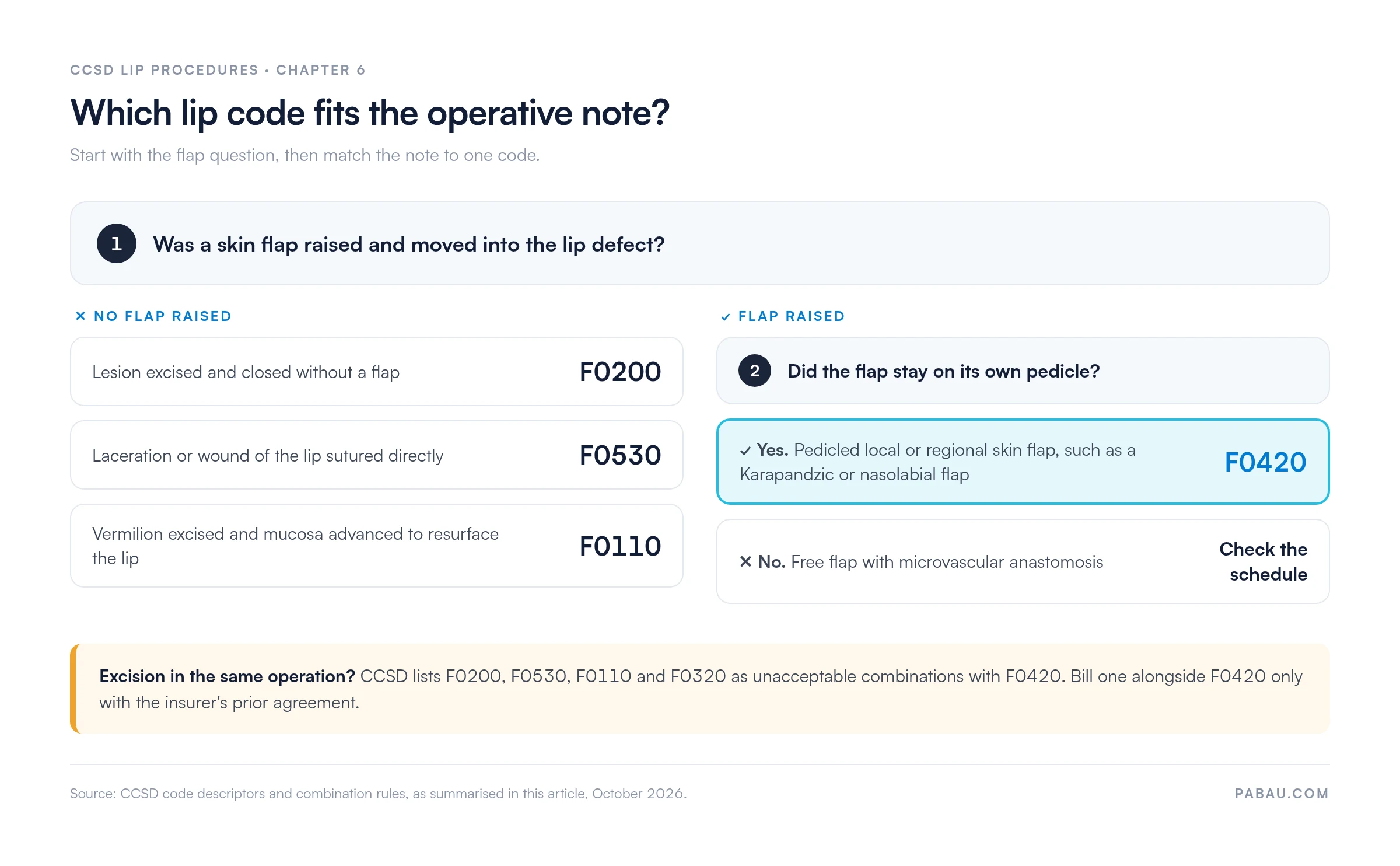
Unbundling risk: A lesion is often excised and the defect rebuilt in the same operation. CCSD lists F0200, F0530, F0110 and F0320 as unacceptable combinations with F0420. A separate excision is therefore billed only with the insurer’s prior agreement.
Ask for that agreement when you request pre-authorisation, not after the claim is queried. If the insurer accepts both codes, document the excision and the reconstruction as separate procedures in the operative note.
Insurers assess F0420 claims against the operative note and the clinical letters. If the record does not support a flap reconstruction, the claim can be queried or declined. Digital surgical forms that prompt for each required field at the point of care mean the billing team receives a complete note.
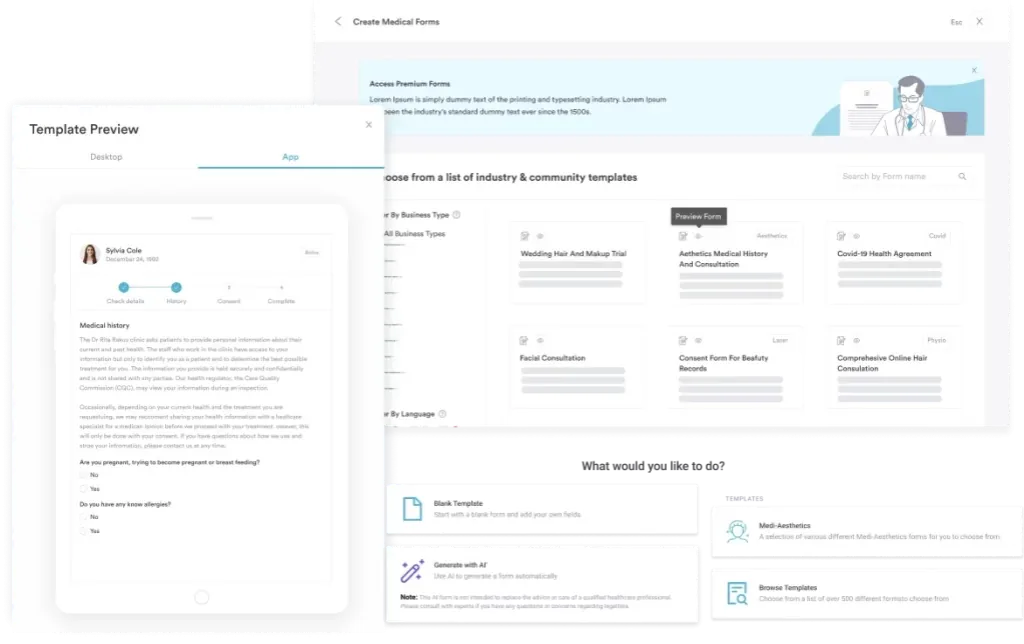
The operative note should contain each of the following to support F0420:
UK private medical insurers generally expect the patient to obtain pre-authorisation before planned surgery. Without an authorisation number, the claim may not be paid.
For F0420, the request usually draws on the consultant letter setting out the indication and the histology report for post-excision cases. Insurers also ask for the planned procedure, its CCSD code and the admission date and hospital.
Requirements differ between insurers, so check each policy before submission. In Pabau, authorisation numbers and insurer correspondence are kept with the patient file. Bupa, AXA Health, Aviva and Vitality each publish guidance for recognised consultants on their provider websites.
Lip flap reconstruction is usually carried out under general anaesthesia in a hospital or day-surgery unit. Each party to the episode invoices the insurer separately. Check each pairing against the insurer’s schedule and the CCSD schedule before submitting.
UK insurers publish their own fee schedules and billing guidance, including the Healix fee schedule guidelines. The same handful of problems recurs across complex surgical codes like F0420.
Review your F0420 claim outcomes every quarter. When claims come back queried, compare the operative note template with the documentation checklist in this article. Defect dimensions and the histology reference are the details most worth checking first.
Oral and maxillofacial and plastic surgery practices billing F0420 face the same problem on every complex code. The detail that decides payment has to be captured in theatre, not pieced together afterwards.
In Pabau, practice teams build procedure-specific note templates that prompt for defect size, flap type, donor site and histology reference. The claims management software then sends invoices to UK insurers through Healthcode and tracks their status.
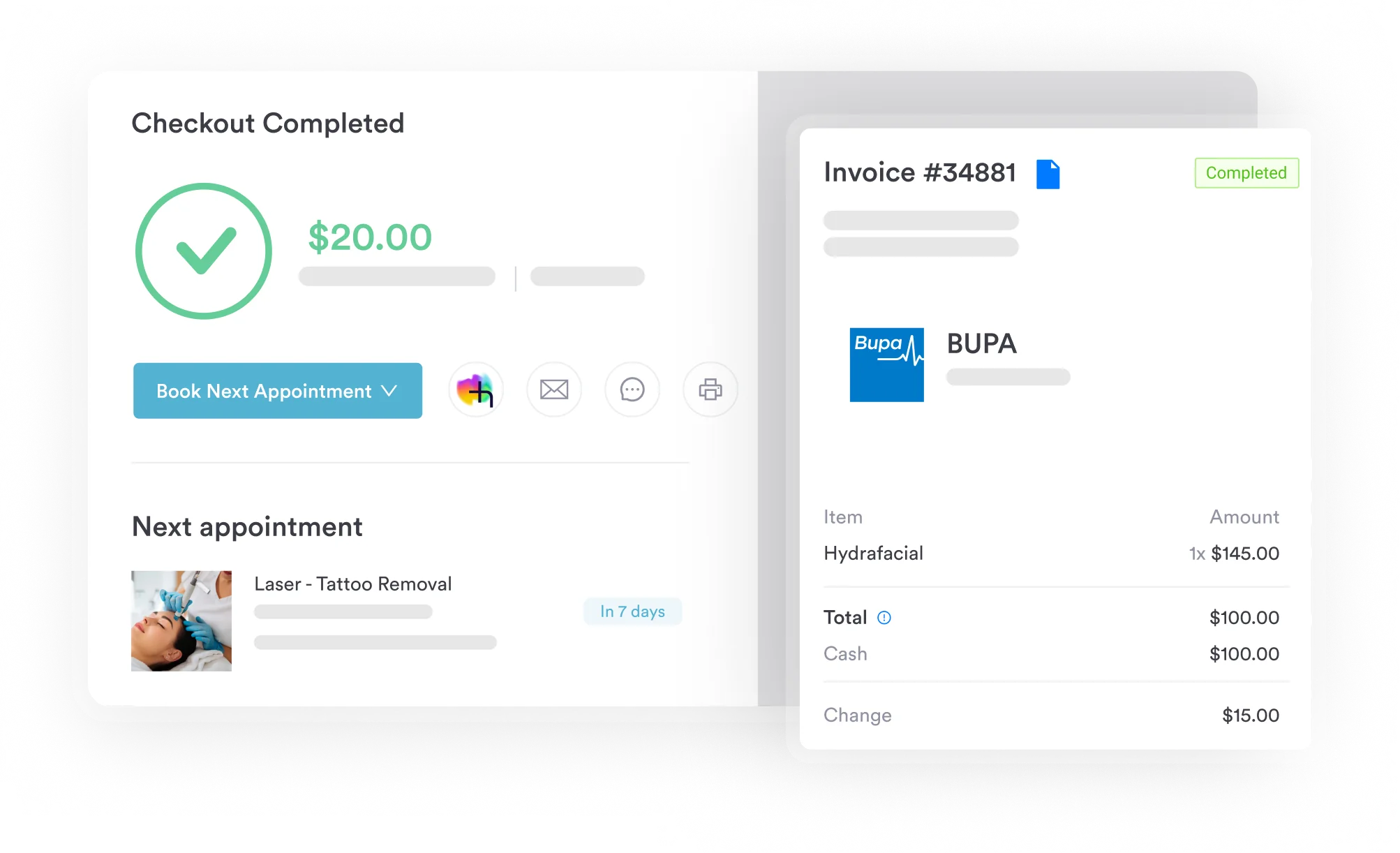
For plastic surgery practices that see both insured and self-pay patients, Pabau keeps records and authorisation correspondence together. The billing team can confirm a claim is ready before submission rather than chasing documents after a query.

Pabau keeps operative notes and authorisation correspondence with the patient record and sends invoices through Healthcode. Your billing team can check an F0420 claim is complete before it goes out.

CCSD code F0420 rewards practices that decide the reconstructive question before surgery, not after the claim comes back. If the consultant letter, histology and operative note all describe the same functional need, UK insurers have little reason to query it.
Settle the excision question in the same conversation. Because F0200 cannot sit alongside F0420 without prior agreement, that request belongs with the pre-authorisation, not the appeal.
To see how Pabau links structured operative notes to Healthcode claims for surgical practices, book a demo.

Billing a lip lesion excision instead? CCSD code F0200 explains when an excision closed without a flap is the right code.
Resurfacing the vermilion rather than raising a flap? CCSD code F0110 covers vermilion excision with mucosal advance and the documentation insurers expect.
Coding other Chapter 6 mouth procedures? CCSD code F3070 walks through suture of the palate and how insurers assess it.
Working across the full Bupa schedule? Bupa CCSD procedure codes covers code structure and fee categories across the F-series and beyond.
Billing salivary gland surgery as well? CCSD code F4430 covers partial parotidectomy coding and claim documentation.
CCSD code F0420 covers reconstruction of the lip using a pedicled local or regional skin flap. Abbe, Estlander, Karapandzic and nasolabial flaps are commonly coded as F0420. The CCSD schedule does not name techniques, so confirm with the insurer. It does not cover simple suture repair or free flap reconstruction.
Usually, when the procedure is reconstructive rather than cosmetic. UK private medical insurers generally exclude cosmetic surgery. The claim needs a functional impairment or a histology-confirmed indication, such as excision of a BCC or SCC. Purely aesthetic lip procedures are not covered.
All three are commonly coded as F0420, along with the nasolabial (melolabial) flap. The CCSD schedule does not name techniques, so confirm with the insurer. Abbe and Estlander flaps are composite, full-thickness flaps, which makes that check more important.
Not on the surgeon’s invoice. The operating surgeon invoices F0420 at the surgeon fee. The anaesthetist sends a separate invoice under the same CCSD code at the insurer’s anaesthetist fee.



