HCPCS Code A4627: Spacer and valved holding chamber
HCPCS Code A4627: official descriptor and code definition HCPCS Code A4627 is th...

Last Updated: Oct 21, 2026
F2660 is the CCSD code for a tongue flap, covering both the first stage and the second stage of the procedure. It's a UK private practice code, used by private medical insurers to process claims from recognised consultants.
The code sits in CCSD Chapter 6, Face, mouth, salivary and thyroid, under sub-chapter 6.3.0 Tongue. CCSD lists F2210, F2220, F2222 and F2650 as unacceptable combinations, so none of them should be billed alongside F2660.
Let Pabau's smart automation suggest the right codes, reduce claim denials, and keep your practice compliant—effortlessly.
Automate repetitive tasks and focus on what matters most—your patients.
Reduce coding errors and ensure compliance with the latest regulations.
Clean claims, fewer denials, and faster reimbursements.
Powerful insights and reporting to help your practice thrive.
HIPAA compliant SOC 2 certified GDPR-compliant Trusted by 4,000+ clinics worldwide

CCSD Code F2660 covers a tongue flap under one code, including the first stage (flap elevation) and the second stage (pedicle division and inset).
Both stages are usually performed under general anaesthesia, roughly 2 to 4 weeks apart, and each one needs its own operative note.
Most insurers expect pre-authorisation before the first stage, so confirm the requirement for each insurer and policy.
CCSD lists F2210, F2220, F2222 and F2650 as unacceptable combinations with F2660.
Pabau, the practice management platform we build, keeps operative notes, consent forms and insurer references on one patient record across both stages.
CCSD Code F2660 is the UK private healthcare procedure code for a tongue flap, covering both its first and second stage. It sits in Chapter 6 of the CCSD schedule, “Face, mouth, salivary and thyroid”, under sub-chapter 6.3.0 Tongue. UK private medical insurers (PMIs), including Bupa, AXA Health, Aviva and WPA, use the schedule to process surgical claims from recognised consultants.
The Clinical Coding and Schedule Development (CCSD) group maintains the schedule. Our guide to CCSD codes explains how its chapters are organised and how insurers apply them.
The official CCSD descriptor is: Tongue flap – first stage and second stage. That descriptor is the reference point for billing. Insurers will typically query or reject a claim that mislabels the procedure or bills one stage without documenting the staging intent. The same goes for a claim that quotes an NHS OPCS-4 code in place of the CCSD code.
CCSD codes are distinct from NHS coding. NHS trusts use OPCS-4 to classify the same surgical interventions for activity reporting. F2660 is used only in private practice billing. Confusing the two systems is a material coding error that can delay payment or trigger a compliance review.
A tongue flap is a pedicle flap. A segment of tongue mucosa and underlying tissue stays attached by a vascular pedicle. It’s rotated or transposed to cover a nearby intraoral defect. Because the flap stays attached during healing, the procedure is staged by design.
The surgeon designs and elevates a portion of the tongue, typically from the dorsal or lateral surface. It’s sutured to the recipient site, which may be a palatal defect, a floor of mouth wound or other intraoral tissue loss. The pedicle remains intact, supplying blood to the transferred tissue while it integrates. This stage is performed under general anaesthesia.
After approximately 2 to 4 weeks, once the transferred tissue has developed an adequate blood supply, the surgeon divides the pedicle. The inset is then refined at both the donor and recipient sites. This second procedure also requires general anaesthesia and is a discrete surgical event with its own operative note.
The interval between the two operations shapes the billing. Each stage is its own clinical encounter, with its own anaesthetic and its own operative note. F2660 is still one code covering both stages. Whether you submit one claim or two, and how the fee is split, depends on the insurer’s rules. Confirm both with the insurer before the first stage.
Oral and maxillofacial surgeons use tongue flaps when no simpler local tissue can close an intraoral defect. They’re also chosen when a free flap would be disproportionate to the size of the defect. Common indications include:
Coders should confirm the indication from the operative note and include the matching ICD-10 diagnosis code on the claim. The indications above span several ICD-10 chapters. The right code depends on the underlying pathology the surgeon documents, whether congenital, traumatic or oncological.
Knowing what sits inside the code prevents unbundling errors and cuts down on insurer queries. The last column lists the codes CCSD marks as unacceptable combinations with F2660.
Anaesthetic fees are always billed independently by the anaesthetist, using their own CCSD or agreed fee schedule. Including them in the surgical claim is a bundling error that the insurer’s audit team will challenge. Other work at the same sitting may need its own code, such as a free flap, a donor-site graft or bone grafting. Check the CCSD schedule before billing it alongside F2660. The CCSD technical guide sets out the current rules on concurrent procedures and anaesthetic supplements for staged cases.
Tongue flap billing under F2660 follows the general CCSD workflow, but the two operations add steps that single-episode codes don’t need. For teams handling CCSD billing with Bupa and other UK insurers, the staged workflow runs as follows:
The flow below shows where each of those checks falls across the two operations, and which codes stay off the claim.
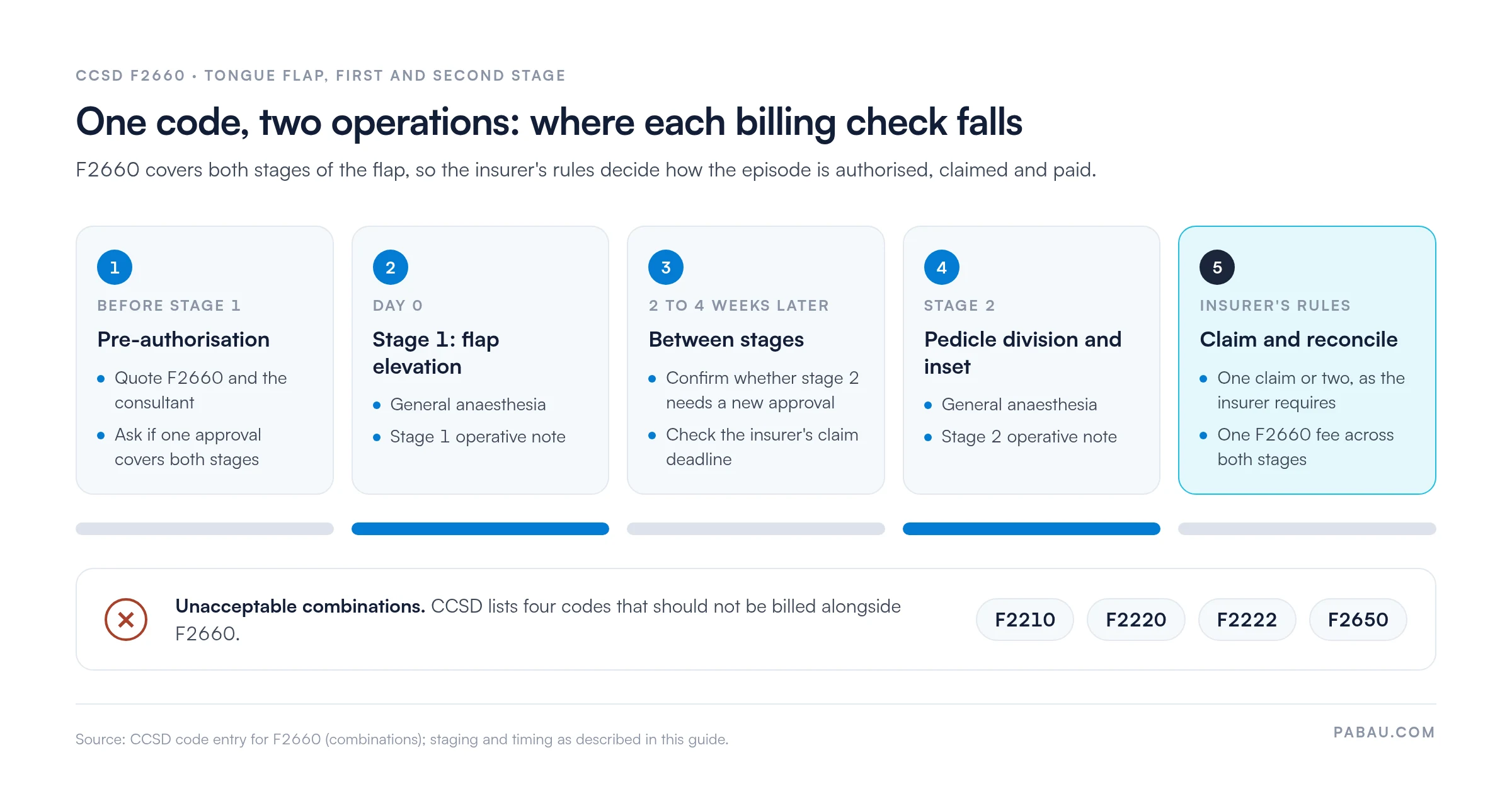
The codes closest to F2660 sit in the same sub-chapter, 6.3.0 Tongue. CCSD lists all four below as unacceptable combinations with F2660, so none of them should be billed alongside it.
CCSD’s coding principles are guidelines, and each insurer decides whether to adopt a given combination rule. Check the current CCSD schedule and the insurer’s own rules before billing, as codes can change in tariff updates. Flap repairs elsewhere in the mouth carry their own codes, such as F0420 for lip reconstruction with a skin flap.
When a patient’s insurer is unfamiliar with staged oral flap procedures, attach a brief covering letter from the consultant at first-stage pre-authorisation. It should confirm the two-stage nature of F2660, the expected timing between stages, and why staging is clinically necessary. This reduces mid-episode policy queries that stall second-stage payment.
Insurers reviewing tongue flap claims look for five core documentation elements. Missing any one of them is enough to trigger a query or rejection. In Pabau, all five can sit together on the patient’s record, so neither stage goes out with a document missing.
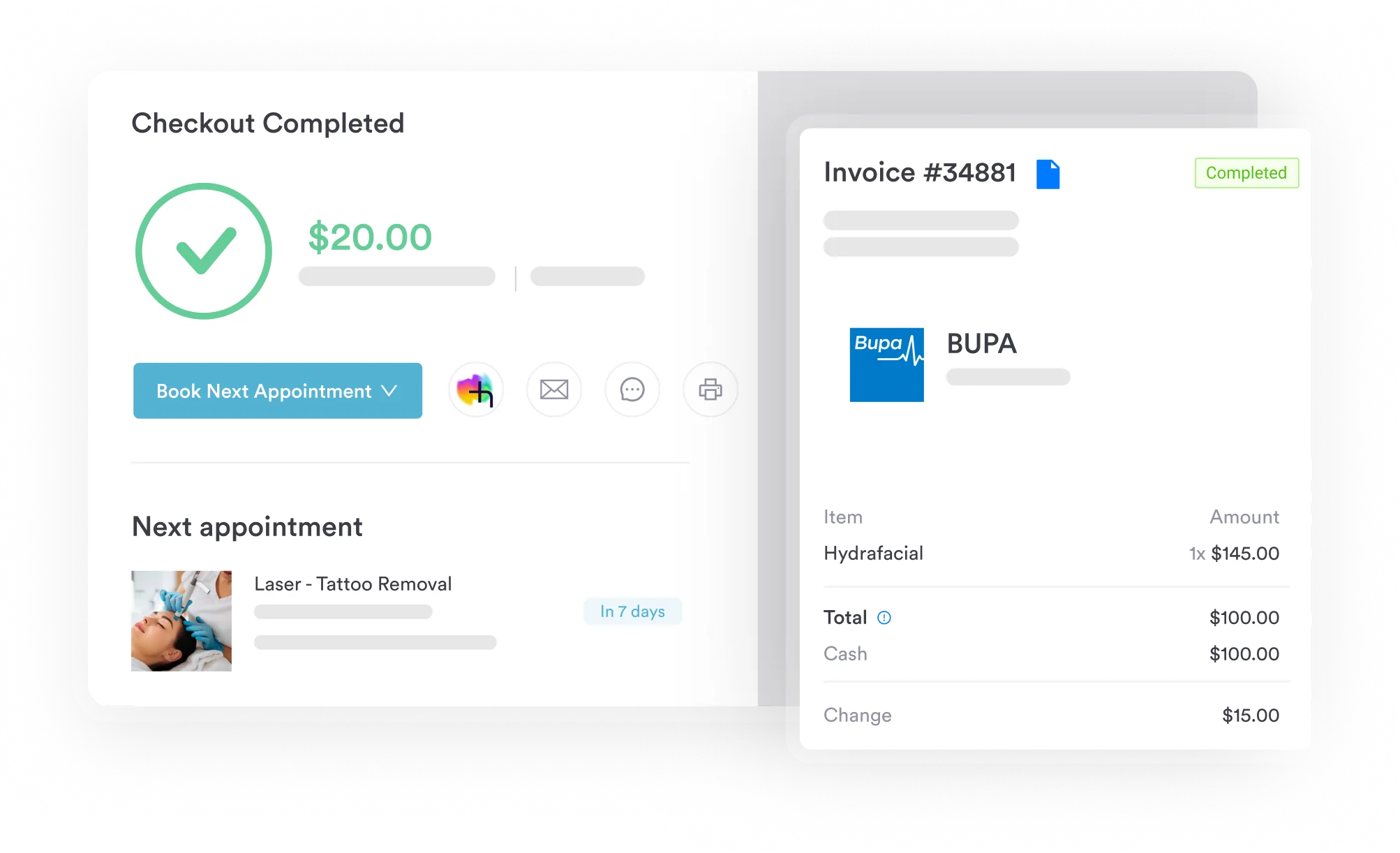
Pre-authorisation requirements vary by insurer and by policy type. Most insurers expect it before surgery, so confirm the rules for each insurer and policy. As a general guide for the major UK PMIs that recognise CCSD coding:
If a patient proceeds to surgery without pre-authorisation, the insurer may decline to pay or reduce payment significantly. That liability falls on the practice, not the patient, if the requirement was not communicated clearly before treatment began.
Tongue flap billing runs across two operations several weeks apart, which gives the insurer two points at which to query the episode. The table below covers the most frequent denial triggers and the corrective action for each.
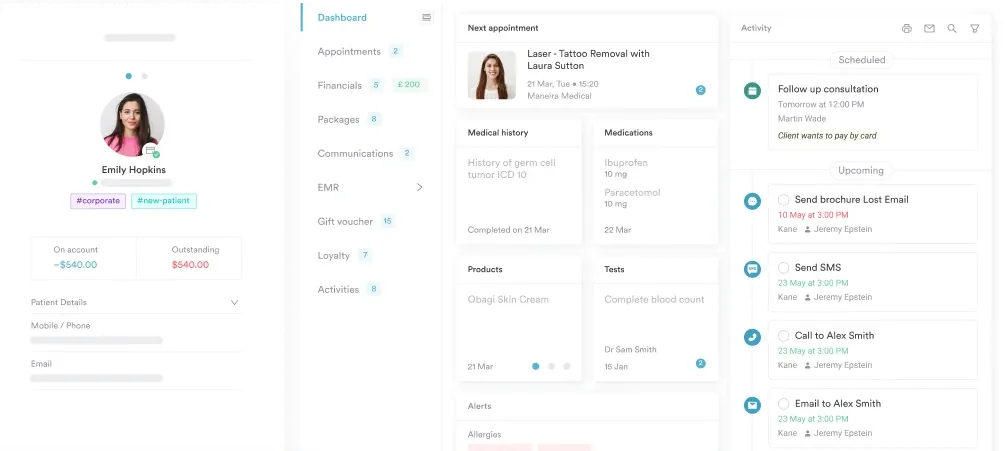
For oral and maxillofacial surgery (OMFS) practices, the hard part of F2660 is holding one episode together across two operations. Pabau’s claims management software sends claims to Healthcode and tracks their status. Both stages’ documents sit on the same patient record, so the billing team works from one file.
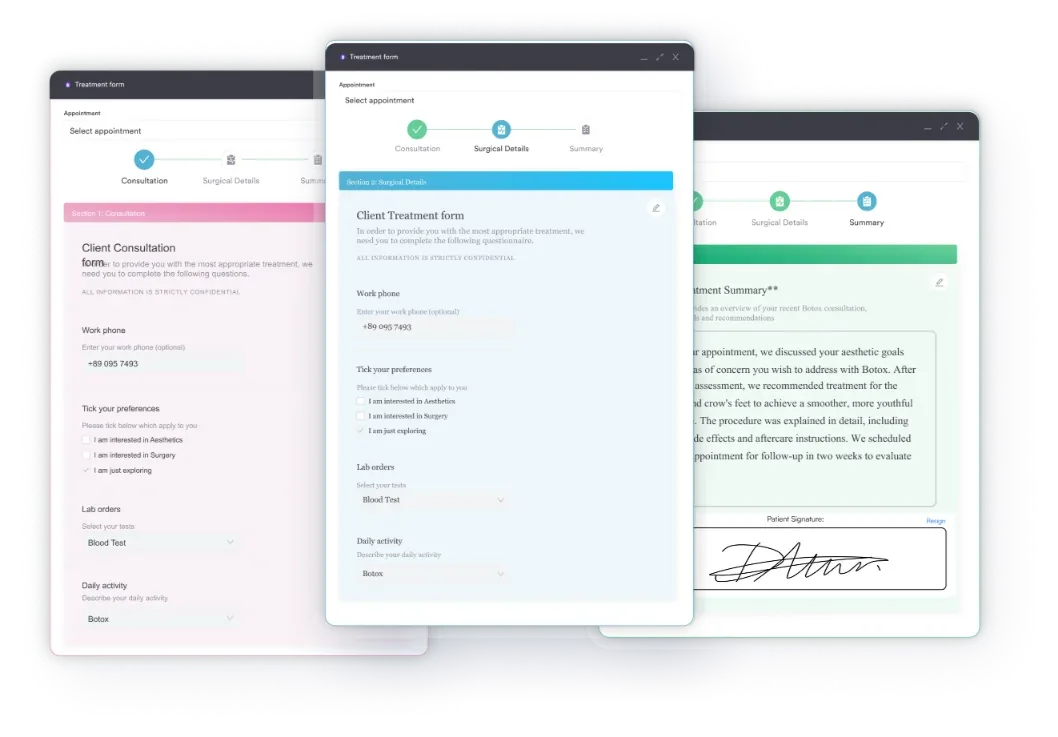
Pabau’s digital consent forms also capture the patient’s consent for each stage electronically. That gives you an audit-ready record if an insurer asks for documentation during a later review.
Keep a staged-procedure tracker in Pabau with a tag on every F2660 patient record that shows whether the second-stage documentation has gone to the insurer. Filtering on ‘F2660 – stage 2 pending’ surfaces any episode still waiting on its second submission.

Pabau keeps operative notes, consent forms and insurer references on one patient record, so your team always knows where a staged claim stands.

F2660 is simple to code and easy to lose track of. The code covers both operations, but the insurer decides how the episode is authorised, claimed and paid. Those rules differ from one PMI to the next.
So settle the questions before the first stage, not after the second. Ask whether one authorisation covers both stages, whether the insurer wants one claim or two, and what its claim deadline is. Then keep both operative notes and the approval on the same record, and keep F2210, F2220, F2222 and F2650 off the claim.
Book a demo to see how Pabau keeps both stages of a tongue flap claim on one patient record, from pre-authorisation to payment.

Need a complete guide to CCSD billing with Bupa? Bupa CCSD codes and billing guide covers code lookup, insurer submission requirements, and fee schedule navigation for UK private practice.
Want to see how the CCSD schedule fits together? CCSD codes explained walks through the chapters, code structure and how UK private insurers use the schedule.
Billing another flap repair in the mouth region? CCSD code F0420: lip reconstruction using a skin flap covers the documentation and claim steps for flap reconstruction of the lip.
Coding a palatal repair instead of a tongue flap? CCSD code F3070: suture of palate explains when a palatal suture is billed and what insurers expect to see.
Repairing a lip wound as a sole procedure? CCSD code F0530: suture of lip sets out the billing rules for a standalone lip suture in Chapter 6.
CCSD Code F2660 covers both stages of a tongue flap procedure. The first stage is flap elevation and suture to the recipient site, and the second is pedicle division and inset refinement. It’s used in UK private practice billing when a pedicle tongue flap reconstructs an intraoral soft-tissue defect.
The first stage elevates a segment of tongue tissue, leaves it attached by a vascular pedicle, and sutures it to the defect site. The second stage follows about 2 to 4 weeks later. It divides the pedicle once the transferred tissue has its own blood supply, then refines the inset at both sites. Both stages typically need general anaesthesia, billed separately.
It depends on the insurer. F2660 is one CCSD code covering both stages. Some insurers take a single claim for the episode, while others expect a submission after each operation. Confirm the insurer’s rules before the first stage. Either way, label each operative note with its stage and procedure date.
Each claim needs a detailed operative note for that stage, the relevant ICD-10 diagnosis code and the pre-authorisation reference number. It also needs a stage identifier (first or second) and the treating consultant’s recognition details. Generic operative notes that do not describe the specific flap technique and recipient site are a common audit trigger.
The closest codes sit in the same sub-chapter, 6.3.0 Tongue. They are F2650 suture of tongue (as sole procedure), F2210 total glossectomy, F2220 partial glossectomy for malignancy and F2222 robotic-assisted total glossectomy. CCSD lists all four as unacceptable combinations with F2660. Check the current CCSD schedule before billing, as codes can change in tariff updates.
The most frequent reasons are a missing pre-authorisation reference, no stage identifier and an absent or thin operative note. A missing ICD-10 diagnosis code and anaesthetic fees bundled into the surgical claim are also common. Missing the insurer’s claim deadline is also avoidable. Deadlines vary by insurer and policy, so check each insurer’s current terms.