CCSD code F3070: Suture of palate billing guide
CCSD code F3070 covers stitching a wound in the palate CCSD code F3070 is the co...

Last Updated: Oct 12, 2026
A7561 is the CCSD code for VATS sympathectomy – bilateral. It covers one operative session in which the surgeon resects, clips or ablates the thoracic sympathetic chain on both sides through video-assisted thoracoscopic ports.
The code sits in section 8.7 (video assisted thoracic surgery) of the CCSD schedule and carries an Xmajor complexity rating. If only one side is completed, bill A7560, the unilateral code, instead.
Let Pabau's smart automation suggest the right codes, reduce claim denials, and keep your practice compliant—effortlessly.
Automate repetitive tasks and focus on what matters most—your patients.
Reduce coding errors and ensure compliance with the latest regulations.
Clean claims, fewer denials, and faster reimbursements.
Powerful insights and reporting to help your practice thrive.
HIPAA compliant SOC 2 certified GDPR-compliant Trusted by 4,000+ clinics worldwide

CCSD Code A7561 covers bilateral VATS sympathectomy only, so both sides must be completed in the same operative session.
Primary indication is palmar or axillary hyperhidrosis. Raynaud’s phenomenon and facial blushing are sometimes accepted, so check each insurer’s policy first.
Insurers such as Bupa, AXA Health, Aviva and Vitality generally expect pre-authorization before surgery. A claim without a valid authorization number is likely to be rejected.
Pabau’s claims management software lets private practice teams log CCSD codes, attach authorization references and track each claim through to payment.
CCSD Code A7561 has the official descriptor “VATS sympathectomy – bilateral.” It covers a single operative session in which the surgeon resects, clips or ablates the sympathetic chain on both sides through video-assisted thoracoscopic (VATS) access. The bilateral requirement sits in the descriptor itself, so no bilateral modifier is added. If the surgeon completed only one side, bill A7560, the unilateral VATS code, instead.
The CCSD schedule, maintained by the Clinical Coding and Schedule Development Group, is the standard procedure code set for UK private healthcare billing. A7561 sits in chapter 8 (thorax and intra-thoracic organs), under section 8.7 for video assisted thoracic surgery. The schedule and the CCSD Technical Guide define codes, complexity bands and business rules, not fees. Insurers publish fees, so check each insurer’s current fee schedule for tariff changes.
A7561 does not cover these procedures:
Knowing the surgical technique helps coders confirm that the operative note supports A7561 and not a neighboring code. VATS bilateral sympathectomy, also called endoscopic thoracic sympathectomy (ETS), follows these steps.
Coders should confirm that the operative note describes both sides as completed. A note that documents the first side only does not support A7561, even if bilateral intent was stated.
Most A7561 claims are driven by primary focal hyperhidrosis. That means excessive, uncontrolled sweating of the palms or armpits that hasn’t responded to conservative management. UK private insurers, including Bupa and AXA Health, generally want evidence of failed first-line treatments before approving surgery. Those treatments include topical antiperspirants, iontophoresis and botulinum toxin injections.
NICE interventional procedures guidance covers endoscopic thoracic sympathectomy for primary hyperhidrosis of the upper limb (IPG487, 2014) and for facial blushing (IPG480, 2014). The guidance notes the risk of compensatory hyperhidrosis in a substantial proportion of patients. Referral letters to insurers should acknowledge this guidance and set out medical necessity clearly. Some insurers treat hyperhidrosis surgery as cosmetic without enough clinical justification, as the prior authorization section explains.
These are the accepted clinical indications, with the ICD-10-CM codes to submit alongside A7561:
Verify the ICD-10-CM codes against the current fiscal year edition before submission. The pre-auth likelihood column is a general guide, so check each insurer’s policy before booking the procedure.
Incomplete operative documentation is a common cause of A7561 claim denials. The operative note must state each of the following explicitly for the claim to survive audit or appeal.
Standardized digital operative note templates reduce the risk of missing a mandatory element. A structured VATS sympathectomy template prompts the surgeon for each field insurers check before the patient leaves the operating room.
Insurers such as Bupa, AXA Health, Aviva and Vitality generally expect pre-authorization before surgery. Confirm the requirement in each insurer’s current policy. A claim submitted without a valid authorization number is likely to be rejected outright. Get the authorization in place before the procedure, because insurers rarely approve retrospective applications.
Clinical evidence typically required at the pre-auth stage:
What to check with each insurer:
Insurers revise their fee schedules, so verify the current fee with the insurer before raising an invoice. For Bupa patients, the Bupa CCSD codes guide explains how that schedule works. A fee quoted verbally or taken from an outdated schedule can leave the invoice short.
Track every authorization reference number against the patient record and the CCSD code before the procedure date. If A7561 is performed without a confirmed authorization number on file, recovering payment afterward takes weeks and sometimes fails. Build the authorization check into your pre-admission workflow rather than your post-procedure billing run.
The A75xx block covers sympathetic nerve procedures. The VATS sympathectomy codes A7560 and A7561 sit in the thoracic chapter’s VATS section. Picking the wrong code means the claim no longer matches the operative note, so read the access route and chain level before counting sides. The CCSD codes library collects our billing guides for other codes in the schedule.
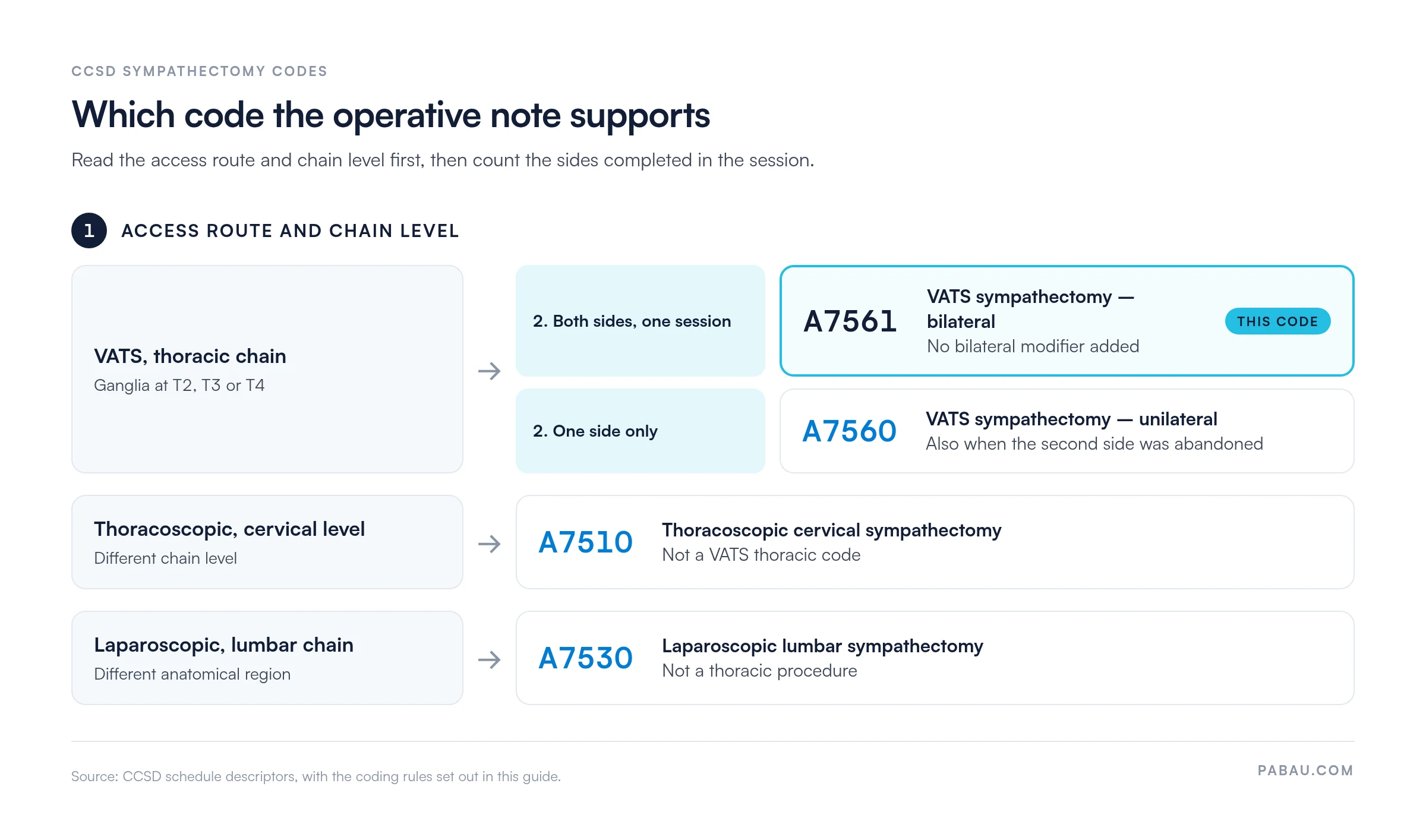
The table gives each neighboring code’s descriptor and the detail in the operative note that separates it from A7561.
CCSD typically gives bilateral procedures a dedicated bilateral code instead of using a modifier 50 convention. A7561 is already bilateral by definition, so don’t append a bilateral modifier.
UK private insurers don’t use CPT codes. CCSD claims go to insurers through Healthcode or a similar electronic claims platform. The cross-reference below is for US-trained coders working in UK private hospitals, or for practices with patients on US employer health plans.
CPT 32664 is cited here for reference only. It is a US code maintained by the AMA, with different reimbursement rules, modifier conventions and payer policies from CCSD A7561. Never put CPT codes on a UK private healthcare invoice.
A7561 denials tend to follow a predictable pattern. Build a pre-submission check for each trigger below into your medical claims management process.
Four of the six triggers trace back to the pre-auth pack or the operative note, so the practice can fix them before the claim leaves.
Post-operative complications of VATS bilateral sympathectomy may need separate coding entries. This section covers the three most clinically significant complications and how each is handled in the billing record.
Compensatory hyperhidrosis is excessive sweating away from the treated area, most commonly on the trunk or thighs. It affects a substantial proportion of patients after thoracic sympathectomy. Published surgical series report widely varying rates depending on the levels treated, and T2 resection carries higher rates than T3 or T4.
For billing, compensatory hyperhidrosis is not separately billable as a new procedure at the same admission. Document it in the clinical record. If it leads to a later consultation or management episode, code it at that encounter with the appropriate ICD-10 code.
Pneumothorax is a recognized procedural complication of any thoracoscopic approach. When it needs active intervention, such as chest drain insertion or aspiration, the drainage procedure is billed separately with the relevant CCSD thoracic drainage code.
The operative and post-operative records must document the pneumothorax, the decision to intervene and the procedure performed. Without that record, the insurer may deny the drainage claim as unbundled from A7561.
Horner’s syndrome, characterized by ptosis, miosis and anhidrosis on the affected side, is a rare but recognized complication of upper thoracic sympathectomy. It results from inadvertent damage to the stellate ganglion or the cervical sympathetic chain.
Horner’s syndrome is not separately billable as a new procedure at the same admission. Document it as a complication in the operative and post-operative notes. If it leads to a specialist ophthalmology review, bill that consultation as a separate episode with standard consultation codes and the appropriate ICD-10 complication code.
Build a complications checklist into the post-operative nursing note for every VATS sympathectomy patient. If signs of Horner’s syndrome or pneumothorax appear within 24 hours, flag them so the clinical record is updated before discharge. A complication documented at discharge is far easier to code, and to appeal if needed, than one added later.
Many private practices still run A7561 billing across separate tools. The authorization number sits in an email, the operative note lives in a document, and the claim is keyed into Healthcode by hand. Each handoff is a chance for the auth reference or the bilateral detail to drop out.
Pabau, the practice management platform we build, keeps the insurer, policy and authorization details on the patient record. When the invoice is ready, Pabau pulls the patient, treatment and insurer details into the claim and sends it to Healthcode. Validation checks run first, so the Send button stays disabled until the membership number and authorization code are in place.
Every claim then moves through clear stages, from pending and submitted to processing, paid or error. Your billing team sees which A7561 claims need attention without chasing insurers by phone.

Pabau checks authorization codes and membership numbers before each CCSD claim goes out. It then sends the claim to Healthcode and tracks it through to payment.

A7561 pays cleanly when VATS access, bilateral completion in one session and a valid authorization all line up. Check those three against the operative note before the claim leaves the practice. If only one side was finished, switch to A7560 rather than defending the bilateral code on appeal.
The trade-off is admin up front, because the pre-auth pack and a structured operative note take time before surgery. That time costs far less than fighting a cosmetic exclusion or an unbundled drainage claim weeks later. Book a demo to see how Pabau checks authorization details before each CCSD claim goes to Healthcode.

Only one side completed during surgery? CCSD Code A7560 covers the unilateral VATS sympathectomy and the documentation it needs.
Billing Bupa patients for surgical procedures? Bupa CCSD codes explains the Bupa schedule and how to submit codes that sit alongside a primary procedure.
Still seeing rejected claims? Denial codes in medical billing walks through the most common denial reasons and how to fix them.
CCSD Code A7561 covers bilateral video-assisted thoracoscopic sympathectomy. The thoracic sympathetic chain is resected, clipped or ablated on both sides within a single operative session. A7561 can’t be used if only one side was performed.
Bilateral is built into the A7561 descriptor. CCSD typically gives bilateral procedures a dedicated code instead of a modifier, unlike US CPT billing, which uses modifier 50. Don’t add a bilateral modifier to A7561.
No. If the surgeon couldn’t complete the second side, A7561 can’t be billed. Causes include adhesions, intra-operative hemorrhage or failed lung re-expansion. Bill A7560, the unilateral code, instead. Billing A7561 when the operative note documents one side would be upcoding.
The closest US equivalent is CPT 32664 (thoracoscopic sympathectomy). Unlike A7561, CPT 32664 has no standalone bilateral code, so bilateral performance is shown by appending modifier 50. CPT codes are for reference only and aren’t used for UK private healthcare billing.
The leading denial reasons are missing or invalid prior authorization and an operative note that doesn’t confirm bilateral completion. Incorrect or missing ICD-10 diagnosis codes and cosmetic exclusions also cause denials. A structured pre-submission checklist prevents each of them.
A7561 is typically accompanied by an anesthesia code for the thoracic procedure and the relevant ICD-10-CM diagnosis code. That is most commonly L74.512 for palmar hyperhidrosis or L74.510 for axillary hyperhidrosis. If complications needed intervention, chest drainage or specialist consultation codes may be submitted as separate episodes.