E2150 is the CCSD code for reconstruction free jejunal graft following pharyngolaryngectomy. It covers rebuilding the pharynx with a segment of jejunum after the larynx and pharynx are removed. The graft keeps its own blood vessels, which are joined to vessels in the neck.
The code sits in chapter 5.0.0 Ear, Nose & Throat, section 5.7.0 Larynx and Trachea, and is used in UK private healthcare billing. The reconstructive surgeon bills E2150, while the head and neck surgeon codes the pharyngolaryngectomy separately.
Automate repetitive tasks and focus on what matters most—your patients.
Improve accuracy
Reduce coding errors and ensure compliance with the latest regulations.
Get paid faster
Clean claims, fewer denials, and faster reimbursements.
Grow with confidence
Powerful insights and reporting to help your practice thrive.
HIPAA compliant•SOC 2 certified•GDPR-compliant•Trusted by 4,000+ clinics worldwide
Key takeaways
CCSD code E2150 covers free jejunal graft reconstruction after total pharyngolaryngectomy, not partial resections or pedicled flaps.
Microvascular anastomosis is part of the procedure, so check the CCSD technical guide for any applicable supplement before adding a second code.
Most UK private insurers require preauthorization before elective surgery of this complexity, so document the referral chain and clinical evidence first.
Incomplete operative notes cause many E2150 queries, so the note must confirm the resection, the jejunal harvest, the anastomoses and restored alimentary continuity.
CCSD code E2150: Definition and schedule context
CCSD code E2150 is the code for rebuilding the pharynx with a free jejunal graft after pharyngolaryngectomy, as set out in the CCSD official schedule. It belongs to the ear, nose and throat chapter (5.7.0 Larynx and Trachea) and describes a microvascular free-tissue transfer.
The surgeon harvests a segment of jejunum with its mesenteric blood vessels and sets it into the defect left by total pharyngolaryngectomy. The jejunal vessels are then joined to recipient vessels in the neck, and the graft restores the swallowing passage.
CCSD codes are used exclusively in UK private healthcare billing, distinct from OPCS-4, the NHS procedure classification. Our CCSD code billing guides cover other procedures in the same schedule.
Code: E2150
Official descriptor: Reconstruction free jejunal graft following pharyngolaryngectomy
Chapter: 5.0.0 Ear, Nose & Throat, section 5.7.0 Larynx and Trachea
Code system: CCSD (Clinical Coding and Schedule Development group)
Setting: UK private healthcare only
Procedure type: Microvascular free-tissue transfer, head and neck reconstruction
The procedure: What free jejunal graft reconstruction involves
Free jejunal graft reconstruction after pharyngolaryngectomy is a two-team operation that lasts six to 14 hours in most specialist centers. Coders selecting or auditing E2150 need to know its phases, because each one must be documented to support the code.
Pharyngolaryngectomy. The head and neck surgeon removes the larynx and pharynx in one piece, usually leaving a circumferential defect in the pharynx.
Jejunal harvest. At the same time, the reconstructive surgeon opens the abdomen and selects a mid-jejunal loop with a good mesenteric vascular pedicle. The bowel is then divided to isolate the graft segment.
Preparation of neck recipient vessels. Branches of the external carotid artery and internal jugular vein are prepared for the microvascular anastomosis.
Inset of the graft. The jejunal segment is sewn to the remaining pharyngeal mucosa above and the cervical esophagus below. This restores a tube for swallowing.
Microvascular anastomosis. The jejunal artery and vein are joined to neck vessels under an operating microscope or loupes, restoring blood flow to the graft.
Wound closure and tracheostomy. A permanent tracheostome is formed, and the abdominal and neck wounds are closed.
Surgeons often choose the jejunum for circumferential pharyngeal defects for three reasons.
Its natural tube shape matches the pharyngeal lumen.
It tolerates radiotherapy field exposure better than some other free flaps.
It secretes mucus that supports swallowing rehabilitation.
Clinical indications: When is E2150 used?
E2150 is used when a total pharyngolaryngectomy is reconstructed with a free jejunal graft, most often for hypopharyngeal or laryngeal cancer. Before assigning it, coders should confirm that at least one of these indications is documented.
Hypopharyngeal or laryngeal malignancy: This is the most common indication, with total pharyngolaryngectomy as the primary resection. Squamous cell carcinoma of the hypopharynx (pyriform sinus, posterior pharyngeal wall, post-cricoid region) qualifies, as does advanced laryngeal carcinoma extending into the hypopharynx.
Salvage surgery after radiotherapy failure: Patients with locoregional recurrence after radiotherapy often present with circumferential pharyngeal involvement. The free jejunal graft is a recognized salvage reconstruction in this setting.
Circumferential pharyngeal defects: In typical clinical practice, the jejunal graft is chosen when the defect is circumferential and cannot be closed primarily. Treat this as a coder check rather than a CCSD requirement, because the official descriptor names only the graft and the pharyngolaryngectomy.
E2150 is not appropriate for partial laryngectomy, partial pharyngectomy with primary closure, or a pedicled pectoralis major or deltopectoral flap. Partial defects are usually closed directly or with a pedicled flap, and esophageal reconstruction below the pharynx is coded elsewhere. Assigning E2150 to a partial resection is an upcoding error that auditors look for in this code range.
What E2150 includes and excludes
Knowing what E2150 bundles prevents both under-billing and unbundling errors. The table below follows standard CCSD bundling principles. Always check it against the CCSD technical guide in force and each insurer’s fee schedule, because supplement rules vary by payer.
Component
Bundled in E2150?
Notes
Jejunal graft harvest
Yes
Harvest is integral to the free jejunal graft procedure
Pharyngeal inset
Yes
Anastomosis to the remaining mucosa is part of the reconstruction
Microvascular anastomosis
Yes, integral to the graft
Check the CCSD technical guide for any applicable supplement before adding a second code
Pharyngolaryngectomy (primary resection)
No
Coded separately by the head and neck surgeon
Neck dissection
No
Coded separately when performed. Check payer-specific bundling rules.
Anesthesia
No
The anesthetist bills separately under the applicable CCSD anesthesia codes
Tracheostomy formation
Check the technical guide
A planned tracheostome formed during total laryngectomy is usually part of the resection. Check the CCSD technical guide before billing it separately.
Co-surgeon fee
No
Each surgeon bills their own component. See the co-surgeon section below.
Pro Tip
Check the CCSD technical guide version in force on the date of surgery, not the version current when you bill. Codes and guidance are updated over time, and billing against the wrong version invites insurer queries.
Neighboring CCSD codes and how to tell them apart
E2150 sits among a group of head and neck reconstruction codes. Picking the wrong one is easy when you code from a brief operative summary instead of the full note. The table below covers the adjacent scenarios coders commonly confuse.
Scenario
Correct approach
Why E2150 does not apply
Pedicled pectoralis major flap to close a pharyngeal defect
Pedicled flap reconstruction code (confirm in the CCSD schedule)
E2150 specifies a free graft with microvascular anastomosis. Pedicled flaps keep their native blood supply.
Partial pharyngectomy with primary closure
Pharyngectomy code with no reconstruction code
E2150 follows a total pharyngolaryngectomy. A defect that closes primarily typically needs no free graft.
Radial forearm free flap for partial pharyngeal reconstruction
The relevant free flap code for a skin or fascia flap
E2150 names jejunum. Other free flap types use different codes.
Gastric pull-up after pharyngolaryngectomy
E2140, reconstruction using stomach pull up following pharyngolaryngectomy
E2150 specifies jejunum, not stomach.
Gastric pull-up for esophageal reconstruction without pharyngolaryngectomy
Esophageal reconstruction code
E2150 specifies jejunum and follows a pharyngolaryngectomy.
Free jejunal graft for esophageal replacement without a laryngectomy component
Confirm in the CCSD schedule, as a different code may apply
The E2150 descriptor names pharyngolaryngectomy as the preceding resection.
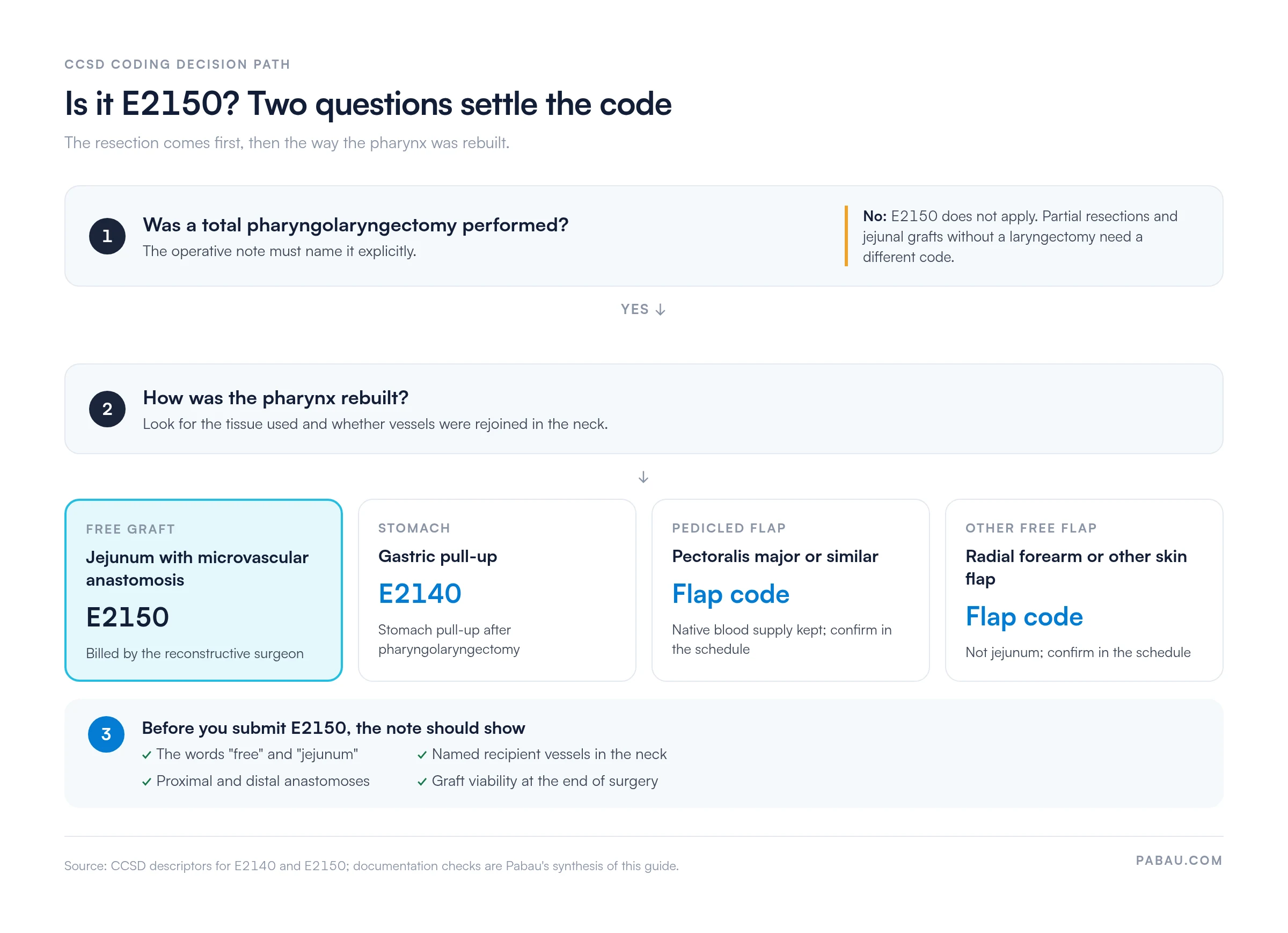
If the note describes a stomach pull-up rather than jejunum, the claim belongs under E2140 instead. For E2150, the operative note should state that a total pharyngolaryngectomy was performed and that the free graft was jejunum. If either element is missing, E2150 is unlikely to be the correct code.
The decision path below runs these checks in the order a coder meets them in the note.
The resection decides whether E2150 is in play, and the tissue used to rebuild the pharynx decides the code. Descriptors are from the CCSD schedule.
Documentation requirements for E2150
UK private insurers assess E2150 claims against the operative note. A brief discharge summary or operating list entry is not enough. These elements should appear in the operative report to support the code and withstand clinical audit.
Confirmation of pharyngolaryngectomy: The primary resection must be named explicitly. “Total pharyngolaryngectomy” is the clearest wording, while abbreviations or implied descriptions cause queries.
Defect description: In typical practice, the surgeon records that the pharyngeal defect was circumferential and could not be closed primarily. CCSD doesn’t require it, but it shows why a free graft was needed.
Jejunal harvest details: Record the segment of jejunum used and its approximate length. Name the mesenteric vascular pedicle, including the artery and vein, and the method of bowel division and closure.
Microvascular anastomosis details: Record the recipient vessels in the neck, typically the superior thyroid artery or an external carotid branch and an internal jugular branch. Add the technique (end-to-end or end-to-side) and confirmation of graft perfusion afterward.
Restoration of alimentary continuity: The note should record the proximal anastomosis to the remaining pharyngeal mucosa and the distal anastomosis to the cervical esophagus.
Graft viability check: The note should confirm the graft was viable when the procedure ended. That means pink, peristalsing and bleeding from the cut edge.
Medical secretaries should read the full operative note before assigning E2150. If any element above is missing, return the note to the operating surgeon for an addendum before submission. A claim denied for an incomplete note delays payment by weeks and draws extra clinical review on resubmission.
Preauthorization: What payers require before accepting E2150
Major UK private medical insurers typically require preauthorization before elective surgery as complex as E2150. The list below covers what the process usually involves. Requirements vary by payer, so confirm them with the insurer before booking the procedure.
Consultant referral chain: The patient needs a valid referral from a recognized GP or specialist to the operating consultant. Insurers check that the chain is complete and that every consultant is recognized by the payer.
Clinical evidence pack: Most insurers ask for imaging, such as CT of the neck and chest and PET-CT where used. They also want biopsy histology confirming malignancy, the multidisciplinary team (MDT) outcome and the proposed operative plan. Bupa and AXA Health typically request this through their preauthorization portals.
Proposed procedure codes: Submit every anticipated CCSD code, including the primary resection code, E2150, any neck dissection codes and the anesthesia codes. Authorization that misses a code is a common cause of denial.
Estimated length of stay: Give an accurate estimate for complex cases. Insurers may query a stay that runs well beyond the benchmark for the procedure.
Emergency exceptions: Sometimes the surgery is urgent, or the full extent of resection only becomes clear during the operation. Most insurers then accept a retrospective authorization request. Document the clinical rationale in the pre-operative note, and contact the insurer within 24 to 48 hours where the policy permits.
Practices using dedicated claims management software can track preauthorization status against each procedure code. Cases with outstanding authorization get flagged before surgery is confirmed, which reduces the risk of unauthorized claims. The Aviva fee schedule portal and Bupa code search both let you check that a code is recognized before submission.
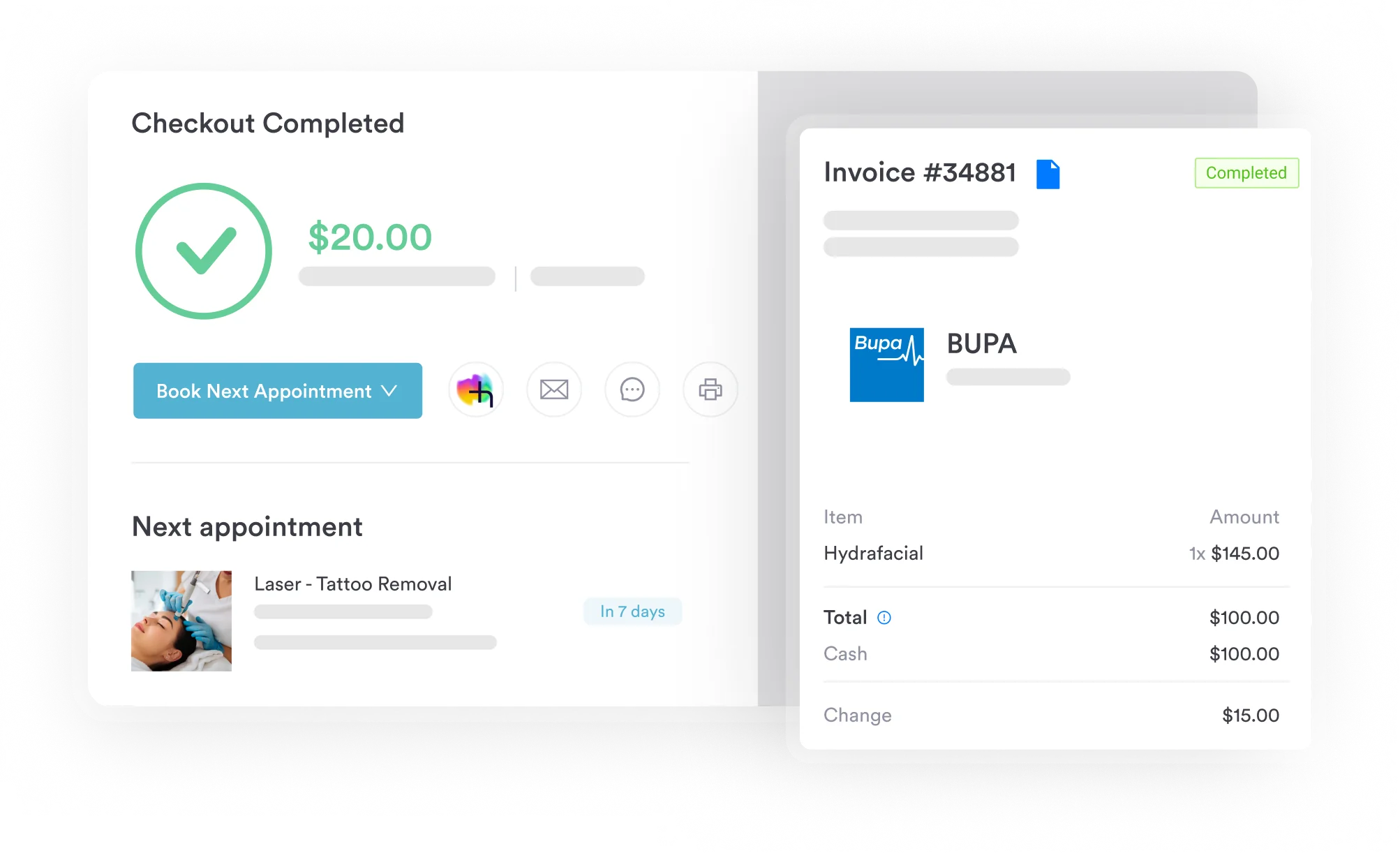
In Pabau’s billing software, the invoice goes to the patient’s insurer, such as Bupa, so the E2150 claim carries the policy details the payer checks.
Common claim denial reasons for E2150 and how to prevent them
E2150 claims draw close scrutiny because the procedure is rare and complex, and insurers often send major reconstructive claims for clinical review. The table below lists frequent denial reasons and how to prevent each one.
Denial reason
Prevention
Missing preauthorization
Get authorization for every anticipated CCSD code before surgery. Tie a preauthorization checklist to the booking workflow.
Incomplete operative note
Have the medical secretary check the note against the six-element checklist in the documentation section before submission.
Wrong code selected (pedicled vs free flap)
Confirm the note describes a “free” transfer with microvascular anastomosis. Pedicled flap reconstruction uses a different code.
Unbundling error
Check which components the current schedule bundles before adding any supplementary code. Never bill the jejunal harvest separately.
Co-surgeon billing conflict (duplicate claims)
Each surgeon bills only their own component. Agree the code split before submission and share the operative note between both billing teams.
Policy exclusion for reconstructive procedures
Check the patient’s policy for reconstructive surgery exclusions beforehand. Oncological reconstruction is usually covered, but confirm with the insurer.
Consultant not recognized by payer
Confirm both surgeons (head and neck, and reconstructive) are recognized by the patient’s insurer before booking.
Co-surgeon and multidisciplinary team billing for E2150
Pharyngolaryngectomy with free jejunal graft reconstruction is almost always a two-team operation. An ear, nose and throat (ENT) or head and neck surgeon performs the resection. A plastic or reconstructive microsurgeon harvests the graft and performs the microvascular anastomosis, and each surgeon bills under their own recognized consultant number.
Head and neck surgeon: Bills the pharyngolaryngectomy resection code and any neck dissection codes. They don’t bill E2150 unless they personally performed the reconstruction.
Reconstructive microsurgeon: Bills E2150 for the free jejunal graft reconstruction, but not the resection codes. Check the CCSD technical guide for any applicable supplement before adding one.
Shared operative note: Name both surgeons in the operative note, with their roles defined. Insurers query claims where the surgeon billing E2150 isn’t named as the reconstructive surgeon.
Anesthetist: Bills separately under CCSD anesthesia codes. A procedure this long typically involves time-based elements, and the anesthetist’s practice submits independently.
Avoid duplicate billing: The most common error is both surgeons billing every CCSD code, so agree the code allocation before submission. Bupa and AXA Health flag claims where two consultants submit the same CCSD code for one patient on the same date.
Medical secretaries for both consultants should talk before submitting claims. A short written agreement on code allocation (email is enough) protects both practitioners if an insurer queries the split. The CCSD technical guide sets out the rules on co-surgeon billing for major procedures.
Bupa patients add one more layer, since each insurer applies the schedule through its own submission rules. Our guide to Bupa CCSD codes walks through how Bupa handles them.
Coding tips for medical secretaries and clinical coders
E2150 comes up rarely, so many coders won’t have assigned it before. These checks help you pick the right code and get the claim through first-pass review.
Read the full operative note, not just the operating list. Operating lists often use shortened names (“pharyngolaryngectomy and reconstruction”) that don’t specify the flap type. Only the operative note confirms whether a free jejunal graft or a pedicled flap was used.
Look for the words “free” and “jejunum” explicitly. If the note doesn’t contain both, don’t assign E2150, and ask the surgeon to clarify.
Check that the microvascular anastomosis is documented. A free graft needs microvascular repair by definition. If the note describes reconstruction without anastomosis details, the graft may have been a pedicled transfer coded elsewhere.
Confirm the primary procedure was a total pharyngolaryngectomy. Partial resections don’t qualify. Look for “total” in the note, along with a description of the defect.
Don’t code from a discharge summary alone. Discharge summaries often leave out the reconstructive detail that separates E2150 from adjacent codes.
Escalate uncertainty. If the note is ambiguous, contact the operating surgeon and check the CCSD technical guide. Correcting a wrong code after a denial takes longer than a short query before submission.
How Pabau keeps E2150 claims complete before submission
Today, an E2150 case is often spread across the operative note, an email thread with the co-surgeon’s secretary and the insurer’s portal. A missing authorization code or membership number only surfaces when the claim comes back.
Pabau keeps the patient’s insurer and policy details on the patient record, next to the clinical notes. Insurer-specific price lists set the fee for each payer, and each invoice routes to the right insurer automatically.
Before a claim goes out, Pabau runs validation checks for the details insurers need, such as membership numbers and authorization codes. UK practices can send claims to Healthcode without leaving Pabau. Each claim is then tracked as pending, submitted, processing, paid or error, so your secretary sees a query the day it lands.
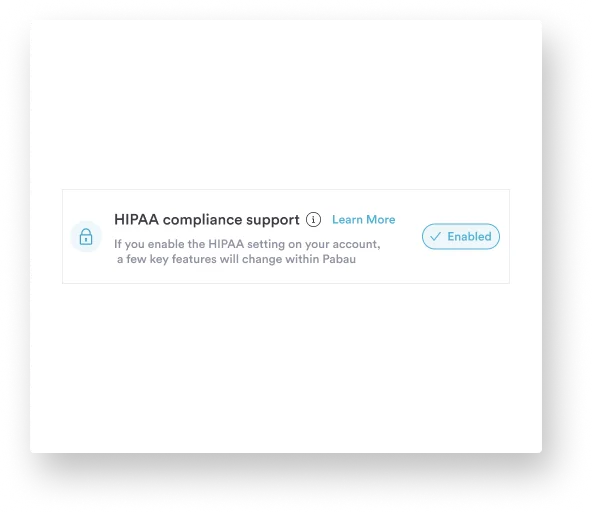
Pabau’s compliance settings, such as this HIPAA toggle, change how key features handle patient data when two surgical teams share one operative note.
Send complete E2150 claims the first time
Pabau checks claims for missing membership numbers and authorization codes, then sends them to Healthcode, so fewer high-value claims come back with queries.
E2150 rewards the coder who reads the whole operative note. The descriptor is narrow, so errors usually come from assigning it on a summary that doesn’t confirm the resection or the jejunal graft.
Start each case by agreeing the code split with the other surgical team and confirming preauthorization for every code. A query on a high-value reconstruction claim can hold up payment for weeks, while the same check before submission takes minutes.
Book a demo to see how Pabau keeps insurer details, authorization codes and claim status together for reconstructive surgery cases.
Continue your research
Need a guide to Bupa’s CCSD billing requirements?Bupa CCSD codes covers how Bupa applies CCSD codes, fee schedules, and submission requirements for UK private practice.
Looking for end-to-end claim tracking for surgical teams?Claims management software explains how Pabau handles preauthorization tracking and claim submission workflows for private practices.
Coding a stomach pull-up instead?CCSD code E2140 covers reconstruction using stomach pull-up after pharyngolaryngectomy, the closest neighbor to E2150.
Working on another pharyngeal procedure?CCSD code E2300 explains how to bill pharyngeal myotomy in UK private practice.
Billing airway surgery as well?CCSD code E4030 walks through tracheoplasty billing for UK private practice.
Frequently asked questions
What does CCSD code E2150 cover?
CCSD code E2150 covers reconstruction of the pharynx with a free jejunal graft following pharyngolaryngectomy. That includes harvesting a vascularized segment of jejunum, setting it into the pharyngeal defect and joining its vessels to neck vessels. It is used only in UK private healthcare billing, typically for the circumferential defect a total pharyngolaryngectomy leaves.
What is a free jejunal graft and when is it used after pharyngolaryngectomy?
A free jejunal graft is a segment of small intestine harvested with its mesenteric blood supply and transplanted into the pharyngeal defect. In typical clinical practice, it is used when the resection leaves a circumferential defect that cannot be closed primarily. Common settings are hypopharyngeal or laryngeal cancer and salvage surgery after radiotherapy failure.
Does E2150 include the microvascular anastomosis or is that coded separately?
The microvascular anastomosis is integral to the free jejunal graft procedure. Check the CCSD technical guide in force on the date of surgery for any applicable supplement. Confirm with the patient’s insurer before adding a second code, to avoid unbundling queries.
Which CCSD codes are used alongside E2150?
E2150 is typically submitted alongside the pharyngolaryngectomy resection code, which the head and neck surgeon bills. Neck dissection and anesthesia codes may apply too, and the anesthetist bills independently. Check the CCSD technical guide for any applicable supplement before adding one.
Why are claims for E2150 commonly denied by private insurers?
The most frequent denial causes are missing preauthorization, an incomplete operative note and co-surgeon billing conflicts where both surgeons submit overlapping codes. Less often, the wrong code is chosen because a pedicled flap was used rather than a free graft. Detailed notes and coordination between both teams before submission prevent most first-pass denials.
What preauthorization is required before billing E2150?
UK private insurers typically require preauthorization before elective surgery at this level of complexity. Submit every anticipated CCSD code, a referral chain confirming consultant recognition, imaging and histology, the multidisciplinary team (MDT) outcome and an estimated length of stay. For emergency cases, contact the insurer within 24 to 48 hours after surgery and document the emergency in the pre-operative note.
How should the head and neck reconstruction be billed for UK private patients?
Each surgeon bills their own component. The head and neck surgeon bills the resection and any neck dissection codes, and the reconstructive microsurgeon bills E2150. Name both surgeons and their roles in the shared operative note. Agreeing the code split before submission prevents the duplicate-billing flags Bupa and AXA Health apply when two consultants submit the same code for one date.