

CCSD code G5100: Bypass of duodenum billing guide
CCSD code G5100 bills a bypass that leaves the duodenum in place CCSD code G5100...

Last Updated: Oct 16, 2026
D0820 is the CCSD code for reconstruction of the external auditory canal. UK private medical insurers use it for surgery that rebuilds, widens or relines a narrowed or absent ear canal. Typical indications are acquired canal stenosis, congenital atresia and canal collapse after trauma.
D0820 sits in the ear, nose and throat chapter of the CCSD schedule. Insurers fund it when audiometry or imaging shows functional impairment, and most require prior authorisation. Excision of a canal lesion (D0810) and bony meatoplasty (D0342) cannot be reported with it.
Let Pabau's smart automation suggest the right codes, reduce claim denials, and keep your practice compliant—effortlessly.
Automate repetitive tasks and focus on what matters most—your patients.
Reduce coding errors and ensure compliance with the latest regulations.
Clean claims, fewer denials, and faster reimbursements.
Powerful insights and reporting to help your practice thrive.
HIPAA compliant SOC 2 certified GDPR-compliant Trusted by 4,000+ clinics worldwide

CCSD code D0820 covers surgical reconstruction of the external auditory canal, including canaloplasty for stenosis, atresia or trauma.
Medical necessity rests on audiometric or imaging evidence of functional impairment, not on cosmetic concern.
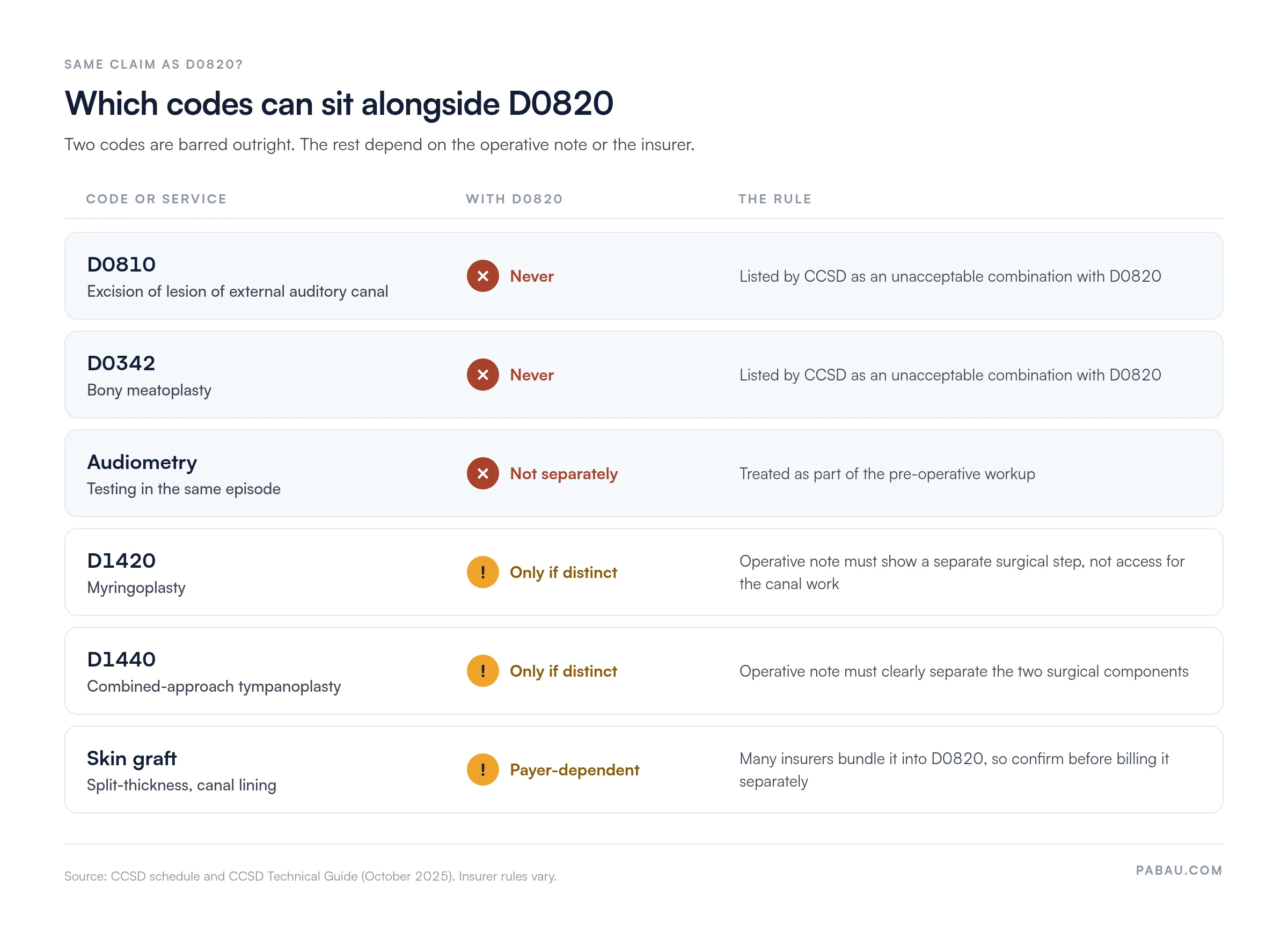
CCSD does not allow D0810 or D0342 on the same claim as D0820. Skin grafts need payer-by-payer confirmation before separate billing.
Most D0820 claims pair with WHO ICD-10 H61.3 or Q16.1, and laterality goes in the operative note and on the claim.
Claims management software such as Pabau helps the team prepare D0820 claims and submit them to UK insurers through Healthcode.
CCSD code D0820 is the UK private healthcare procedure code for reconstruction of the external auditory canal (EAC). It belongs to the Clinical Coding and Schedule Development (CCSD) Group schedule, run by the CCSD Group of UK insurers (Bupa, AXA Health, Aviva, Vitality). Surgeons report it when they rebuild, widen or resurface the bony or cartilaginous ear canal to restore its normal diameter and function.
D0820 sits in the ear, nose and throat chapter of the CCSD code schedule. It covers the canal itself, which runs from the auricle to the tympanic membrane. When the operation also involves the tympanic membrane or middle ear structures, separate codes apply.
In external auditory canal reconstruction, an ENT surgeon removes obstructing bone or tissue and reshapes the canal walls. The reconstructed surface is usually lined to prevent re-stenosis. The approach varies with the cause and extent of the problem.
For acquired stenosis from chronic otitis externa or repeated instrumentation, the surgeon drills away scar tissue and redundant soft tissue and widens the bony canal. A split-thickness skin graft or local flap then covers the raw surface. Congenital atresia needs a more extensive approach, with a new canal created through the atretic plate out to the auricle.
Skin grafting is indicated when the reconstructed surface is too large to heal on its own without re-stenosis risk. Whether a separate graft code can be reported alongside D0820 depends on the insurer, as the bundling section below explains.
Insurers treat EAC reconstruction as medically necessary when it corrects a structural abnormality causing documented functional impairment. The line between functional reconstruction and cosmetic surgery is the most common source of D0820 coverage disputes.
Accepted clinical indications include:
Some requests fall below the medical necessity threshold. These include cosmetic widening of a canal with normal audiometric function and surgery done only to improve the ear’s appearance. Reconstruction without audiometric or imaging evidence of obstruction also falls short. Bupa, AXA Health and Aviva typically expect the operative notes to show functional impairment, not just anatomical findings.
Every D0820 claim needs a supporting ICD-10 diagnosis code that confirms the clinical indication. UK private insurers use WHO ICD-10 for diagnosis pairing, and the table below lists the codes most often paired with D0820. WHO ICD-10 codes don’t carry laterality, so record the side in the operative note and on the claim.
Check each code against WHO ICD-10 (5th edition) before submission, and confirm any insurer-specific pairing rules in its fee schedule.
Several CCSD codes are billed alongside or instead of D0820 in error. Knowing where each code begins and ends prevents unbundling queries and claim rejections.
So when exostoses or a canal lesion are removed during the reconstruction, D0810 and D0342 stay off the D0820 claim. Eardrum and middle ear work is a different matter. Myringoplasty and D1440 both sit in the middle ear and mastoid section, and they can appear on the same claim only with separate operative documentation.
The CCSD Technical Guide (October 2025) sets out the unbundling rules for codes reported on the same date of service. Always consult the current edition before combining codes.
Check the Bupa fee schedule for D0820 at the start of each calendar year. Bupa publishes updated CCSD fee tables annually, and the relative value of ENT reconstruction codes can shift. Confirming the current fee before quoting a patient prevents billing shortfalls and disputes over the contracted amount.
Operative documentation decides most D0820 reviews. Insurers including Bupa and Healix cite inadequate operative documentation as the main reason for post-service claim reviews. Every submission should include the following.
Laterality must appear in both the operative note and the claim. A claim with no right, left or bilateral marker is one of the most common avoidable denial triggers for this code. Good medical billing compliance catches this before submission rather than during an appeal.
Most major UK private medical insurers require prior authorisation (PA) before elective EAC reconstruction. Requirements vary by insurer and plan, so confirm them with the individual insurer before the surgery date.
A PA request for D0820 typically includes:
Some insurers apply a cosmetic exclusion clause to ear procedures. If the initial PA decision is “cosmetic”, the appeal should include audiometric evidence of functional hearing loss. Add a surgeon’s letter that separates the functional goal of the reconstruction from any cosmetic benefit.
Many patients do look better after EAC reconstruction. That outcome doesn’t make the procedure cosmetic when the primary indication is restoring hearing.
The CCSD Technical Guide sets out which procedures may be reported separately on the same date of service. Everything else counts as part of the primary code. For D0820, the key questions are the two barred codes, skin grafts and concurrent middle ear procedures.
Under the general CCSD principle, ancillary procedures in a single operative episode are bundled into the primary code. The exception is where the schedule explicitly permits separate reporting. The chart below shows how that plays out for each code that tends to appear next to D0820.
The Healix fee schedule addresses ENT unbundling in its guidelines and shows how insurers approach complex same-day ENT episodes. Aviva also publishes procedure fee and unbundling guidance for CCSD-coded claims.
D0820 claims attract a higher-than-average review rate among UK private insurers. Ear canal reconstruction sits in a grey zone between functional surgery and cosmetic work. Knowing the most frequent denial patterns helps practice administrators build a stronger first submission.
Run a pre-submission check on every D0820 claim before sending it to the insurer. Confirm the side is recorded in the operative report and on the claim, and that the prior authorisation reference is attached. The operative note should also state the functional indication. Fixing these points before submission takes minutes, while fixing them after a denial takes days.
A denied D0820 claim can be overturned through a structured appeal when the denial rests on incomplete documentation or an unsupported cosmetic classification. Work through these steps promptly. Most UK private insurers expect appeals within 28 to 90 days of the denial letter, so confirm the exact window in your insurer contracts.
A few habits in the billing workflow address the denial triggers above before a claim leaves the practice. They suit ENT and private surgical practices that bill several insurers.
For practices billing CCSD codes across several insurers, our Bupa CCSD codes guide is a consolidated starting point. Use it alongside each insurer’s portal to verify code acceptance and fees before each submission cycle.
Effective denial management in healthcare starts with the charge capture workflow, not the appeal. Build the D0820 documentation fields into the post-operative note template, so the surgeon captures them while they are clinically fresh.
Many ENT practices still assemble a D0820 claim by hand. The coder pulls the audiogram, the CT report and the authorisation number from separate files, then keys the claim into each insurer’s system.
Pabau’s claims management software keeps that work in one place. Your team prepares the claim from the patient record, where the operative note and correspondence already sit. They then submit it to the insurer through Healthcode without leaving Pabau.
Fewer trips between systems means more time for the checks that decide a D0820 claim, such as laterality, the diagnosis pairing and the authorisation reference.
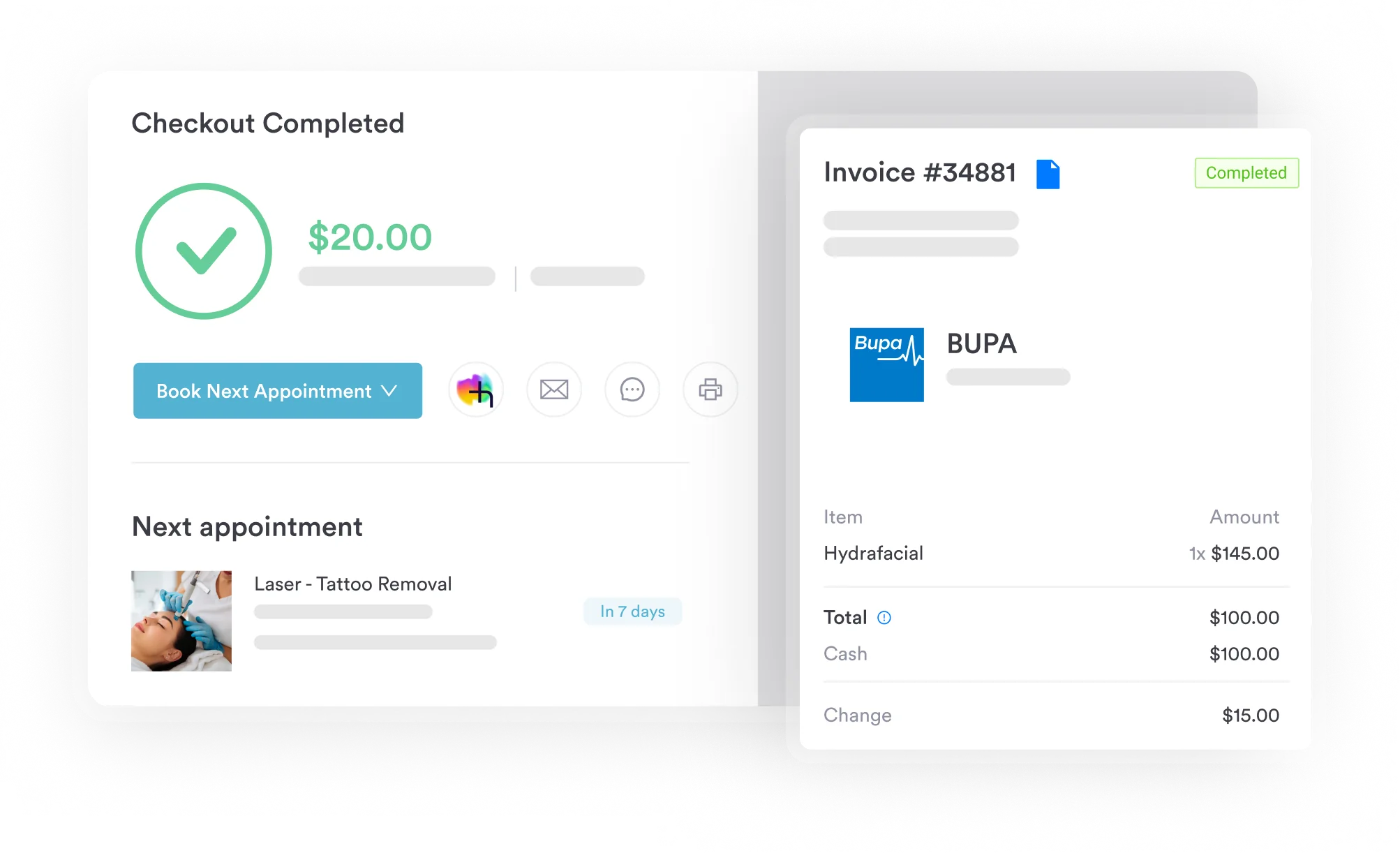

Pabau’s claims management helps ENT and private surgical practices prepare CCSD claims from the patient record and submit them to UK insurers through Healthcode.

Insurers pay D0820 on first submission when the file proves functional impairment. Put the audiogram, the CT report and the surgeon’s justification letter into the authorisation request before the surgery date. That single step answers the cosmetic objection before an insurer can raise it.
The trade-off is time up front. Your team spends longer on the authorisation pack and far less on appeals, resubmissions and calls to the insurer afterwards.
Book a demo to see how Pabau helps ENT practices prepare CCSD claims and send them to insurers through Healthcode.

Does the surgery also involve the middle ear? CCSD code D1440 covers combined-approach tympanoplasty with an intact canal wall, including its indications and authorisation needs.
Billing multiple CCSD codes in a single episode? Bupa CCSD codes reference guide sets out the Bupa schedule structure and the unbundling principles for ENT and surgical procedures.
Need current Bupa fees before quoting a patient? Bupa procedure codes and fee schedule brings Bupa procedure codes and fees together in one reference.
Need to build a claim denial workflow for your practice? Denial management in healthcare covers the appeal process, escalation steps and how to track denial patterns across insurers.
CCSD code D0820 is the procedure code for reconstruction of the external auditory canal. It covers surgery in which an ENT surgeon rebuilds, widens or resurfaces the ear canal to restore its normal diameter and function. It applies to congenital conditions (atresia) and acquired ones (stenosis, exostosis, post-traumatic deformity).
The most common WHO ICD-10 pairings are H61.3 (acquired stenosis of external ear canal) and Q16.1 (congenital atresia or stricture of the external auditory canal). H61.0 (perichondritis of external ear) applies where perichondritis involves the canal. WHO ICD-10 codes don’t carry laterality, so record the side in the operative note and on the claim.
Yes, most major UK private medical insurers require prior authorisation for elective EAC reconstruction. Requirements vary by insurer, so confirm them before the surgery date. The request should include audiometric findings, imaging reports and the surgeon’s clinical justification letter.
The most common reasons are cosmetic classification, missing prior authorisation and laterality missing from the claim or operative note. Unbundling queries also arise when skin graft codes are billed separately without insurer confirmation, or when D0810 or D0342 appear on the same claim. A structured pre-submission checklist prevents most of these.



