

CCSD code G5100: Bypass of duodenum billing guide
CCSD code G5100 bills a bypass that leaves the duodenum in place CCSD code G5100...

Last Updated: Oct 16, 2026
D0702 is the CCSD code for aural toilet (including microsuction and/or suction of exteriorised mastoid cavity) including bilateral. UK private medical insurers use it for suction clearance of wax, debris or discharge from the ear canal or a mastoid bowl.
Treating both ears in one appointment is billed as a single D0702 line. The code sits in CCSD Chapter 5 (Ear, nose and throat), under External Ear. CCSD lists D0730, D1510 and D1520 as unacceptable combinations with it.
Let Pabau's smart automation suggest the right codes, reduce claim denials, and keep your practice compliant—effortlessly.
Automate repetitive tasks and focus on what matters most—your patients.
Reduce coding errors and ensure compliance with the latest regulations.
Clean claims, fewer denials, and faster reimbursements.
Powerful insights and reporting to help your practice thrive.
HIPAA compliant SOC 2 certified GDPR-compliant Trusted by 4,000+ clinics worldwide

CCSD Code D0702 covers aural toilet by microsuction and/or mastoid cavity suction, with bilateral treatment billed on one claim line.
The code applies in UK private practice only, as NHS trusts use OPCS-4 rather than the CCSD schedule.
Missing bilateral documentation and the wrong technique code (ear syringing instead of microsuction) are the top two denial triggers.
CCSD lists D0730, D1510 and D1520 as unacceptable combinations with D0702.
Pabau’s claims management submits claims to UK insurers through Healthcode, and its procedure note templates capture laterality, technique and indication.
CCSD Code D0702 is the CCSD schedule code for aural toilet (including microsuction and/or suction of exteriorised mastoid cavity) including bilateral. That descriptor carries three billing facts. First, the procedure is aural toilet. Second, the permitted techniques are microsuction, mastoid cavity suction or both. Third, treating both ears is bundled into the one code rather than billed as two lines.
The CCSD schedule is maintained by the Clinical Coding and Schedule Development Group, and UK private medical insurers use it to identify procedures on claims. However, CCSD does not set fees or cover. Instead, each insurer applies its own schedule. D0702 sits in CCSD Chapter 5 (Ear, nose and throat), category External Ear.
NHS trusts, in contrast, record procedures in OPCS-4 for hospital episode statistics. CCSD procedure codes appear on private claims to Bupa, AXA Health, Vitality, Aviva, WPA and similar payers.
Aural toilet is the clinical removal of debris, cerumen or discharge from the external auditory canal or an exteriorised mastoid cavity. It is performed under direct vision with suction instruments. So for D0702 billing, microsuction and mastoid cavity suction qualify, while irrigation or ear syringing falls outside the code.
A standard microsuction session proceeds in five stages that your procedure note must reflect:
The clinical indication must appear in the patient record to support a D0702 claim. Otherwise, insurers treat the absence of a documented indication as grounds for denial. Accepted indications include:
The code’s descriptor explicitly bundles bilateral treatment, which means treating both ears in one appointment is billed as a single D0702 submission. Knowing the inclusions and exclusions prevents the two most common coding errors. Those are claiming D0702 for ear syringing and submitting two D0702 lines for bilateral treatment.
The bilateral inclusion is the code’s most important feature for billing. A clinician who treats both ears in one appointment submits D0702 once with bilateral noted in the documentation. In contrast, submitting separate D0702 lines for the left and right ears triggers duplicate-claim detection, and the second line is denied.
D0702 covers two clinically distinct scenarios under a single code, and coders regularly misread this as meaning two separate billing events. However, both scenarios submit as one D0702 line regardless of which technique is used or whether both are performed in the same session.
Post-mastoidectomy patients are a distinct clinical group. A canal wall down or modified radical mastoidectomy creates an exteriorised mastoid cavity, often called a mastoid bowl. It then accumulates squamous debris, so it needs routine outpatient clearance. In fact, these appointments are not follow-up consultations. Instead, they are therapeutic procedures that correctly bill under D0702 rather than an outpatient review code.
The most common D0702 coding errors are applying the code to ear syringing and billing it with a neighbouring ear code. CCSD lists three Chapter 5 codes as unacceptable combinations, so none of them can be billed with D0702.
If the clinician used suction to clear the canal or mastoid bowl, D0702 applies. However, if they removed a foreign body, D0730 applies, and it cannot be billed alongside D0702. Likewise, irrigation alone and an examination with no intervention fall outside D0702.
Middle ear work follows its own codes. For example, D1510 covers myringotomy with tube insertion, and D1520 covers suction clearance of the middle ear as a sole procedure. Also check adjacent codes against the current CCSD schedule each billing year, because codes and descriptors are revised. The decision table below sets out which code fits each documented technique.
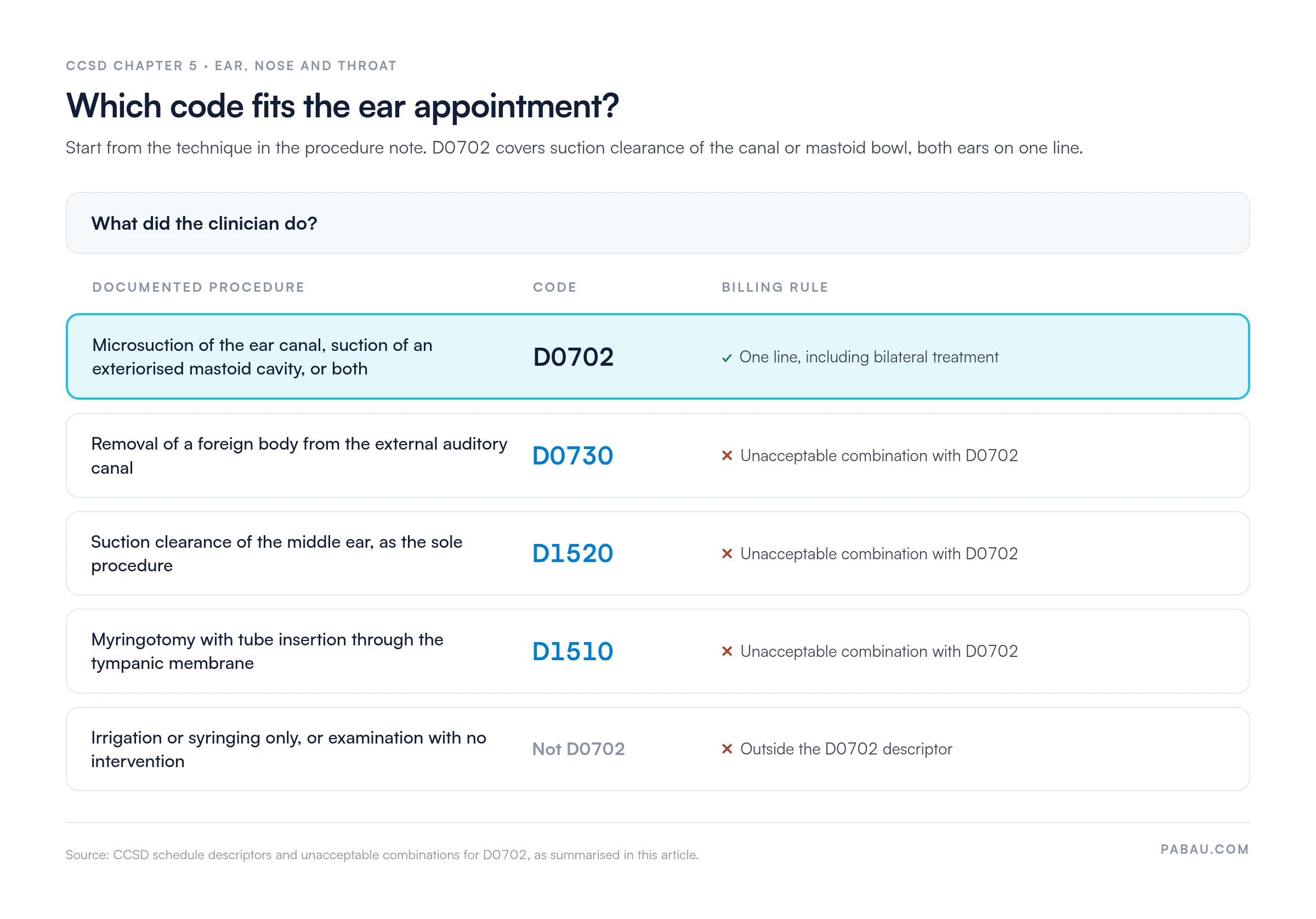
Check the technique documented in the procedure note before assigning any ear code. Microsuction or mastoid cavity suction points to D0702, while irrigation or examination alone does not. If the note does not specify the technique, ask the clinician before submitting. A wrong code rejected by the insurer is harder to resubmit than a delayed claim.
UK private medical insurers assess D0702 claims against two parallel criteria: the completeness of the procedure note and whether pre-authorisation was obtained. Both need to be right before the claim reaches the insurer’s adjudication queue.
A D0702 procedure note must document each of the following elements to withstand a payer review. Indeed, missing any single element is enough for an insurer to request further information or deny the claim outright.
Digital procedure notes with structured fields capture each of these data points consistently. By contrast, free-text notes often omit laterality or technique, and either omission can stall a D0702 claim.
Pre-authorisation requirements for D0702 vary by insurer and can change each policy year. The table below reflects general guidance. Always verify against the insurer’s current provider portal before treating, as requirements may have changed since publication.
The safest approach for a UK private ENT practice is to request pre-authorisation for every D0702 claim, whatever the urgency. Otherwise, treating without authorisation when the policy requires it produces a denial that cannot always be approved after the event.
D0702 denials cluster around a small number of avoidable errors. In fact, auditing your rejection reasons against this list is the fastest way to find where your billing workflow breaks down.
A consistent D0702 billing workflow shortens the time from procedure to payment and prevents the avoidable denials listed above. This sequence suits UK private ENT outpatient departments and independent ENT specialists.
Manual CCSD billing depends on staff remembering to check the code, record laterality, attach the procedure note and submit within each insurer’s window. Pabau, the practice management platform we build, includes private practice claims software that keeps documentation and submission in one workflow.
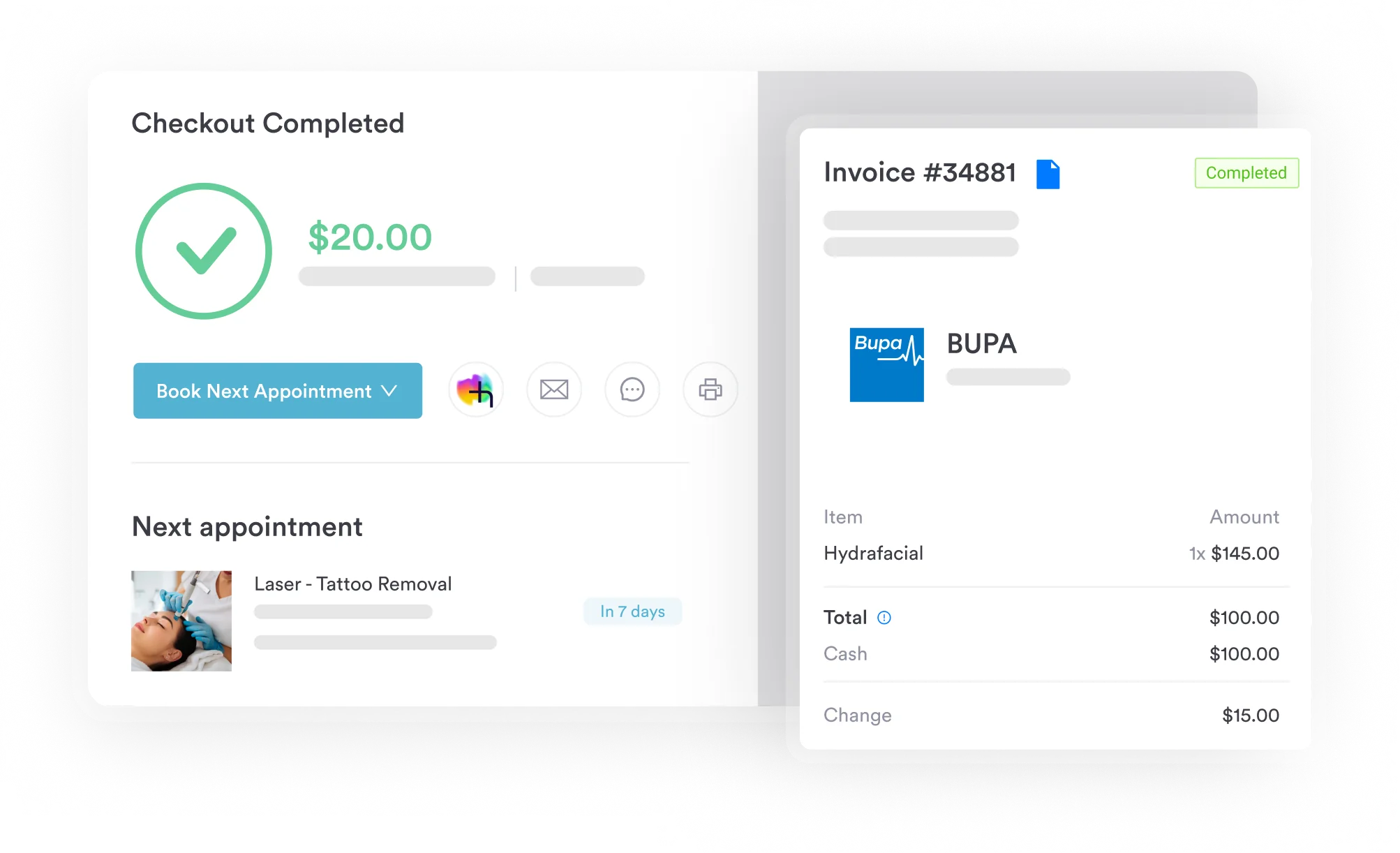
Pabau’s claims management submits claims to UK insurers, including Bupa, AXA Health, Vitality and Aviva, through Healthcode. Procedure note templates capture laterality, technique and indication while the patient is still in the room. Billing staff then send the claim with the documentation insurers query most often already in place.
For ENT practices running microsuction lists alongside post-mastoidectomy follow-ups, that means fewer D0702 claims returned for missing laterality or technique.

Pabau submits claims to UK insurers through Healthcode. Its procedure note templates capture laterality, technique and indication, so each D0702 claim leaves with the details insurers check.

Most D0702 rejections start in the procedure note. So a note that names the technique, states left, right or bilateral, and records the indication leaves the insurer little to query.
The bilateral rule is the trade-off worth remembering. One D0702 line covers both ears, so splitting the treatment into two lines earns a denial rather than a second fee. Before the next microsuction list, check your note template against the six documentation fields above. Then confirm each insurer’s pre-authorisation rule for the code.
Book a demo to see how Pabau’s procedure note templates and Healthcode claim submission keep D0702 claims complete for your ENT list.

Need a broader CCSD billing reference? Pabau’s Bupa CCSD codes guide covers the CCSD procedure codes Bupa accepts, with descriptor summaries and submission tips.
Clearing the middle ear rather than the canal? CCSD code D1520: suction clearance of middle ear explains when middle ear suction bills as a sole procedure.
Billing a myringotomy with grommets? CCSD code D1510: myringotomy and tube insertion covers documentation and bilateral billing for tube insertion.
Coding tympanoplasty for the same patients? CCSD code D1440: combined approach tympanoplasty walks through the intact canal wall procedure and its claim requirements.
CCSD Code D0702 is the billing code for aural toilet by microsuction and/or suction of an exteriorised mastoid cavity. Bilateral treatment is included on a single claim line. Also, it applies in UK private healthcare settings under the CCSD schedule maintained by the Clinical Coding and Schedule Development Group.
Yes. The official CCSD descriptor for D0702 explicitly states “including bilateral,” which means treating both ears in one appointment is submitted as a single D0702 line. However, submitting two separate D0702 lines for bilateral treatment triggers automatic duplicate-claim denial.
Aural toilet by microsuction bills under D0702. Ear syringing (warm water or saline irrigation) falls outside the D0702 descriptor. The technique documented in the procedure note determines which code applies, and insurers flag and deny D0702 claimed for syringing.
The most common rejection reasons are two D0702 lines for bilateral treatment and D0702 applied to ear syringing. In addition, missing clinical indications, absent pre-authorisation and thin procedure notes follow close behind. Thus, a structured billing and documentation workflow prevents all five.
CCSD lists three unacceptable combinations with D0702. They are D0730 (foreign body removal from the ear canal), D1510 (myringotomy with tube insertion) and D1520 (middle ear suction clearance as a sole procedure). Instead, bill the code that matches the documented procedure, not both.



