CPT code 63081: Vertebral corpectomy, cervical spine
CPT code 63081: official descriptor and procedure overview CPT code 63081 descri...

Last Updated: Oct 6, 2026
C7923 is the CCSD code for intravitreal injection of pharmaceutical for neovascular age-related macular degeneration. It covers the ophthalmologist's work of injecting an anti-VEGF drug into the vitreous to treat wet AMD, not dry AMD or other retinal conditions.
The code sits in CCSD section 4.10 (Vitreous) and is graded Minor complexity. Injections for central retinal vein occlusion use C7924, and other indications use C7940. Most UK private insurers bill the drug separately and require prior authorization first.
Let Pabau's smart automation suggest the right codes, reduce claim denials, and keep your practice compliant—effortlessly.
Automate repetitive tasks and focus on what matters most—your patients.
Reduce coding errors and ensure compliance with the latest regulations.
Clean claims, fewer denials, and faster reimbursements.
Powerful insights and reporting to help your practice thrive.
HIPAA compliant SOC 2 certified GDPR-compliant Trusted by 4,000+ clinics worldwide

CCSD Code C7923 covers an intravitreal drug injection for neovascular (wet) AMD only, not dry AMD or other retinal conditions.
Most UK private insurers pay the procedure fee and the drug cost separately, so confirm the drug billing model with each payer.
Most UK private insurers require prior authorization before anti-VEGF injections start. Treating without it is the most common reason C7923 claims are denied.
Injections for central retinal vein occlusion (C7924) or any other indication (C7940) take their own codes, even though the procedure is the same.
Pabau, the practice management platform we build, keeps each injection record, authorization reference and CCSD code together for insurer review.
CCSD Code C7923 is the procedure code for an intravitreal injection of a pharmaceutical for neovascular age-related macular degeneration (AMD).
It sits in section 4.10 (Vitreous) of chapter 4, Eye and orbital contents, in the CCSD schedule. The code covers the ophthalmologist’s procedural work: injecting the drug into the vitreous cavity to treat active choroidal neovascularization.
Two points define the code’s scope. First, it applies to neovascular AMD only, so dry AMD without active neovascularization doesn’t qualify. Second, the code doesn’t name a drug. Any agent indicated for neovascular AMD is billed under it, and the drug itself is usually invoiced separately (see the drug cost section below).
US practices bill the same procedure under CPT 67028, which covers an intravitreal drug injection for any indication. CCSD splits that work into three codes by diagnosis, which is why every C7923 claim turns on the AMD diagnosis.
An intravitreal injection delivers medication straight into the vitreous humor of the eye. That bypasses the blood-retinal barrier, which stops systemic anti-VEGF drugs from reaching therapeutic levels at the macula. The ophthalmologist injects under sterile conditions, usually in an outpatient or treatment room setting.
The steps that support a valid C7923 claim are:
Each step produces a documentation element that private insurers may ask for when they review a C7923 claim. Leave one out and you risk a request for more information or an outright denial.
C7923 covers any pharmaceutical injected intravitreally for neovascular AMD, because it’s a procedure code rather than a drug code. In UK private ophthalmology, the agents in use are four NICE-approved drugs and one off-label option.
If you use newer agents such as faricimab or brolucizumab, confirm acceptance with each insurer before you submit a claim. NICE approval doesn’t guarantee private reimbursement, especially in the first months after a technology appraisal is published.
No. Under most UK private insurer contracts, the anti-VEGF drug cost isn’t bundled into the C7923 procedure fee. The procedure fee covers the ophthalmologist’s time, the clinical setting and the injection itself. The drug is usually charged as a separate line on the invoice.
How that drug charge is handled depends on the insurer and the individual policy. The three common models are:
Verify the drug reimbursement model with the insurer before the patient’s first injection. Insurer portals, such as Vitality’s healthcare provider pages and the fee finder inside them, show which charges a policy covers before you raise the invoice.
C7923 is one of seven codes in section 4.10 (Vitreous) of the CCSD procedure codes schedule. Three are drug injections and four are vitrectomies, so the right pick depends on both the procedure and the diagnosis. The vitrectomy codes start with C7910 for anterior vitrectomy and run up to C7982 for vitrectomy with macular surgery.
The codes most often confused with C7923 are its two injection siblings, C7924 and C7940. The procedure is identical, so the confirmed diagnosis decides the code. Neovascular AMD on OCT means C7923, central retinal vein occlusion means C7924, and any other indication, such as diabetic macular edema, means C7940.
The fee won’t catch a wrong pick. On Freedom’s January 2026 schedule, C7923 and C7940 carry the same specialist fee (£350) and anesthetist fee (£142). The error only surfaces when the insurer checks the diagnosis on the claim against the code. The chart below maps each vitreous code to the procedure and diagnosis it covers.
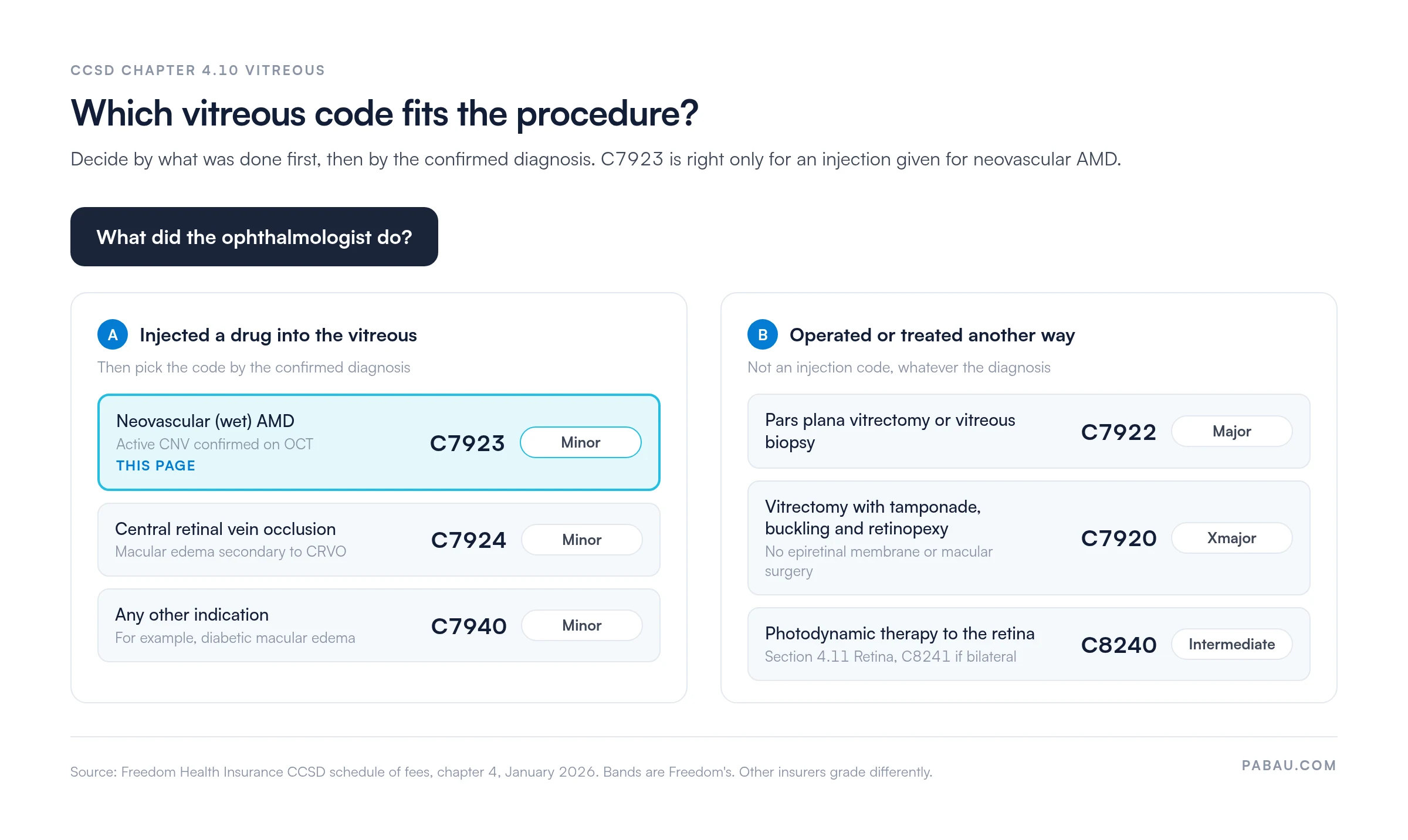
Check each insurer’s chapter 4 schedule for the complexity band it applies to C7923. Freedom grades it Minor while Bupa lists it as Minor 3, and the band shapes the fee you can claim.
A complete C7923 claim needs documentation that confirms the diagnosis, the decision to treat and the details of the injection. Insurers reviewing anti-VEGF claims look for all of the following in the clinical record:
Capture this information in structured digital forms at the point of care, not in free-text notes. It then stays easy to retrieve when an insurer asks for evidence. Practices relying on handwritten or unstructured notes often can’t produce the specific data an insurer needs within the response window.

Most UK private health insurers require prior authorization before anti-VEGF injections can go ahead under a C7923 claim. Treatment that starts without a valid authorization reference is almost always denied, however clinically appropriate it was.
The criteria insurers apply to a prior authorization request usually mirror NICE eligibility standards:
Check the current criteria with each insurer, because thresholds are updated periodically.
If you submit several C7923 claims a week, track authorization reference numbers, expiry dates and approved injection counts against each patient record. Authorizations are usually time-limited, for example to six months or a set injection course. Treating past the approved period without renewal is a frequent denial trigger.
Our Bupa CCSD procedure codes guide covers how Bupa lists and pays CCSD-coded procedures. For the request itself, the prior authorization process guide breaks the workflow into steps your team can follow.
When a patient has injections in both eyes in the same session, the billing approach depends on the insurer. UK private payers have no single standard.
The two approaches in use are:
Before billing a bilateral session, get the insurer’s preferred approach in writing. Document the bilateral injection explicitly in the procedure note, with each eye treated and the drug details for each injection. Never assume one insurer’s bilateral rules apply to another.
Anti-VEGF injection claims have more ways to fail than most eye procedure claims. Prior authorization rules, high drug costs and detailed documentation requirements each create a point where a claim can be rejected. The most frequent denial reasons are:
Structured medical billing compliance processes, including pre-submission checklists built around each insurer’s requirements, cut the frequency of these denial types.
Most denied C7923 claims are recoverable, provided the clinical basis for treatment is sound and the documentation exists. The appeal follows the same sequence with most UK private insurers.
Log every appeal with dates, reference numbers and outcomes. Repeated denials on one code or from one insurer usually point to a process problem worth fixing at practice level, rather than claim by claim.
Practices billing C7923 every week need the clinical record and the billing workflow in one place, so nobody re-keys injection data into a claim. Pabau’s claims management software lets you attach authorization references to patient records and track claim status across insurers from one workspace.
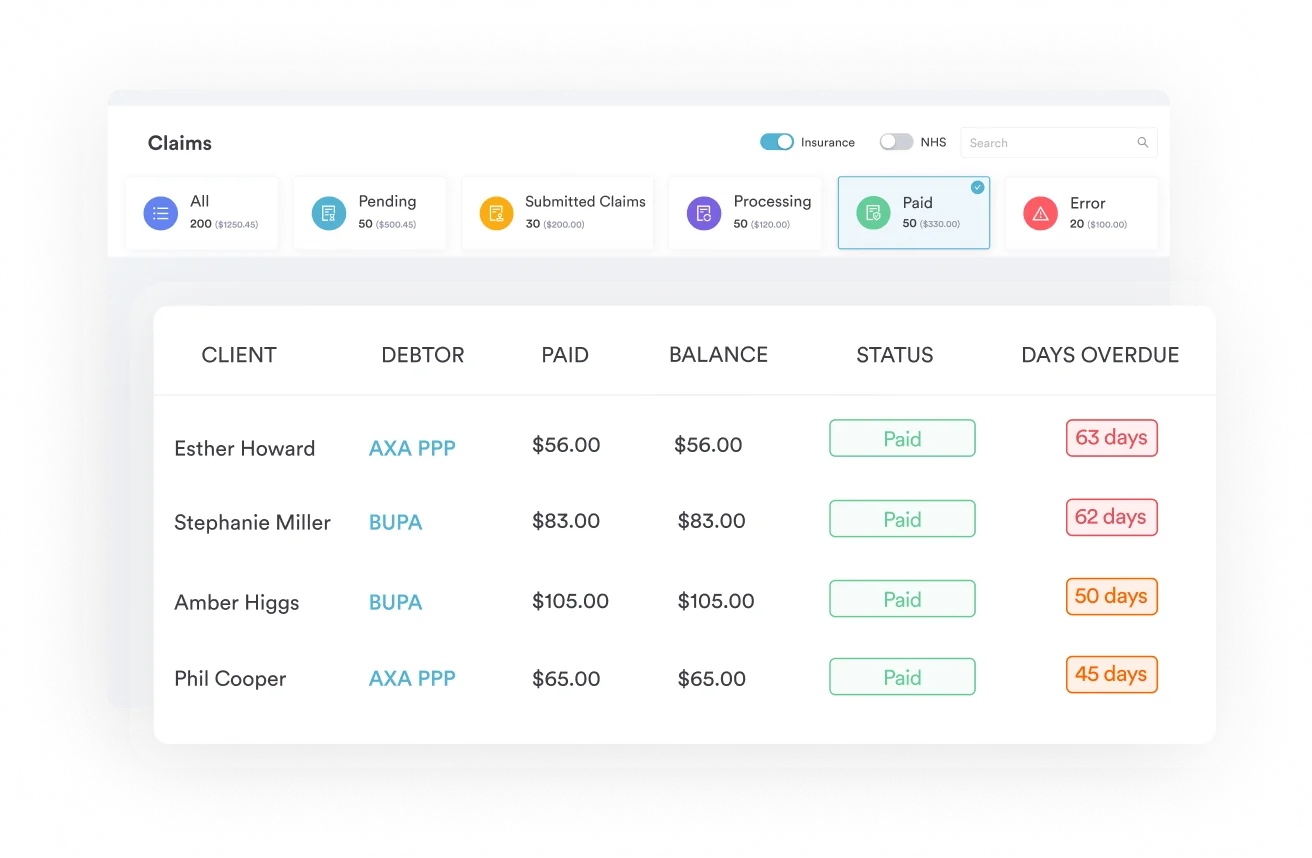
The features that matter most for anti-VEGF injection billing are:
Build a pre-submission checklist in Pabau for each insurer you bill C7923 to. Include the authorization reference, the drug batch number, a current OCT report, documented laterality, and the drug cost as a separate line where required. Running it before every submission catches the most common avoidable denials.

Pabau helps ophthalmology practices track prior authorization references, store structured injection records, and submit accurate CCSD-coded claims. See how it works for your practice.

C7923 pays reliably when three checks line up before the needle goes in. Confirm neovascular AMD on OCT, so the claim can’t be read as C7924 or C7940. Secure the authorization and note when it expires. Agree with each insurer how the drug is invoiced.
Practices that build those checks into the booking and the procedure note see fewer denials and spend less time on appeals. The trade-off is setting the checks up once per insurer, rather than fixing each claim after it bounces.
Book a demo to see how Pabau keeps C7923 authorizations, injection records and CCSD codes together, so your claims go out complete the first time.

Coding other eye procedures in chapter 4? CCSD code C6920: Paracentesis of the eye walks through billing another common eye procedure under CCSD.
Working on corneal surgery claims? CCSD Code C4620: Lamellar graft to cornea shows how to bill a corneal graft under the CCSD schedule.
Want a structured prior authorization request? Medical prior authorization form gives you a ready-made form for requesting insurer approval before treatment.
CCSD Code C7923 covers an intravitreal injection of a pharmaceutical to treat neovascular (wet) age-related macular degeneration. It covers the procedure only. Most UK private insurers bill the drug cost separately.
C7923 applies to neovascular (wet) AMD only. Dry AMD, which involves no active choroidal neovascularization, doesn’t qualify. Billing C7923 for a dry AMD patient is a coding error and will likely be denied.
Yes, most UK private health insurers require prior authorization before anti-VEGF injections under C7923 go ahead. Bupa and AXA Health both require prior approval, while WPA and Aviva requirements vary by policy. Always confirm the requirement with the specific insurer and policy before treating.
It depends on the insurer. Most UK private insurers accept two separate C7923 claim lines, one per eye, with laterality documented on each. Some reduce the fee for the second eye. A minority of contracts require a single claim with a bilateral notation, so confirm the insurer’s rules before submitting.
The codes most often confused with C7923 are the other two vitreous injection codes. C7924 covers an intravitreal injection for central retinal vein occlusion, and C7940 covers an intravitreal injection for any other indication, such as diabetic macular edema. C7920 and C7922 are vitrectomy codes, not injections. The confirmed diagnosis decides which injection code applies.
The leading reasons are missing or expired prior authorization, the wrong code (often C7924 or C7940 in place of C7923), and incomplete documentation. Missing OCT evidence, no visual acuity measurement or unstated laterality all count. Drug cost disputes and newer agents not yet on the insurer’s formulary account for many of the rest.