CPT code 93503: Swan-Ganz catheter billing and modifiers
CPT code 93503: Official descriptor and procedure overview In the AMA CPT code s...

Last Updated: Oct 23, 2026
Billable Code
C1640 is the CCSD code for tarsorrhaphy. It covers suturing the upper and lower eyelid margins together to protect the cornea, in any lateral, medial, partial or total variant. Bupa and Freedom both list it in their 2026 schedules, and most UK private insurers expect prior authorization before surgery.
Let Pabau's smart automation suggest the right codes, reduce claim denials, and keep your practice compliant—effortlessly.
Automate repetitive tasks and focus on what matters most—your patients.
Reduce coding errors and ensure compliance with the latest regulations.
Clean claims, fewer denials, and faster reimbursements.
Powerful insights and reporting to help your practice thrive.
HIPAA compliant SOC 2 certified GDPR-compliant Trusted by 4,000+ clinics worldwide

CCSD code C1640 covers tarsorrhaphy in any variant (lateral, medial, partial, or total) under a single code.
Lagophthalmos secondary to facial nerve palsy is a common indication, and clinical documentation must confirm the specific diagnosis to support medical necessity.
Proceeding without prior authorization where the insurer requires it is a common cause of C1640 non-payment, so verify pre-auth requirements before scheduling.
Pabau’s claims management tools help private ophthalmology practices track pre-authorization status and spot missing documentation before a C1640 claim goes out.
CCSD code C1640 is the UK private medical insurance billing code whose official descriptor is “Tarsorrhaphy.” It covers surgery in which the upper and lower eyelid margins are sutured together to protect the cornea.
It belongs to the C-series of CCSD codes, which covers ophthalmic surgical procedures. Insurers that use the CCSD framework list it in their fee schedules (Bupa and Freedom both do in 2026). A single C1640 claim covers the tarsorrhaphy construction regardless of whether the approach is lateral, medial, partial, or total.
The CCSD is maintained by a consortium of UK healthcare bodies and insurers. All participating insurers publish their own fee schedules against CCSD codes. So the reimbursement rate for C1640 varies by insurer and by the terms agreed with each consultant.
Tarsorrhaphy is a surgical procedure that joins the upper and lower eyelid margins, either partially or fully. It reduces the palpebral aperture and protects the corneal surface. It is performed under local or general anesthetic depending on patient factors and extent of closure required.
There are four main variants, all of which bill under C1640:
The surgeon freshens the lid margin epithelium and places sutures through the tarsal plates or lid margins. The sutures are then tied to achieve the desired degree of closure. Temporary tarsorrhaphy uses sutures that are left in place until the underlying cause resolves. Permanent tarsorrhaphy involves tissue apposition that does not spontaneously reverse.
Tarsorrhaphy is indicated whenever corneal exposure threatens the integrity of the corneal epithelium and conservative measures (lubricants, moisture chambers, scleral lenses) have proved insufficient. Each indication must be documented clearly to support C1640 medical necessity.
Understanding the scope of CCSD code C1640 prevents two common billing errors. These are under-claiming (omitting legitimate concurrent codes) and over-claiming (reusing C1640 for procedures it does not cover).
Oculoplastic practices billing C1640 routinely encounter the following codes. Review the Bupa CCSD codes reference for full descriptor listings across the ophthalmology chapter.
Always verify concurrent billing rules with each insurer’s current Schedule of Procedures and Prices (SOPP) before submitting. Bundling policies differ between Bupa, AXA Health, and Vitality. If the ptosis repair uses a fascia lata sling, the C1813 guide covers the graft detail insurers expect.
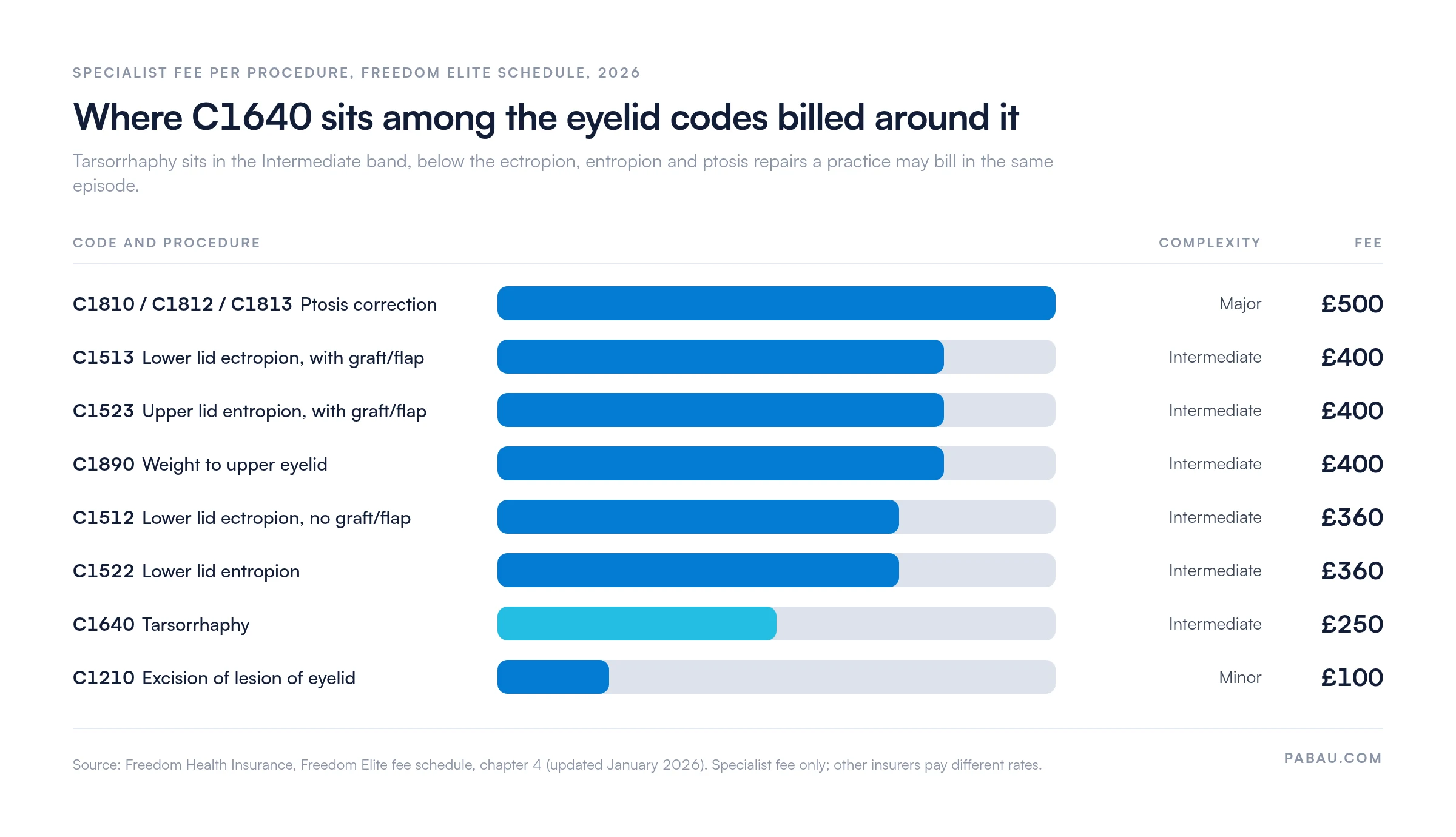
Fees differ by insurer, but one published schedule shows how C1640 compares with these neighbors. Freedom’s 2026 specialist fees put tarsorrhaphy below every ectropion, entropion and ptosis repair in the table.
Some practices also see international patients billed under US CPT coding. For them, the nearest CPT equivalents to C1640 are 67880 and 67882. CPT 67880 covers construction of intermarginal adhesions, median tarsorrhaphy, or canthorrhaphy. CPT 67882 covers the same procedure with transposition of tarsal plate.
Temporary closure of the eyelids by suture has its own code, CPT 67875. The mapping is approximate, not official. The two systems do not share a published crosswalk.
The key practical difference is that the CCSD does not split C1640 by technique. A temporary suture closure, a permanent intermarginal adhesion and a tarsal-plate transposition all bill as C1640 in the UK private system. In the US, they attract different CPT codes (67875, 67880 and 67882) and different Medicare RVU values.
That single-code approach is not unique to C1640. In ear, nose and throat billing, E2300 covers a pharyngeal myotomy whether the surgeon uses an open transcervical or an endoscopic transoral approach.
The CCSD splits other procedures by approach. G2430 covers an antireflux operation completed through an open abdominal incision, while a laparoscopic case is billed as G2331.
Practices billing both systems for the same patient should note which technique was used in the operative report, since US payers will ask.
Incomplete documentation is a common cause of C1640 claim rejection. Every claim should be supported by a clinical record that contains all of the following elements.
An operative note that cites the indication, technique, and extent of closure is one of the most effective ways to avoid a medical necessity challenge. Review your practice’s medical billing compliance process to ensure operative notes are completed and attached before claim submission.
Most major UK private insurers require prior authorization before tarsorrhaphy. Proceeding without pre-authorization where it is required is a common cause of C1640 non-payment. Policies differ by insurer, policy type, and clinical urgency, so always verify directly with the individual insurer before scheduling.
A pre-authorization request typically needs the confirmed diagnosis and a brief clinical summary of the conservative treatment tried. Insurers also expect the consultant’s recommendation for tarsorrhaphy and the anticipated procedure date. Submit this before the patient is listed.
C1640 claims are denied for a predictable set of reasons. Each has a straightforward corrective action.
A structured denial management workflow ensures rejections are caught, investigated, and resubmitted within the insurer’s appeal window. That window typically runs 30 to 90 days from the original decision.
Before submitting any C1640 claim, run a pre-submission checklist. Confirm the pre-auth reference number and complete the operative note with indication and technique. Then align the anesthetic code and include the diagnostic code where required. Practices that build this check into their billing workflow are better placed to avoid C1640 rejections.
Published 2026 CCSD schedules, including the Bupa CCSD reference, list C1640 Tarsorrhaphy as the only tarsorrhaphy code. None of them lists a separate code for dividing or reversing a tarsorrhaphy.
That means a takedown has no listed CCSD code. Before you schedule one, ask the insurer which code it expects and record its answer alongside the pre-authorization reference.
The operative note should still show that the procedure took down an existing tarsorrhaphy. Record the original site and extent, the reason for reversal, and the technique used.
CCSD codes do not carry a single national fee. Each insurer publishes its own Schedule of Procedures and Prices (SOPP) that sets the reimbursable amount for C1640 under their policies. The rate a consultant can charge privately may exceed the insurer’s SOPP rate. That shortfall must be discussed with the patient before treatment.
For a published benchmark, Freedom’s Elite schedule (updated January 2026) places C1640 in its Intermediate complexity band. It allows a £250 specialist fee and a £213 anesthetist fee.
Practices moving from NHS into private ophthalmology should also review the Bupa procedure codes fee schedule. Check how CCSD coding applies to the recognition agreement with each insurer, too.
Each denial reason above starts with paperwork that sits outside the billing system. The pre-auth reference lives in an email, or the operative note reaches the insurer after the claim does.
In Pabau’s claims management software, the CCSD submission, the authorization reference and the operative note sit on one patient record. Your team tracks each C1640 claim from submission to payment.
Insurer payments are checked against the expected SOPP fee, and short-paid claims get flagged. That way, you can query a shortfall inside the appeal window instead of finding it at month end.
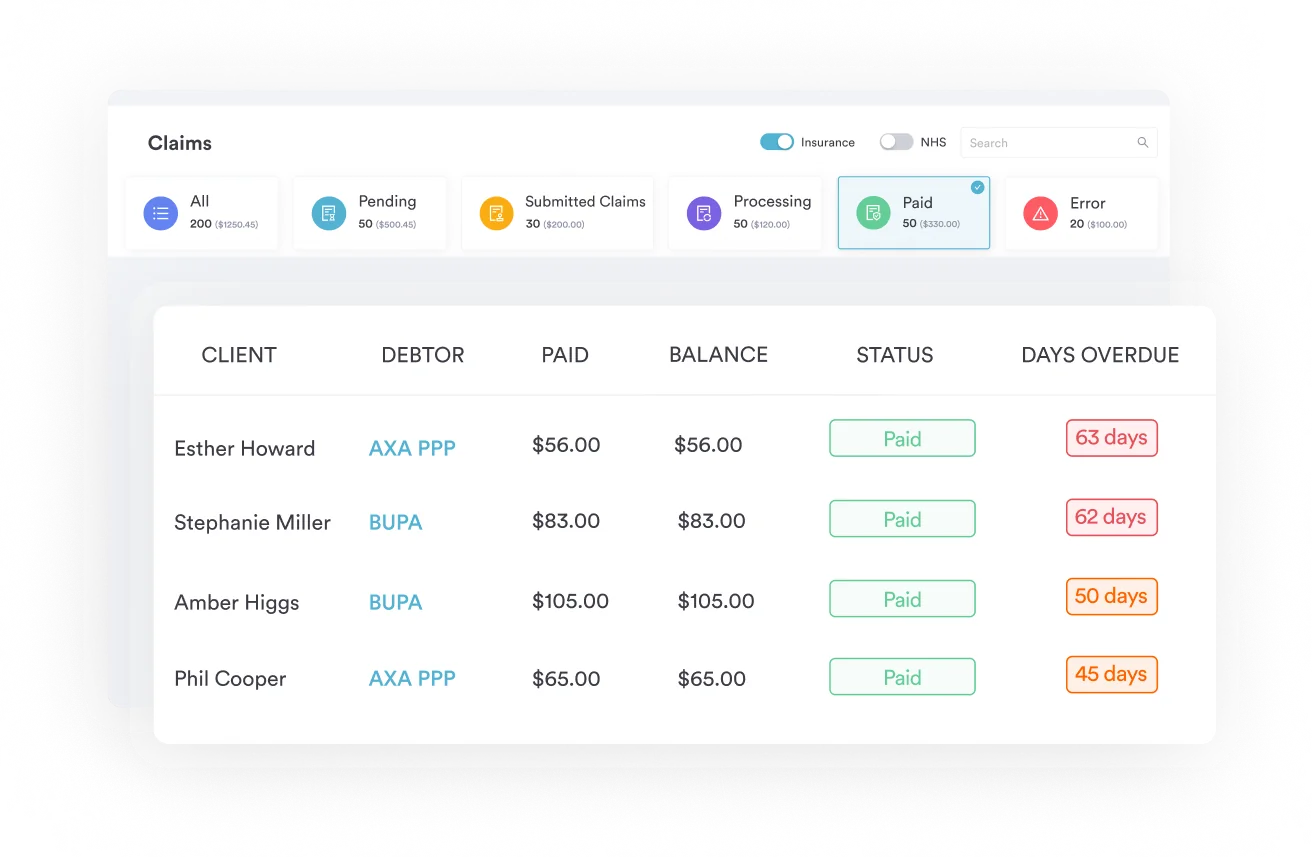

Pabau helps private ophthalmology and oculoplastic practices track pre-auth status, attach supporting documentation to claims, and reduce the administrative burden of CCSD billing.

Choosing the code is the easy part of billing tarsorrhaphy. C1640 covers every variant, so the coding decision rarely needs a second look.
Payment turns on the work done before surgery. Confirm pre-authorization, write the indication and extent into the operative note, and check the insurer’s current SOPP rate. A practice that finishes those steps before listing the patient protects the fee.
A takedown is the one case to settle with the insurer first, because no listed CCSD code covers it. Book a demo to see how Pabau keeps pre-auth references, operative notes and CCSD claims on one patient record.

Correcting a droop rather than closing the lid? CCSD code C1813: Fascia lata ptosis correction billing guide covers the graft and harvest-site detail insurers expect in the operative note.
Treating eyelid lesions in the same practice? CCSD code C1230: Eyelid lesion curettage billing guide shows where neighboring eyelid codes trip up claims.
Protecting the cornea with sutures instead? CCSD code C4980: Corneal tension sutures billing guide explains what the code includes and why insurers deny it.
Coding the corneal problem behind the closure? ICD-10 code H18.9: Unspecified disorder of cornea sets out when to swap the unspecified code for a more specific H18 code.
Recording the eyelid condition on the claim? ICD-10 code H02.9: Unspecified disorder of eyelid compares H02.9 with H02.89 and lists the documentation payers expect.
Tarsorrhaphy is a surgical procedure in which the upper and lower eyelid margins are sutured together to reduce corneal exposure and protect the ocular surface. It is performed when lagophthalmos, thyroid eye disease, exposure keratopathy, or neurotrophic corneal ulceration cannot be controlled conservatively. Those conservative measures include lubricants, moisture chambers, and scleral lenses.
CCSD code C1640 covers tarsorrhaphy in any variant, including lateral, medial, partial, and total approaches. Concurrent oculoplastic procedures, such as ptosis repair, bill under their own codes.
CPT 67880 (intermarginal adhesions, median tarsorrhaphy, or canthorrhaphy) and CPT 67882 (the same with tarsal plate transposition) are the nearest US equivalents to C1640. Temporary suture closure of the eyelids is CPT 67875. No official CCSD-to-CPT mapping has been published. In the UK private system, every variant bills under the single C1640 descriptor.
Published 2026 CCSD schedules list no separate code for dividing or reversing a tarsorrhaphy. C1640 Tarsorrhaphy is the only tarsorrhaphy code they list. Confirm the right code with the insurer before the takedown.
Most major UK private insurers, including Bupa, AXA Health, Aviva, Vitality, and WPA, typically require prior authorization before elective tarsorrhaphy. Requirements may vary by individual policy and clinical urgency. Always verify directly with the insurer before listing the patient to avoid non-payment.
Missing or inadequate pre-authorization is a common cause of C1640 non-payment. Insufficient clinical justification in the operative note and an absent or incorrect diagnostic code also lead to denials. Each is preventable with a structured pre-submission checklist.