CPT Code 69610: Tympanic membrane patch repair (myringoplasty)
CPT code 69610: official descriptor and procedure overview CPT code 69610 descri...

Last Updated: Oct 19, 2026
C1110 is the CCSD code for excision of lesion of canthus. It covers surgical removal of a lesion at the inner (medial) or outer (lateral) corner of the eye, where the upper and lower lids meet.
The same code applies to benign and malignant lesions at either corner. Lesions destroyed by laser, cryotherapy, or cautery, or sited on the lid margin or conjunctiva, take a different code. Bupa lists C1110 in its MINOR 4 fee category.
Let Pabau's smart automation suggest the right codes, reduce claim denials, and keep your practice compliant—effortlessly.
Automate repetitive tasks and focus on what matters most—your patients.
Reduce coding errors and ensure compliance with the latest regulations.
Clean claims, fewer denials, and faster reimbursements.
Powerful insights and reporting to help your practice thrive.
HIPAA compliant SOC 2 certified GDPR-compliant Trusted by 4,000+ clinics worldwide

CCSD code C1110 covers surgical excision of a lesion at the canthal angle, and Bupa lists it in its MINOR 4 fee category.
The CCSD schedule uses one code for medial and lateral canthus excisions, so the operative note has to name the site.
Pre-authorisation is typically required by Bupa, AXA Health, Aviva, and Vitality, and cosmetic-appearing lesions need additional clinical justification.
Missing operative note detail and absent histology are the two most common reasons UK private insurers deny C1110 claims.
Practice management software like Pabau records, invoices, and submits the CCSD code your coder has selected. It doesn’t assign the code itself.
CCSD Code C1110 covers the surgical excision of a lesion at the canthus. The canthus is the angle where the upper and lower eyelid margins meet, at the inner (medial) or outer (lateral) corner of the eye. C1110 sits in the eye and orbital contents chapter of the CCSD codes schedule. Bupa lists it in its MINOR 4 fee category.
Use it only when the lesion is cut out. Removal by destruction, curettage, or laser ablation takes a different code. At the lid, a lesion treated by curettage or cryotherapy bills as C1230.
The CCSD schedule separates C1110 from neighbouring eyelid excision codes. The canthus is anatomically and surgically distinct from the lid margin, conjunctival fornix, and periorbital skin. Before assigning this code, confirm the operative note names the canthal angle as the lesion site, not the lid margin.
A lesion taken from the lid itself, rather than the canthal angle, bills as C1210. Where the note places the lesion on nasal skin instead, the excision belongs under CCSD code E0910.
Lesions commonly billed under C1110 include basal cell carcinoma (BCC), squamous cell carcinoma (SCC), sebaceous cysts, and papillomas. Chalazia at the canthal angle and melanocytic naevi are billed under it too. Whether the lesion is benign or malignant doesn’t change the code. It does change the documentation insurers expect and how closely they review the claim.
Canthus lesion excision is usually performed under local anaesthesia. General anaesthesia may be used for anxious patients, children, or extensive lesions that need wide-margin clearance. The surgeon maps the lesion boundaries and plans the incision to protect canthal anatomy and lacrimal drainage. The lesion is then excised with a margin suited to the suspected histology.
Wound management after excision depends on defect size and location. Small defects at the lateral canthus often close primarily. Medial canthal defects are more surgically demanding because of proximity to the lacrimal canaliculi and the medial canthal tendon. Larger defects at either site may require local flap repair or skin grafting, which generates a separate reconstruction code.
The excised specimen should be sent for histopathological analysis in all cases where malignancy is clinically suspected. Most UK private insurers expect a histology request to accompany the operative note when the pre-operative diagnosis includes any malignant differential. Where malignancy isn’t a concern, histology may not be mandatory. Many practices still send every specimen as standard.
Benign lesions tend to involve straightforward excision with primary closure and shorter operative times. Malignant lesions, particularly BCC and SCC at the medial canthus, need wider margins and sometimes intraoperative margin assessment. They are also more likely to need staged reconstruction.
The billing code remains C1110 in either case. For a malignant excision, the operative note should document the suspected diagnosis, the excision margins taken, and specimen labelling. That detail stops the insurer classing the procedure as cosmetic.
No, the site doesn’t change the code. The current CCSD schedule uses a single C1110 code, with no published sub-codes for medial or lateral canthus excisions. The schedule is updated regularly, so check the latest CCSD technical guide to confirm this still holds. The table below shows where the two sites differ for documentation and insurer handling.
The canthus sits where several anatomical territories meet. Picking the wrong neighbouring code is one of the most common coding errors for this procedure. The Bupa fee schedule and the CCSD eye chapter both list eyelid, conjunctival, and canthal codes that look alike at first glance. The table below covers the codes most often confused with C1110.
Depth matters as much as site. A lesion reached by taking down the lateral orbital wall sits behind the eye, not at the canthal angle, so it bills as C0213.
The operative note is the audit trail for code selection. When the site is documented as “medial canthal area” or “outer canthal angle,” C1110 is defensible. When the note says “upper lid margin” or “lower lid skin,” a different code is more accurate. A C1110 claim on that note is likely to be queried. The three questions below follow the order a coder reads the note in.
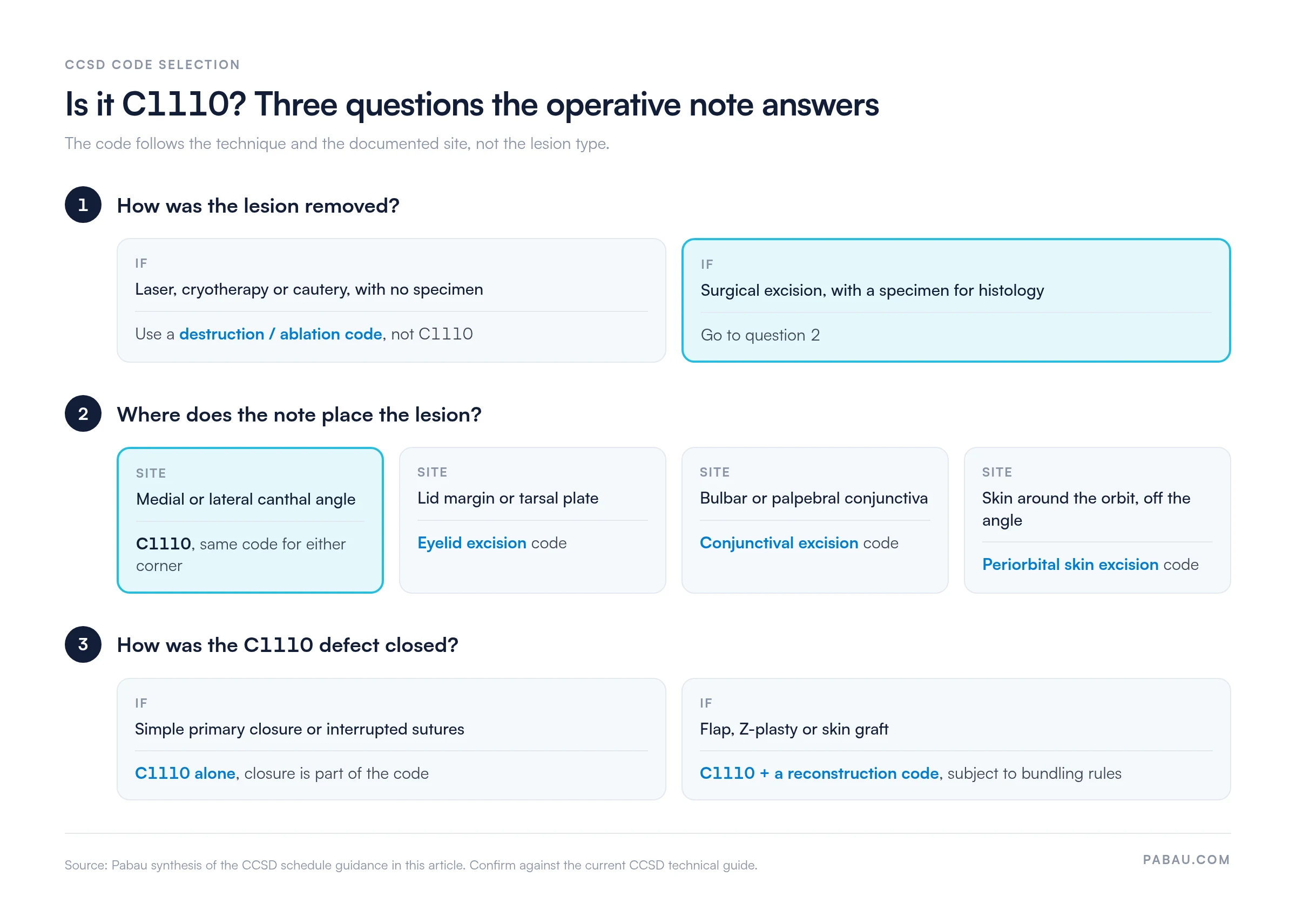
Insurers audit C1110 claims against the operative note, and incomplete documentation is the fastest route to a rejected or delayed payment. Care Quality Commission standards set the baseline for clinical record content in England. UK private insurers add their own billing requirements on top, and record retention follows Information Commissioner’s Office guidance.
Every C1110 operative note must contain the following minimum content to support a successful claim:
A digital operative note template pre-loaded with C1110 fields makes an incomplete note far less likely. A CQC inspection checklist is a useful reference when you review whether those templates meet the standard. If you hold patient records electronically, confirm your retention and access controls meet UK GDPR.
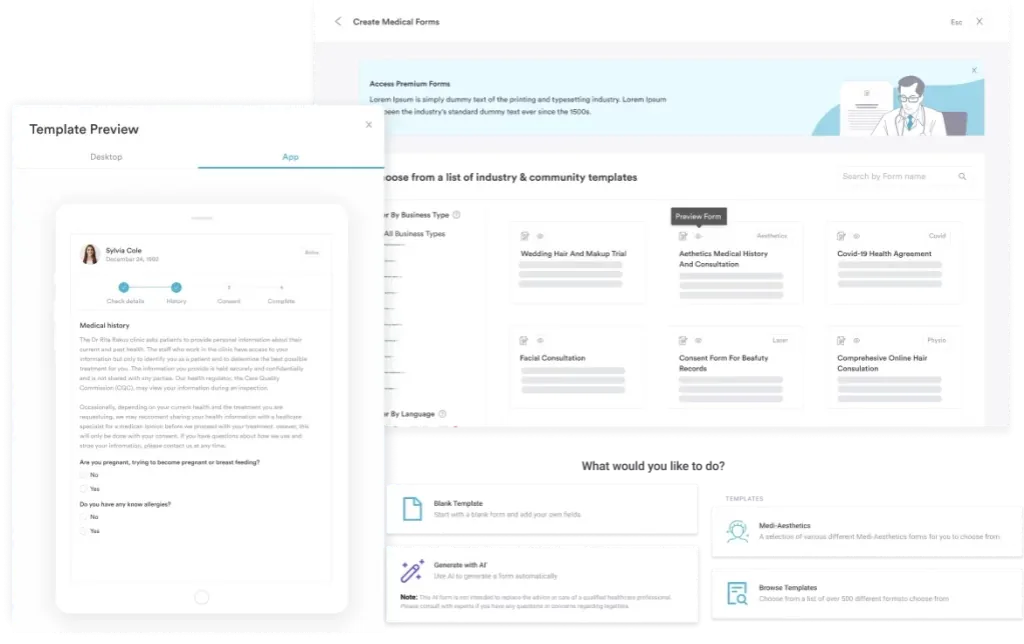
Run a quarterly internal audit of C1110 operative notes against the minimum content list above. Review five randomly selected C1110 cases each quarter. Flag any note missing lesion dimensions, site laterality, or a histology request reference. Fixing those notes before an insurer audit saves significant administrative rework.
Most UK private medical insurers require pre-authorisation for elective oculoplastic procedures, including canthus lesion excision, before they settle a C1110 claim. Requirements vary by insurer and change periodically, so verify them with the insurer before the procedure.
The following summarises typical pre-authorisation requirements across major UK private medical insurers for C1110. Insurer portals, including the Bupa code search portal and the Vitality fee finder, publish current guidance. Check the relevant one for each case.
Cosmetic presentations are the most common trigger for additional clinical justification. The insurer’s clinical team may class a visible canthal lesion as cosmetic if it causes no functional impairment. Functional impairment here means visual field restriction, epiphora, or recurrent infection. That can mean a refused claim even after pre-auth was granted.
Where functional impact exists, document it explicitly in the referral and the pre-auth request.
UK private insurers deny C1110 claims for six recurring reasons, from missing pre-authorisation to policy exclusions. Each one needs a different prevention step, set out in the table below.
When the canthal defect needs flap repair, Z-plasty, or skin grafting, a reconstruction code may be billed alongside C1110. Whether insurers accept it depends on the CCSD bundling rules, the insurer’s fee policy, and how well the operative note links the two procedures. The Healix fee schedule publishes explicit unbundling guidelines, which make a useful reference for how reconstruction is treated relative to excision.
The general principle within CCSD is that the excision code and the reconstruction code cover distinct surgical phases. C1110 covers the excision itself. A separate reconstruction code covers the wound repair when that repair goes beyond simple primary closure. Simple interrupted suture closure is typically considered part of C1110 and should not attract a separate reconstruction billing line.
For co-billing to be accepted, the operative note must:
Bundling interpretations vary, and some insurers want additional clinical justification for combined billing. Check the current CCSD technical guide and the insurer’s policy before submitting a reconstruction code with C1110.
Practices running high volumes of oculoplastic procedures under CCSD cut claim rejections by building coding checks into the clinical workflow. When coding is left as a post-procedure admin task, wrong-code errors only surface after submission.
Practical steps for oculoplastic coding teams:
Keep your patient data handling up to date as well, because insurer audits increasingly ask for original clinical records alongside the claim.
Many oculoplastic practices still raise C1110 invoices by hand and re-key patient and insurer details into each Healthcode submission. Authorisation numbers get chased by email, and every re-keyed field is another chance of a rejection.
Pabau’s medical claims management keeps the patient’s insurer and policy on the patient record. Invoices route to the right insurer automatically, and the Healthcode submission arrives pre-filled. Insurers not on Healthcode get the claim by email from the same dashboard.
Before a claim goes out, Pabau checks that the membership number and authorisation code are in place. The Send button stays disabled until they are. Code selection stays with your coder, and Pabau carries the CCSD code they choose through to the invoice.
Each claim then moves through pending, submitted, processing, paid, or error, so your team can see which C1110 claims need attention today.
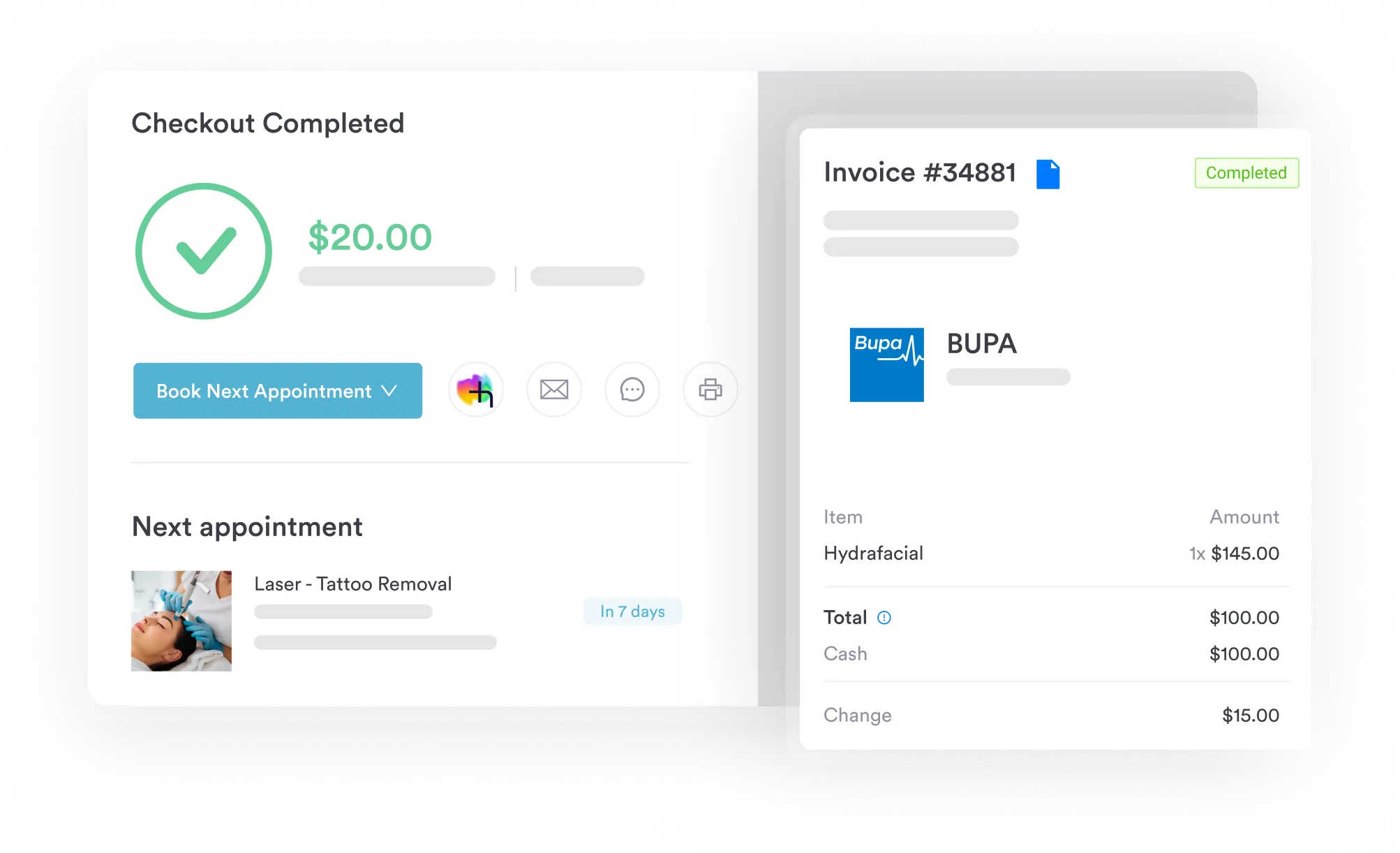

Pabau carries the CCSD code your team selects onto the invoice, checks authorisation numbers before sending, and submits claims through Healthcode or by email.

A C1110 claim is won or lost in the operative note. If the note names the canthal angle, measures the lesion, and logs the histology reference, the code holds up at audit.
The trade-off is a few extra minutes per note against weeks spent chasing a refused claim. Build the C1110 template once, secure the pre-auth number before booking the date, and audit a sample of notes each quarter.
Book a demo to see how Pabau keeps CCSD invoicing and Healthcode submission in one place for your oculoplastic practice.

Need a structured approach to CCSD procedure billing? Bupa procedure code fee schedule explains how Bupa’s fee schedule is structured across CCSD chapters and what practices need to know before submitting.
Looking up a different Bupa code? Bupa CCSD codes sets out how the codes are organised and where to find each one.
Treating the lacrimal system near the medial canthus? CCSD code C2640 covers incision of the lacrimal sac and the diagnosis code insurers expect alongside it.
CCSD Code C1110 covers the surgical excision of a lesion at the canthus. That is the angle where the upper and lower eyelid margins meet, at the inner or outer corner of the eye. It applies to both medial and lateral canthal sites and to benign and malignant lesion types.
Histology is expected by most UK private insurers when malignancy is clinically suspected pre-operatively. It is not universally mandatory for confirmed benign lesions. Sending every specimen for histopathological analysis is still best clinical practice and lowers audit risk.
Yes, when the excision defect requires flap repair or grafting beyond simple primary closure, a separate reconstruction code may be billed alongside C1110. The operative note must clearly document both surgical phases, the defect dimensions requiring reconstruction, and the technique used. Simple suture closure is considered part of C1110 and should not generate a separate billing line.
Four code families cause most of the confusion. Eyelid margin excision codes apply at the lid border, and conjunctival excision codes apply to conjunctival tissue. Destructive treatment codes involve no surgical excision. Periorbital skin excision codes cover skin around the orbit rather than the canthal junction. The operative note’s anatomical site description is the deciding factor.