

CCSD code G5100: Bypass of duodenum billing guide
CCSD code G5100 bills a bypass that leaves the duodenum in place CCSD code G5100...

Last Updated: Oct 16, 2026
C2640 is the CCSD code for incision of the lacrimal sac, with syringing and/or irrigation where indicated. It applies when a surgeon opens the lacrimal sac to drain infected, mucopurulent, or mucocele contents. The code covers the incision, the drainage, sac irrigation, hemostasis, and wound closure.
C2640 does not cover creation of a new bony or mucosal channel into the nasal cavity. That procedure is a dacryocystorhinostomy and carries its own code. UK private medical insurers expect a paired ICD-10 diagnosis code that confirms sac-level pathology, most often H04.3 for acute dacryocystitis.
Let Pabau's smart automation suggest the right codes, reduce claim denials, and keep your practice compliant—effortlessly.
Automate repetitive tasks and focus on what matters most—your patients.
Reduce coding errors and ensure compliance with the latest regulations.
Clean claims, fewer denials, and faster reimbursements.
Powerful insights and reporting to help your practice thrive.
HIPAA compliant SOC 2 certified GDPR-compliant Trusted by 4,000+ clinics worldwide

CCSD code C2640 covers incision of the lacrimal sac, a drainage procedure that differs from dacryocystorhinostomy because no new nasal channel is created.
Acute dacryocystitis (ICD-10 H04.3) is the most common paired diagnosis. UK insurers reject claims whose diagnosis code does not confirm sac-level pathology.
Operative documentation must record the incision site, drainage findings, hemostasis method, and the consultant’s recognition details for that insurer.
Pabau’s claims management software supports accurate code pairing and operative record capture, which reduces C2640 claim rejections.
CCSD code C2640 is the UK private healthcare procedure code for “Incision of lacrimal sac +/- syringing and/or irrigation”. It applies when a surgeon makes a deliberate incision into the lacrimal sac to release infected, mucopurulent, or mucocele contents. No new bony or mucosal drainage channel into the nasal cavity is created.
The code comes from the schedule published by the CCSD Group, whose member insurers are Bupa, AXA Health, Aviva, and Vitality. WPA and Cigna UK also work from CCSD codes. C2640 sits in chapter 4 of the schedule, “Eye and orbital contents”, under the lacrimal system heading, in the minor procedure band.
In the United States, HCPCS code C2640 refers to palladium-103 brachytherapy seeds. That is a separate code in a separate national system, so coders working across both markets should never treat the two as interchangeable. CCSD code C2640 is exclusively a UK private healthcare classification. For a broader overview of Bupa-submitted CCSD codes and how the schedule is structured, see Pabau’s Bupa CCSD code guide.
The lacrimal sac sits in the medial canthal region of the orbit, nestled between the medial canthal tendon anteriorly and the lacrimal bone posteriorly. When the nasolacrimal duct becomes obstructed, the sac fills with stagnant secretions and bacteria colonize it. The result can be acute dacryocystitis, a painful, fluctuant swelling at the inner corner of the eye.
The incision procedure (dacryocystotomy) involves the following intraoperative steps:
The procedure is performed under local anesthesia in most cases. Acute abscess presentations with significant cellulitis may require general anesthesia and a theatre setting. That distinction changes the facility charge raised alongside CCSD code C2640, and the anesthetist’s invoice with it.
UK private medical insurers require documented medical necessity linking the procedure to an accepted clinical indication. The three primary indications for billing CCSD code C2640 are:
Epiphora (excessive tearing) alone does not justify C2640. The operative indication must describe a sac-level pathology, not simply nasolacrimal duct obstruction without sac involvement. Coders who pair C2640 with a diagnosis code for simple epiphora without a sac-specific finding risk automatic claim rejection.
UK insurers want a diagnosis code on the invoice that confirms sac-level pathology, alongside the CCSD procedure code. The diagnosis side uses ICD-10 as published by the World Health Organization, the same classification the NHS works from. The table below lists the H04 codes that support a C2640 claim. For a diagnosis outside the lacrimal system, start from the ICD-10 codes insurers accept.
One detail catches coders who also bill into the US market. American ICD-10-CM splits dacryocystitis across H04.30 to H04.33 and adds a laterality digit. The WHO version used in the UK stops at four characters, so H04.3 carries acute, subacute and phlegmonous dacryocystitis together, abscess included.
Two things follow from that. Laterality has to be stated in the narrative and the operative note, because the code cannot carry it. And a US-style code such as H04.31 will be rejected by a UK insurer as invalid, even though it describes the same condition.
The most consequential coding distinction for this procedure is between C2640 (incision and drainage of the lacrimal sac) and the dacryocystorhinostomy (DCR) code. A DCR creates a new bony opening and mucosal anastomosis from the lacrimal sac into the nasal cavity, providing a permanent alternative drainage route. A C2640 incision only opens and drains the sac. No new channel is created. Billing a DCR code when only drainage was performed constitutes upcoding.
The clinical record must clearly document that no new drainage channel was established. An operative report describing “creation of an opening into the nose” will trigger review as potential DCR upcoding. That holds even where the surgeon intended only dacryocystotomy. Precise operative language protects the claim. For US coders researching the CPT equivalent, AAPC’s CPT code search provides the dacryocystotomy (CPT 68420) descriptor and bundling notes.
Anatomical site separates C2640 from another chapter 4 code. Where the collection sits in the orbit rather than the lacrimal sac, the drainage bills under C0620.
Document the operative intent explicitly in the procedure note: ‘Incision and drainage of lacrimal sac only. No new bony or mucosal nasal channel created.’ This single sentence eliminates the most common DCR upcoding query from insurer reviewers.
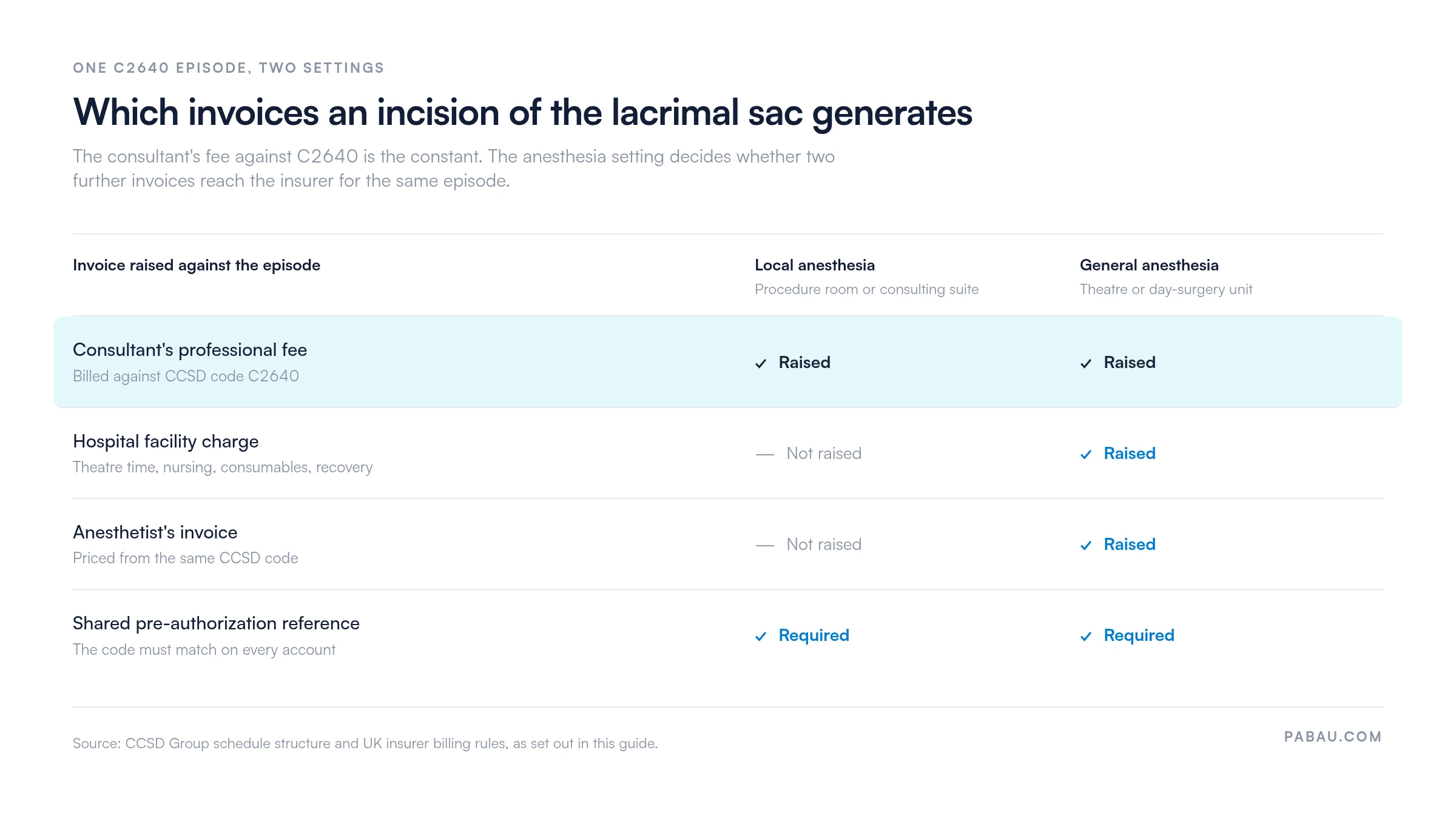
One CCSD code usually generates more than one invoice. The consultant bills the insurer for the professional fee against C2640. The hospital or day-surgery unit raises a separate facility charge for theatre time, nursing, consumables, and recovery, quoting the same code on its own account.
The CCSD Group supplies the code and its descriptor. It does not set prices. Each insurer publishes its own benefit for C2640 in its fee schedule. Bupa, AXA Health, Aviva, and Vitality can all pay a different amount for the same procedure.
Where the consultant’s fee sits above the published benefit, the patient is invoiced for the difference. That shortfall is the most common complaint in private ophthalmology billing, and it is avoidable. Quote the figure in writing before the procedure date.
Both invoices trace back to a single pre-authorization reference, so the code on the consultant’s invoice and the code on the hospital account must match. A DCR code on one account and C2640 on the other will stall the whole episode. Check the descriptor against the CCSD schedule documentation before either invoice is raised, as the schedule is revised annually.
UK private medical insurers audit lacrimal sac claims at higher-than-average rates because the procedure sits near higher-value codes (DCR, nasolacrimal intubation). A complete operative record is non-negotiable. Capturing structured operative data at the point of care reduces the risk of missing documentation items during retrospective billing.

The claim record must contain all of the following:
A complete patient record for each episode provides the audit trail insurers require. That record includes the pre-operative clinic note, the consent documentation, and the operative report. An insurer may request any of these documents when processing or reviewing a C2640 claim.
The CCSD multiple-procedure rules determine which services can be claimed separately on the same day as CCSD code C2640. UK insurers apply bundling policies that classify some concurrent services as integral to the primary procedure, and therefore not separately billable.
Insurer bundling rules for CCSD codes are updated periodically. Always verify current multiple-procedure reduction policies with the individual insurer, particularly Bupa and AXA Health, which maintain their own fee schedule supplements.
Denial rates for lacrimal sac procedures tend to be higher than average because insurers scrutinize claims near the DCR code range. The most frequent rejection reasons for CCSD code C2640 are listed below with corrective actions.
Practice management software like Pabau runs that check before the claim leaves the practice. Its claims validation software compares the ICD-10 diagnosis with the CCSD procedure code. Most denial triggers then surface at the point of billing rather than weeks after a rejection.
Before submitting any C2640 claim, run a check against the insurer’s current ophthalmology schedule. Confirm the ICD-10 code is accepted, the provider number is current, and the operative note contains all required elements. This takes under five minutes and prevents the six to eight week delay that follows a denial and resubmission cycle.
The anesthesia approach used for a C2640 procedure directly affects the billing scenario. Most uncomplicated dacryocystotomies for acute dacryocystitis are performed under local anesthesia in a procedure room or consulting suite. No theatre facility charge or anesthetist’s invoice arises. The claim covers only the CCSD code C2640 and the consultation leading to the procedure.
When the presentation involves significant orbital cellulitis, an uncooperative patient, or concurrent procedures that require theatre conditions, general anesthesia becomes necessary. In that scenario:
The comparison below sets the two settings side by side, so you can see which invoices an insurer should expect against each episode.
Insurer rules on whether a procedure qualifies for theatre-setting billing rather than rooms billing vary by payer and by policy. Verify the applicable rules with the individual insurer before performing the procedure in theatre rather than a procedure room. A rooms-level procedure billed at theatre rates will be reduced or rejected.
See the CCSD Technical Guide for current business rules on procedure settings.
In many practices, a C2640 claim is assembled long after the patient has gone home. Someone retrieves the operative note, hunts for the matching ICD-10 code, checks the provider number, then submits and waits. A missing element surfaces weeks later as a rejection.
Pabau, our practice management software, moves those checks to the point of care. Operative templates capture the incision site, drainage findings, hemostasis method, and the explicit no-DCR statement as structured fields. The biller reconstructs no detail from memory at submission time.
The diagnosis code is paired with the procedure code on the same screen, so a sac-level mismatch is caught before the claim leaves the practice. Claims go out to the insurer through our Healthcode integration, and submission status is tracked against each episode. A query is then answered from the record rather than from a search through paper files.
The outcome is fewer resubmissions on lacrimal claims. Billing staff spend less time chasing operative notes, and more C2640 claims are paid on first submission.

Pabau’s claims management tools help oculoplastic and ophthalmology practices capture operative documentation, pair ICD-10 codes accurately, and reduce C2640 claim rejections, all from one platform.

CCSD code C2640 is a technically straightforward procedure code with a disproportionately high claim rejection rate. Incomplete documentation and mismatched diagnosis codes cause most of those rejections, not clinical complexity. The operative note is the claim.
Pair the procedure with H04.3 or H04.4 and state explicitly that no new nasal drainage channel was created. Confirm the consultant’s recognition with the insurer, and confirm the benefit before the patient is quoted. Those three steps resolve most denials before they occur.
Pabau helps ophthalmology and oculoplastic practices capture structured operative data, validate code pairs, and track submission status. That cuts the administrative load of lacrimal billing, so clinical teams spend their time on patients rather than resubmissions. Book a demo to see how Pabau handles specialist billing workflows.

Need a Bupa-specific CCSD code reference? Bupa CCSD codes guide covers how CCSD codes are structured and submitted to Bupa for private hospital claims.
Looking for Bupa procedure fee details? Bupa procedure codes fee schedule lists the current fee schedule and benefit amounts for common CCSD-coded procedures.
Billing a neighboring lacrimal procedure? CCSD code C2550 covers lacrimal intubation as a sole procedure, with its own indications and documentation rules.
CCSD code C2640 covers incision of the lacrimal sac, with syringing or irrigation where indicated. It is a surgical drainage procedure used when the sac is infected or distended, most commonly in acute dacryocystitis or mucocele formation. It does not cover creation of a new nasal drainage channel. That procedure, dacryocystorhinostomy, is billed under a different CCSD code.
C2640 covers incision and drainage of the lacrimal sac only. A DCR code covers a more extensive procedure that creates a permanent bony and mucosal channel from the sac into the nasal cavity. Submitting a DCR code when only incision and drainage was performed constitutes upcoding, and it triggers insurer review.
H04.3 (acute and unspecified inflammation of lacrimal passages) is the primary pairing, and it covers phlegmonous dacryocystitis and sac abscess. H04.4 (chronic inflammation of lacrimal passages) covers chronic dacryocystitis and lacrimal mucocele. H04.5 is accepted only where sac-level pathology is documented alongside the stenosis. UK insurers work from the four-character WHO version of ICD-10, so a US subcode such as H04.31 is rejected as invalid.
Common denial reasons are a diagnosis code that does not confirm sac-level pathology, a missing operative report, and operative language implying DCR was performed. Claims are also rejected where the provider number does not match the insurer’s recognition record. Other common triggers are bilateral surgery booked without pre-authorization, and an episode the policy does not cover. Each of these is correctable on resubmission with the right supporting documentation.
Yes, but only when nasolacrimal duct probing was a clinically distinct service with its own documented indication and operative findings. If probing was incidental to the sac drainage, it is bundled into C2640 and not separately billable.
Yes. Acute dacryocystitis with abscess is one of the strongest indications for C2640 and provides the clearest evidence of medical necessity. UK ICD-10 carries it under H04.3, which has no separate abscess subcode. The operative note should therefore document the fluctuant abscess, the drainage approach, and the character of material removed.



