CPT code 49321: Laparoscopy with biopsy billing guide
What is CPT code 49321? CPT code 49321 is the surgical laparoscopy code for a bi...

Last Updated: Oct 7, 2026
K0554 is the deleted HCPCS Level II code for receiver (monitor), dedicated, for use with therapeutic glucose continuous monitor system. CMS ended it on December 31, 2022, so it is not billable for any date of service from January 1, 2023.
Its replacement is E2103, the receiver code for a non-adjunctive CGM, with monthly supplies under A4239. An adjunctive CGM bills as E2102 for the receiver and A4238 for supplies, under Glucose Monitors LCD L33822.
Let Pabau's smart automation suggest the right codes, reduce claim denials, and keep your practice compliant—effortlessly.
Automate repetitive tasks and focus on what matters most—your patients.
Reduce coding errors and ensure compliance with the latest regulations.
Clean claims, fewer denials, and faster reimbursements.
Powerful insights and reporting to help your practice thrive.
HIPAA compliant SOC 2 certified GDPR-compliant Trusted by 4,000+ clinics worldwide

K0554 was deleted effective December 31, 2022, so it is not billable for any date of service from January 1, 2023.
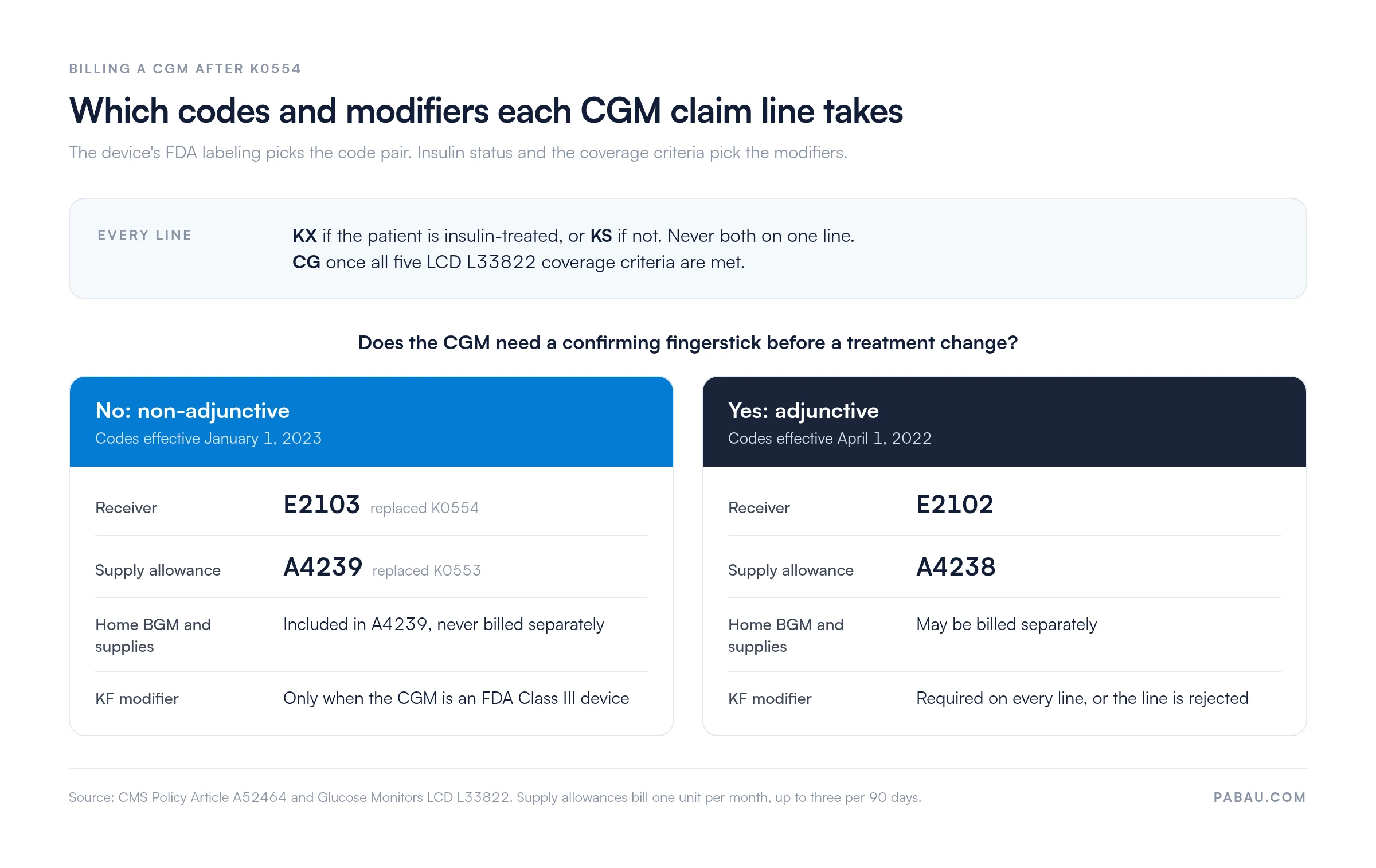
A non-adjunctive CGM receiver now bills as E2103, with its monthly supply allowance under A4239.
An adjunctive CGM bills as E2102 for the receiver and A4238 for supplies, with up to three monthly units per 90 days.
Coverage runs on one national LCD, L33822, and Medicare applies no prior authorization to these CGM codes.
HCPCS code K0554 described a receiver (monitor), dedicated, for use with a therapeutic glucose continuous monitor system. CMS deleted it effective December 31, 2022, and cross-walked it to E2103. The deletion appears in the CMS HCPCS quarterly update files.
A claim that carries K0554 for a date of service on or after January 1, 2023 is rejected as an invalid code. If you still see it in a charge master, a fee table, or a supplier template, replace it before the next billing cycle.
K0553 and K0554 were the temporary codes for therapeutic CGMs. K0553 was the monthly supply allowance and K0554 was the receiver. Both covered the same type of device, so they never split adjunctive from non-adjunctive systems.
The adjunctive codes, E2102 and A4238, had existed since April 1, 2022. From January 1, 2023, E2103 and A4239 took over the non-adjunctive role, which completed the split. The revised Glucose Monitors LCD L33822 uses them for every CGM Medicare covers under the DME benefit.
A non-adjunctive CGM can be used to make treatment decisions without a confirming fingerstick. An adjunctive CGM needs a fingerstick reading before the patient changes treatment. The device’s FDA labeling decides which pair of codes you bill.
Bill the supply allowance in monthly units, up to three units per 90 days. A4239 already includes sensors, transmitters, a home blood glucose monitor (BGM), and its supplies, so none of them is billed separately. That no-unbundling rule applies to A4239 only.
A4238 users may bill the BGM and its test supplies separately, such as lancets under A4259. Implanted CGMs fall outside all four codes, since each descriptor is limited to nonimplanted systems.
Search your billing system for K0553 and K0554 before your next DME claim run. A deleted code left in a supplier template or fee table will reject every claim it touches. The fix is a one-line mapping to E2103 or A4239.
Medicare covers a CGM and its supply allowance under the Part B DME benefit when the patient meets all five initial criteria in LCD L33822:
The training criterion refers to training on the CGM itself. It is not a diabetes self-management training (DSMT) requirement. For continued coverage, the practitioner sees the patient every six months to review CGM use and diabetes control, in person or by Medicare-approved telehealth.
Problematic hypoglycemia means recurrent level 2 events that persist despite treatment changes, or at least one level 3 event that needed help from another person. Code the diabetes diagnosis to full specificity and check it against the ICD-10-CM list in Policy Article A52464.
L33822 is a single national LCD shared by all four DME Medicare Administrative Contractors (MACs). Noridian covers Jurisdictions A and D, and CGS covers Jurisdictions B and C. The coverage criteria are the same in every jurisdiction.
The supplier needs each of these on file before the claim goes out. Keeping HIPAA-compliant records for every item also protects you on a post-payment audit.
No Medicare prior authorization applies to E2102, E2103, A4238, or A4239. Commercial and Medicare Advantage plans set their own rules, so check each payer before delivery.
Every CGM claim line carries KX or KS, never both, depending on insulin status. CG depends on the coverage criteria, and KF depends on the code billed and the device’s FDA class.
Never put KX and KS on the same claim line. Confirm the current modifier set, including the CG rule, against Policy Article A52464 before you submit. The chart below puts the code pair and modifier choices for each device type side by side.
Billing a CGM after the K0554 deletion follows the standard DMEPOS claim path. The steps below apply to both non-adjunctive and adjunctive systems.
Most CGM denials trace back to a deleted code, a mismatched code pair, or a missing document. Each one below can be corrected before resubmission.
The supplier bills the equipment codes, which sit with the other DME items in our HCPCS code library. The treating practitioner bills the clinical CGM services under CPT codes such as 95251, on a separate claim. The AAPC HCPCS code lookup is a quick way to confirm any descriptor below.
K0554 has no current Medicare rate, because a deleted code has no fee schedule amount. E2103 and its siblings are paid from the DMEPOS fee schedule, which sets allowables by state.
Pull current amounts from the CMS DMEPOS fee schedule files instead of the Physician Fee Schedule. CMS updates those files each quarter, with the main annual update taking effect on January 1. Commercial payers set their own CGM rates in your contract.
Most CGM denials start with a deleted code or a missing document that nobody spotted before submission. Pabau keeps the visit note, order, and claim in one patient record, so your team can check them side by side.
Your team still selects the codes and diagnoses. Pabau’s claims management software then submits the claim electronically and tracks its status, so a rejection shows up quickly for correction.

Pabau submits your claims electronically and tracks each one, so your team can spot a rejected CGM claim and correct it quickly.

Treat K0554 as a retired code. Any CGM claim built on it for a 2023 or later service date will reject, and it cannot be fixed with a modifier.
Map each system to the right replacement pair, E2103 and A4239 or E2102 and A4238. Then document the five L33822 criteria before the first claim goes out.
Pabau keeps those records and the claim history in one place, next to each patient’s visit notes. Book a demo to see how Pabau helps your team submit and track CGM claims.

Billing the old supply allowance code? HCPCS code K0553 explains the deleted CGM supply allowance and how A4239 replaced it.
Billing a CGM that falls outside the DME benefit? HCPCS code A9278 covers external CGM receivers that do not meet the Medicare DME definition.
Billing fingerstick supplies for a patient on a CGM? HCPCS code A4259 explains when lancets are payable and when an allowance already covers them.
Billing the practitioner side of CGM? CPT code 95251 covers monthly analysis and interpretation of CGM data.
Billing diabetes education alongside the supplies? HCPCS code G0109 covers group self-management training and its frequency limits.
No. CMS deleted K0554 effective December 31, 2022, so it cannot be billed for any date of service from January 1, 2023. Claims that carry it are rejected as an invalid code.
E2103 replaced K0554 as the receiver code for a non-adjunctive CGM. Its monthly supplies bill under A4239. An adjunctive CGM uses E2102 for the receiver and A4238 for supplies.
No. K0553 was the monthly supply allowance for a therapeutic CGM, while K0554 was its receiver. Both were deleted on December 31, 2022, and K0553 was cross-walked to A4239.
Under LCD L33822, the patient must have diabetes and be trained on the CGM. The device must be used per its FDA indications. The patient must be insulin-treated or have problematic hypoglycemia, with a qualifying practitioner visit in the six months before ordering.
No. Medicare applies no prior authorization to E2102, E2103, A4238, or A4239. Commercial and Medicare Advantage plans may set their own requirements, so check each payer before delivery.
Every line carries KX if the patient is insulin-treated, or KS if not, never both. Add CG when all five LCD criteria are met. Add KF only when the CGM is an FDA Class III device. On E2102 and A4238, KF is required on every line.