

HCPCS code E0198: Water pressure pad billing guide
HCPCS code E0198 is a water pad for a standard mattress HCPCS code E0198 is the ...

Last Updated: Oct 13, 2026
A5230 is the CCSD code for an epidurogram with or without an epidural injection. It covers contrast imaging of the epidural space under fluoroscopy, plus any therapeutic injection given through the same needle in the same session.
The code sits in CCSD Chapter 3 under 3.3 Paraspinal injections. It is listed alongside the level-specific epidural injection codes: A5200 cervical, A5210 lumbar, A5211 caudal and A5220 thoracic. If no epidurogram is performed, those injection codes apply instead.
Let Pabau's smart automation suggest the right codes, reduce claim denials, and keep your practice compliant—effortlessly.
Automate repetitive tasks and focus on what matters most—your patients.
Reduce coding errors and ensure compliance with the latest regulations.
Clean claims, fewer denials, and faster reimbursements.
Powerful insights and reporting to help your practice thrive.
HIPAA compliant SOC 2 certified GDPR-compliant Trusted by 4,000+ clinics worldwide

CCSD Code A5230 covers an epidurogram on its own and an epidurogram followed by a therapeutic epidural injection in the same session.
The code sits in CCSD Chapter 3 (Spine, spinal cord and peripheral nerves). AXA Health and Freedom Health both list it in their published Chapter 3 schedules.
Without contrast imaging of the epidural space, code the injection by spinal level instead: A5200 cervical, A5220 thoracic, A5210 lumbar or A5211 caudal.
Missing proof of contrast use is a common reason for a query or reduced payment at audit. Check the payer’s rules.
Pabau, the practice management platform we build, keeps the procedure note, consent form and invoice on one patient record.
CCSD Code A5230 is the CCSD billing code for an epidurogram with or without an epidural injection.
The Clinical Coding and Schedule Development (CCSD) group publishes it in Chapter 3 (Spine, spinal cord and peripheral nerves), under 3.3 Paraspinal injections.
CCSD is a UK code set that private medical insurers (PMIs) use to pay specialists. It has no link to NHS tariffs, ICD-10 diagnosis codes or US CPT codes. A5230 sits alongside the A5200–A5220 epidural injection codes in 3.3 Paraspinal injections. Our guide to CCSD codes shows how the rest of the schedule is organized.
The “+/-” notation in the A5230 descriptor matters. It confirms that the same code is used in two scenarios:
You don’t need a separate code for the “with injection” scenario, because A5230 covers both. Invoices often go wrong when a neighboring injection code is added alongside A5230 for what was one combined procedure. AXA Health lists A5230 as an unacceptable combination with A5200, A5210, A5211 and A5220.
An epidurogram is a fluoroscopically guided procedure in which iodinated contrast medium is injected into the epidural space. It produces real-time X-ray images of the spinal canal. The contrast outlines the epidural space and reveals filling defects caused by scar tissue or disc herniation. It also confirms needle tip placement before any therapeutic agent is delivered.
Typical clinical indications include radiculopathy, epidural fibrosis after previous spinal surgery, and failed back surgery syndrome. In these cases the anatomy of the epidural space is uncertain or distorted. Image guidance is widely used for epidural procedures where imaging the epidural space is the objective.
The procedural steps relevant to billing A5230 are:
Not on the face of the descriptor, because A5230 names no spinal level. Check the payer’s schedule for any level rule before you invoice, since the descriptor alone doesn’t settle it.
The plain epidural injection codes work differently, because they are split by level. A5200 covers the cervical spine, A5210 the lumbar spine, A5211 a caudal injection and A5220 the thoracic spine. The table below places A5230 among these Chapter 3 neighbors, so you can pick the right code when a session involves more than one procedure.
The choice that matters most is A5230 versus the plain injection codes. If contrast medium and fluoroscopy are used to image the epidural space, A5230 applies. Otherwise, use the injection code for the level: A5200 cervical, A5210 lumbar, A5211 caudal or A5220 thoracic. The flow below turns that rule into a single question about imaging.
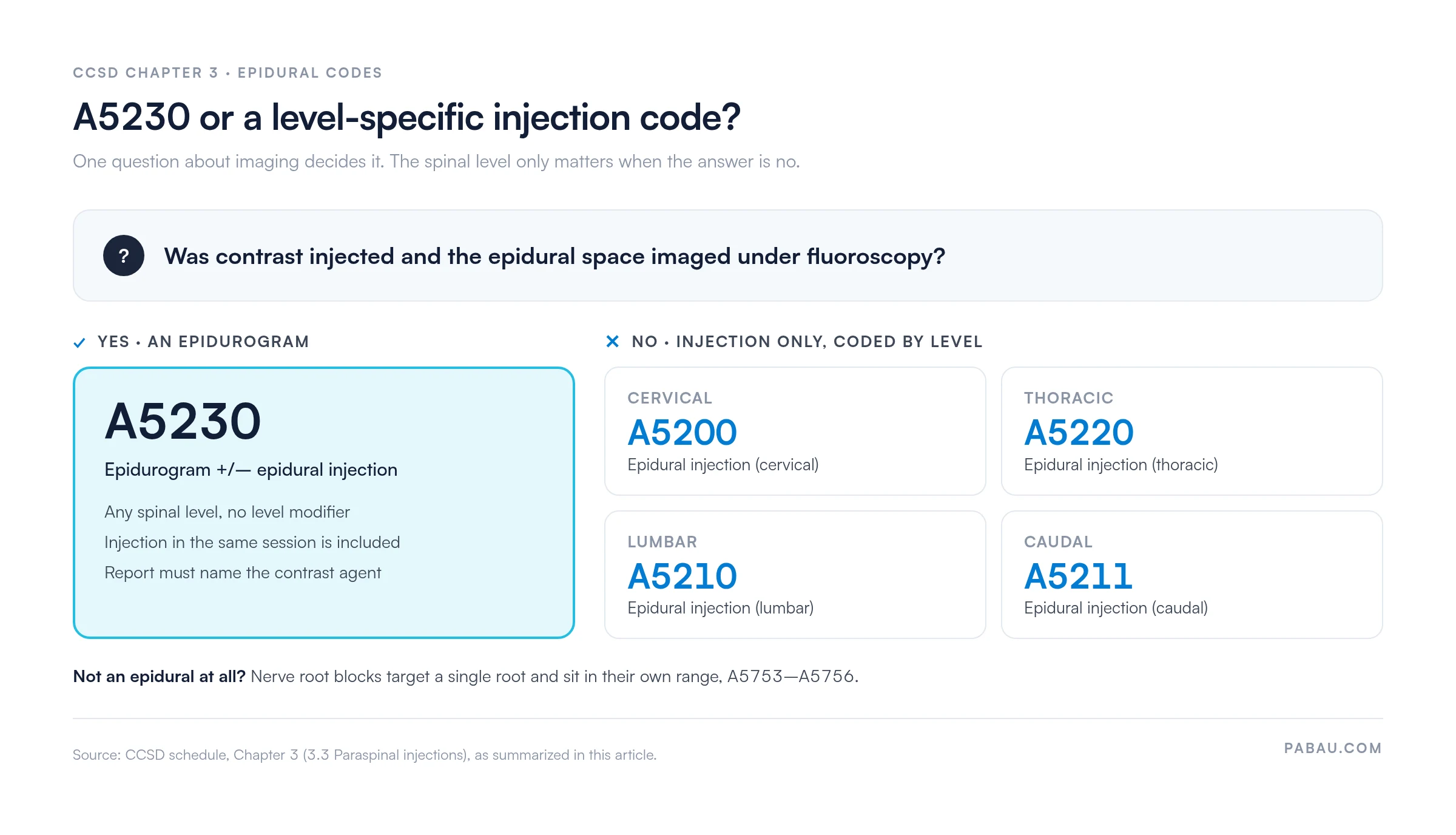
A5230 bundles several components, and billing them again on separate lines is a common cause of duplicate billing rejections.
Included within A5230:
Typically excluded and separately billable (verify per payer):
Fluoroscopy is the more contentious item, because imaging is part of what defines an epidurogram. Check each payer’s schedule, because treatment of fluoroscopy varies. Some payers may allow a separate reporting fee when a different clinician reports the images, so confirm the unbundling rules before adding a fluoroscopy line.
Check the contrast medium line separately. Iodinated contrast is a drug, and some PMIs allow it as a consumable item alongside A5230. Request the payer’s drug tariff or consumables schedule, not just the procedure code schedule, before deciding whether to include it on the invoice.
Most UK PMIs require pre-authorization before an epidurogram is performed. Interventional spine procedures routinely trigger it, because insurers scrutinize both clinical necessity and cost. Performing A5230 without a valid authorization reference nearly always leads to claim rejection. Retrospective authorization is rarely granted for elective procedures.
The table below summarizes the published pre-authorization positions of the major UK private medical insurers that recognize CCSD codes. Verify current requirements directly with each payer before the procedure.
Bupa’s open-referral scheme adds a layer covered in our guide to Bupa CCSD codes. Patients who self-refer under open referral must use a Bupa-recognized provider. The pre-authorization reference must also reflect the open-referral route. Otherwise the claim may be rejected on eligibility grounds rather than clinical ones.
UK PMIs audit CCSD Code A5230 claims against the clinical record. If the procedure report doesn’t state that contrast was given and the epidural space was imaged, the payer can’t verify that an epidurogram took place. It may then query or reject the claim.
A complete A5230 claim file should include all of the following:
Digital procedure documentation lets you attach operative notes and consent records to the patient record as you work. The claim file is then complete without a hunt through paper folders. A procedure-note template with a required contrast field removes one predictable trigger for an A5230 query.
A5230 claim denials cluster around a handful of predictable failure points. Each one has a clear avoidance strategy and, where the error is on the payer’s side, an appeal pathway.
Accurate A5230 billing follows six steps, and the first two happen before the patient arrives. Each step depends on the one before it.
Audit your A5230 submissions quarterly. Pull every claim where A5230 was invoiced and cross-reference it against payment received. If payers keep querying or reducing A5230 claims, review your procedure reports for contrast documentation language. One template sentence added to your operative note structure can head off the next query.
A5230 problems usually start with paperwork spread across systems. The procedure report sits in one place, the pre-authorization email in another and the invoice in a third. Nobody sees that the contrast line is missing until the payer queries the claim.
Pabau, the practice management platform we build, keeps the procedure note, consent form and invoice on one patient record. Because the note sits on the same record, your billing team can check the contrast line before sending the claim from Pabau’s claims management software.
The payer gets a complete A5230 file on the first submission. Your team spends less time on appeals, and the epidurogram is paid as an epidurogram rather than queried or rejected.

Pabau keeps procedure notes, pre-authorization references and CCSD invoices on one patient record, so fewer epidurogram claims are queried or denied.

Getting A5230 paid comes down to one sentence in the procedure report. If the note names the contrast agent and confirms the epidural space was imaged, the code holds at audit. If it doesn’t, expect the payer to query or reduce the claim.
So make contrast a required field in your epidurogram note template, and secure the pre-authorization reference before the patient attends. The cost is a few seconds of charting per case, set against a queried claim and an appeal. Book a demo to see how Pabau links procedure notes, authorizations and CCSD invoices for your practice.

Need to understand how CCSD billing fits into Bupa’s code schedule? Bupa CCSD codes and fee schedule covers Bupa’s chapter-by-chapter CCSD structure and how to navigate its provider portal.
Billing a lumbar epidural without an epidurogram? CCSD Code A5210 explains the lumbar epidural injection code and the documentation its claims need.
Looking up a different procedure? CCSD codes brings the CCSD code guides together, so you can check neighboring codes before you invoice.
Handling invoicing across multiple PMIs from one platform? Pabau’s claims management tools support CCSD invoice generation, pre-auth tracking, and claim submission workflows for UK private practices.
Comparing billing systems for a UK practice? Best medical billing software in the UK compares the options for practices that bill private medical insurers.
CCSD Code A5230 covers an epidurogram with or without an epidural injection. Contrast is injected into the epidural space under fluoroscopy to produce diagnostic images, and a therapeutic injection may follow in the same session. The “+/-” notation means one code applies to both scenarios.
No. An epidural injection (coded by spinal level, A5200–A5220) delivers a therapeutic agent without an epidurogram. An epidurogram (A5230) injects contrast medium under fluoroscopy to visualize the epidural space. A drug injection may follow, but imaging is the defining component. Select A5230 whenever contrast and fluoroscopy are part of the procedure.
Yes, in most cases. AXA Health, Bupa, Aviva, VitalityHealth and Freedom Health typically require pre-authorization before an epidurogram is performed. The authorization reference number must appear on the invoice. Performing the procedure without it almost always leads to full claim rejection.
It depends on the payer. Some UK PMIs allow iodinated contrast as a separately itemized consumable drug alongside A5230. Others treat it as bundled within the procedure fee. Check the payer’s consumables tariff or drug schedule before adding a contrast line to the invoice.
It depends on the payer. Check each payer’s schedule, because treatment of fluoroscopy varies. Imaging is part of what defines an epidurogram, but a separate fee may be allowed when a radiologist reports the images independently.
The usual triggers are a missing pre-authorization reference and no documented contrast medium use. Missing contrast documentation can lead to a query or reduced payment. Other triggers are the wrong code, duplicate billing of bundled components, and late submission outside the payer’s claims window. Structured pre-procedure and billing checks prevent each one.



