HCPCS Code G0163: Skilled nursing observation and assessment
What is HCPCS Code G0163? HCPCS Code G0163 is a deleted Level II code for skille...

Last Updated: Oct 15, 2026
A4850 is the CCSD code for implantation/removal of intrathecal drug delivery system. It covers the complete system, meaning the implantable programmable pump together with its intrathecal catheter. The same code is used whether the system is implanted or explanted, so the operative report has to say which.
Catheter-only placement, pump refills, reprogramming and catheter revision are excluded and carry their own CCSD codes. In the CCSD schedule the code sits in chapter 3, under section 3.2, spinal cord.
Let Pabau's smart automation suggest the right codes, reduce claim denials, and keep your practice compliant—effortlessly.
Automate repetitive tasks and focus on what matters most—your patients.
Reduce coding errors and ensure compliance with the latest regulations.
Clean claims, fewer denials, and faster reimbursements.
Powerful insights and reporting to help your practice thrive.
HIPAA compliant SOC 2 certified GDPR-compliant Trusted by 4,000+ clinics worldwide

CCSD Code A4850 covers both implantation and removal of a complete intrathecal drug delivery system under one descriptor.
A screening trial has to be documented and billed separately before an insurer will authorize the implant.
Pre-authorization is required before the procedure, and missing it is the most common reason A4850 claims are denied.
Pump refills, catheter revision and programmer interrogation sit outside A4850 and each need their own code.
The operative note has to say whether the encounter was an implantation or a removal, because the code cannot.
CCSD Code A4850 covers the implantation or removal of an intrathecal drug delivery system. The descriptor comes from the Classification of Clinical Services and Diagnoses (CCSD). The code applies to the complete system: the implantable programmable pump and its intrathecal catheter together.
It does not apply to catheter-only procedures, pump refills, or device reprogramming, which each have their own CCSD codes. In the CCSD schedule it sits in chapter 3, spine, spinal cord and peripheral nerves, under section 3.2, spinal cord.
Practitioners eligible to bill it include pain consultants, neurosurgeons, and anesthesiologists with recognized neuromodulation training. The GMC governs practitioner eligibility. Only consultants on the relevant specialist register may lead these procedures in UK private practice.
Implantation of an intrathecal drug delivery system is a two-stage surgical procedure performed under general or regional anesthesia. The operative steps matter for billing because the report has to document each one to support an A4850 claim.
Removal follows a comparable approach. The pump pocket is reopened, the catheter is disconnected and withdrawn, and the pump is explanted. Both procedures are captured under the single A4850 descriptor, so the operative report must state explicitly which one was performed.
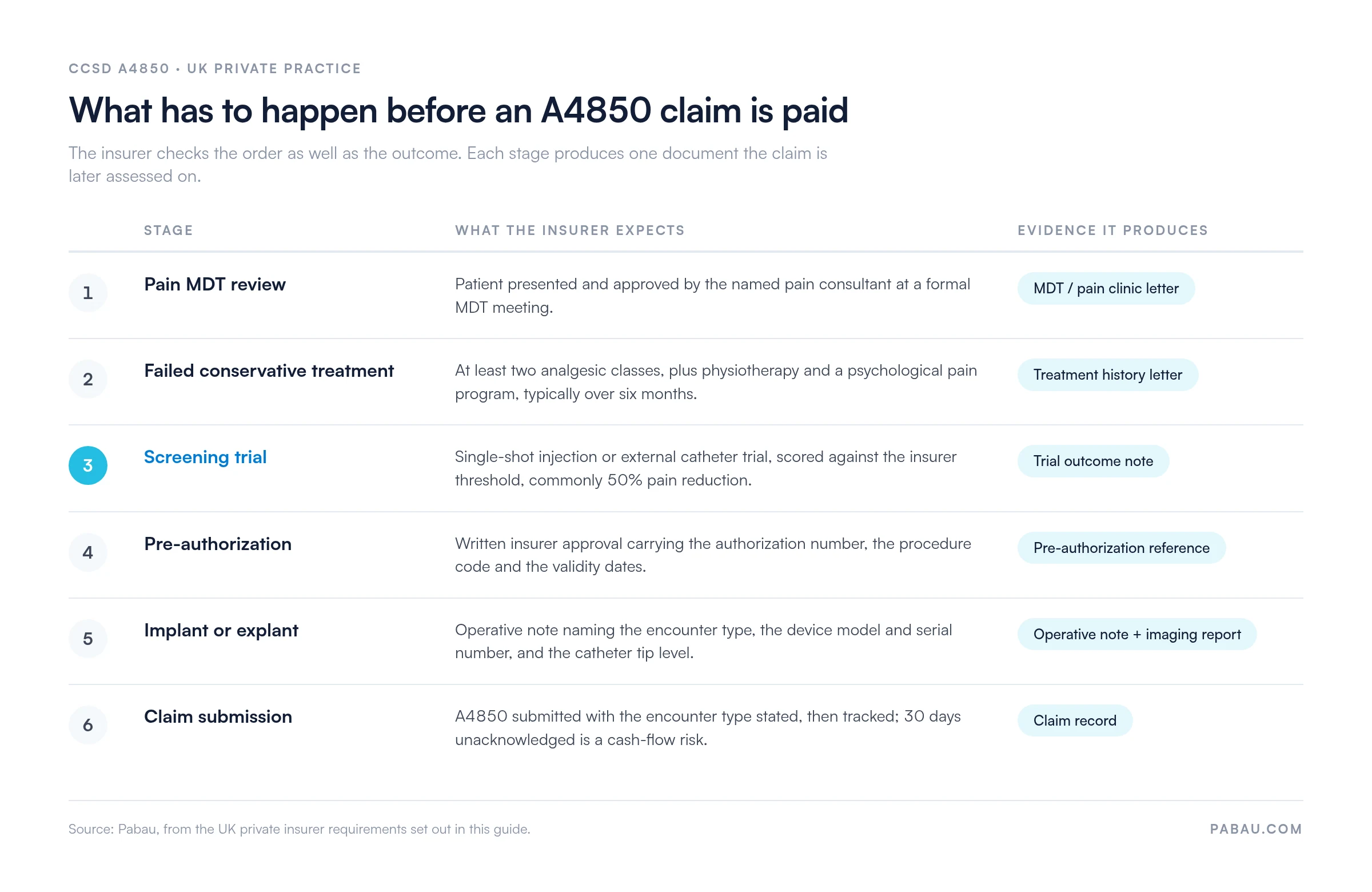
An intrathecal drug delivery system is used when pain or severe spasticity stops responding to oral drugs and interventional procedures. UK private insurers set their A4850 criteria at that same threshold, and they expect the referring team to evidence it.
A positive screening trial is a prerequisite for implantation across all indications. Insurers will not authorize A4850 without documented trial results showing a defined threshold of pain or functional improvement.
Before implanting a permanent system, most UK private insurers require a formal intrathecal trial to confirm the patient responds to intrathecal drug delivery. The trial is a distinct clinical episode, separately billed, and must be completed and documented before A4850 is submitted.
Two trial formats are used in practice. A single-shot intrathecal injection delivers the candidate drug, most commonly morphine or baclofen. The patient is then observed for pain or spasticity reduction against a predefined threshold.
An external trial uses a percutaneous catheter connected to an external pump for several days, which allows assessment of sustained response. The external catheter and pump carry their own CCSD codes and are billed separately from A4850.
The trial outcome note must record the baseline pain or spasticity score, the agent and dose administered, and the post-trial score with the percentage improvement. Most insurer policies require at least 50% pain reduction, or an equivalent functional improvement, for the trial to count as positive. Without this document, an A4850 claim will be denied whether or not the surgery was clinically appropriate.
The choice of intrathecal agent depends on the indication and on each drug’s UK licensing status for intrathecal use. Billing teams should note the agent in the operative or anesthetic record, because insurers sometimes ask for it during assessment.
A common source of claim errors is conflating the complete-system procedures covered by A4850 with the related but separately coded maintenance and component procedures. The table below clarifies the boundary.
A4850 sits inside a family of CCSD neuromodulation codes, and picking the adjacent one correctly is what stops a second encounter being denied. Billing teams can check the current Bupa code search against our own reference list of CCSD codes.
For the wider Bupa code set relevant to UK private specialists, our Bupa CCSD codes guide sets the fee schedule alongside the descriptors. The table below outlines the categories most often co-billed with A4850.
A patient may need a pump removed and a new one implanted in the same session. Check with the insurer before submitting two A4850 codes for that episode. Most UK private insurers treat it as a revision encounter and apply a single code with modifier documentation. Confirming this in writing at the pre-authorization stage prevents disputes at adjudication.
Thorough documentation is the foundation of a successful A4850 claim. Insurers audit high-value implantable device procedures closely, and a claim submitted without the full document set is usually held or denied. Attaching digital clinical forms and operative notes to the claim record at the point of submission removes most of that risk.
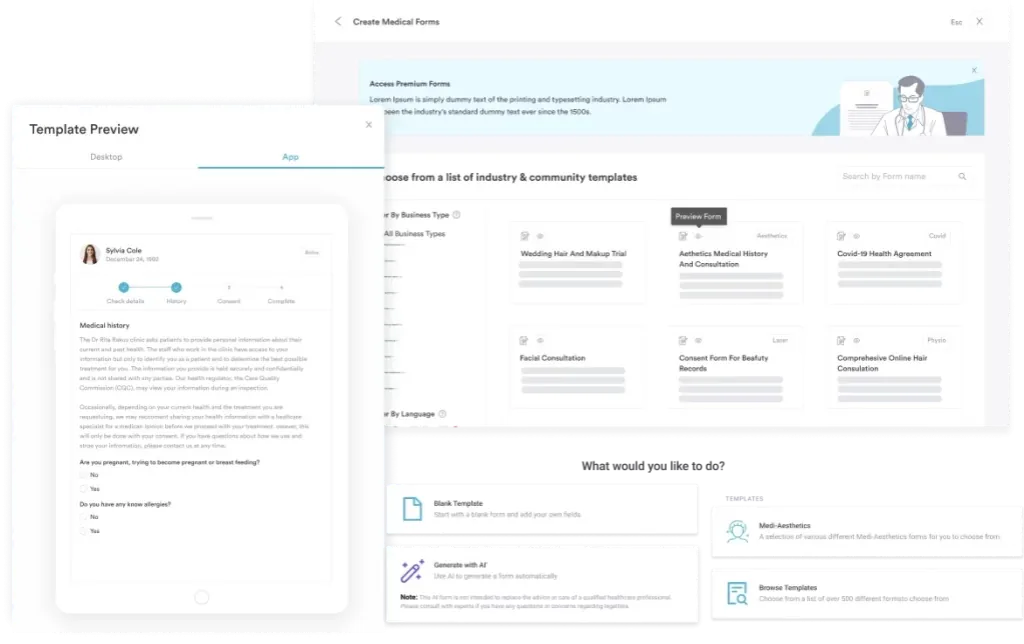
Assemble this file before the procedure date rather than afterwards. Many insurers impose strict deadlines for submitting supporting evidence once a claim has been flagged.
A4850 is a high-cost, elective surgical code, and every major UK private insurer requires pre-authorization before treatment. Criteria vary by payer, so verify directly with each insurer. The requirements below appear consistently across Aviva, Vitality, and WPA.
The order matters as much as the list. Each stage produces one document the assessor later looks for, and a stage completed out of sequence is hard to evidence afterwards.
Insurers increasingly ask for attendance records from physiotherapy and pain management programs as part of that evidence. Exporting them from one system is faster than collecting letters from three, and it keeps the authorization submission moving.
A4850 carries one of the higher denial rates among CCSD interventional pain codes, mainly because of the volume of supporting documentation required. The table below covers the most frequent denial reasons and the corrective action for each.
Because A4850 covers both procedures under one code, the operative report carries the whole burden of distinguishing implantation from removal at adjudication. Insurers cannot tell the two encounters apart from the code alone.
Elsewhere in the CCSD schedule, the code itself names the encounter. A1430 covers removal of a cerebroventricular shunt only, and placing a new shunt carries its own code.
In practice, the operative note must state in its opening lines whether the procedure is an implantation or a removal. Some billing teams also add a free-text comment in the claim submission specifying the encounter type. A standard note template that flags implant versus removal at the top prevents most adjudication queries.
Where a patient undergoes removal of an existing pump and same-session reimplantation of a new device, the operative report should document both procedures in sequence. Check with the insurer before submitting. Some payers treat it as one A4850 encounter, and others expect a revision or exchange code.
Ophthalmic billing separates the two encounters too. C5480 covers removal of silicone oil only, so inserting the oil is coded separately.
Keep two versions of your intrathecal pump operative note template. Head one ‘Implantation of intrathecal drug delivery system’ and the other ‘Removal of intrathecal drug delivery system’. Store both in your practice management system so the right one is selected at the point of dictation. That single step removes the most common adjudication query on A4850 claims.
Submitting an A4850 claim successfully takes more than entering the correct code. The workflow below is how UK private practices run the cycle in practice management software like Pabau.
Its claims management software holds the code, the authorization reference and every supporting document on one claim record. That saves re-gathering the file when an assessor queries the submission.
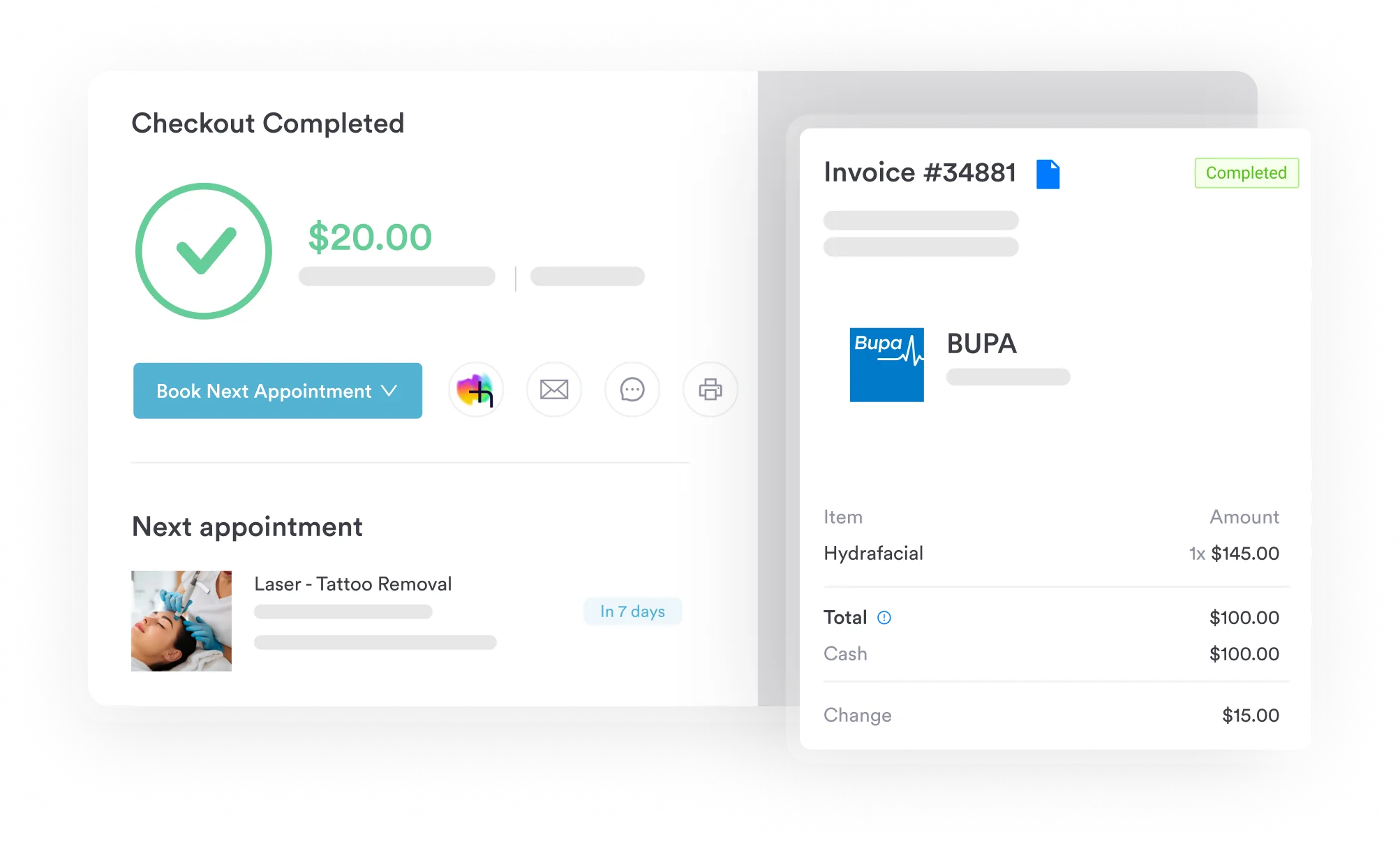
Across every CCSD code, the manual steps between finishing a procedure and submitting a claim are where documents go missing. Cutting those steps out is what keeps the invoice complete.

Pabau attaches pre-authorization references, operative notes and device records to the claim itself. Your team submits to Bupa, AXA Health, Vitality or Aviva with the file already complete.

A4850 rewards preparation more than it rewards speed. The code itself is simple. What decides the claim is whether the trial note, the pre-authorization reference and the operative note were produced in the right order.
The trade-off worth remembering is that assembling the file after the procedure costs far more time than assembling it before. Practices that build the document set alongside the clinical pathway rarely see an A4850 query at all.
If your billing team is still chasing operative notes after submission, the fix is a claim record that holds them from the start. Book a demo to see how Pabau keeps CCSD evidence attached to the claim.

Looking for guidance on CCSD billing across all Bupa procedure codes? Bupa CCSD codes and fee schedule walks through the full Bupa code set relevant to UK private specialists.
Need to tighten the pre-authorization step before a high-cost procedure? The prior authorization process sets out what payers check and how to get an approval on the first request.
Want fewer denials on your implantable device claims? Denial management in healthcare covers how to triage, appeal and prevent the denials that hit high-value codes hardest.
CCSD Code A4850 covers the implantation or removal of a complete intrathecal drug delivery system, meaning both the implantable programmable pump and the intrathecal catheter. It does not cover catheter-only procedures, pump refilling, device reprogramming, or catheter revision, each of which requires a separate CCSD code.
Yes, in practice. UK private insurers including Bupa, AXA Health, and Vitality consistently require a positive screening trial before authorizing A4850. The trial must be separately documented and billed. Without a recorded positive outcome, pre-authorization for implantation is unlikely to be granted.
Five reasons account for most of them. Missing pre-authorization, no documented screening trial, and incomplete operative notes lead the list. The others are using A4850 for a catheter-only procedure, and bundling it with a refill code at the same encounter. Each has a straightforward correction at the document preparation stage.
Yes. Every major UK private insurer treats A4850 as a pre-authorization-required procedure because it involves a high-cost implantable device. Submitting A4850 without a valid pre-authorization reference is the most reliable way to receive an immediate denial. Verify the requirements directly with each insurer before scheduling.
The most frequent co-billing scenarios involve the screening trial codes, anesthetic codes, and fluoroscopy or imaging codes for intraoperative guidance. Post-implant follow-up visits involve the programmer interrogation and refill codes, which are always billed as separate encounters from A4850 itself.
A4850 covers the complete intrathecal drug delivery system, pump plus catheter as a unit, for implantation or removal. Related neuromodulation codes cover spinal cord stimulator implantation, catheter-only procedures, pump refilling, and device revision, each scoped to a different component or encounter type. Using the wrong code in place of A4850 is a common error on catheter-only work.