ICD-10 code S61.201A: Open wound of left index finger without nail damage
ICD-10 code S61.201A covers a left index finger wound of unstated type ICD-10 co...

Last Updated: Oct 16, 2026
Billable Code Specific Code
Z41.9 is the billable ICD-10-CM code for encounter for procedure for purposes other than remedying health state, unspecified.
That does not make it the right choice. Z41.9 is the last stop in the Z41 family, and coders land there more often than the documentation justifies.
For a billing team, the cost of that habit is easy to miss. Unspecified codes invite payer questions, slow elective and cosmetic claims, and hide a documentation problem that one dropdown could fix. So the useful question is when a better Z41 code was available all along.
Let Pabau's smart automation suggest the right codes, reduce claim denials, and keep your practice compliant—effortlessly.
Automate repetitive tasks and focus on what matters most—your patients.
Reduce coding errors and ensure compliance with the latest regulations.
Clean claims, fewer denials, and faster reimbursements.
Powerful insights and reporting to help your practice thrive.
HIPAA compliant SOC 2 certified GDPR-compliant Trusted by 4,000+ clinics worldwide

ICD-10 code Z41.9 reports a procedure done for reasons other than treating a disease or injury, with the purpose left undocumented.
Z41.9 is billable and valid for submission in FY2026, effective October 1, 2025.
Use Z41.8 when the note names the non-remedying purpose, and save Z41.9 for records that name none.
ICD-10-CM has no Z41.0, so the WHO version’s hair transplant code has no US equivalent.
Practice management software like Pabau captures the purpose of each visit at intake, so coders rarely fall back on Z41.9.
Z41.9 reports an encounter for a procedure that was not meant to remedy a health condition. In this case, the record never states what the purpose was.
The code sits in category Z41, Encounters for procedures for purposes other than remedying health state. ICD-10-CM files that category in the Z40-Z53 block, Encounters for other specific health care.
The code is billable and specific, so it can stand alone as the diagnosis on a claim. No extra character or extension follows it. According to the CDC/NCHS official ICD-10-CM web tool, Z41.9 took effect on October 1, 2025 for the FY2026 coding year.
The rest of the code’s reference detail is short enough for one table.
Z41 is the parent category. It covers every encounter for a procedure that is not aimed at treating a disease or correcting an injury. Z41 itself is a header code, so it is never billable, and a claim always carries one of its subcodes.
The block above Z41 is where the two classifications part ways. ICD-10-CM files Z41 under Z40-Z53, Encounters for other specific health care.
The WHO’s ICD-10 uses a wider block, Z40-Z54, titled Persons encountering health services for specific procedures and health care. WHO’s Z41 also carries Z41.0 for a hair transplant encounter, and ICD-10-CM has no equivalent. So a code you find in the international version may not exist on a US claim.
Z41.9 sits at the bottom of that list as the catch-all. It applies only when no sibling code fits and the record genuinely does not state the purpose.
If you need the neighboring families next, the ICD-10-CM code index collects them in one place.
The phrase means the visit was not about treating, curing, or managing a disease or injury. The reason sits outside clinical need. It might be personal, ritual, or cosmetic.
“Unspecified” points at the record, not at the coder’s uncertainty. It applies when the note names no purpose and no sibling subcode fits. Convenience does not count as a reason, and a quick query to the provider usually settles the choice.
Certain wording in a note tends to lead here. Watch for phrases such as these:
None of these are official synonyms for Z41.9. They are the shapes a thin note takes, and each one is worth a query before the claim goes out.
Z41.9 fits a narrow band of encounters, and two conditions have to hold at once. The procedure was not aimed at remedying a health condition. The record does not identify the non-remedying purpose. Miss either test and a different code applies.
The diagram below runs those two tests across the whole Z41 family.
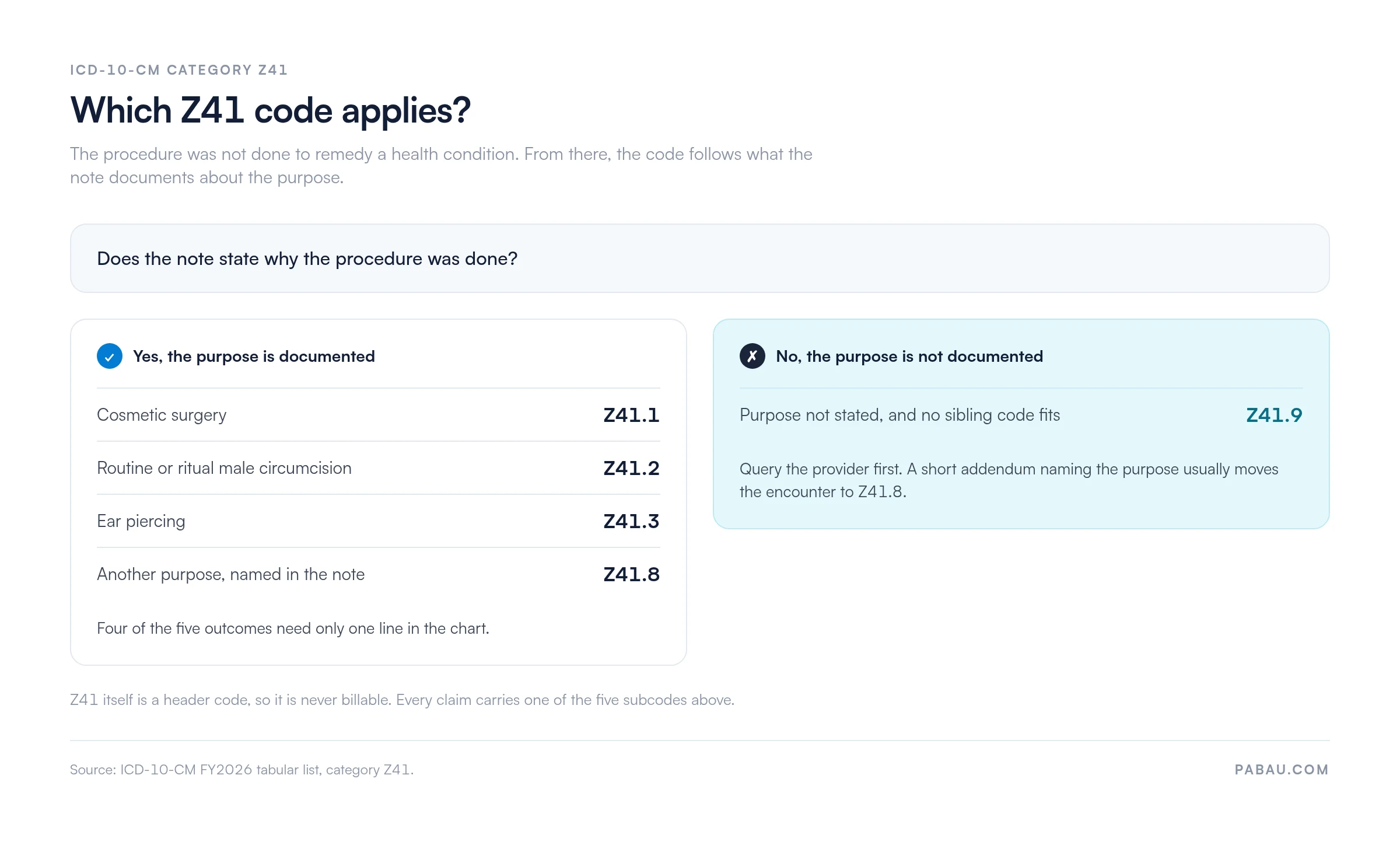
Documentation is what holds up when a payer looks twice. CMS ICD-10 guidance asks providers to record the reason for each encounter in enough detail to support the code. For Z41.9, run through four items.
The ICD-10-CM Official Guidelines for Coding and Reporting, published by CMS and NCHS, limit unspecified codes to records that cannot support something more specific.
A note that stays vague every time is a coaching problem rather than a coding one. One added line usually moves the claim to a defensible Z41 subcode.
Add a documentation prompt to your intake workflow. Ask the provider to pick the encounter purpose from a short dropdown, such as cosmetic, ritual, personal, or other. That one step usually replaces Z41.9 with a defensible Z41.1, Z41.2, Z41.3, or Z41.8 at billing time.
Use Z41.8 whenever the note names the purpose. Z41.9 is only for records that name none. Confusing the two invites a payer question, and the fix is usually one sentence in the chart.
Here is how the pair compares on the factors that decide it.
Standard practice is to query the provider before assigning Z41.9. A short addendum naming the purpose almost always moves the encounter to Z41.8. Catching that before submission costs less than working the rejection afterward, which is where claim denial management earns its keep.
Z41.9 is valid for submission in FY2026. It is billable, specific, and accepted by HIPAA-covered payers for electronic claims under the ICD-10-CM standard.
Coverage is a separate question. Medicare and Medicaid generally do not pay for procedures performed purely for non-remedying purposes, because those services sit outside medical necessity. Commercial payers vary, and a Local Coverage Determination can decide the outcome for one specific service.
So check the policy before you quote the patient a covered price. For most elective and cosmetic work, that conversation ends in self-pay rather than a claim. Where the practice does submit, the claim needs the Z41 code, the service code, and a note that supports both.
The Present on Admission (POA) indicator applies to inpatient hospital claims under Medicare’s Inpatient Prospective Payment System. It separates conditions that existed on admission from those that developed during the stay.
For Z41.9, the indicator is generally treated as exempt. Z-codes that describe the reason for an encounter, rather than a condition, usually sit on the CMS POA exempt list. Check that list each fiscal year, since CMS revises it with the annual update.
Outpatient and physician office claims carry no POA indicator at all. Z41.9 appears in both settings, so only the inpatient side of the practice has to think about it.
The Alphabetic Index reaches Z41.9 from two main terms. A third path looks similar and lands on a different code.
In the Tabular List, Z41.9 appears in Chapter 21, Factors influencing health status and contact with health services. Confirm the code there after every index lookup. The instructional notes on includes, excludes1, and excludes2 live in the Tabular List, and they govern how the code may be used.
The AAPC’s ICD-10-CM code lookup shows the same tabular view with those notes attached. Cross-check it against the official FY2026 tables before you rely on either one.
If the first main term does not give a clear path, try another. ‘Encounter for,’ ‘Procedure for,’ and ‘History of’ all work as starting points for Z-code lookups. The Tabular List is the final authority, so confirm the code there before you bill it.
Z41.9 is not a new code. It has been in the ICD-10-CM tabular list since the US adopted ICD-10-CM, and recent fiscal years left its description and hierarchy alone. FY2026, effective October 1, 2025, carried the code forward from FY2025 unchanged.
CMS and NCHS publish the updates each October. Check the CMS ICD-10 code files at the start of every fiscal year, and read the addenda for the siblings too. Z41.9 has held steady, but a description change to Z41.1 through Z41.8 would change which code your documentation supports.
Practices running elective and non-therapeutic procedures hit the same wall repeatedly. The purpose of the visit is obvious in the treatment room and missing from the note. Coders then choose between Z41.8 and Z41.9 without the one detail that settles it.
Practice management software like Pabau closes that loop at the front end. Digital intake forms can ask why the patient is attending, in a short dropdown the front desk fills in at registration. The answer then lands in the patient record instead of someone’s memory.
Pabau’s claims management tools build the claim from that record. The service and its codes carry across from the appointment, and ICD-10 and CPT lookup libraries sit inside the claim form. Pabau checks that every required field is complete before the claim can be sent, and the coding call stays with your team.
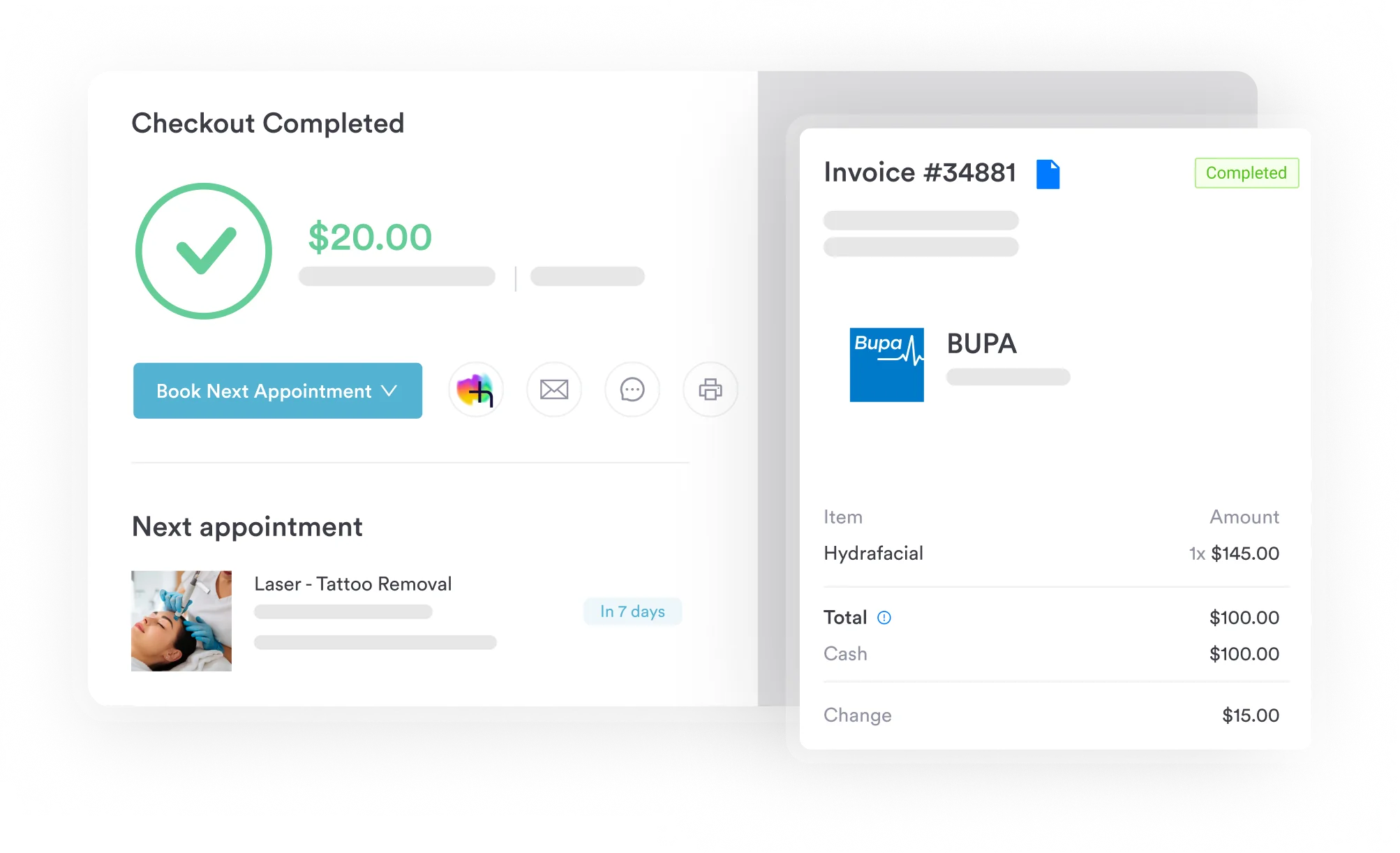
Records stay structured, so a coder can open the treatment note and read the documented purpose in seconds. Fewer Z41.9 claims go out as a result, and the ones that do are the encounters where Z41.9 was genuinely right.
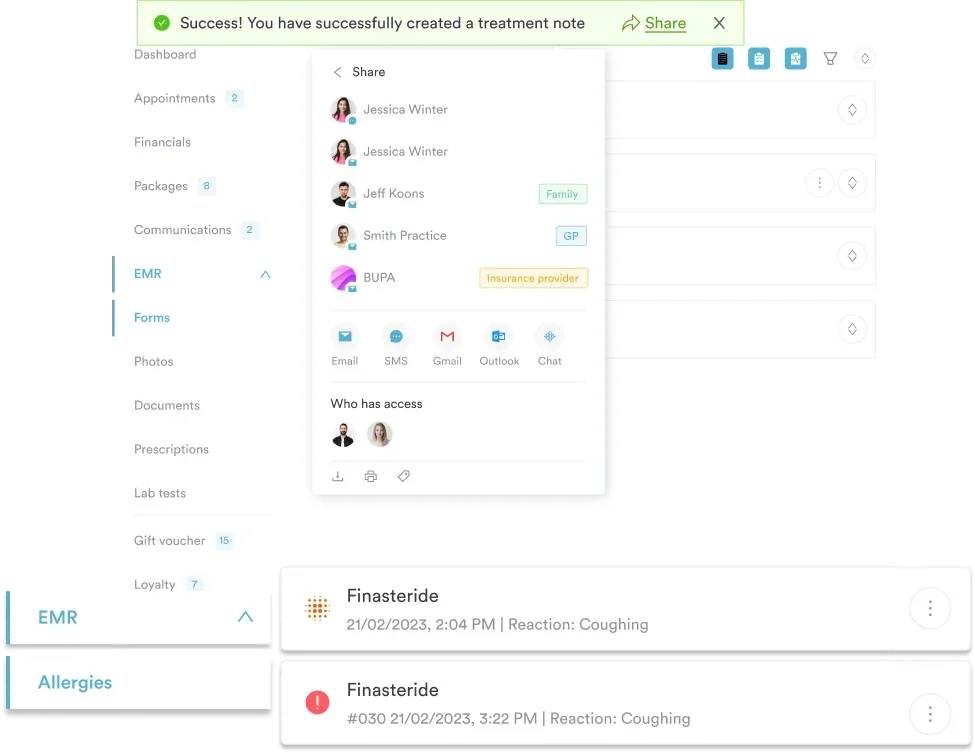

Pabau’s digital intake forms record why each patient is attending, so your coders can assign a specific Z41 code instead of defaulting to Z41.9. Claims then build straight from the patient record.

Z41.9 is a legitimate code with a narrow job. Reach for it when the record truly does not say why a non-remedying procedure happened, and not a claim earlier. A run of Z41.9 lines in your billing data usually points at documentation, not at a genuine cluster of unexplained visits.
So fix it upstream. One dropdown at registration, or one line in the note, moves most of those encounters to Z41.8 or a named subcode.
Pabau captures that detail at intake and carries it through to the claim. Book a demo to see how Pabau keeps the purpose of each visit where your coders can find it.

Need a structured approach to ICD-10 denial prevention? Denial management in healthcare covers the claim lifecycle steps that reduce Z-code and other diagnosis code rejections.
Want to understand how clean claims are built? What makes a clean claim explains the documentation and coding steps that let a claim pass payer edits first time.
Looking for guidance on medical billing compliance for your practice? Medical billing compliance practices outlines the ICD-10, HIPAA, and payer-rule obligations every coding team should know.
Yes. Z41.9 describes the reason for the encounter, so it can sit first on an outpatient claim when no disease or injury was treated. Payment is a separate matter, and many payers treat non-remedying procedures as patient responsibility.
Z41.9 is complete at four characters. No fifth character, no seventh character, and no laterality applies. A rejection for an invalid code usually points at a typo, such as Z41 or Z41.99.
The WHO’s ICD-10 uses Z41.0 for a hair transplant encounter, and ICD-10-CM never adopted it. US coders work from Z41.1, Z41.2, Z41.3, Z41.8, and Z41.9 only. Code the purpose the note documents, and do not borrow a code from the international version.
No CPT code is tied to Z41.9. The diagnosis code explains why the patient attended, and the CPT or HCPCS code reports what was performed. A payer reviewing the claim looks for both, so the note has to support each one.
Rarely. Most elective encounters have a purpose someone could write down in five words. If Z41.9 shows up across a whole day’s schedule, audit the intake form rather than the coder.