ICD-10 Code S42.444P: Medial epicondyle fracture, right humerus
ICD-10 Code S42.444P: full descriptor and code validity ICD-10 Code S42.444P car...

Last Updated: Oct 13, 2026
Billable Code Specific Code
Z04.9 is the billable ICD-10-CM code for encounter for examination and observation for unspecified reason. It reports a visit made for examination or observation where the record names no reason that fits another Z04 code. Its single inclusion term, encounter for examination for medicolegal reasons NOS, makes it the usual code for a medicolegal exam with no documented legal context.
Z04.9 sits at the end of the Z04 category, so assignment turns on what the documentation supports. Where the record names a transport accident, a work accident, or another specified reason, the matching sibling code is used instead.
Let Pabau's smart automation suggest the right codes, reduce claim denials, and keep your practice compliant—effortlessly.
Automate repetitive tasks and focus on what matters most—your patients.
Reduce coding errors and ensure compliance with the latest regulations.
Clean claims, fewer denials, and faster reimbursements.
Powerful insights and reporting to help your practice thrive.
HIPAA compliant SOC 2 certified GDPR-compliant Trusted by 4,000+ clinics worldwide

ICD-10 code Z04.9 is a billable 2026 ICD-10-CM code for encounters where the reason for observation is unspecified.
It has been valid since October 1, 2015, and the 2026 edition carries the same descriptor and notes.
Its one inclusion term, examination for medicolegal reasons NOS, makes it the default code for undocumented medicolegal visits.
An Excludes1 note prohibits reporting Z04.9 alongside Z20.-, the codes for suspected communicable disease exposure.
Pabau’s claims management software and Claim.MD integration help practices submit clean Z04.9 claims and track denials.
ICD-10 code Z04.9 is defined by the CDC/NCHS ICD-10-CM tool as “Encounter for examination and observation for unspecified reason.” It is a billable, diagnosis-specific code valid for claims submission. The 2026 edition became effective October 1, 2025, and no descriptor changes have been made since its introduction.
Understanding where Z04.9 sits within ICD-10-CM matters for correct sequencing. The table below captures the essential reference data coders and billers need at a glance.
The code’s classification under Z00-Z99 signals that it is administrative rather than clinical. Z04.9 does not report a disease or an injury. It records an encounter where observation took place and no specific reason was documented. Sequencing follows from that. A Z code is not the principal diagnosis once the record establishes an acute condition.
The full descriptor reads “encounter for examination and observation for unspecified reason.” It applies when a patient presents for examination or observation and the record captures no reason that maps to another Z04 sibling code.
The CMS ICD-10-CM tabular list carries one inclusion term for Z04.9:
The medicolegal context covers a wide range of clinical-administrative encounters:
When the reason is specified (for example, an employer-mandated drug screen or a suspected workplace injury), a more specific Z04 sibling code applies instead.
Medicolegal examination encounters coded to Z04.9 share one defining feature. The provider is carrying out an objective assessment at the request of a third party, such as a court, employer, insurer, or government agency. The record does not document a more specific legal reason. The inclusion term “NOS” is the operative qualifier. If the documentation names the legal proceeding, check whether a sibling code in Z04 covers it before defaulting to Z04.9.
Practices handling a volume of occupational health, forensic, or insurance examinations benefit from a standardized documentation workflow. Without one, the same encounter type gets coded differently by each provider, and the pattern only surfaces at audit.
Z04.9 is the unspecified residual within the Z04 category block. The other Z04 codes cover encounters driven by a specified external reason, from a transport accident to a court-ordered psychiatric assessment. Z04.9 picks up the encounters those codes leave behind, so knowing the siblings prevents miscoding a specific encounter as unspecified.
The coding principle is specificity first. If Z04.1 through Z04.8x cover the documented reason, use those codes. Z04.9 is the residual for genuinely unspecified encounters. Applying Z04.9 when a more specific code exists is a coding error that may trigger a documentation request or a denial. Coders checking Z04.9 against neighboring categories can work from the wider ICD-10-CM reference for coders, which lists each category alongside its billable subcodes.
Z04.9 carries specific excludes and inclusion notes that govern how it interacts with other codes on the same claim. Misreading these notes is one of the most common reasons for denials on observation-encounter claims.
Z04.9 carries the following Excludes1 note, which means these codes cannot be used on the same claim:
Z04.9 does not carry Excludes2 notes at the individual code level. The Z04 category block itself excludes encounters for examination for suspected conditions that are ruled out (Z03.-). If the encounter was prompted by a suspected condition that was subsequently ruled out, Z03.- applies, not Z04.9.
Z04.9 applies when a patient attends for examination or observation and the record specifies no reason that maps to Z04.1 through Z04.8x. Below are the scenarios where Z04.9 is the correct assignment.
One pattern to watch: coders sometimes apply Z04.9 to post-accident encounters when Z04.1, Z04.2, or Z04.3 would be more accurate. The question is always whether the clinical record documents the accident type. If it does, the specific sibling code takes priority over ICD-10 code Z04.9. The chart below runs that test across the whole Z04 block, and names the two encounters Z04.9 can never cover.
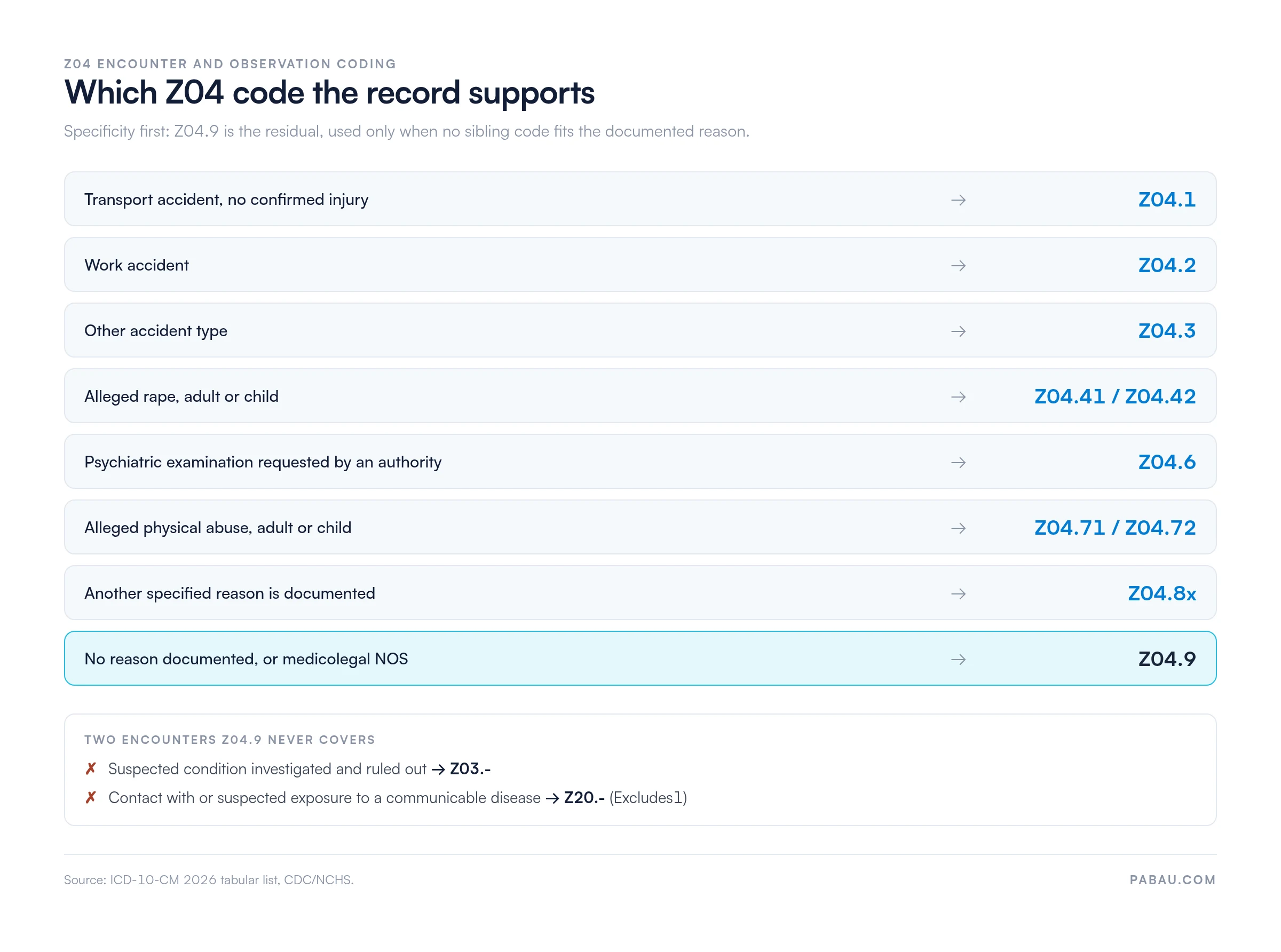
Because Z04.9 is an unspecified code, the supporting documentation has to show that no more specific code applies. Payers auditing Z-code claims look for one of two signals. Either the record shows the reason was genuinely undocumented, or it shows the medicolegal NOS inclusion term fits.
Meeting medical billing compliance requirements for Z04.9 means the clinical record carries the following before the claim goes out:
Medicolegal records may be subpoenaed or reviewed by a third party, so they also have to meet HIPAA documentation standards. Keeping them audit-ready reduces the risk of a claim reversal. When a Z04.9 denial does arrive, it almost always traces back to one of the five items above.
The ICD-10-CM Official Guidelines for Coding and Reporting, maintained by CMS and NCHS, contain specific instructions governing Z-code observation encounters. Coders must apply these rules before assigning Z04.9.
Billing teams that build these sequencing rules into the workflow stop assigning Z codes reactively at month end. The AAPC Codify ICD-10-CM lookup carries the current official guideline notes alongside the Z04.9 code entry.
Z04.9 has been a valid ICD-10-CM code since the US implementation on October 1, 2015. No descriptor changes have been made since its introduction. The 2026 edition, effective October 1, 2025, carries the same descriptor, inclusion terms, and excludes notes as prior editions.
Stability across editions is typical for Z04.9. Unlike codes in chapters covering active disease processes, administrative Z-code encounters tend to remain unchanged unless CMS or NCHS identifies a need for greater specificity. Monitoring the annual ICD-10-CM updates from CDC/NCHS each fiscal year remains best practice.
Check the CMS ICD-10-CM update files each October. Z04.9 has been stable since 2015, but sibling codes in the Z04 block have seen descriptor refinements. A change to Z04.8x or Z04.7x could affect the boundary where Z04.9 applies.
Observation encounters coded to ICD-10 code Z04.9 draw denials because an unspecified code carries no clinical justification of its own. What protects the claim is the quality of the record behind it. Practice management software like Pabau gives the team one place to capture, structure, and submit those encounters with the evidence payers ask for.
Pabau’s Claim.MD clearinghouse integration connects practices to thousands of US payers. Claims for Z04.9 encounters run through eligibility verification before submission, and ERA/835 remittance files come back automatically. When a payer rejects one, the CARC denial reason lands in the billing dashboard. The team sees it the same week rather than at month end.
Pabau’s claims software for practices structures encounter records around the fields payers audit. On a Z04.9 encounter, the documentation prompts cover three points:
Those fields pre-populate the CMS-1500 form, which cuts the manual re-keying that leads to omissions. Digital intake forms collect the medicolegal or administrative context at check-in, before a coder opens the encounter. That upstream capture is what makes Z04.9 documentation defensible.

Pabau’s claims management software and Claim.MD integration help practices document observation encounters correctly, verify eligibility before submission, and resolve denials fast. See how it works for your practice.

Z04.9 is easy to assign and just as easy to over-assign. Reach for it only when the record genuinely cannot support a more specific Z04 sibling code. Then build the note around two points: why the patient presented, and what the examination did or did not find. A coder who can show both has a defensible claim, even on an unspecified code.
Pabau’s claims management software and Claim.MD integration give practices the structure to document, submit, and track observation encounters. That structure is what keeps Z04.9 claims out of the preventable-denial pile. Book a demo to see how Pabau handles ICD-10 billing workflows end to end.

Need help navigating ICD-10-CM Z-code encounters? Superbill documentation guide explains how to structure encounter records that support clean Z-code claims.
Want to reduce claim denials on administrative encounters? Denial codes in medical billing covers the most common CARC codes that affect Z04.9 and similar observation encounter claims.
Looking for credentialing guidance before billing payers? How to get credentialed with insurance companies walks through the payer enrollment steps that affect Z-code reimbursement eligibility.
ICD-10 code Z04.9 is a billable diagnosis code for encounters for examination and observation. It applies when no specific reason for the observation is documented. Its inclusion term covers examination for medicolegal reasons NOS, making it the default code for undocumented medicolegal encounters.
Yes, Z04.9 is a billable, diagnosis-specific ICD-10-CM code valid for submission on claims. It has been billable since October 1, 2015, and remains valid in the 2026 edition (effective October 1, 2025).
Z04.9 applies only when the encounter reason does not match any sibling code from Z04.1 through Z04.8x. If the record documents a transport accident, work accident, forensic examination, or another specified reason, use the matching specific code. Z04.9 is the residual for genuinely unspecified encounters.
Z04.9 has one Excludes1 note: contact with and (suspected) exposure to communicable diseases (Z20.-). Excludes1 means Z04.9 and Z20.- codes cannot appear together on the same claim. If the encounter involves suspected communicable disease exposure, Z20.- is the correct code family.
Z04.9 captures medicolegal examinations when the specific legal reason is not documented. The inclusion term “Encounter for examination for medicolegal reasons NOS” is its only listed applicable-to note. If the examination’s legal context is specified (for example, a court-ordered psychiatric assessment), Z04.6 or another specific sibling code may apply.
Yes. Z04.9 is valid in the 2026 ICD-10-CM edition, effective October 1, 2025. The descriptor, inclusion terms, and excludes notes are unchanged from prior editions.