ICD-10 Code Y76.0: Diagnostic obstetric and gynecological devices
ICD-10 Code Y76.0: Definition and billable status ICD-10 Code Y76.0 is a valid, ...

Last Updated: Oct 23, 2026
Billable Code Specific Code
Y83.5 is the billable ICD-10-CM code for amputation of limb(s) as the cause of abnormal reaction of the patient, or of later complication, without mention of misadventure at the time of the procedure.
Three errors cause most of the trouble with this code. Coders use it as a principal diagnosis, confuse it with the misadventure codes in Y62-Y69, or type Y83.4 by mistake. That neighboring code means something else entirely.
Let Pabau's smart automation suggest the right codes, reduce claim denials, and keep your practice compliant—effortlessly.
Automate repetitive tasks and focus on what matters most—your patients.
Reduce coding errors and ensure compliance with the latest regulations.
Clean claims, fewer denials, and faster reimbursements.
Powerful insights and reporting to help your practice thrive.
HIPAA compliant SOC 2 certified GDPR-compliant Trusted by 4,000+ clinics worldwide

ICD-10 code Y83.5 covers amputation of limb(s) as the cause of abnormal patient reaction or later complication, without misadventure.
Y83.4 is a different code entirely: Other reconstructive surgery as the cause of abnormal reaction or later complication.
Y83.5 is a billable, FY2026-valid external cause code, but it is not on the CMS present on admission (POA) exempt list.
It must always be assigned as a secondary code alongside a principal diagnosis describing the complication itself.
Pabau’s claims management software and Claim.MD clearinghouse integration support accurate external cause code capture and submission.
The official ICD-10-CM tabular list defines Y83.5 as amputation of limb(s) as the cause of abnormal reaction of the patient, or of later complication. The title then closes with the qualifier that decides the code: Without mention of misadventure at the time of the procedure. According to the CDC/NCHS ICD-10-CM web tool, Y83.5 sits in Chapter 20, External Causes of Morbidity. Within that chapter it falls in the Y83-Y84 block, which groups surgical and other medical procedures that cause an abnormal reaction or a later complication.
The code captures a specific clinical situation. A limb amputation is performed correctly, without error or misadventure, and the patient still has an abnormal reaction or develops a later complication. The amputation is the external cause. The complication or reaction is the reason for the encounter, and it is coded separately as the principal diagnosis.
Yes. Y83.5 is a billable, specific ICD-10-CM code valid for FY2026 claim submission. The CMS ICD-10 codes page confirms that the Y83.x codes in this block are specific and valid for reporting on claims. “Billable” in ICD-10-CM means the code is granular enough to be submitted on a claim form without further specificity. Y83.5 meets that threshold.
Billable status alone does not mean Y83.5 can stand on its own on a claim. It is an external cause code, so it must always accompany a principal diagnosis. Submitting it without a primary complication code is a common error that triggers denial.
Y83.4 and Y83.5 sit next to each other in the tabular list and are easy to transpose. Y83.4 is other reconstructive surgery. Y83.5 is amputation of limb(s). Check the digit against the CMS ICD-10-CM tabular list before the claim goes out, and re-verify at the start of each fiscal year. FY2026 validity runs from October 1, 2025 through September 30, 2026.
Y83.5 is not POA exempt. Inpatient claims that carry it need a present on admission indicator, the same as the principal diagnosis it accompanies. Appendix I of the ICD-10-CM Official Guidelines lists the categories that are exempt. Within Chapter 20 those exemptions cover ranges such as Y92 (place of occurrence), Y93 (activity), and Y99 (external cause status). The Y83 block is not among them.
Secondhand reference pages often state the opposite, so read Appendix I directly before you rely on one. POA reporting applies to principal diagnoses, secondary diagnoses, and external cause codes alike. For an external cause code, the indicator reflects whether the event behind the condition happened before the patient was admitted. Compliant reporting needs both the indicator and accurate sequencing of the principal diagnosis alongside Y83.5.
The phrase “without mention of misadventure” is the most consequential part of Y83.5’s title. It separates a normal procedure outcome from a clinician error or a surgical accident. Misadventure codes occupy a different ICD-10-CM block, Y62-Y69, and the Y83-Y84 block carries a Type 1 Excludes note pointing there. Conflating the two is a documentation and compliance error with consequences for quality reporting and audits.
The distinction is documentation-driven. If the medical record mentions no misadventure, clinician error, or accident during the procedure, Y83.5 is correct. If the documentation indicates a surgical accident or error, coders must use the applicable Y62-Y69 misadventure code instead. Never assign Y83.5 when the documentation suggests a misadventure, even where the code appears to fit the clinical picture. Query the attending physician when the record is ambiguous.
Y83.5 belongs to the Y83 parent category. Y83 covers surgical operation and other surgical procedures as the cause of abnormal reaction of the patient, or of later complication. The full category title then closes with without mention of misadventure at the time of the procedure. Knowing the whole Y83.x structure helps coders pick the most specific code for any surgical procedure, not just amputation. The AAPC Codify ICD-10-CM lookup lists every Y83.x subcode with its description.
When the procedure that caused the complication was an amputation, Y83.5 is the correct code. Y83.4 is its immediate neighbor and covers other reconstructive surgery, so a single transposed digit changes the documented procedure. If the surgical procedure is documented but matches none of Y83.0 through Y83.6, use Y83.8. Y83.9 is a last resort for an unspecified surgical procedure, and it should be avoided when the record names the procedure type. Two questions in the chart settle the whole selection, as the chart below sets out.
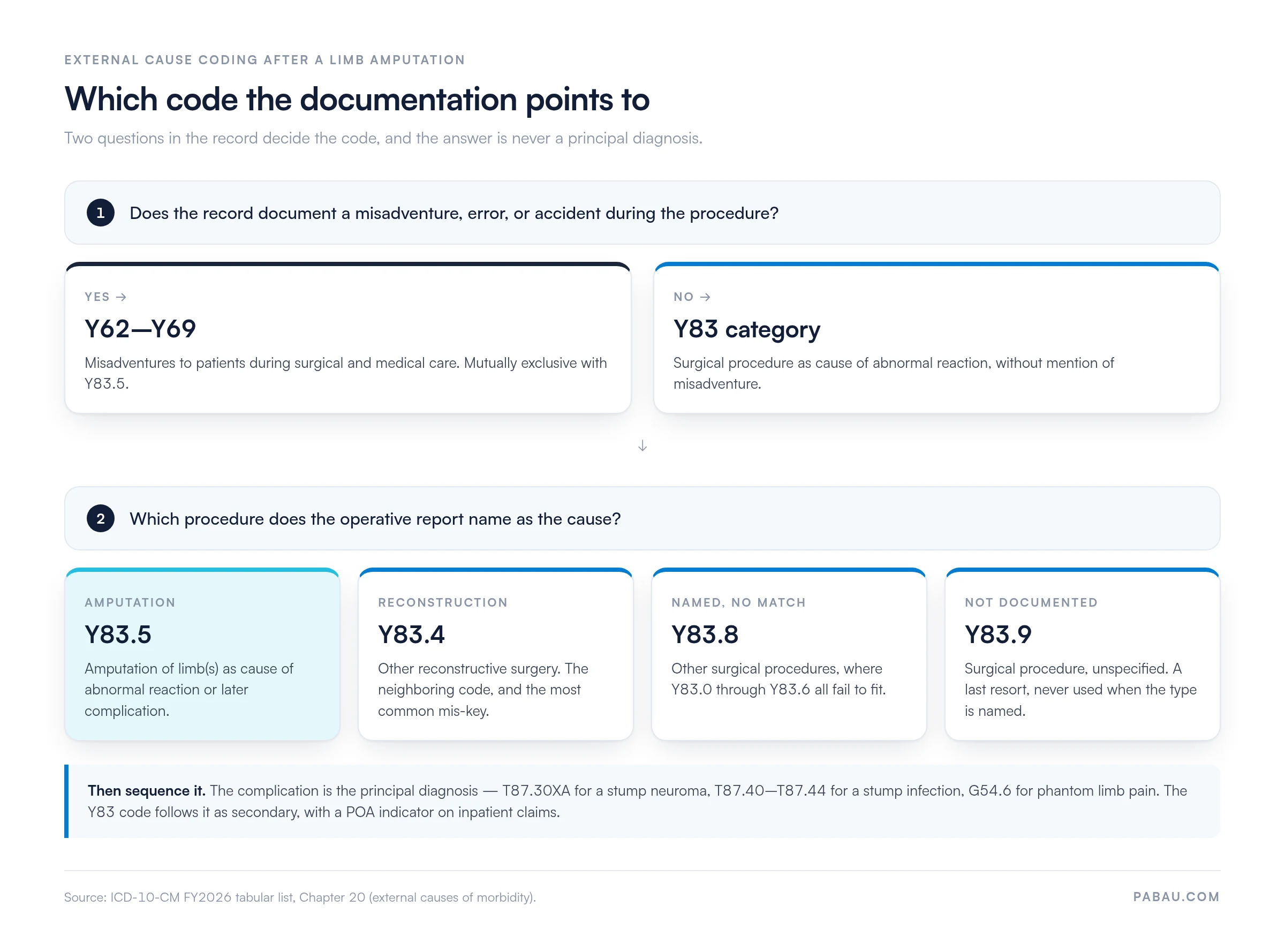
Y83.5 must always be used as a secondary code. It cannot function as a principal or first-listed diagnosis under any circumstances. This is a fundamental rule for every external cause code in Chapter 20 of ICD-10-CM, and it applies to Y83.5 regardless of the clinical scenario. Correct sequencing works as follows.
Insurers may query claims where Y83.5 appears without a complication principal diagnosis. Checking that every Y83.5 submission pairs with a specific complication code heads off the most common rejection. The denial codes reference explains the remittance messages that follow one. The chart documentation also has to support the external cause designation explicitly.
The ICD-10-CM official tabular list includes “Applicable To” notes that clarify which clinical presentations fall within a code’s scope. Y83.5 carries no separate “Applicable To” inclusions beyond the code title, because the title already names amputation of limb(s). The External Cause Index route is worth memorizing. Look up “Complication (delayed) of or following (medical or surgical procedure)”, then the subterm “amputation of limb(s)”. That entry points straight to Y83.5. Approximate synonyms used in clinical documentation and coding references include:
These synonyms appear in clinical notes and operative reports. Coders should read them as pointers to Y83.5, provided the documentation confirms no misadventure. Where the wording is only an approximate match, the tabular list decides, not the synonym.
A code definition says what Y83.5 means. The three scenarios below show how it behaves in a chart, alongside the principal diagnosis it has to follow. All are illustrative, and coders should verify against the official ICD-10-CM guidelines and AHA Coding Clinic before applying them to a specific case.
A 62-year-old patient with peripheral arterial disease undergoes a below-knee amputation. Six weeks post-procedure, the patient is readmitted with significant stump pain and a diagnosed stump neuroma. The documentation states the amputation was performed without complication. The neuroma is a known sequela of nerve division during amputation.
Correct sequencing: Principal diagnosis: T87.30XA (Neuroma of amputation stump, unspecified extremity, initial encounter). Secondary: ICD-10 code Y83.5 (amputation of limb(s) as cause, no misadventure). Assign a POA indicator for both codes on the inpatient claim.
A patient undergoes an above-knee amputation following a traumatic injury. During a follow-up admission three months later, the patient is treated for phantom limb pain. The record documents the amputation as correctly performed, with no mention of misadventure or surgical error.
Correct sequencing: Principal diagnosis: G54.6 (Phantom limb syndrome with pain). Secondary: ICD-10 code Y83.5. The phantom limb pain is a later complication attributable to the amputation, which Y83.5 identifies as the external cause.
Following a transradial amputation, a patient returns to the surgical ward with wound dehiscence at the stump site. Chart notes document normal operative technique, and no misadventure or error is mentioned. The dehiscence is managed with wound care and re-closure.
Correct sequencing: Principal diagnosis: T87.81XA (Dehiscence of amputation stump, initial encounter). Secondary: ICD-10 code Y83.5, identifying the amputation as the procedural cause. If the surgeon later documents a misadventure, replace Y83.5 with the applicable Y62-Y69 code.
When documentation is ambiguous about whether a misadventure occurred, query the surgeon before assigning Y83.5 or a Y62-Y69 code. Incorrect external cause code assignment can affect quality metrics, malpractice reviews, and payer audits. Always code from documentation, never from inference.
When coding amputation-related complications, Y83.5 is rarely the only code on the claim. Coders should know the surrounding code landscape well enough to sequence accurately. Surgical versus medical is the first split, because an unspecified medical procedure belongs in Y84.9 rather than Y83. The table below covers the most relevant sibling and adjacent codes.
Accurate external cause coding depends on complete, accessible clinical documentation at the point of coding. When surgical notes, operative reports, and post-procedure follow-up records sit in separate systems, coders spend their time chasing information rather than coding. Claims software for practices like Pabau keeps the clinical record and the billing workflow in one system. A coder can open the operative report and the follow-up note from the same chart.
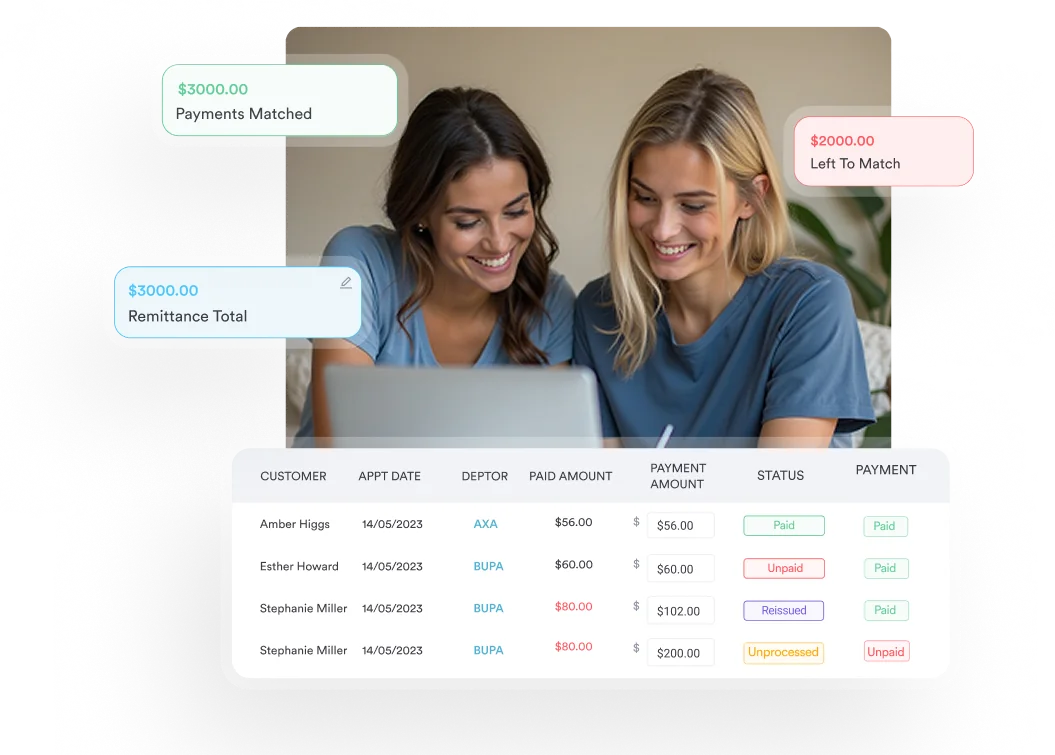
US practices submitting external cause codes like ICD-10 code Y83.5 can route claims through Pabau’s Claim.MD clearinghouse integration. It validates and submits ICD-10-coded claims to thousands of US payers. The integration supports CMS-1500 and 837P claim formats, real-time eligibility verification, and electronic remittance advice (ERA/835) for automated payment posting. Claims carrying secondary external cause codes go through the same validation pipeline as primary diagnosis codes. Formatting errors get caught before they reach the payer.
Practices handling postoperative complication claims can also read how a medical claims clearinghouse sits between the practice and the payer. That guide covers what the clearinghouse checks on submission and which payer networks it reaches.

Pabau connects clinical documentation to claims submission through the Claim.MD clearinghouse integration, supporting accurate external cause code workflows and faster payment cycles for surgical practices.

ICD-10 code Y83.5 is the specific, billable external cause code for amputation-related complications where no misadventure is documented. Correct use comes down to four habits. Pair it with the right principal complication diagnosis. Never assign it as the first-listed code. Keep a POA indicator on inpatient claims. And check the fourth digit, because Y83.4 covers other reconstructive surgery, not amputation.
The habit that pays off is reading the operative note before the code, not after the denial. A record that states the procedure and rules out misadventure settles the choice in seconds. One that does not needs a physician query, and that query is cheaper than a rebill.
Practices submitting external cause codes benefit from keeping documentation and claims in the same place. Pabau connects the chart to the claim and routes submissions through the Claim.MD clearinghouse integration. To see how a Y83.5 pairing gets checked before it reaches the payer, book a demo.

Need a broader overview of ICD-10 claim submission workflows? What is medical billing covers the end-to-end process from patient encounter through payment posting.
Want to understand how clean claims reduce denials? Clean claim best practices explains what constitutes a clean claim and how to avoid the most common submission errors.
Handling denied claims that include external cause codes? Denial codes in medical billing provides a reference guide for common remittance denial codes and their resolutions.
Unsure what POA reporting and audits demand of your records? Medical billing compliance sets out the documentation standards behind accurate diagnosis and external cause coding.
Tracking what happens to a claim after submission? What is revenue cycle management follows the money from patient registration through to final payment posting.
ICD-10 code Y83.5 is the billable ICD-10-CM external cause code for amputation of limb(s) as a cause of abnormal patient reaction or later complication. The code applies only where the record mentions no misadventure at the time of the procedure. It belongs to Chapter 20, External Causes of Morbidity. Assign it as a secondary code alongside a principal complication diagnosis, never as a standalone or first-listed code.
Yes. Y83.5 is a billable, specific ICD-10-CM code valid for FY2026 claim submission, which runs from October 1, 2025 through September 30, 2026. It is specific enough to submit on a claim form without further coding granularity. It still requires an accompanying principal complication diagnosis code.
Assign Y83.5 when an encounter involves a complication or abnormal reaction attributable to a prior limb amputation. The record must mention no misadventure, error, or accident during that procedure. Sequence the specific complication code first, such as a stump infection or neuroma code. Y83.5 follows it.
Y83.5 is amputation of limb(s) as the cause of an abnormal reaction or later complication. Y83.4 is other reconstructive surgery as the cause. The two codes sit next to each other in the tabular list, so one transposed digit changes the documented procedure entirely. Check the fourth digit against the official tabular list before submitting.
No. Y83.5 does not appear on the CMS present on admission exempt list published in Appendix I of the ICD-10-CM Official Guidelines. Inpatient claims carrying Y83.5 need a POA indicator. The Chapter 20 exemptions cover categories such as Y92, Y93, and Y99, not the Y83 block.
Code the specific complication as the principal diagnosis, such as T87.40-T87.44 for a stump infection or G54.6 for phantom limb pain. Then add ICD-10 code Y83.5 as the secondary external cause code identifying the amputation. Confirm the record documents no misadventure, surgical error, or accident before choosing Y83.5 over a Y62-Y69 code.