ICD-10 code S61.201A: Open wound of left index finger without nail damage
ICD-10 code S61.201A covers a left index finger wound of unstated type ICD-10 co...

Last Updated: Oct 16, 2026
Billable Code Specific Code
X38.XXXA is the billable ICD-10-CM code for flood, initial encounter. It records a flood as the external cause of an injury during active treatment, and it is never the principal diagnosis.
The code sits in block X30-X39 (Exposure to forces of nature). It follows the injury code on the claim and changes to X38.XXXD once active treatment ends.
Let Pabau's smart automation suggest the right codes, reduce claim denials, and keep your practice compliant—effortlessly.
Automate repetitive tasks and focus on what matters most—your patients.
Reduce coding errors and ensure compliance with the latest regulations.
Clean claims, fewer denials, and faster reimbursements.
Powerful insights and reporting to help your practice thrive.
HIPAA compliant SOC 2 certified GDPR-compliant Trusted by 4,000+ clinics worldwide

X38.XXXA is an external cause code, so it never serves as the principal diagnosis and always follows the injury code on the claim.
The 7th character A covers the initial, active-treatment encounter. Switch to D for follow-up visits and S for sequela care.
Claims fail when X38.XXXA is sent without an injury code, or when a flood injury is coded as X37 (storm) or X39 (other natural forces).
Practice management software like Pabau pre-fills claims from the patient record and holds submission until required details are complete.
ICD-10 Code X38.XXXA is a supplementary external cause code describing a flood as the precipitating event for an injury at the patient’s initial encounter.
It belongs to ICD-10-CM Chapter 20 (External causes of morbidity), block X30-X39 (Exposure to forces of nature), under parent category X38 (Flood). The code is valid for FY2026 claim submission, as confirmed by the CMS ICD-10-CM annual release.
The full hierarchy runs: V00-Y99 (External causes of morbidity) > X30-X39 (Exposure to forces of nature) > X38 (Flood) > X38.XXX (Flood) > X38.XXXA (Flood, initial encounter).
Unlike many ICD-10-CM codes, X38 carries placeholder X characters because the category does not have 4th, 5th, or 6th character subdivisions. The three placeholder Xs fill those positions so the mandatory 7th character can be appended correctly.
The 7th character in X38.XXXA determines which phase of care the encounter represents. A character that doesn’t match the documented phase of care is a common trigger for payer edits on flood-related claims.
The 7th character tracks the phase of treatment, whatever the visit count. A patient transferred between two facilities on the same day still uses “A” for both encounters if active treatment is ongoing.
Once active treatment ends and the patient returns for routine healing care, switch to “D.” The CDC/NCHS ICD-10-CM coding tool confirms these encounter definitions under the Official Guidelines Section I.C.19.
X38.XXXA is never a principal or first-listed diagnosis. Per the ICD-10-CM Official Guidelines, Section I.C.20, external cause codes are supplementary. They explain how an injury occurred, while the injury code says what the injury is. The injury code always leads.
Correct sequencing example: A patient presents to the ED after falling through a collapsed floor during a flash flood, sustaining a right forearm fracture.
Submitting X38.XXXA as the only code on a claim, without the injury code in the first position, will trigger a payer edit. Most commercial payers and Medicare reject claims where an external cause code appears without an accompanying injury, poisoning, or other clinical code.
X38.XXXA covers any injury caused by a flood and treated at the initial encounter. River overflow, levee failure, flash flooding, and floods from snowmelt or a storm all fall under X38. The code names the cause, and the paired principal code describes the injury itself.
Injury types commonly paired with X38.XXXA include:
Occupational flood exposure (workers deployed in flood response) is also appropriately coded with X38.XXXA when a clinical injury results. Flood-response workers are coded the same way as residents caught in the flood.
The ICD-10-CM tabular lists three inclusion terms under X38:
X38 also carries Excludes1 notes for collapse of a dam or man-made structure causing earth movement (X36.0) and for tidal waves (X37.41, X37.42). An Excludes1 note means the two codes are never reported together, so those events go to X36 or X37 instead.
Coders also need to tell X38 apart from its siblings in the X30-X39 block. A hurricane that floods a town is the classic trap. Injuries from the floodwater take X38, while injuries from the wind take X37. Assign based on the documented proximate cause of injury, because payer auditors check the code against the precipitating event in the note.
The table below shows the most frequent principal diagnosis codes paired with ICD-10 Code X38.XXXA, with correct sequencing for each scenario. All codes shown are valid for FY2026 per the WHO ICD-10 classification and the CMS tabular list.
Document the exact flood mechanism in your clinical notes, such as river overflow, flash flooding, or levee failure. Payers often request source documentation for natural disaster claims during post-disaster audits. A specific flood description in the record supports X38 over X37 or X39 and speeds claim resolution.
Flood-related encounters produce a recognizable pattern of coding errors. Most of them trace back to one of the three checks below.
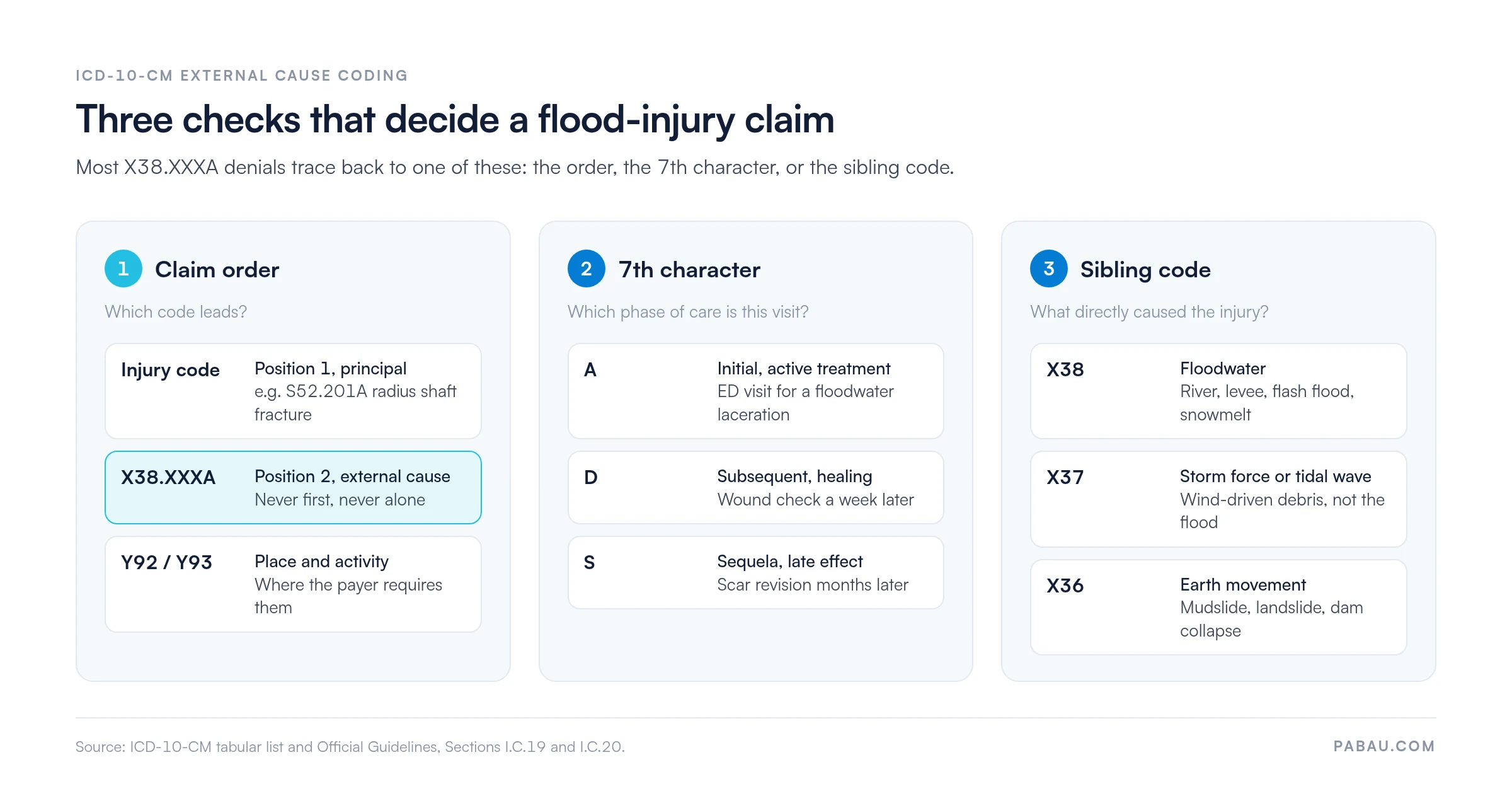
These are the most frequent errors, along with the payer edit response each generates.
A clean claim for a flood-related encounter lists the injury code first and X38.XXXA second. It adds place-of-occurrence and activity codes where the payer requires them. Getting all four elements in place on the first submission prevents the most common denial reasons.
The coder cannot assign ICD-10 Code X38.XXXA without adequate documentation. These are the elements clinicians must capture in the medical record for the code to be defensible on audit. Building these fields into flood-encounter note templates cuts coder query-back time. Claims software for billing teams can then pre-fill the claim from the same record.
Train clinical staff to note the flood mechanism explicitly in their documentation even when it feels obvious during a disaster event. Post-event audits, especially on mass casualty or federally declared disaster claims, routinely request source records to validate external cause code assignment. Vague notes delay resolution.
The ICD-9-CM predecessor to X38.XXXA is E908.2 (Floods). The mapping is direct, since E908.2 described flood as an external cause of injury in ICD-9’s supplementary E-code classification. ICD-9-CM had no 7th character encounter extension, so E908.2 applied to every encounter type. Coders converting legacy records or running retrospective studies won’t find the initial, subsequent, and sequela split in ICD-9 data.
For retrospective ICD-9 to ICD-10 crosswalk work, the AAPC Codify ICD-10-CM lookup provides bidirectional conversion tools. A single ICD-9 E908.2 record may map to any of the three X38 7th character variants. The choice depends on the encounter type documented in the original record.
After a flood, billing teams often re-key diagnosis codes into a separate clearinghouse portal. Sequencing mistakes then surface only when a denial comes back, weeks after the visit.
In Pabau, the insurer’s details live on the patient record, so claims are pre-filled from the visit with no re-keying. Validation checks run in the background and hold a claim until missing details are fixed, such as membership numbers or authorization codes.
US claims go out as electronic CMS-1500s through the Claim.MD integration, and our guide to the Claim.MD clearinghouse walks through each step.
Each claim’s status sits in one dashboard, and denied claims are flagged for rework. Remittance comes back into Pabau against the right invoice, so your team can clear a post-flood surge without chasing payers by phone.

Pabau pre-fills claims from the patient record and holds submission until required details are complete, so flood-injury claims reach the payer ready to process.

Treat X38.XXXA as the second line of every flood-injury claim, never the first. Match the 7th character to the phase of care. Then check that the note names water as the cause, rather than wind or earth movement.
The trade-off is a minute more on each note during a disaster surge. That minute costs far less than reworking a batch of denied claims once post-event audits begin.
Book a demo to see how Pabau pre-fills and checks flood-injury claims before they reach the payer.

Need to understand how clearinghouses validate external cause codes? How medical claims clearinghouses work explains the validation steps applied to diagnosis code pairs before claims reach payers.
Managing a high volume of disaster-related denials? Denial management in healthcare covers systematic workflows for resolving external cause code rejections efficiently.
Want to see how coding guidelines translate into billing compliance? Medical billing compliance covers documentation standards that support external cause code assignment under payer audits.
Want claims accepted on the first pass? Clean claims in medical billing covers the fields and code pairings payers check before they process a claim.
ICD-10 Code X38.XXXA is the ICD-10-CM external cause code for a flood injury at the initial encounter. It is a supplementary code from Chapter 20 (External causes of morbidity), block X30-X39. It documents that flooding was the precipitating event for an injury. It cannot be used as a principal diagnosis and must always be paired with and sequenced after the injury code.
Use X38.XXXA when the encounter is the patient’s first contact for active treatment of the flood-related injury. Switch to X38.XXXD for all follow-up visits while the injury is still healing. The distinction is phase of treatment, not visit number. A patient transferred between two facilities on the same day still uses “A” for both encounters if active treatment is ongoing.
X38.XXXA is always a secondary code. Per ICD-10-CM Official Guidelines Section I.C.20, external cause codes are supplementary by definition. The injury, poisoning, or clinical condition code always occupies the principal diagnosis position. Submitting X38.XXXA as the first-listed code on a claim will trigger a payer edit or denial in most systems.
Yes. X38.XXXA must always be accompanied by at least one clinical injury or condition code in the principal position. Common pairings include W65-W74 series codes for drowning or submersion, T68.XXXA for hypothermia, and S-series codes for fractures and lacerations. A claim with only X38.XXXA and no injury code will fail basic edit checks at the clearinghouse or payer level.
The code for flood-related sequelae is X38.XXXS. Use this 7th character “S” variant when treating a late effect or complication of a prior flood injury. Examples include scar revision after a flood-related wound, or managing an anoxic brain injury after near-drowning. The principal diagnosis in sequela encounters should be the late effect condition code, followed by X38.XXXS as the external cause.
No. The ICD-10-CM Official Guidelines recommend external cause codes but do not mandate them universally. Individual payer contracts determine whether external cause codes are required for payment. Submitting X38.XXXA anyway is still best practice. It cuts documentation requests during post-disaster audits and supports coordination-of-benefits decisions. It also completes the public health data collected after major flood events.