

CCSD code G5100: Bypass of duodenum billing guide
CCSD code G5100 bills a bypass that leaves the duodenum in place CCSD code G5100...

Last Updated: Oct 16, 2026
Billable Code Specific Code
U07.0 is the billable ICD-10-CM code for vaping-related disorder.
ICD-10 code U07.0 is the billable diagnosis code for vaping-related disorder, including EVALI. Two elements have to be in the chart before you can use it. The provider must confirm e-cigarette or vaping product use, and must tie a lung injury to that use.
One without the other will not hold. The date matters too. Most references say October 2019, but CDC/NCHS added U07.0 to ICD-10-CM on April 1, 2020, and older code books still miss it.
Below we cover billability, the official terms U07.0 includes, sequencing, companion codes, documentation, and the errors that draw denials.
Let Pabau's smart automation suggest the right codes, reduce claim denials, and keep your practice compliant—effortlessly.
Automate repetitive tasks and focus on what matters most—your patients.
Reduce coding errors and ensure compliance with the latest regulations.
Clean claims, fewer denials, and faster reimbursements.
Powerful insights and reporting to help your practice thrive.
HIPAA compliant SOC 2 certified GDPR-compliant Trusted by 4,000+ clinics worldwide

ICD-10 code U07.0 is the billable diagnosis code for vaping-related disorder, including EVALI, and it took effect on April 1, 2020.
U07.0 needs confirmed vaping or e-cigarette use in the chart alongside a lung injury the provider links to that use.
Report U07.0 with companion codes such as F17.29- for nicotine dependence and J68.0 or J96.0- for respiratory manifestations.
Sequencing follows the reason for the encounter, so U07.0 is not automatically the principal diagnosis.
Pabau’s claims tools carry ICD-10 and CPT lookup libraries plus required-field checks, so U07.0 claims leave with fewer blanks.
U07.0 is a billable, specific ICD-10-CM code titled “Vaping-related disorder.” It is valid for the fiscal year that runs from October 1, 2025 through September 30, 2026 (FY2026). You can submit it on its own, because it needs no further characters to be complete.
The effective date is where sources disagree. The World Health Organization released an international emergency code for vaping-related disorder on September 24, 2019. CDC/NCHS then added U07.0 to the US ICD-10-CM set on April 1, 2020, outside the usual October cycle.
Guidance issued in October 2019 only told US coders how to use existing respiratory codes in the meantime. So if a colleague insists the code has been live since 2019, they are half right, and they are reading the wrong code set.
U07.0 sits in the U00-U85 block, which ICD-10-CM reserves for provisional and emergency additions. Its neighbor in the U07 subcategory is U07.1, the code for COVID-19. You can confirm the current entry any time in the CDC/NCHS ICD-10-CM tool.
U07.0 covers more ground than the word “vaping” suggests. The ICD-10-CM tabular list prints these terms under the code, and each one maps to U07.0:
Dabbing is worth flagging, because plenty of coders assume it needs a separate code. It does not. If a physician documents lung damage after dabbing concentrates, U07.0 is the entry.
Clinical notes rarely use the tabular wording, though. Expect to see “vaping-associated lung injury,” “vaping-induced pneumonitis,” or “e-cigarette lung injury” instead.
All of them land on U07.0 when the provider confirms the injury. What does not land there is e-cigarette use with no lung injury, and that distinction drives most of the coding decisions below.
The 2019 outbreak gave the code set a problem it could not solve. CDC counted more than 2,800 hospitalized cases and 68 confirmed deaths across the United States.
Most severe cases traced back to vitamin E acetate, an additive in THC-containing vaping products, although nicotine products were also implicated.
Coders had respiratory codes, but no cause. J68.0 described chemical pneumonitis and J80 described acute respiratory distress syndrome.
Neither one said the injury came from an inhaled vaping product. Surveillance teams could not count cases, and payers could not see why the admission happened.
The National Center for Health Statistics answered with U07.0 as an emergency addition. Public health teams got a code they could track, and coders got one place to record confirmed vaping-related lung injury.
In practice, the cases that qualify tend to share the same profile:
Assign U07.0 only when the record documents confirmed vaping or e-cigarette product use and a lung injury the provider attributes to that use.
The word “confirmed” carries a lot of weight there. If the note says “suspected EVALI” or “possible vaping-related lung injury,” coding guidelines send you to the presenting signs and symptoms instead.
Imaging alone is not enough either. A patient can mention vaping at triage without any physician connecting that history to the finding on the film. Until the provider makes the link in writing, U07.0 stays off the claim.
The CMS ICD-10 codes guidance and the official ICD-10-CM guidelines both put that decision with the provider, not the coder.
Four combinations cover almost every chart you will meet, and only one of them earns the code.
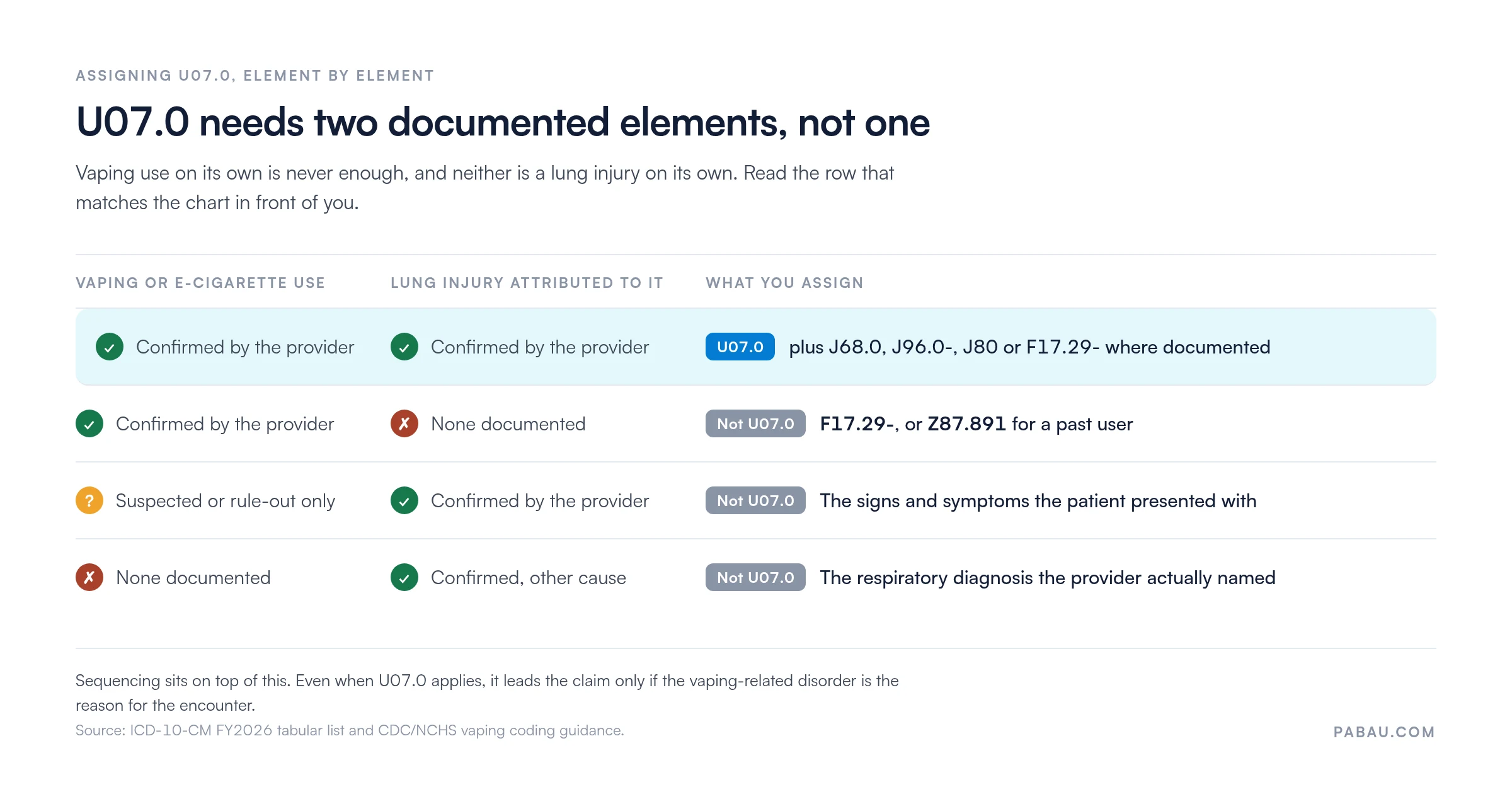
U07.0 is not automatically the principal diagnosis. The reason for the encounter decides the order, and that reason changes from visit to visit. Three patterns cover the usual cases.
An example makes the difference concrete. A 22-year-old arrives hypoxic with bilateral infiltrates, and the pulmonologist documents acute respiratory failure plus three months of daily THC cartridge use.
Failure drove the admission, so J96.01 leads and U07.0 follows. Two weeks later the same patient comes in for a follow-up, breathing comfortably. Now the vaping-related disorder is the reason for the visit, so U07.0 leads. Same patient, same history, different order.
When the note leaves you guessing, query the attending. Defaulting to a fixed order is how inpatient claims end up with the wrong DRG.
The tabular tells you to add codes for the manifestations present, so U07.0 rarely travels alone. Below are the ones you will reach for most, cross-checked against the AAPC ICD-10-CM lookup.
The nicotine dependence row is the one that catches people out. F17.210 is dependence on cigarettes, so it does not describe a vaping patient. CDC’s 2019 vaping coding guidance sends e-cigarette dependence to F17.29-, the “other tobacco product” subcategory.
Pick the sixth character from the note. The tabular is refreshed every year, so confirm the subcode in our ICD-10-CM code library before the claim goes out.
Clean submission comes down to what the physician wrote. Work through these six items before the code leaves your queue:
Miss one of these and the claim gets thin. Payers deny or downcode when the record never connects the vaping history to the lung injury. Structured note templates help here, because the fields sit in front of the clinician during the visit rather than in a query two weeks later.
Record the device type (pod system, vape pen, e-hookah) and the substance (THC-containing or nicotine only) in every EVALI note. That detail decides whether you add F17.29- or Z87.891, and it is the evidence your billing team needs when a payer questions medical necessity.
A U07.0 claim travels the same road as any other diagnosis claim. The provider documents, the coder assigns U07.0 plus companions, the biller attaches the CPT codes for the work performed, and the claim goes out electronically. Two points on that road cause most of the trouble.
The first is your own code set. U07.0 arrived mid-year, so systems that only refresh each October missed it for months. Any lookup tool still running an older edition will not offer the code at all. The second is the payer side.
EVALI admissions often mean intensive care and extended stays, so check whether prior authorization applies before the patient is admitted, since policies differ by plan.
Practices that submit electronically through a clearinghouse such as Claim.MD reach thousands of US payers for eligibility checks and 835 remittance advice. That cuts the reconciliation work on multi-code encounters, which is exactly what an EVALI case is.
Before you submit, run down this list:
Audit your denied U07.0 claims once a quarter and sort them by reason code. Missing nicotine dependence is usually the top line. Query the physician after the encounter to add that documentation, rather than waiting for the next acute admission to fix the pattern.
Errors with U07.0 cluster around three habits: using the code too broadly, sequencing it by reflex, and dropping the companions. Here is how those habits show up on a claim.
These five patterns repeat across practices, which makes them easy to catch. Feed them into your denial management routine as named reason codes, and the same claim stops coming back a second time.
Both codes came through the same emergency mechanism, and both sit in the U07 subcategory. That is where the similarity stops.
EVALI and COVID-19 pneumonia can produce comparable imaging and symptoms, so the documented cause is the only reliable way to choose between them.
Both codes reached US claims on the same day, which is a useful memory hook. If your system offers one but not the other, the update it received was incomplete.
Most U07.0 problems start in the note, not in the billing queue. When a clinician has to remember, unprompted, to record the device, the timeline, and the infection workup, some of that detail goes missing. The coder then chases an addendum, and the claim ages while they wait.
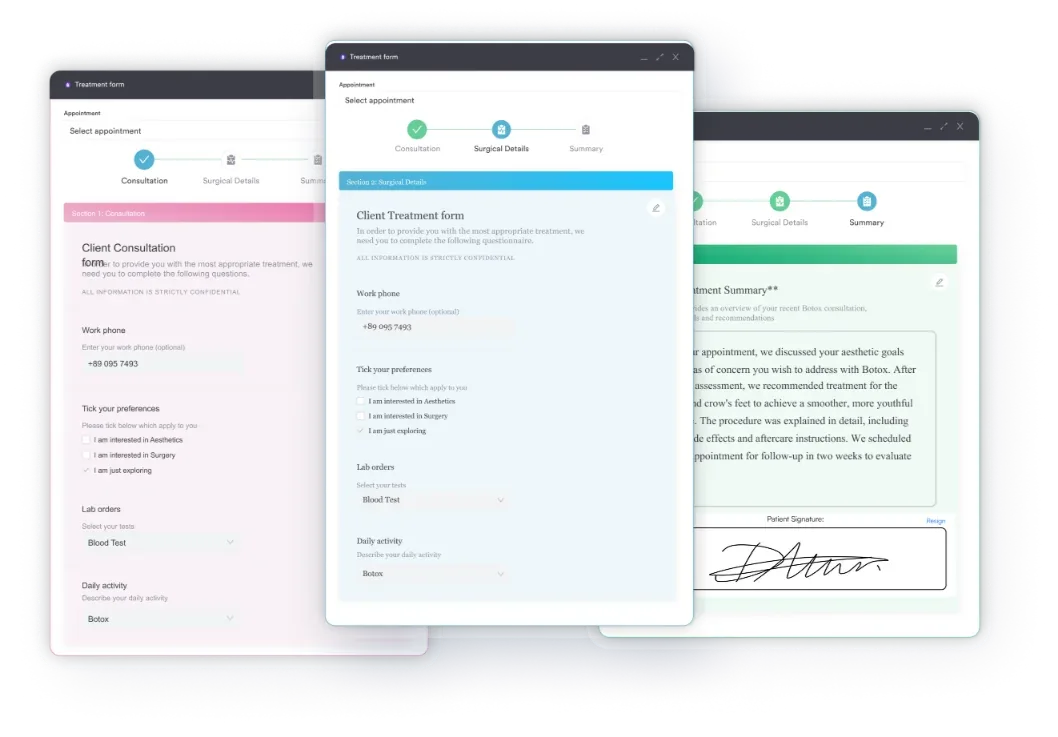
Practice management software like Pabau moves those prompts into the visit itself. Structured SOAP note templates hold the fields EVALI coding needs, so the vaping history is recorded while the patient is still in the room.
Pabau’s tools for billing teams then sit in the same system as that note. They carry ICD-10 and CPT lookup libraries, and they check that required claim fields are filled in. A claim then cannot go out with a blank where a companion code belongs.
These are completeness checks, not clinical judgment. Sequencing U07.0 is still a coder’s decision, made from the provider’s documentation. What the software removes is the clerical layer: the missing field, the stale code set, the addendum nobody requested.
Audit trails also record who assigned what and when, which is the evidence you want when a payer asks about an EVALI claim months later.
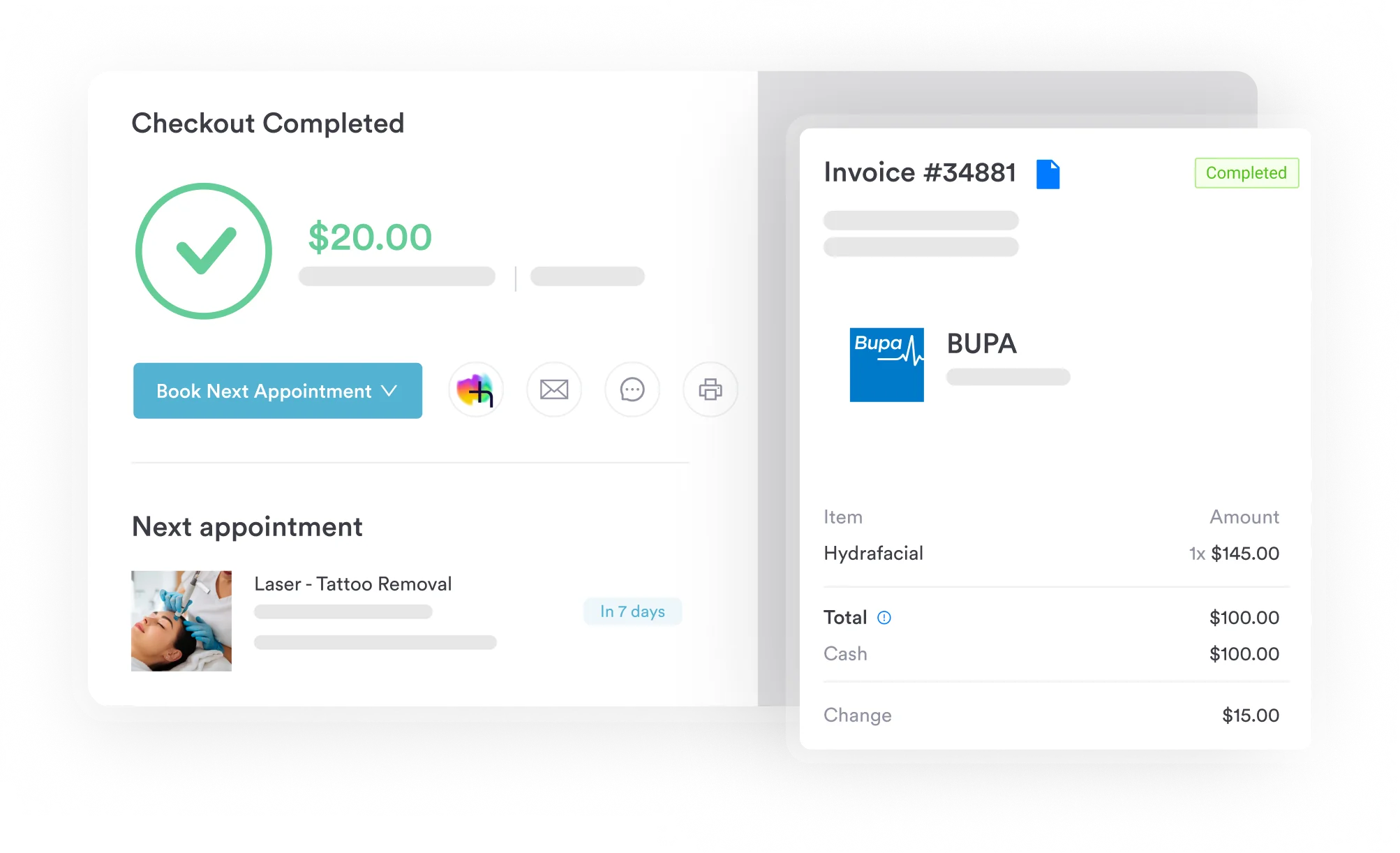

Pabau keeps ICD-10 and CPT lookup libraries next to the clinical note, and checks required claim fields before submission. Your billing team spends less time chasing blanks on multi-code encounters like EVALI.

U07.0 is an easy code to describe and a fussy one to apply. The concept takes one sentence. Confirmed vaping use, plus a documented lung injury. The application takes a chart that says both, in the provider’s own words.
So the work worth doing is upstream. Fix the note template and the code set, and the coding decisions get easier on their own. Leave them alone, and you will keep paying for it one denial at a time, usually for a missing F17.29- rather than a headline error.
One trade-off is worth remembering. Structured templates take discipline to set up, and clinicians will push back on another required field. The return shows up quietly, in claims that clear on the first pass. Book a demo to see how Pabau keeps the note, the codes, and the claim in one place for encounters like these.

Need the cigarette-specific dependence code for comparison? ICD-10 code F17.210 explains why the cigarette subcodes do not fit a vaping patient.
Coding a patient who has quit? ICD-10 code Z87.891 covers personal history of nicotine dependence and when it replaces an active F17 code.
Documenting use without dependence? ICD-10 code Z72.0 walks through tobacco use coding and the line between use and dependence.
Losing revenue to repeat denials? Denial management in healthcare sets out root-cause analysis and prevention for the patterns above.
Want the full path from note to payment? Revenue cycle management fundamentals covers each stage a diagnosis code passes through.
Yes. The code stays active for FY2026, and practices still report individual cases. Case counts dropped once vitamin E acetate left most products. No update has retired it, so treat it as a live option whenever the documentation supports it.
No. The code needs the patient’s own e-cigarette or vaping product use in the record. For a bystander, code the respiratory condition the provider named instead. Exposure on its own does not meet the U07.0 threshold.
No, U07.0 applies at any age. Pediatric cases use the same code and the same two documentation elements. Age can change the E/M level and any counseling codes you add, but not the diagnosis code itself.
That depends on what the provider did. Office or emergency department E/M codes and chest imaging are the usual partners. U07.0 supports medical necessity for the service, so choose the CPT code from the documented work.
Yes, if the provider confirms both elements during the visit. Telehealth changes the place of service and the modifier, not the diagnosis code. Most EVALI presentations need imaging, so these cases often move to an in-person setting anyway.



