ICD-10 Code Y76.0: Diagnostic obstetric and gynecological devices
ICD-10 Code Y76.0: Definition and billable status ICD-10 Code Y76.0 is a valid, ...

Last Updated: Oct 23, 2026
Billable Code Specific Code
T86.829 is the billable ICD-10-CM code for unspecified complication of skin graft (allograft) (autograft).
The T86.82 subcategory carries five billable codes, and T86.829 is the least specific of the five. Reaching for it while the chart documents rejection, failure, or infection is a common graft-coding error.
Below are the code's hierarchy and billable status, the documentation it needs, how the five siblings differ, and its POA and HCC treatment.
Let Pabau's smart automation suggest the right codes, reduce claim denials, and keep your practice compliant—effortlessly.
Automate repetitive tasks and focus on what matters most—your patients.
Reduce coding errors and ensure compliance with the latest regulations.
Clean claims, fewer denials, and faster reimbursements.
Powerful insights and reporting to help your practice thrive.
HIPAA compliant SOC 2 certified GDPR-compliant Trusted by 4,000+ clinics worldwide

T86.829 is a 6-character billable ICD-10-CM code covering both allograft and autograft complications when the complication type is undocumented.
The T86.82 subcategory holds five billable codes: T86.820 rejection, T86.821 failure, T86.822 infection, T86.828 other, and T86.829 unspecified.
A documented graft infection is coded T86.822. It does not belong in the broader T86.828 or T86.829 buckets.
Documentation must confirm a post-graft complication is present. Query the physician before defaulting to the unspecified code.
T86.829 is POA exempt and may map to an HCC category, with reimbursement implications for Medicare Advantage plans.
Practice management software like Pabau supports structured coding workflows and electronic claim submission for skin graft complication codes.
ICD-10 code T86.829 is the unspecified complication of skin graft (allograft) (autograft). It is a billable, specific ICD-10-CM diagnosis code, valid for reimbursement under the 2026 edition of the code set.
The parenthetical “(allograft) (autograft)” in the official title signals that one code covers both donor tissue and the patient’s own tissue. T86.829 is a 6-character code with no 7th character extension requirement. The T86 category is not an injury code, so it does not use the episode-of-care suffixes found in S00-S99.
The table below summarizes the administrative facts coders need before assigning T86.829 to a claim.
According to the CDC/NCHS ICD-10-CM web tool, T86.829 sits within Section T80-T88, which covers complications of surgical and medical care. Its parent category, T86, covers complications of transplanted organs and tissue.
Check each fiscal year’s edition for code changes before you submit a claim. Our diagnostic code library carries the current descriptor for every ICD-10 code we cover.
T86.829 sits at the fourth level of the ICD-10-CM hierarchy, underneath two non-billable parents. Those parents carry clinical context but are not reportable on their own. Reading the full path keeps coders from stopping one level too early and submitting T86.82 on a claim.
The T86 category spans transplanted organs and tissue, from bone marrow through to skin. That breadth is why the fourth and fifth characters carry so much weight here. T86.82 narrows the claim to skin, and the sixth character names the complication.
Bone grafts follow the same pattern one subcategory over. T86.83 covers complications of bone graft, and T86.839 is its unspecified option when the record names no complication type.
T86.829 is one of five codes under the T86.82 subcategory, and coders must review all five before selecting the unspecified option. Four of them name the complication: rejection, failure, infection, and other specified complications. The table below maps each code to its clinical scenario and the documentation signal that confirms it.
One title breaks the pattern. T86.820 reads “Skin graft (allograft) rejection” in the official tabular, with no autograft parenthetical. An autograft comes from the patient’s own body, so the host immune system has nothing foreign to reject.
The other four codes carry both parentheticals. The order in which you check the five is what keeps T86.829 off a claim it does not belong on.
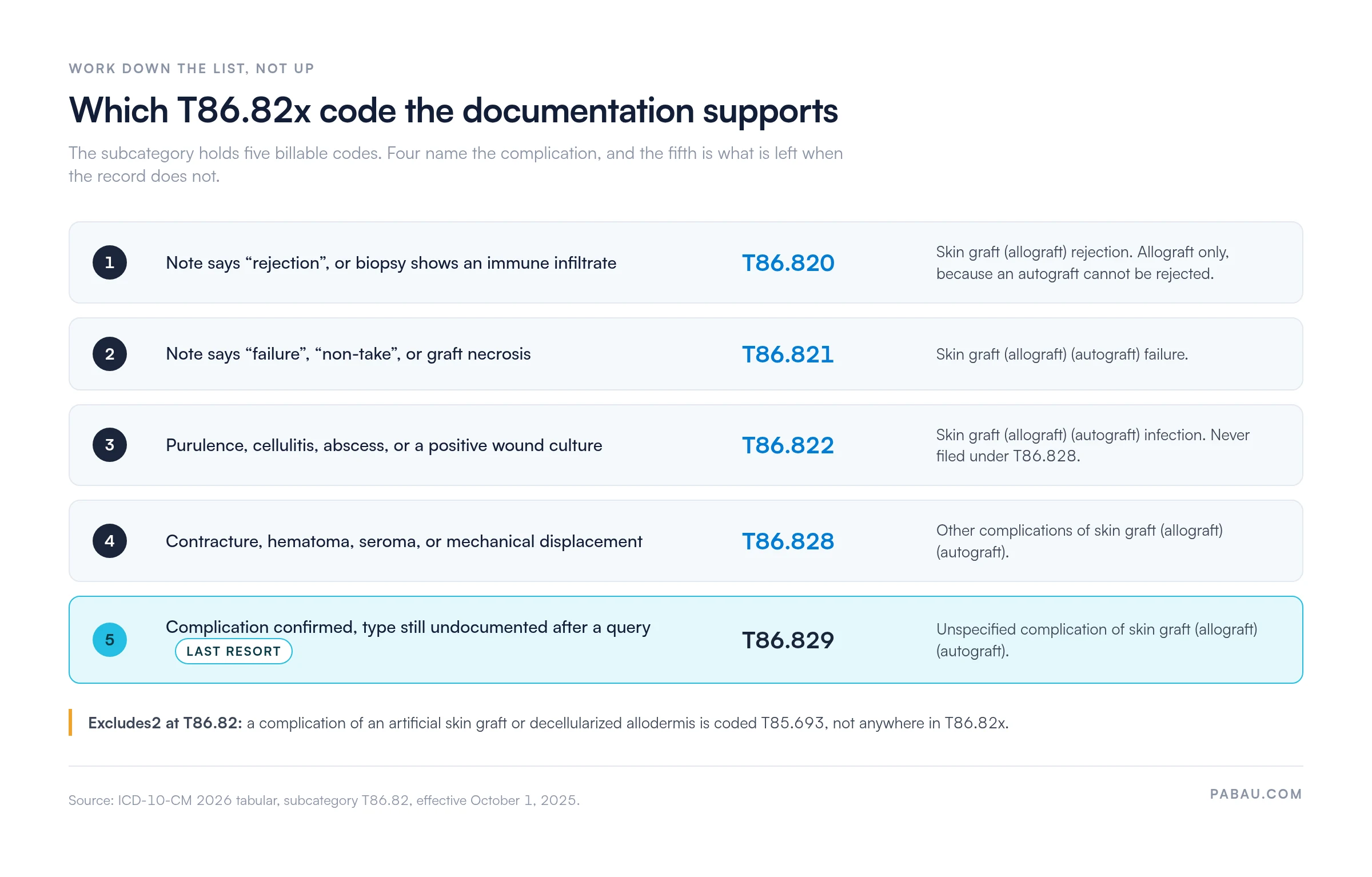
T86.829 applies when a post-graft complication is clinically evident but the physician’s documentation does not characterize it as rejection, failure, or a separately named problem.
The ICD-10-CM Official Guidelines for Coding and Reporting are clear: coders select the most specific code supported by documentation. T86.829 is only appropriate when that specificity is genuinely absent, not when the coder has not yet queried the physician.
Practices can cut unspecified code usage by adding structured complication fields to post-operative note templates. A field that asks for the complication type prompts the provider to name it at the point of care. The scenarios below show when T86.829 is and is not appropriate.
Before defaulting to T86.829, send a clinical documentation improvement (CDI) query to the treating physician. Ask one question: does this graft complication represent rejection, failure, infection, or another specific finding? Most providers can clarify the type in a brief addendum. That addendum supports a specific sibling code and lowers the audit risk that follows a pattern of unspecified codes.
Assigning ICD-10 code T86.829 requires the medical record to satisfy several documentation criteria. Missing any of them exposes the claim to denial or audit scrutiny. Five criteria carry the code, and the first two decide whether it is the right choice at all.
T86.829 vs T86.821 is the comparison coders make most often, because graft failure and unspecified complication read alike in early post-operative notes.
Infection is the sibling most often lost, since a documented graft infection has its own code in T86.822 and never belongs in T86.828. The table below covers all five codes and says when NOT to use each one.
The graft source does not change the ICD-10 code at the T86.82x level. ICD-10-CM does not split skin graft complications by source within this subcategory, so donor tissue and the patient’s own tissue share the same codes.
The parenthetical “(allograft) (autograft)” in the official titles of T86.821, T86.822, T86.828, and T86.829 confirms it. T86.820 is the exception, and its official title reads “Skin graft (allograft) rejection” with no autograft parenthetical.
The clinical distinction between the two graft types remains important for documentation and care planning, even though it does not alter the ICD-10-CM code assigned.
The parenthetical notation is easy to misread. A coder who is unfamiliar with graft biology may query the physician about the graft source. The complication type is the detail that changes the code. Only T86.820 carries the source in its title, and that is because an autograft cannot be rejected.
ICD-10-CM takes a similar approach to corneal grafts. Failure of a transplanted cornea codes to T86.841 whether the surgeon performed penetrating keratoplasty, DSAEK or DMEK.
Three administrative factors govern how T86.829 affects reimbursement and hospital coding compliance. Each carries a different practical consequence for the coding team.
Practices submitting claims electronically can route T86.829 through the Claim.MD clearinghouse integration in practice management software like Pabau. It screens diagnosis codes against payer edits before submission and flags rejections in real time.
POA-exempt status means hospital coders do not need to assign a POA indicator when T86.829 appears on an inpatient claim.
Transplant complication codes are typically exempt because the complication arises from a prior procedure by definition. That makes a “present on admission” determination clinically meaningless. Verify the FY2026 CMS POA exempt code list at cms.gov before you make coding decisions.
Confirm HCC mapping for T86.829 against the current CMS HCC model version, v28 or later, because mappings change annually. Older crosswalk tables go stale quickly.
A positive mapping raises the risk-adjustment factor for Medicare Advantage patients, which affects capitation payments to the plan. Pabau’s claims management software ties that coding decision to the claim that carries it.
Unspecified codes draw auditor attention precisely because they are easy to abuse. The errors below account for most T86.829 denials and audit flags in dermatology and burn treatment billing. The last one turns on the line between the diagnosis and the graft procedure, which carries its own entry such as CPT code 15200.
Build a physician query template for the T86.82x codes that asks three questions. First, is the skin graft complication best described as rejection, failure, infection, or another named finding? Second, was the graft an allograft or an autograft? Third, is a secondary condition documented that needs its own code? A standardized query cuts the back-and-forth and shortens the claim cycle.
The unspecified-code problem usually surfaces after the denial arrives. The claim goes out with T86.829, the payer questions the specificity, and a coder re-opens a note that was already vague three weeks ago. By then the provider is working from memory.
Pabau keeps that decision next to the clinical record. Post-operative templates can require the complication type before the note is signed, so the chart supports T86.820, T86.821, or T86.822 when one of them applies. Coders then read a named complication instead of guessing at one.
Claims leave through the Claim.MD integration, which screens diagnosis codes against payer edits before submission. A pattern of unspecified graft codes surfaces while a query can still fix it. Fewer complication claims come back denied, and rework stays low.

Pabau’s practice management platform integrates with Claim.MD to validate diagnosis codes before submission, reducing denials on transplant complication claims and skin graft procedure billing.

ICD-10 code T86.829 is a legitimate, billable code for unspecified skin graft complications. Assign it once the four specific siblings have been ruled out: rejection, failure, infection, and other named complications. Post-graft notes are often written before the complication type is characterized, so treat T86.829 as a placeholder that a physician query can usually resolve.
For dermatology and plastic surgery practices, the payoff from specificity reaches past audit defense. Accurate T86.82x coding supports cleaner HCC risk adjustment and a more defensible claim record.
Pabau connects to the Claim.MD clearinghouse and screens ICD-10 codes against payer edits before submission. An unspecified pattern surfaces while a query can still fix it. Book a demo to see how graft complication coding holds up across a full claim cycle.

Need a structured framework for billing code accuracy? What is revenue cycle management explains how ICD-10 coding accuracy feeds into the broader claim-to-payment process.
Working with Medicare Advantage risk adjustment? Medical billing compliance covers how HCC mapping and diagnosis documentation affect risk-adjustment scores.
Looking to reduce claim denials on complication codes? Denial codes in medical billing breaks down the most common denial reasons and how to prevent them.
ICD-10 code T86.829 is the billable diagnosis code for unspecified complication of skin graft (allograft) (autograft). Coders use it when documentation confirms a post-graft complication but does not name the type. It applies to donor grafts and to the patient’s own tissue. Assign a specific sibling instead whenever the record supports one: T86.820 rejection, T86.821 failure, T86.822 infection, or T86.828 other specified complications.
The T86.82 subcategory contains five billable codes. They are T86.820 rejection, T86.821 failure, and T86.822 infection. The last two are T86.828 other complications of skin graft and T86.829 unspecified complication of skin graft. The subcategory code T86.82 itself is not billable, so a claim must carry one of the five children.
Yes, T86.829 is a billable and specific ICD-10-CM code valid for reimbursement. It is accepted on CMS-1500 and UB-04 claim forms for the 2026 edition, effective October 1, 2025. Being billable means it can be submitted as a standalone diagnosis code on a claim. Payer-specific coverage policies still apply.
T86.821 is skin graft failure, used when the physician documents that the graft did not integrate, showed necrosis, or failed to take. T86.829 is the unspecified version, used only when a complication is confirmed but no type is documented. If the record contains failure language, T86.821 is correct and T86.829 should not be assigned.
T86.820 is skin graft rejection, an immune-mediated response in which the host body attacks donor tissue. T86.829 is unspecified complication, used when the type is undocumented. Rejection needs documentation of an immune mechanism, or the physician’s use of the word “rejection”. Note that the official title of T86.820 covers allografts only, because an autograft cannot be rejected immunologically.
An infected skin graft is coded T86.822, skin graft (allograft) (autograft) infection. It is a billable code. Use it when the record documents purulence, cellulitis, an abscess, or a positive wound culture at the graft site. Do not file a documented graft infection under T86.828 or T86.829, since both are less specific and invite payer questions. Add a code for the organism when the record identifies one.
No, T86.829 does not require a 7th character. It is a complete 6-character code. The T86 category covers transplant complications rather than traumatic injuries. The episode-of-care extensions used in S00-S99 injury codes, such as A, D, and S, therefore do not apply here.
T86.829 is likely POA exempt, so hospital coders typically do not assign a Present on Admission indicator on inpatient claims. Verify that against the current FY2026 CMS POA exempt code list. On HCC mapping, T86.829 may map to a Hierarchical Condition Category affecting Medicare Advantage risk adjustment. Confirm it against the current CMS HCC model, since mappings change with annual model updates.