ICD-10 Code R34: Anuria and oliguria
ICD-10 Code R34 is the billable ICD-10-CM diagnosis code for anuria and oliguria...

Last Updated: Oct 6, 2026
Billable Code Specific Code
T31.76 is the billable ICD-10-CM code for burns involving 70-79% of body surface with 60-69% third degree burns.
According to the Centers for Medicare and Medicaid Services (CMS), ICD-10-CM is updated annually on October 1. The FY2026 edition, effective October 1, 2025, confirms T31.76 as a valid billable code.
Let Pabau's smart automation suggest the right codes, reduce claim denials, and keep your practice compliant—effortlessly.
Automate repetitive tasks and focus on what matters most—your patients.
Reduce coding errors and ensure compliance with the latest regulations.
Clean claims, fewer denials, and faster reimbursements.
Powerful insights and reporting to help your practice thrive.
HIPAA compliant SOC 2 certified GDPR-compliant Trusted by 4,000+ clinics worldwide

ICD-10 Code T31.76 covers burns involving 70-79% of body surface with 60-69% third-degree burns, effective October 1, 2025.
T31.76 is billable on a claim, while its parent code T31.7 is not.
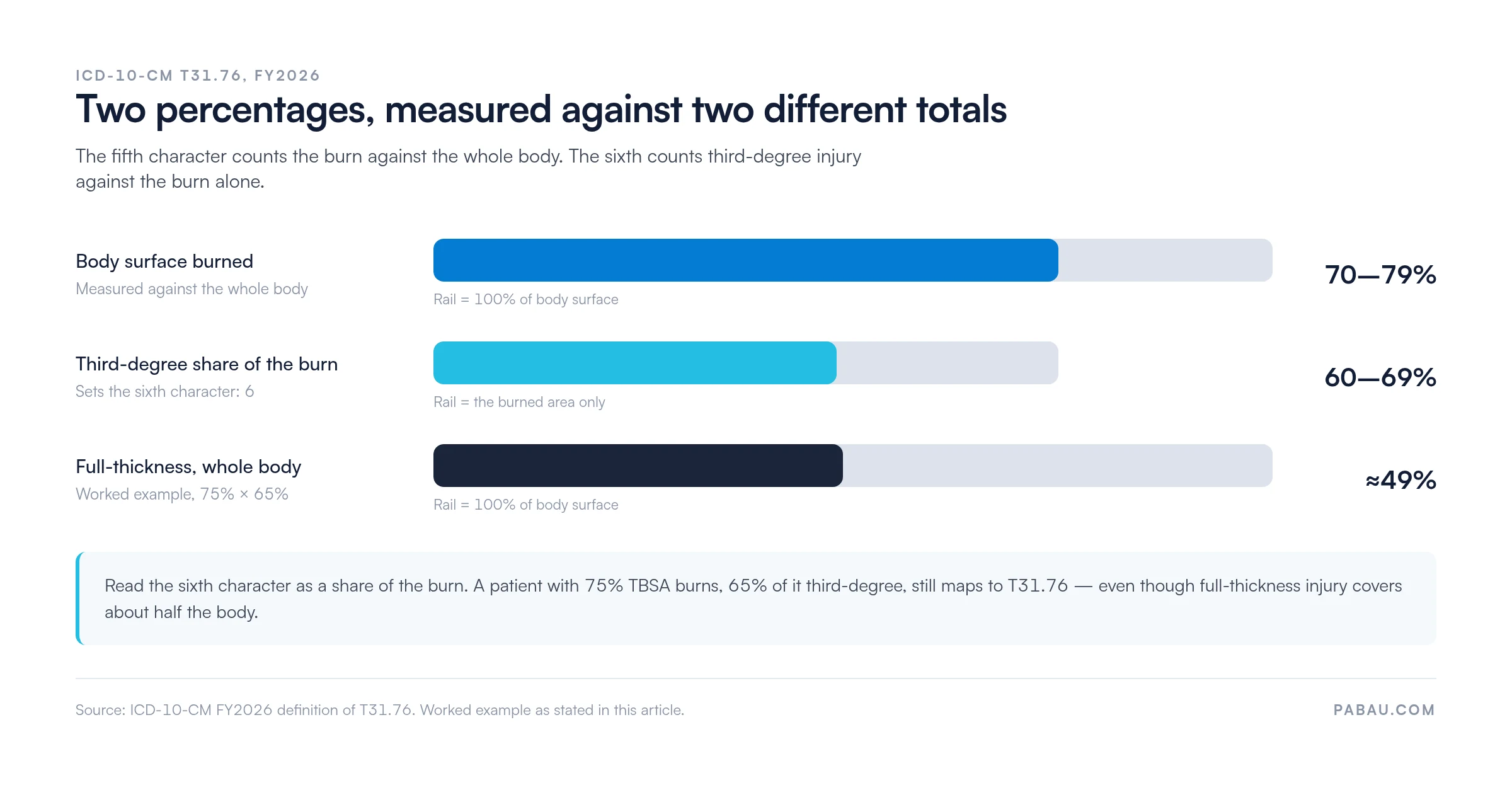
The sixth character measures third-degree injury against the burned area, not against the whole body.
Documentation must state the TBSA percentage, the third-degree share, the body regions burned, and the cause of injury.
Practice management software like Pabau submits and tracks these claims once the record holds the required detail.
T31.76 is a billable, specific ICD-10-CM code. It can be used directly on a claim for reimbursement. Below is the at-a-glance reference coders need most.
The alphanumeric structure of T31.76 encodes three distinct clinical concepts in six characters. Each segment tells a payer something precise about the injury.
The two figures do not share a denominator. The fifth character measures the burn against the whole body. The sixth measures third-degree injury against the burned area alone. Miss either figure and the code cannot be supported on audit.
The T31 category classifies burns by extent of body surface involved, not by site or cause. It runs from T31.0 (less than 10% TBSA) through T31.9 (90% or more TBSA). Many severe burns therefore need two codes, because a T20-T25 code records the site and a T31 code records the extent.
T31.76 sits within the T31.7 subcategory for 70-79% TBSA. It is one of ten codes there, separated only by the sixth character. That character records the third-degree share, which the next section sets out in full.
Selecting T31.76 requires a documented TBSA calculation. Two validated methods are in clinical use, the Rule of Nines and the Lund-Browder chart. The WHO ICD-10 classification does not mandate a measurement tool. But the documented figure has to sit in the clinical record to justify the code.
The Rule of Nines divides the adult body into regions, each representing 9% of total body surface area (or multiples of 9%). Head and neck: 9%. Each arm: 9%. Each leg: 18%. Anterior trunk: 18%. Posterior trunk: 18%. Perineum: 1%. To reach 70-79% TBSA, a burn would typically involve the entire trunk plus both legs, or equivalent combinations.
The Lund-Browder chart adjusts for age-related body proportion differences, making it more accurate for pediatric patients. Burns of 70-79% TBSA in a child require this chart for defensible documentation. Either method is acceptable provided the clinician records the figure in the patient record.
Both figures must appear in physician documentation before the coder assigns T31.76. Query the provider if either value is missing rather than making an assumption.
The sixth digit in the T31.7x subcategory specifies what proportion of the total burn area involves third-degree (full-thickness) injury. This is where T31.76 gets its clinical specificity. Third-degree burns destroy all layers of the dermis and often extend into subcutaneous tissue, requiring grafting and long-term reconstructive care.
Grafting carries its own coding trail. Surgical preparation of the recipient site on the trunk, arms, or legs is reported with CPT code 15002.
T31.76 sits at the 60-69% third-degree mark. A patient with 75% TBSA burns where 65% of that area is full-thickness maps precisely to this code. Document both figures in the attending physician’s note before assigning.
Always verify both the TBSA percentage and the third-degree percentage from the attending physician’s note before assigning T31.76. If the documentation states ‘70% TBSA burns’ without specifying depth distribution, query the provider. Assigning T31.70 (no third-degree) when third-degree injury exists understates case severity and may trigger a payer audit.
Per the ICD-10-CM Official Guidelines for Coding and Reporting, T31.76 is used alongside site-specific burn codes rather than as a standalone replacement. The sequencing hierarchy below is what keeps these claims from coming back.
T31 codes apply to thermal burns (heat, flame, radiation, electricity, friction). T32 codes are the parallel category for corrosions (chemical burns). If a patient sustains chemical burns covering 70-79% TBSA with 60-69% third-degree involvement, the correct code is T32.76, not T31.76. The cause of injury determines which category applies.
When both a site-specific code and an extent code apply, the site-specific code from T20-T25 is sequenced first. In most inpatient encounters it becomes the principal diagnosis. T31.76 follows as an additional code capturing total burn extent. That pairing supports DRG assignment and reflects the severity of the case.
Assign an external cause code (from the X00-X19 range or similar) to identify the mechanism of injury. For example, X00 codes cover exposure to uncontrolled fire. This is not always required for reimbursement, but per ICD-10-CM guidelines, external cause codes should be assigned to the full extent possible when reported.
Burns of this extent frequently involve secondary diagnoses. Assign additional codes for sepsis, infections, fluid imbalance, inhalation injury, or any other documented complication. Each complication code must be supported by the physician’s documentation. Do not infer a complication from clinical notes alone.
This is where claims for burns coded under ICD-10 Code T31.76 most commonly fail. The elements below have to be present in the physician’s record. A coder cannot infer them from nursing notes or operative reports alone.
Burns coded to ICD-10 Code T31.76 typically represent critical care admissions with high resource intensity. Claims for these encounters usually group under the major burn DRGs, and payers scrutinize them for documentation quality.
Practice management software like Pabau connects to the Claim.MD clearinghouse for electronic claim submission across thousands of US payers. Burn center billing teams can submit CMS-1500 and 837P claims and receive electronic remittance advice as 835 files. Tracking the medical billing denial codes that come back is what shortens the appeal cycle.
Per the CDC/NCHS ICD-10-CM web tool, T31.76 is valid for FY2026 encounters (discharges and outpatient encounters on or after October 1, 2025). Verify code validity annually, as ICD-10-CM updates occur every October 1.
Coders working with T31.76 regularly cross-reference adjacent codes in the T31.7x subcategory. The AAPC ICD-10-CM code lookup provides a searchable reference for the full T31 hierarchy. Below are the immediately adjacent codes and their descriptions.
The following alternate descriptions and approximate synonyms are recognized for ICD-10 Code T31.76. These appear in clinical documentation, charge capture notes, and coding software queries.
Burns involving 70-79% TBSA with a majority of full-thickness injury represent some of the most resource-intensive cases in acute care. ICD-10 Code T31.76 applies in a defined set of clinical scenarios.
Burn centers tracking outcomes and resource use rely on accurate T31-coded data. Understating burn extent through the wrong T31 code lowers the severity the claim reports, and the reimbursement with it.
Burn center coders: query the treating physician if documentation states ‘70% TBSA burns’ without specifying depth. A query resolves to either T31.70 (no third-degree) or a more specific T31.7x code. Defaulting to T31.70 when third-degree injury is present misrepresents case severity and can trigger a compliance review.
In most burn units the coder finds the missing depth figure after the encounter closes. The claim then waits on an email or a phone call to the attending physician. Days pass before the record says what the sixth character needs.
Pabau’s claims management software keeps the clinical record and the claim in one system. The TBSA figure and the depth split are recorded in structured fields at the point of care. Coding stays with the coder, who reads that note and assigns T31.76 from it.

The billing team then submits and tracks the claim from the same record, without retyping payer detail into a separate portal. Fewer retrospective queries reach the physician, and fewer claims come back asking what the burn extent was.

Pabau’s claims management tools help burn units and critical care teams submit accurate, documentation-supported claims for complex ICD-10 codes like T31.76. Book a demo to see how it works.

Two figures decide this code, and they answer to different totals. Get the TBSA percentage and the third-degree share into the physician’s note, and T31.76 stops being a coding judgment call. Sequence it behind the T20-T25 site codes and the claim reports the severity the case carried.
The query to the attending physician is cheaper than the appeal, every time. Book a demo to see how Pabau keeps burn documentation and claim submission in one record.

Need the wider billing picture behind these codes? What is medical billing walks through the claim lifecycle from encounter to payment.
Curious how clearinghouse billing works end to end? Medical claims clearinghouse overview explains how electronic claims flow from practice to payer and what happens when a claim is rejected.
Want to reduce claim denials on complex cases? Denial codes in medical billing breaks down the most common CARC codes and how to respond to each one.
ICD-10 Code T31.76 describes burns involving 70-79% of total body surface area (TBSA). Within that burned area, 60-69% is third-degree, or full-thickness, injury. It belongs to the T31 category, which classifies burns by extent rather than by anatomical site. The code took effect on October 1, 2025 under the FY2026 ICD-10-CM edition.
Yes. T31.76 is a billable, specific ICD-10-CM code that can go straight onto a claim. Its parent code T31.7 is not billable on its own, because it stops at the TBSA band. T31.76 adds the third-degree share, which is the specificity a payer needs. It is valid for encounters on or after October 1, 2025.
T31 codes classify thermal burns by total body surface area. Those are burns caused by heat, flame, radiation, electricity, or friction. T32 codes are the parallel category for corrosions, which are chemical burns. A chemical injury covering 70-79% TBSA with 60-69% third-degree involvement is coded T32.76, not T31.76. The cause of injury decides which category applies.
TBSA is calculated with the Rule of Nines or the Lund-Browder chart. The Rule of Nines divides the adult body into 9% segments. Lund-Browder adjusts for age-related proportions, which makes it more accurate for children. The physician documents the resulting percentage in the medical record. Coders should not calculate TBSA from body diagrams themselves, so a physician query is needed when the figure is absent.