ICD-10 Code Y76.0: Diagnostic obstetric and gynecological devices
ICD-10 Code Y76.0: Definition and billable status ICD-10 Code Y76.0 is a valid, ...

Last Updated: Oct 23, 2026
Billable Code Specific Code
T31.72 is the billable ICD-10-CM code for burns involving 70-79% of body surface with 20-29% third degree burns.
Two separate percentages drive the selection, and neither one can be inferred from the other. It also covers how T31.72 is sequenced against the T20-T25 site codes.
Let Pabau's smart automation suggest the right codes, reduce claim denials, and keep your practice compliant—effortlessly.
Automate repetitive tasks and focus on what matters most—your patients.
Reduce coding errors and ensure compliance with the latest regulations.
Clean claims, fewer denials, and faster reimbursements.
Powerful insights and reporting to help your practice thrive.
HIPAA compliant SOC 2 certified GDPR-compliant Trusted by 4,000+ clinics worldwide

T31.72 is a billable ICD-10-CM code for burns covering 70-79% TBSA with a 20-29% third-degree component, valid for FY2026 reimbursement.
Two percentages must be documented: Total burn extent (TBSA) and the third-degree portion. Both are required to select T31.72 over its sibling codes.
T31.72 is sequenced as a secondary code alongside the applicable T20-T25 site-specific burn code. It stands as the primary code only when the burn site is unspecified.
Companion codes for external cause (X00-X19, X75-X77, X96-X98, Y92) and smoke inhalation (J70.5) are instructional notes within the T31 category. Report them when clinically present.
Pabau’s claims management software supports accurate burn code submission with built-in ICD-10 catalogs and Claim.MD clearinghouse integration for US payers.
ICD-10 code T31.72 is a billable, specific ICD-10-CM diagnosis code valid for reimbursement purposes in the FY2026 edition. It became effective on October 1, 2025, and is unchanged from the prior fiscal year. The code is classified as specific, meaning it carries enough detail to go on a claim without a more granular child code beneath it.
ICD-10-CM is maintained jointly by the Centers for Medicare and Medicaid Services (CMS) and the Centers for Disease Control and Prevention (CDC). Code updates follow an annual release cycle, with FY2026 codes active from October 1, 2025 through September 30, 2026. Before a burn claim goes out, confirm the code’s position in the hierarchy and its companion code obligations.
T31.72 sits within the T31 category, which classifies burns according to the total body surface area involved rather than by anatomical location. The T31 category is part of the broader S00-T88 chapter covering injury, poisoning, and certain other consequences of external causes.
The parent code T31.7 covers all burns in the 70-79% TBSA range. The fifth character then specifies the third-degree percentage. Within T31.7, the siblings start at T31.70 for a 0% third-degree component and run through T31.79. Each step up the fifth character represents a higher proportion of full-thickness injury. A parent code is never submitted on its own when a more specific child code applies.
T31.72 describes a patient who has sustained burns across 70 to 79 percent of their total body surface area. Of that burned area, 20 to 29 percent is third degree, or full thickness. These are catastrophic injuries that usually require intensive care, fluid resuscitation, surgical debridement, and extended inpatient management.
Two distinct measurements drive this code selection:
The distinction matters clinically and for reimbursement. Take two patients, both with 75% TBSA burns. The one with 5% third degree carries a very different surgical and resource burden than the one with 25%. Practice management software like Pabau bundles claims management software with built-in ICD-10 catalogs. Your team can check the selected code against the documented percentages before the claim goes out.

The rule of nines is the standard clinical method for estimating TBSA burned in adults. It divides the body into regions, each assigned roughly nine percent of total surface area or a multiple of it. Accurate TBSA estimation is what separates a clean T31.72 claim from a coding error.
Adding these values produces the patient’s total TBSA. For T31.72 to apply, that sum must fall between 70% and 79%. The clinician then separately documents what fraction of the total burn area is third degree.
Pediatric patients require a modified approach. The Lund-Browder chart redistributes body surface proportions to account for the larger head-to-body ratio in children. Confirm which estimation method the treating clinician used before you rely on the documented percentage for code selection.
Burn depth determines the second axis of T31 code selection: The third-degree percentage that drives the fifth character. The three main depth classifications reflect progressively deeper tissue destruction.
For T31.72, the clinical record must show that 20 to 29 percent of the patient’s burned surface area is third degree. If the documented third-degree component is 30% or higher, the correct code shifts to T31.73 or beyond. First-degree burns are typically excluded from TBSA calculations per American Burn Association guidance, though coders should follow the clinician’s documented methodology.
The pattern continues up the fifth character, all within the same 70-79% TBSA band. A documented third-degree share of 50 to 59 percent makes T31.75 the correct code.
The T31 family covers burns from less than 10% TBSA up to 90% or more, with each subcategory refined further by third-degree percentage. The two numbers work on separate axes, which is quicker to see laid out than to read described.
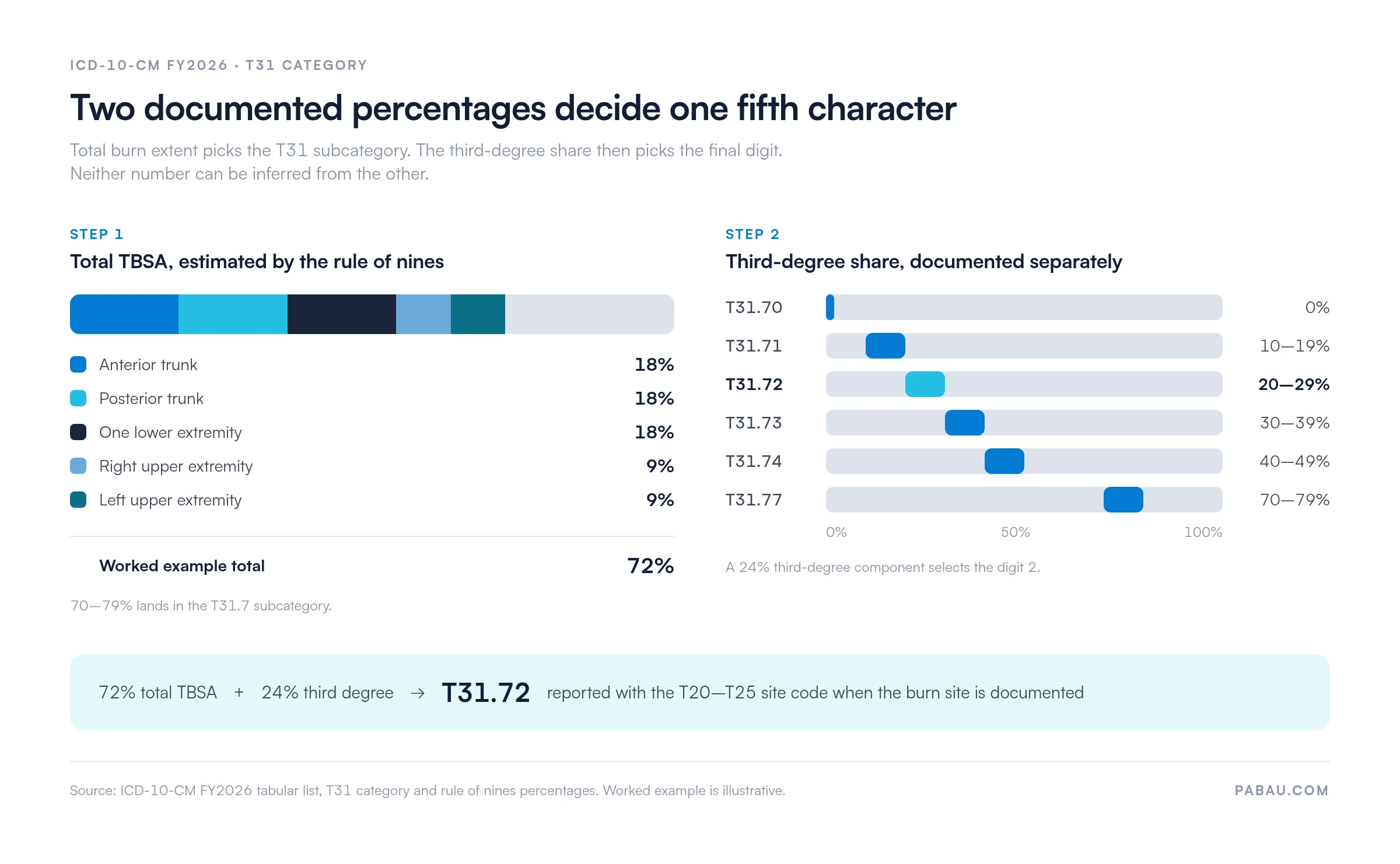
The matrix below shows selected codes across the T31.7 row to illustrate how T31.72 relates to its siblings.
The full T31 matrix spans from T31.0 (less than 10% TBSA) through T31.99 (90% or more TBSA with 90% or more third degree). Each subcategory row corresponds to a TBSA range, and each column to a third-degree percentage range. The AAPC ICD-10-CM code lookup carries the full T31 matrix for reference.
When coding any T31 burn, read the TBSA row first. Confirm the total percentage documented by the clinician falls in the 70-79% range before you touch the fifth character. Then verify the third-degree component against the same note. Checking one axis and assuming the other is how T31.71 gets submitted when T31.73 is correct.
Sequencing comes before anything else. T31.72 is reported as a secondary code alongside the applicable site-specific burn code from T20-T25. That code names where the burn is and how deep it runs. T31.72 stands as the primary code only when the record does not specify the burn site. That instructional note sits at category level, so it governs every code in T31.
The ICD-10-CM tabular list carries further instructional notes within the T31 category that call for additional codes. Omitting one when the clinical circumstances warrant it can trigger a rejection or a request for more documentation.
Each of these comes from a different chapter of the ICD-10-CM code set. A burn encounter usually goes out with three or four diagnosis codes rather than one. Clearinghouse edits catch most companion-code omissions before the claim leaves. Pabau connects to Claim.MD, which supports CMS-1500 and 837P claim formats and reaches thousands of US payers.
The clinical record has to carry specific elements for T31.72 to hold up on audit. Where one of them is missing, the coder has nothing to work from and the encounter goes back to the clinician as a query.
Facilities managing large burn caseloads benefit from structured burn admission templates that prompt clinicians to document TBSA and depth systematically. That structure keeps the record audit-ready and cuts the retrospective queries that slow high-acuity case coding to a crawl.
T31.72 is one of the more commonly miscoded entries in the T31 family because it demands precision on two separate numeric axes. An error on either axis moves the claim to a different code with a different severity profile.
Chasing a denial after the fact costs far more than checking the note before submission. A pre-submission checklist tied to T31 codes, run inside a practice management system, catches most of these errors at the point of coding. A clean burn claim needs three things: The correct T31.7x code, the applicable companion codes, and the supporting clinical documentation on file. Good denial management in healthcare starts with checking all three.
Run a payer-specific edit check on every T31 claim before submission. Some payers require a particular external cause code format. Others flag T31.70 for medical necessity review when the total TBSA runs above 60%. Knowing those edits in advance saves the whole denial turnaround cycle.
On paper, burn coding happens twice. A coder reads the admission note and hunts for two percentages that often sit in different paragraphs. When one of them is missing, the clinician gets a query. By the time the answer comes back, the encounter has closed and the claim is already late.
Pabau keeps the documentation and the claim in the same system. Charting templates prompt for total TBSA, the estimation method, the burn site, and the third-degree share at the point of care. The ICD-10 catalog is built in, so your coder selects T31.72 against the note instead of from memory.
Claims then run through the Claim.MD clearinghouse with payer-specific edits applied before they go out. A missing external cause code or an absent T20-T25 site code gets flagged while the encounter is still open. So your billing team fixes the claim once, instead of working a denial three weeks later.

Pabau integrates with Claim.MD to support accurate ICD-10 burn code submission across thousands of US payers. Built-in code catalogs and automated claim checks reduce companion-code omissions before submission.

Coding T31.72 comes down to two numbers the clinical record has to supply. The first is a total TBSA in the 70-79% range. The second is a third-degree component of 20-29%, documented separately. Miss either one and the claim carries the wrong code, or it cannot be coded without a clinician query.
Then check the sequencing. Where the note names the burn site, T31.72 rides behind a T20-T25 code rather than leading the claim. Fix the documentation upstream and the coding stops being the hard part.
Pabau pairs built-in ICD-10 catalogs with pre-submission edit checks across thousands of US payers, so burn claims leave the practice complete. Book a demo to see how Pabau handles high-acuity billing from admission note to remittance.

Need guidance on how medical billing compliance applies to burn injury claims? Medical billing compliance for healthcare practices covers audit-readiness, documentation standards, and payer-specific requirements.
Want to understand how a clearinghouse processes burn injury claims? How a medical claims clearinghouse works explains the 837P submission path, real-time eligibility, and ERA handling.
Looking for guidance on structuring a burn patient superbill? What goes on a superbill walks through the ICD-10 and CPT fields required for complete claim submission.
ICD-10 code T31.72 is the billable diagnosis code for burns covering 70 to 79 percent of total body surface area. Of that burned area, 20 to 29 percent is third degree, or full thickness. It is valid for FY2026 reimbursement, effective October 1, 2025.
Yes, T31.72 is a billable and specific ICD-10-CM code. It can go on a claim without a more granular child code beneath it, and it is valid for reimbursement under the FY2026 ICD-10-CM edition.
T31.71 covers burns involving 70-79% TBSA with a 10-19% third-degree component. T31.72 covers the same total TBSA range with a higher third-degree component of 20-29%. The total burn extent is identical. Only the documented proportion of full-thickness injury moves the fifth character.
ICD-10-CM instructional notes for the T31 category require a code for the external cause of burn, from ranges X00-X19, X75-X77, X96-X98, or Y92. Smoke inhalation is reported with J70.5 when clinically present. T31.72 is also sequenced as a secondary code alongside the applicable T20-T25 site-specific burn code. Report an infection code as well if the burn wound is infected.
Adults use the rule of nines: Head and neck 9%, each arm 9%, anterior trunk 18%, posterior trunk 18%, each leg 18%, and perineum 1%. For pediatric patients, the Lund-Browder chart redistributes proportions to account for a child’s larger head-to-body ratio. The documented method must match the percentage used in code selection.
T31.72 became effective on October 1, 2025 under the FY2026 ICD-10-CM edition. The code is unchanged from the prior fiscal year, and it applies to encounters from October 1, 2025 through September 30, 2026.
The parent code for T31.72 is T31.7, which covers all burns involving 70-79% of body surface without specifying the third-degree component. T31.7 is not billable on its own. A fifth-character code such as T31.72 is required for claim submission.