ICD-10 Code S52.101P: Right radius fracture with malunion
ICD-10 Code S52.101P: definition and code details ICD-10 Code S52.101P is a bill...

Last Updated: Oct 19, 2026
Billable Code Specific Code
T23.052D is the billable ICD-10-CM code for burn of unspecified degree of left palm, subsequent encounter.
The code became effective on October 1, 2025 as part of the 2026 ICD-10-CM update. It is valid for use in HIPAA-covered transactions for reimbursement purposes. "Unspecified degree" means the documentation does not state whether the burn is first, second, or third degree. It does not mean the burn is minor.
Let Pabau's smart automation suggest the right codes, reduce claim denials, and keep your practice compliant—effortlessly.
Automate repetitive tasks and focus on what matters most—your patients.
Reduce coding errors and ensure compliance with the latest regulations.
Clean claims, fewer denials, and faster reimbursements.
Powerful insights and reporting to help your practice thrive.
HIPAA compliant SOC 2 certified GDPR-compliant Trusted by 4,000+ clinics worldwide

ICD-10 code T23.052D describes a burn of unspecified degree of the left palm, subsequent encounter. It is a billable ICD-10-CM code valid for FY2026 reimbursement.
The 7th character ‘D’ designates a subsequent encounter. Use it for any visit where active wound management continues after the initial evaluation.
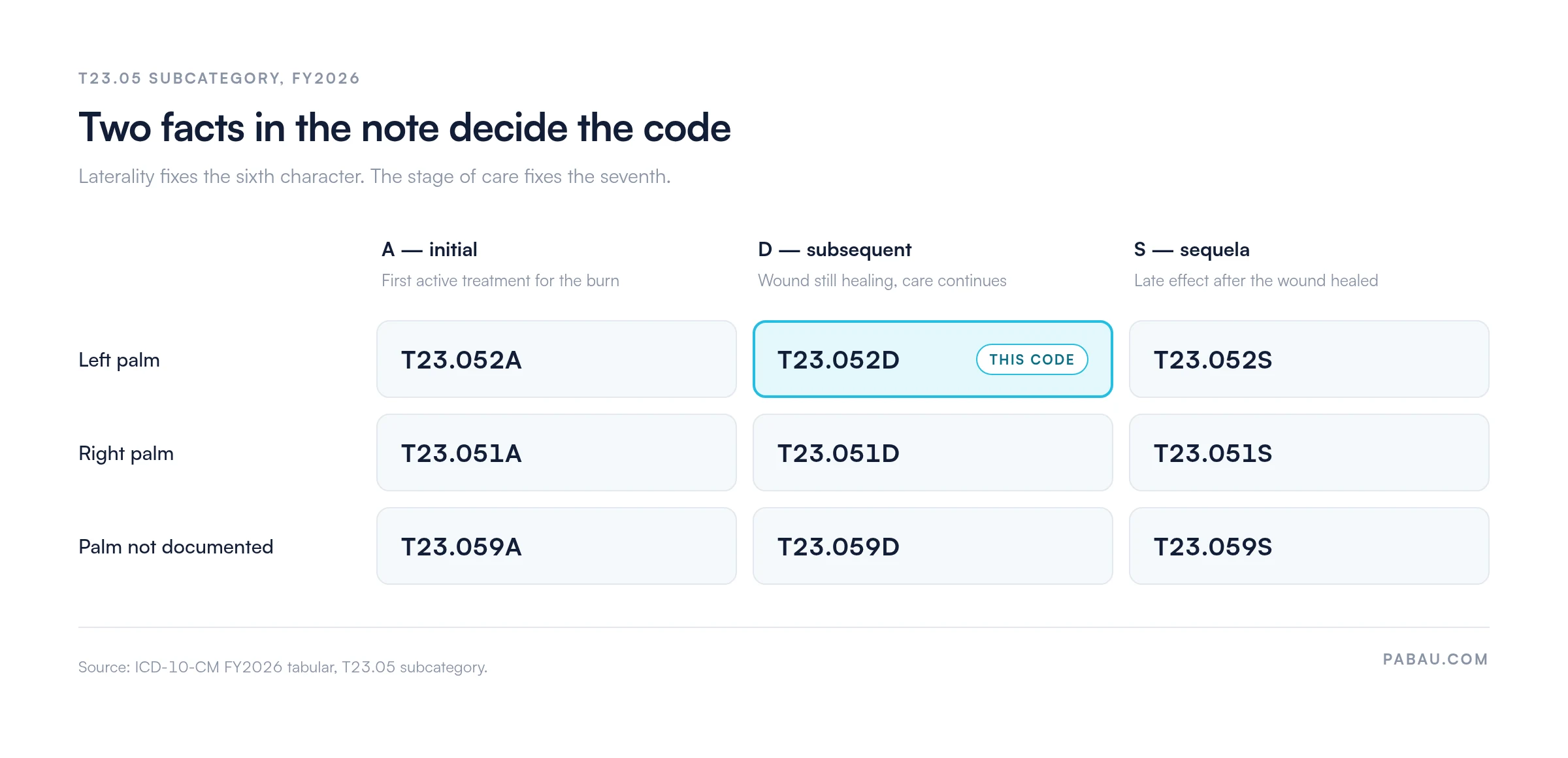
T23.052D applies to the left palm only. T23.051D covers the right palm, and T23.059D covers unspecified laterality.
Practice management software like Pabau integrates with Claim.MD to validate ICD-10 codes, check payer eligibility, and submit burn claims electronically.
The anatomical site is the palmar surface of the left hand. It excludes the dorsum, the fingers, the thumb, and the wrist. Burns to the palm are clinically significant because the palm holds dense sensory nerve endings and flexor tendon structures. Damage at any depth can impair grip and fine motor function.
“Unspecified degree” does not imply a trivial injury. It means the provider did not document the burn degree, or the depth was clinically indeterminate at the encounter.
Per the CMS ICD-10-CM coding guidelines, coders assign the highest degree of specificity the documentation supports. When degree is genuinely absent from the note, unspecified codes like T23.052D are the correct choice.
The ICD-10-CM hierarchy for this code breaks down as follows:
The same specificity rule runs through the whole T20-T25 range, so always code to the level of detail the record supports. Our complete ICD-10-CM code index lists the neighboring burn subcategories if a second site turns up in the note.
The 7th character is the most commonly misapplied element in injury coding. For T23.052D, the ‘D’ signals a subsequent encounter. The patient is receiving ongoing active treatment for the burn after the initial visit was coded.
The ‘D’ character applies whenever the wound is still healing and active treatment continues. That includes a wound care nurse performing a routine dressing change.
Selecting ‘A’ for a third or fourth follow-up visit is a common denial trigger. It tells the payer a new injury occurred rather than ongoing care for the same burn.
Document the encounter type explicitly in the clinical note. A note reading ‘patient returning for wound check and dressing change of left palm burn’ gives the coder what they need. That phrasing points to T23.052D rather than T23.052A or T23.052S.
The T23.052 family covers all encounter types for unspecified-degree burns of the left palm. Related codes extend to the right palm and to unspecified laterality. Knowing the full sibling set prevents the laterality and encounter-type errors that trigger automatic edits.
The AAPC ICD-10-CM code lookup confirms these sibling codes and their billable status. Always verify laterality against the clinical note before choosing between T23.052D and T23.051D, because payers apply automatic edits for laterality mismatches.
The grid below pairs each laterality with each stage of care, so the right code falls out of two documented facts.
The ICD-10-CM tabular includes “Applicable To” notes at the T23 category and subcategory levels. These tell coders which clinical presentations fall within the code’s scope and which do not.
Under T23.052D, the Applicable To notes from the parent category indicate:
“Applicable To” notes are official inclusions, not optional guidance. If the clinical scenario matches one of them, the code applies.
T23.052D carries “Use Additional Code” instructions. These are mandatory when the relevant clinical information is documented. Omitting them can result in incomplete claims or audit findings.
External cause codes are not always required by payers, but CMS expects them on inpatient claims. Include them whenever the documentation describes the mechanism, the place, and the activity in enough detail.
For inpatient hospital billing, ICD-10 code T23.052D maps to MS-DRG groupings under the CMS MS-DRG Definitions Manual. The assignment depends on whether a major complication or comorbidity (MCC) or a complication or comorbidity (CC) is present as a secondary diagnosis.
Payment rates vary by facility, payer contract, and fiscal year. Never quote a DRG dollar amount without checking the current CMS rate table.
For outpatient wound care, the procedure code on the claim drives reimbursement rather than the ICD-10 diagnosis. A dressing change or selective debridement carries its own code, and CPT 97597 is the one that pairs most often with burn follow-up visits.
The ICD-10-CM Official Guidelines for Coding and Reporting (Section I.C.19) governs burn code assignment. Four rules bear directly on T23.052D.
The first two rules work together on a multi-site injury. A documented second-degree burn carries its own code, such as T24.221A for the right knee. That code then sequences ahead of an unspecified-degree burn like T23.052D.
Keeping burn documentation current across follow-up visits reduces the query burden on coders. Structured clinical note templates help, because they prompt the provider to record degree, laterality, and wound status at every visit. The WHO ICD-10 browser holds the international hierarchy that underpins the ICD-10-CM American edition.
Run a monthly claim edit report filtered for T23.052A codes appearing on visits after the initial encounter date. Any T23.052A claim dated more than seven days after the first treatment for the same injury is probably a coding error. Recode it to T23.052D before resubmission.
A burn injury claim spans multiple visits and usually carries more than one code. The primary ICD-10 diagnosis sits alongside external cause codes, wound care procedure codes, and sometimes an infection code. Keeping them aligned across a multi-week wound care episode is where errors accumulate.
Pabau integrates with Claim.MD, our US clearinghouse partner, to validate ICD-10 codes against payer edits before submission. The check covers code validity, payer coverage rules, and real-time eligibility. It catches laterality mismatches and 7th character errors before a claim reaches the payer.
Built-in CPT and ICD-10 catalogues flag an incomplete code set at the point of entry. The coder fixes it before the claim leaves the practice.
Pabau also supports cleaner claims management across CMS-1500 and 837P formats, secondary claims, and corrected claims. That matters when an initial submission used the wrong encounter type. Getting the code set right the first time cuts days in accounts receivable and lowers the denial rate.
Patient records in Pabau link diagnosis codes to individual appointments. A coder reviewing a burn episode can see which visit was coded T23.052A and which follow-ups carry T23.052D. That audit trail shortens the response to a payer documentation request.

Pabau integrates with Claim.MD to validate ICD-10 codes, check payer eligibility, and submit burn injury claims electronically. That cuts denials caused by laterality and 7th character errors.

Burn injury billing fails most often when the 7th character and laterality do not match the clinical record. T23.052D is the right code for a left palm burn follow-up visit. Whether it holds up depends on what the provider documented about the encounter type, the side, and the degree.
One judgment is worth carrying forward. “Unspecified degree” belongs in the record only while the depth is genuinely undocumented. Once the note describes the depth, the specific-degree code takes over at the next visit.
Pabau’s integration with Claim.MD tests these details against payer rules before the claim goes out. Book a demo to see how that check runs against your own burn wound claims.

Need a full burn coding audit trail? Medical billing compliance explains how to document and retain records that support ICD-10 code selection across multi-visit injury episodes.
Unfamiliar with how clearinghouses validate ICD-10 claims? How the Claim.MD clearinghouse works walks through real-time eligibility checks, 837P submission, and ERA reconciliation for US practices.
Tracking denial trends by diagnosis code? Denial codes in medical billing covers the CARC codes payers return when an ICD-10 code fails their edit criteria.
ICD-10 code T23.052D is a billable ICD-10-CM diagnosis code for a burn of unspecified degree of the left palm, subsequent encounter. It is valid for FY2026 reimbursement, effective October 1, 2025. It applies to follow-up visits where active wound treatment continues after the initial encounter was coded T23.052A.
Yes. T23.052D is a billable and specific ICD-10-CM code valid for reimbursement in HIPAA-covered transactions. It sits at the highest level of specificity within the T23.052 family. Submit it on outpatient or inpatient claims whenever the clinical documentation supports it.
T23.052A covers the initial encounter, the first visit where the burn receives active treatment. T23.052D covers every later visit where the wound is still being treated. Using T23.052A on a follow-up visit is a common denial trigger. Payers read it as a new injury.
Use the ‘D’ character whenever the patient returns for wound management, a dressing change, or follow-up evaluation of a burn that is still healing. It applies from the second visit until the wound fully resolves. After that, sequela codes with the 7th character ‘S’ cover any late effects.
Use additional codes for the external cause of the burn (X00-X19), place of occurrence (Y92.-), and activity at the time of injury (Y93.-). Code any documented infection of the burn wound as well. CMS expects these secondary codes on inpatient claims.
Unspecified degree means the provider’s documentation does not state whether the burn is first, second, or third degree. It says nothing about severity, only that the depth was never recorded. When degree is clinically indeterminate or undocumented, coders assign the unspecified degree code and may issue a provider query.
T23.052D maps to the CMS burn DRGs, and a non-extensive burn without an MCC or CC groups to MS-DRG 935. Confirm the assignment with a CMS-certified grouper and the full claim data. Payment rates vary by facility, payer, and fiscal year.