ICD-10 code S61.201A: Open wound of left index finger without nail damage
ICD-10 code S61.201A covers a left index finger wound of unstated type ICD-10 co...

Last Updated: Oct 16, 2026
Billable Code Specific Code
T15.91XD is the billable ICD-10-CM code for foreign body on external eye, part unspecified, right eye, subsequent encounter. The part of the eye stays unspecified. The laterality does not, because the fifth character names the right eye.
Use T15.91XD when the patient returns for follow-up care after active treatment has already been given. Reaching for T15.91XA, the initial-encounter code, is the error payers catch most often on this code.
Let Pabau's smart automation suggest the right codes, reduce claim denials, and keep your practice compliant—effortlessly.
Automate repetitive tasks and focus on what matters most—your patients.
Reduce coding errors and ensure compliance with the latest regulations.
Clean claims, fewer denials, and faster reimbursements.
Powerful insights and reporting to help your practice thrive.
HIPAA compliant SOC 2 certified GDPR-compliant Trusted by 4,000+ clinics worldwide

T15.91XD is a billable ICD-10-CM code for fiscal year 2026, effective October 1, 2025.
The 7th character D means active treatment already happened, so a first removal attempt takes T15.91XA instead.
Only the part of the eye is unspecified here, because the fifth character 1 names the right eye.
When the note identifies the cornea or the conjunctival sac, code T15.01XD or T15.11XD instead.
Practice management software like Pabau pre-fills the CMS-1500 from the patient record and checks required fields before submission.
ICD-10 code T15.91XD is billable, specific, and valid for fiscal year 2026. Its official descriptor reads Foreign body on external eye, part unspecified, right eye, subsequent encounter. Only the part of the eye goes unspecified. The fifth character, 1, names the right eye.
The code lives in Chapter 19 of ICD-10-CM, the injury and poisoning chapter, inside block S00-T88. Payers accept it on the CMS-1500 and the UB-04, and it clears HIPAA-compliant electronic billing.
On a claim, T15.91XD carries the diagnosis and nothing else. The line still needs a matched procedure code, plus a note that shows the patient came back after treatment.
T15.91XD runs to seven characters, and each position narrows the picture. Read them left to right and the code explains itself, which is how coders catch a mistake before submission rather than after a denial.
The X in position 6 is not decoration. ICD-10-CM requires it whenever a code shorter than six characters needs a 7th character extension. Leave it out and you have submitted an invalid code, which payers reject on format alone.
T15.91XD sits at the bottom rung of a four-tier structure. Each tier narrows the clinical picture, from the whole injury chapter down to a single billable code.
A payer asking for the most specific code available is asking about this ladder. If the record names the cornea, the parent moves from T15.9 to T15.0. The follow-up code then becomes T15.01XD for the right eye, T15.02XD for the left, or T15.00XD when no eye is named.
Pick the 7th character from the treatment phase, not the visit count. D applies once active treatment has been delivered and the patient is healing. A third visit can still be an initial encounter if today is the day someone finally removes the object.
That reading comes straight from the CDC/NCHS ICD-10-CM Official Guidelines, which tie D to routine care during healing or recovery.
Here is the quick test. If the note says the object came out at a prior visit and today is a wound check, the code is T15.91XD. If the object is still in the eye and someone is removing it now, the code is T15.91XA.
Say the encounter type in the note itself. A line like ‘returns for follow-up after foreign body removal at the prior visit’ lets the coder assign the D character with confidence. Progress notes that never mention the earlier treatment are the main reason the 7th character comes out wrong.
T15.91XD is the vaguest code in the T15 category. The category covers four anatomical sub-sites and three laterality options. Add the three encounter types and the family runs to 36 billable codes.
Twelve of those carry the subsequent-encounter character. The grid below puts them side by side. You read the right one off the note instead of hunting through the tabular list.
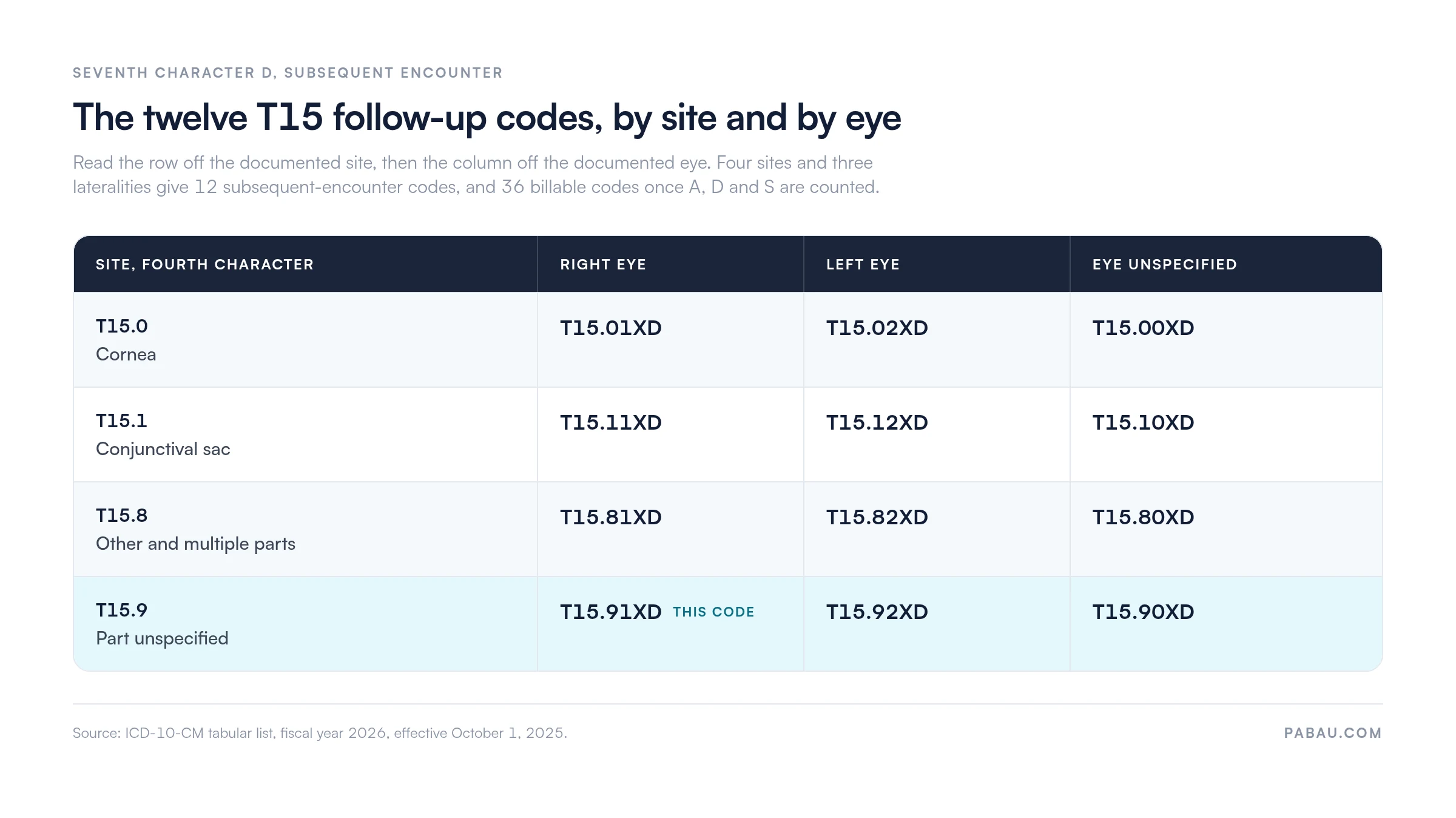
Corneal codes (T15.0x) and conjunctival sac codes (T15.1x) are more specific than T15.9x. Reach for T15.91XD only when the record genuinely cannot place the object. Defaulting to unspecified without reading the note is what draws an audit.
Each group also holds an option for when no eye is named. That is T15.00XD for the cornea, T15.10XD for the conjunctival sac, and T15.80XD for other and multiple parts.
When the part is unspecified too, the code is T15.90XD. You can look any of them up in the ICD-10-CM code index before you submit.
Clinicians rarely write the descriptor word for word. Knowing the recognized synonyms helps when you search an EHR’s code picker, or when you read a narrative note looking for coding support.
The AAPC Codify ICD-10-CM lookup carries more alternate descriptions if you need to cross-check a phrase against the official code set.
Knowing T15.91XD is billable gets you nowhere on its own. The note has to support every qualifier in the descriptor, or a payer can downcode or deny the claim on audit. Five elements do that work.
A note that states the phase and the eye in plain words moves through billing without a coder query. Notes that force someone to infer the phase add review time and raise denial risk.
It helps to picture the route the claim takes. The provider signs the note, a coder assigns the diagnosis, and the charge lands on a CMS-1500 or an 837P file. The clearinghouse then forwards it to the payer.
Format problems bounce back within hours, which is annoying but cheap. Coding problems come back weeks later as a denial, by which time the encounter is cold and nobody remembers the visit. So it pays to run a short check first.
That fourth line is where eye care practices tend to slow down. A follow-up visit with no removal usually bills as an established-patient eye exam. CPT code 92012 is the intermediate level most of these visits land on.
T15.91XD is POA exempt. Present-on-admission reporting exists to separate conditions a patient arrived with from conditions acquired in hospital. An external-cause injury clearly arrived with the patient, so facilities do not report a POA indicator for it.
Two practical notes on that:
The CMS ICD-10 codes page publishes the POA exempt list alongside the tabular updates each October.
The errors on this code repeat themselves, which is good news. Each one has a fix you can build into a workflow.
One incorrect character on a high-volume code multiplies fast. A busy eye care practice can produce dozens of denials in a single billing period from the same habit.
Audit your T15.9x claims once a month. Filter by 7th character and compare how many A, D and S codes you submitted against your encounter notes. A practice that mostly sees foreign body patients at follow-up should show more D codes than A codes. An inverted ratio means coders are reaching for A without checking the record.
Most coders bounce between a lookup site and the billing screen. The code gets read in one window and retyped into another. That hop is exactly where a character like the X placeholder goes missing.
Pabau, our practice management software, brings both together. Its one-screen claims management pre-fills the claim form from the patient record. The service already attached to the appointment lands on the charge line.
ICD-10-CM and CPT lookup libraries sit behind a search icon on that same screen, refreshed with each official release. Before the send button unlocks, Pabau checks that the claim’s required fields are complete. That covers membership and authorization details, not coding judgment.
So the software will not tell you whether D is the right 7th character for today’s visit. Your note answers that. What it does remove is the retyping, the second browser tab, and the half-finished claim that sits in a queue for a week.
US practices submit through Claim.MD without leaving Pabau, with eligibility checks, claim status tracking and ERA remittance posting in the same place. A T15.91XD claim goes out, gets tracked, and posts back where the visit already lives.
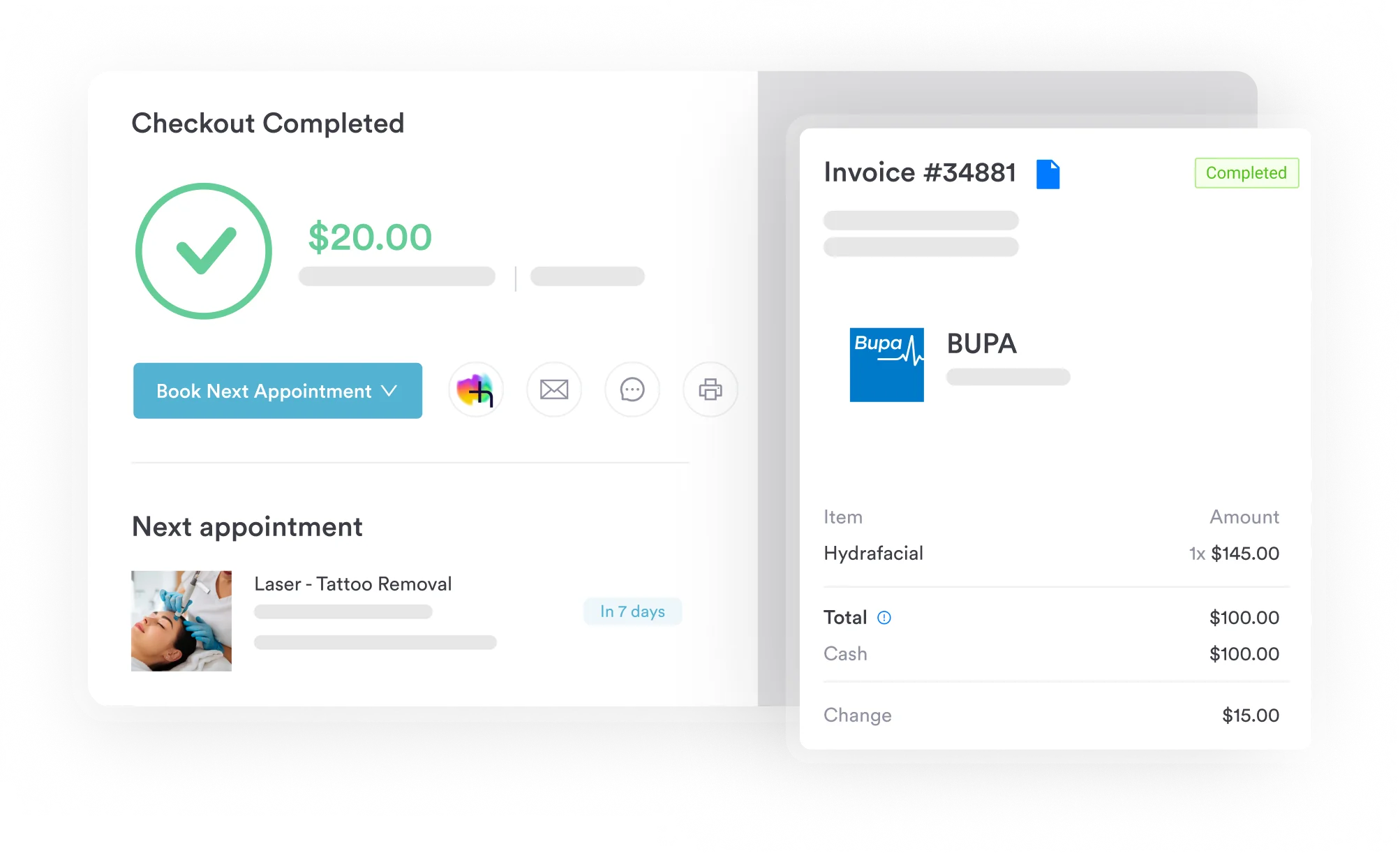

Pabau pre-fills the CMS-1500 from the patient record and keeps ICD-10-CM and CPT lookups on the same screen. US practices then submit through Claim.MD without leaving the platform.

T15.91XD comes down to two checks. Confirm the treatment phase before you pick the 7th character, and confirm the note names the right eye. Miss the first and the claim bounces. Miss the second and you should be coding T15.90XD.
The code is billable and valid for 2026, but it remains the vaguest option in its subcategory. Audit your T15.9x mix every few months. A habit of reaching for A instead of D is cheap to correct now and expensive to unwind after a quarter of denials.
Want the code lookup and the claim on the same screen? Book a demo and see how Pabau carries an eye care claim from the follow-up note through to remittance.

Need to understand how claims move from code to payment? What is revenue cycle management covers the end-to-end process from diagnosis coding through reimbursement posting.
Submitting claims electronically and want to know how the 837P file works? 837 file format and submission guide explains the electronic claim structure used by US payers and clearinghouses.
Dealing with denials on eye care codes? Denial codes in medical billing explains the most common CARC denial reason codes and how to respond to each one.
The right eye. The fifth character 1 sets the laterality, so only the part of the eye is unspecified in T15.91XD. Use T15.90XD when the record never names an eye, and T15.92XD for the left eye.
Removal codes 65205, 65210, 65220 and 65222 are the usual pairings, depending on the site and whether a slit lamp was used. A follow-up visit with no removal often bills as an eye exam instead. Check payer bundling rules before you submit.
No. The laterality already sits inside the diagnosis code, so T15.91XD takes no modifier. RT and LT belong on the procedure code, where the payer expects to see them.
Yes. An injury code can lead the claim when the injury is the reason for the visit. On a follow-up wound check, T15.91XD is usually first-listed, with any residual finding coded after it.
Only where your payer or state requires one. ICD-10-CM treats external cause codes as optional without a reporting mandate. Where they are required, the external cause code takes its own 7th character for the subsequent encounter.